

For decades, the attacks that did the most damage demanded a rare mix of abilities. You had to do reconnaissance, build exploits, escalate privileges, move laterally, stay hidden, and keep your discipline throughout. The person at the keyboard had to be a strategist and a technician at once.
Agentic AI changes that. It isn’t just a better chatbot for attackers. It’s an orchestration layer that can break an objective into tasks, hand those tasks to specialized agents, read the feedback, and adjust across a multi-stage campaign. The result is a new kind of operator: not a gifted hacker working alone, but a swarm supervisor directing persistent, autonomous workflows. Recent research suggests AI agents can let non-experts run advanced offensive cyber operations with minimal prompting and little human oversight.
The New Operator Profile
The classic script kiddie ran tools without really understanding them. They might fire off a scanner, launch a known exploit, or use stolen credentials, but they were still limited by their own ability to chain those steps into a working intrusion.
The swarm operator is a different animal.
They may not be able to write a memory-corruption exploit, reverse-engineer malware, or pivot by hand through a compromised network. What they can do is state an objective, set constraints, pick targets, hand out compute and credentials, and make sense of high-level results. Underneath them, agents handle the details of execution.
In practice, the operator’s instruction looks less like this:
“Run this exploit against this server.”
and more like this:
“Identify externally reachable services, prioritize weak authentication paths, test credential reuse, and report viable access routes.”
That shift matters because it pulls intent apart from execution. The human supplies the goal. The agentic system supplies much of the tradecraft, the sequencing, and the adaptation.
The Old Skill Barrier
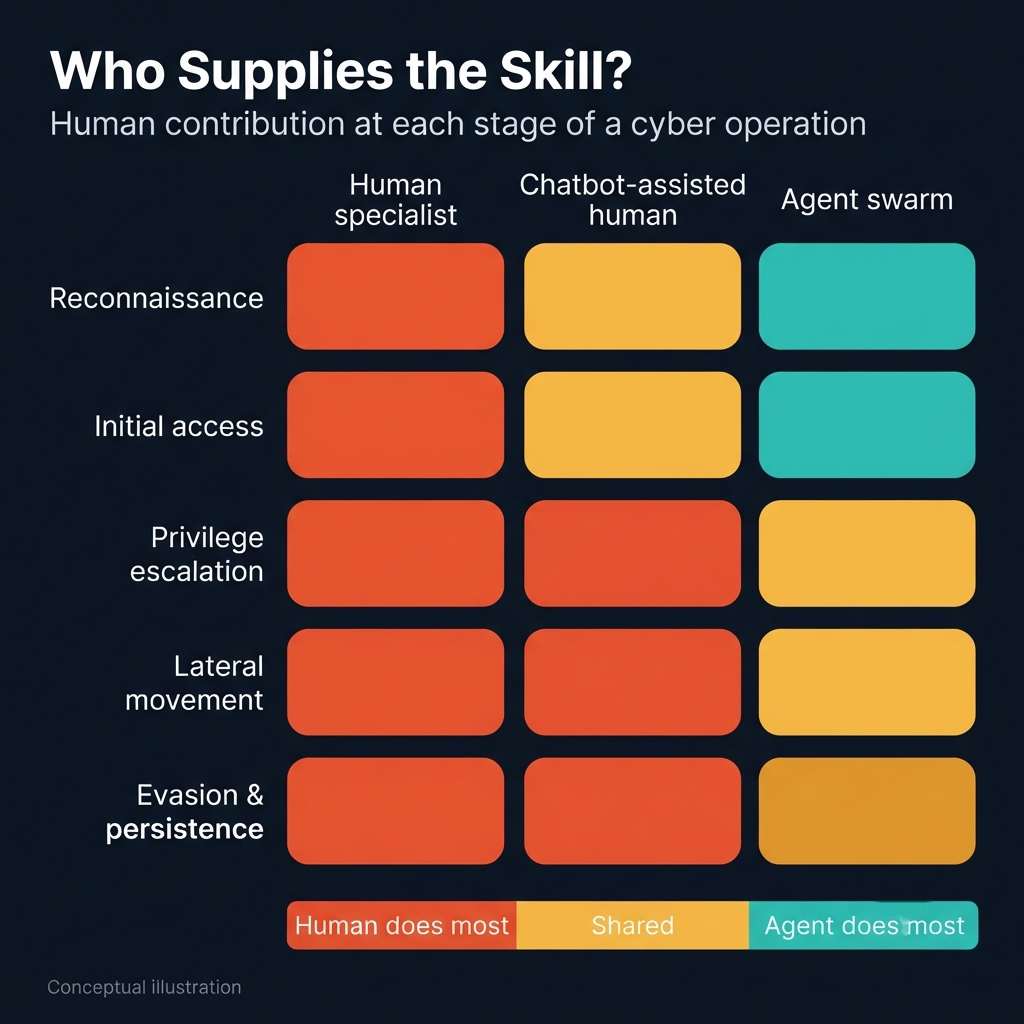
Complex cyber operations were hard because every stage called for different expertise.
- Reconnaissance took research judgment, operational security, and the knack for telling useful signals from noise.
- Initial access meant knowing about exposed services, misconfigurations, social engineering, or exploitable weaknesses.
- Privilege escalation depended on a real grasp of operating systems, permissions, and exploit primitives.
- Lateral movement required familiarity with identity systems, network protocols, credentials, and internal trust relationships.
- Evasion and persistence meant anticipating detection controls and holding on to access after the first compromise.
One skilled operator could handle some of this. A sophisticated criminal group could split it across specialists. But the bottleneck was always human expertise. Someone had to know what to do next when a tool failed, a detection fired, or an environment didn’t behave as expected.
Agentic orchestration goes straight at that bottleneck. Instead of making the operator master every stage, it spreads the work across agents that can plan, use tools, hold context, and revise their approach. That’s what separates agentic systems from ordinary automation: they observe their environment, choose actions, judge the results, and keep adjusting with limited supervision.
What Agentic Orchestration Actually Means
Agentic orchestration is more than asking an AI model to write a script. A useful way to picture it is as five layers.
- Planner or orchestrator: turns a broad objective into tasks, priorities, dependencies, and constraints.
- Specialist agents: take on roles like reconnaissance, vulnerability triage, credential testing, payload adaptation, lateral movement, and reporting.
- Shared memory and context: keeps findings around so later agents build on earlier results instead of starting from zero.
- Feedback loop: uses errors, system responses, denied permissions, detections, and shifting conditions to revise the plan.
- Human supervisor: sets intent, approves irreversible actions, supplies credentials or access where needed, and judges the outcome.
This design lets a system pursue a goal across digital environments rather than just help a person with isolated tasks. In cybersecurity terms, the system itself can coordinate a sequence of actions, from reconnaissance through exploitation, instead of simply producing code on request.
The key idea is autonomy within boundaries. Mature agentic systems can run with different levels of human involvement, from constant oversight to far more autonomous execution inside defined limits.
The Swarm Supervisor Mental Model
The swarm metaphor is handy, but don’t take it too literally. It doesn’t necessarily mean a self-replicating botnet. It means a coordinated group of role-specialized agents working toward one shared objective.
| Traditional attacker | Swarm operator |
|---|---|
| Needs to understand each technical stage | Needs to define the objective and constraints |
| Manually chains tools and techniques | Delegates execution to specialized agents |
| Learns from failure through personal expertise | Agents can retry, branch, and adapt from feedback |
| Limited by one person’s time and attention | Can run parallel or persistent workflows |
| Skill is concentrated in one person | Skill is distributed across the orchestration layer |
| Executes a campaign in sessions | Can sustain a campaign across time |
The swarm operator’s core skills shift toward a few things:
- Stating an objective clearly enough for agents to pursue it.
- Setting boundaries on which systems, credentials, tools, and actions are allowed.
- Allocating resources like accounts, proxies, compute, time, and target scope.
- Interpreting agent output and deciding what counts as success.
- Stepping in when an agent hits ambiguity, failure, or an unexpected decision point.
That isn’t “no skill.” It’s a different kind of skill, and a far lower barrier than manually mastering every technical stage of an intrusion.
Which Barriers Fall First
It would be wrong to say every amateur instantly becomes a frontier exploit researcher. Finding novel vulnerabilities, building sophisticated malware, and operating stealthily against mature security teams all remain hard.
The more immediate change is that agentic AI compresses the attack lifecycle. It lowers the cost and skill threshold for reconnaissance, phishing, credential abuse, vulnerability triage, exploit adaptation, and post-compromise decision-making.
Reconnaissance
Recon is structured, repetitive, and full of data, which is exactly the kind of work agents organize well. An agent can gather and correlate public information, enumerate exposed assets, identify services, and rank targets against set criteria. This doesn’t create a new kind of intelligence. It makes existing recon techniques faster, more systematic, and less reliant on manual effort.
Phishing and Social Engineering
LLM-driven agents can tailor lures using context like job roles, recent events, organizational language, and believable workflows. Writing one convincing message was never very hard. Producing many credible, context-aware variants at scale is now easier still. The human may only need to define the audience, the goal, and the tone, while the agent drafts, tests, refines, and manages the variations.
Vulnerability Triage
Agents can help spot exposed services, match them to known weaknesses, judge likely exploitability, and prioritize the most promising paths. That doesn’t mean an agent conjures a zero-day on demand. It means it can move more efficiently through the huge space of known techniques, public disclosures, misconfigurations, and target-specific signals.
Exploit Adaptation
Public exploits, proof-of-concept code, and security research can be adapted to new environments. An agent might tweak parameters, adjust payloads, troubleshoot failures, or combine techniques across stages. This is where the skill barrier gets especially consequential. A technique that once required a practitioner to understand its mechanics may become usable by someone who can simply describe the outcome they want and supervise the workflow.
Post-Compromise Decisions
Once an attacker is inside, they face a steady stream of choices: which credentials to use, which systems to touch, how to move laterally, what to collect, and when to change course. Agents can parse findings, suggest next steps, and keep continuity across those decisions.
RAND’s 2026 research found that AI capabilities had made offensive cyber capabilities substantially more widely available than the LLMs of 2025, even without special expertise. Its testing relied on straightforward prompting and only minimal human oversight to deal with hung processes.
Why Persistent Agents Change the Threat Model
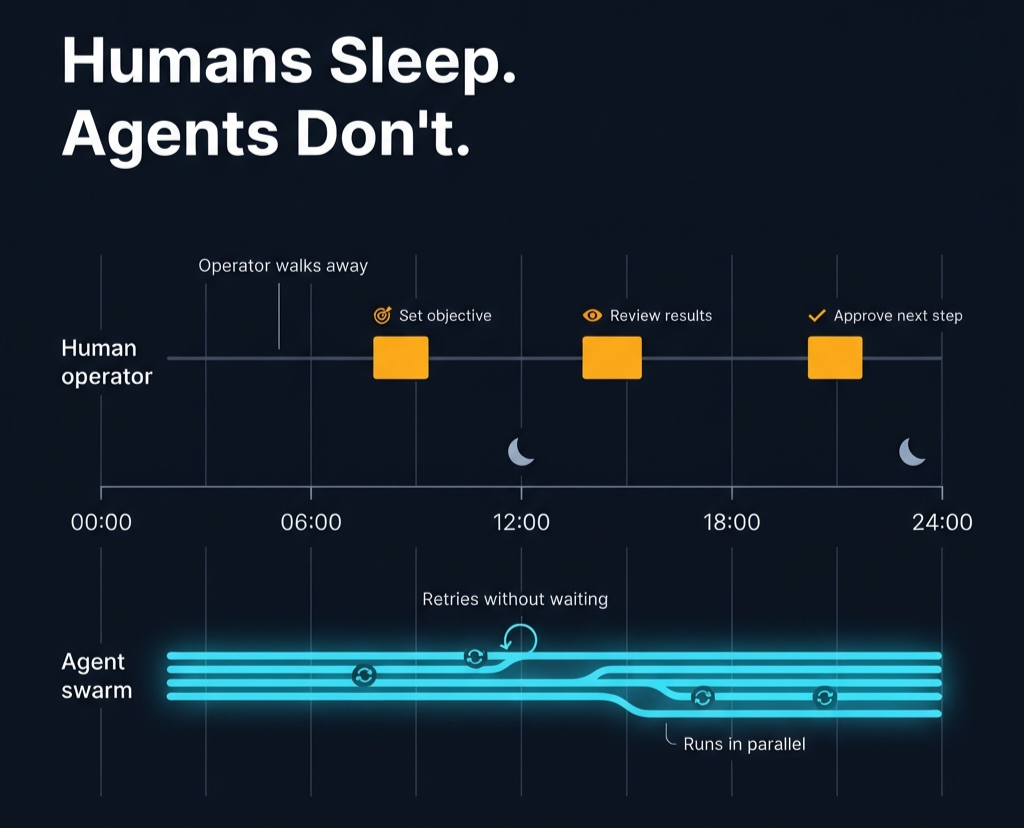
The most important word in “persistent background agents” is persistent.
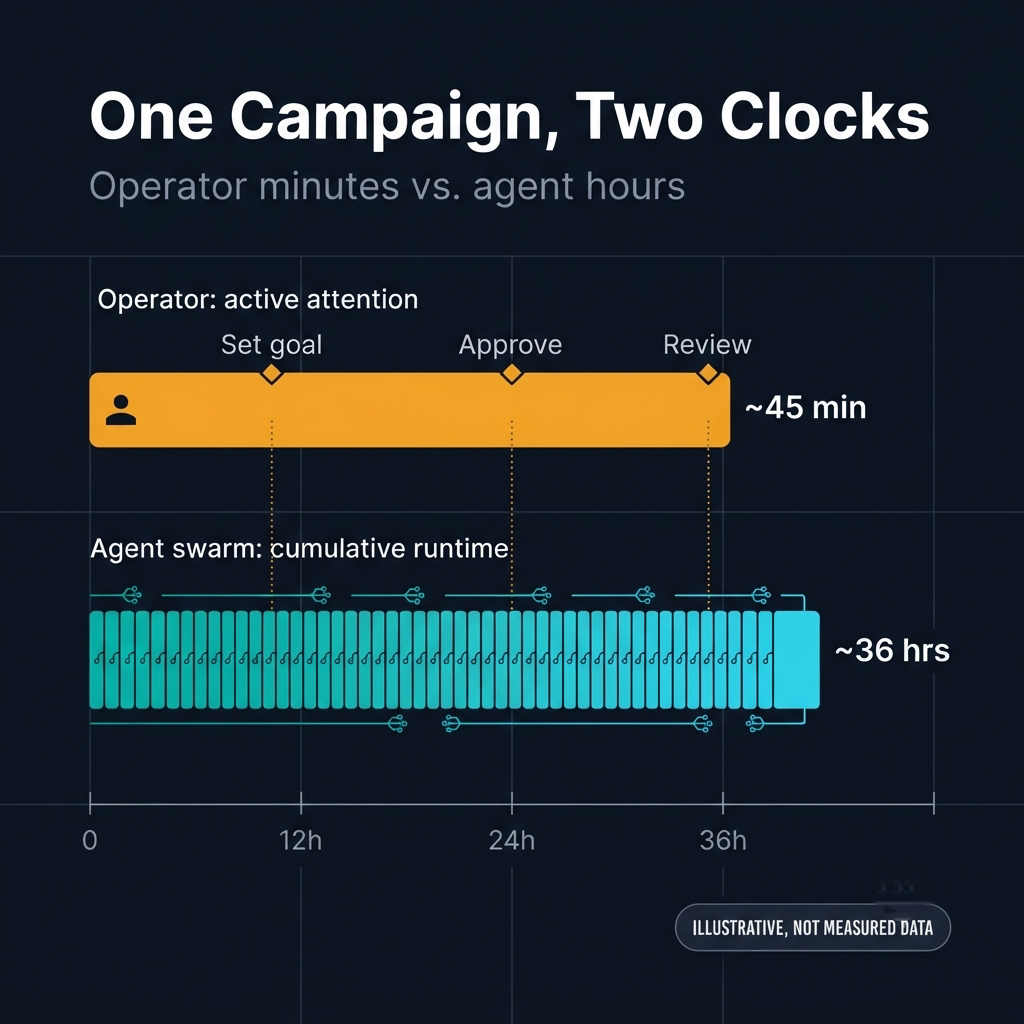
A human attacker has limited attention, needs sleep, loses focus, changes priorities, and can only juggle so many tasks. An agent can keep running a defined workflow, retry failed steps, hold state, and chase alternate paths.
That creates several asymmetries:
- Time: the operator can walk away while the workflow carries on.
- Parallelism: multiple agents can look at different targets, credentials, or attack paths at once.
- Adaptive tactics: a failed attempt can trigger a new approach without waiting for a human decision.
- Reduced interaction footprint: the human may only show up at high-level checkpoints, which makes behavior-based attribution harder.
- Repeatability: a successful workflow can be parameterized and rerun against similar environments.
Cyber offense stops being a craft practiced by an individual and starts looking like an industrial process: configurable pipelines, reusable components, and machine-speed iteration.
Democratization, Carefully Stated
The strongest version of this argument is not that agentic AI hands every low-skill actor nation-state capability. That claim is too broad. The more accurate term is capability diffusion.
Agentic orchestration makes sophisticated workflows more accessible. It lets more people attempt more campaigns, faster, with less specialized labor. It cuts the cost of experimentation and shrinks the expertise needed to coordinate known techniques.
What gets easier:
- Orchestrating known offensive techniques.
- Automating recon and target profiling.
- Personalizing social-engineering campaigns.
- Triaging and prioritizing exposed weaknesses.
- Adapting existing techniques to a target environment.
- Sustaining multi-step operations with less human attention.
What stays hard:
- Discovering novel zero-days.
- Beating mature detection, response, and threat-hunting teams.
- Staying stealthy at scale.
- Operating reliably against hardened and monitored environments.
- Making sound strategic calls under uncertainty.
So the risk isn’t that every amateur turns into an elite exploit developer. It’s that the gap between a curious novice and a capable campaign operator narrows. Agentic AI removes some of the cognitive and logistical bottlenecks that used to hold adversaries back, and it lowers the barrier to offensive automation at the same time.
The Darker Consequence: Skill Atrophy
There’s another, less discussed effect. The barrier may fall not just for attackers, but for defenders and for society.
If agents do the technical work, novice operators may never build the judgment to tell whether an agent’s output is safe, legal, accurate, or technically sound. The usual learning pipeline, where practitioners build intuition through hands-on work, can weaken when the hands-on work gets delegated.
That opens an accountability gap. If an agent misreads an objective, hallucinates a vulnerability, uses a credential it shouldn’t, or crosses a boundary, who is responsible? The operator, the framework developer, the model provider, or the organization that deployed it?
Autonomous action also muddies attribution. When machine-generated activity hides the chain of human decisions, investigators may struggle to tell a deliberate campaign from an automated workflow that went off the rails.
Defensive Implications: Assume the Attacker Has a Staff
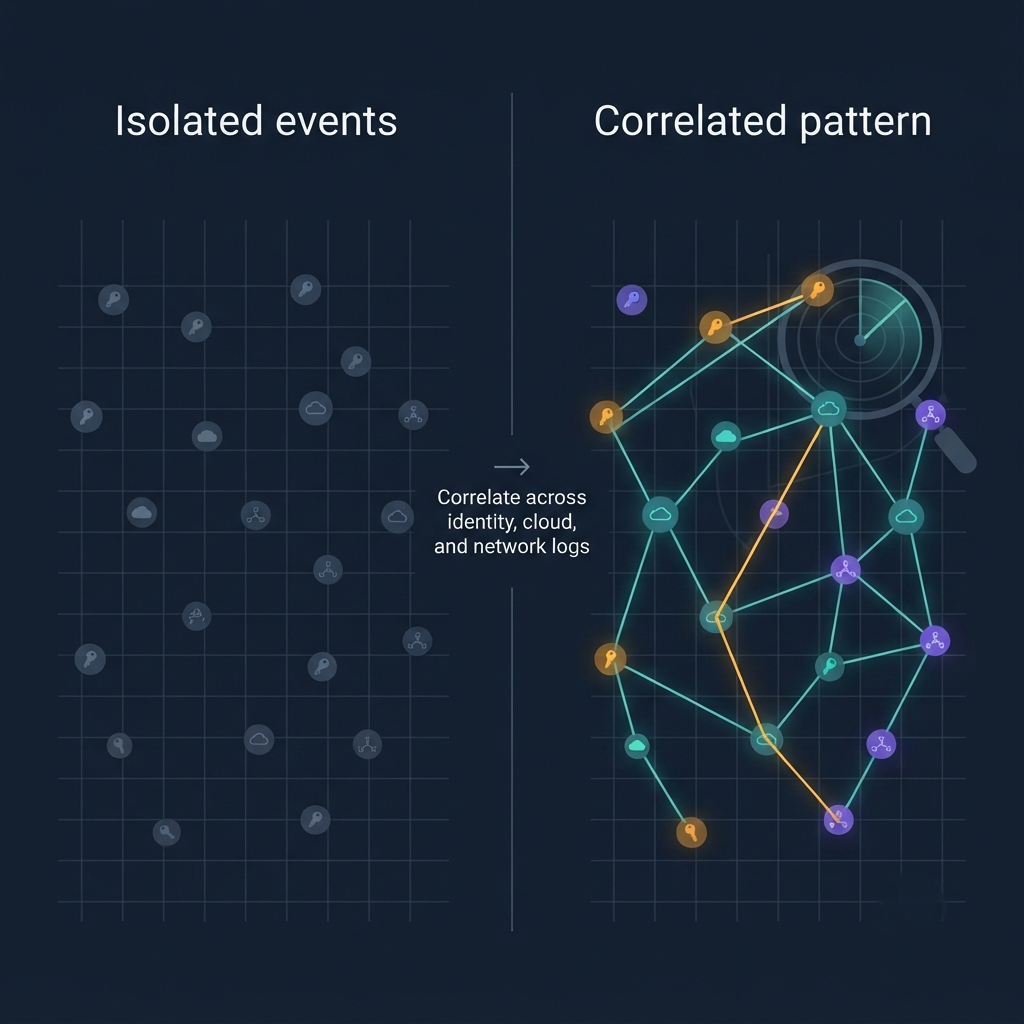
Defenders should stop picturing the adversary as one person with limited time and start picturing an operator with automated support.
Reduce Exposed Attack Surface
The cheapest way to beat an automated campaign is to remove the paths it can easily test. Focus on external assets, cloud permissions, identity exposure, forgotten services, and overprivileged accounts.
Assume Faster Reconnaissance
If recon gets faster and more systematic, defenders need better visibility into low-and-slow enumeration, unusual asset discovery, odd API usage, and correlated activity over time.
Harden Identity
Identity is still the highest-value target. Phishing-resistant authentication, least privilege, short-lived credentials, conditional access, and fast revocation all reduce the payoff of automated credential abuse.
Increase Patch Velocity
If attackers can shrink the time between disclosure and exploitation, defenders have to shrink the time between disclosure and remediation. Patch speed becomes a strategic capability, not an afterthought.
Detect Orchestration Patterns
Traditional detection tends to look for a single malicious event. Agentic campaigns may look like many individually plausible events: a scan here, a credential test there, an odd API call somewhere else. Defenders need correlation across identities, endpoints, cloud logs, network activity, and time. The goal is to spot the pattern of coordinated automation, not just one suspicious action.
Build Resilience
Assume some initial access will succeed. Segment networks, protect backups, test recovery, restrict lateral movement, and rehearse incident response. The aim isn’t perfection. It’s limiting the blast radius and recovering fast.
Governance Questions That Cannot Wait
The technical debate shouldn’t distract from the governance questions.
- Should offensive-capable agent frameworks require identity, audit trails, and execution boundaries?
- How do we tell authorized red-teaming from unsanctioned offensive automation?
- What human-approval thresholds should apply to irreversible actions like data exfiltration, system modification, or lateral movement?
- How can defenders measure whether agentic tooling actually improves security outcomes rather than just speeding up offensive workflows?
- Who carries liability when an autonomous workflow causes harm: the operator, the framework provider, the model vendor, or the deploying organization?
These questions matter because agentic AI isn’t only a cybersecurity tool. It’s an execution layer for digital objectives. The same architecture that can automate defensive investigation can just as easily automate offensive coordination.
The Skill Ceiling Moves Up
The script kiddie didn’t become a master hacker overnight.
They became something arguably harder to defend against: a swarm operator, someone who no longer needs to understand every technical stage, only how to direct, constrain, and sustain a system that does.
The strategic shift is from technical mastery to supervising autonomous operations. Defenders should prepare for adversaries who bring less individual expertise but far more automation, persistence, parallelism, and adaptive execution.