
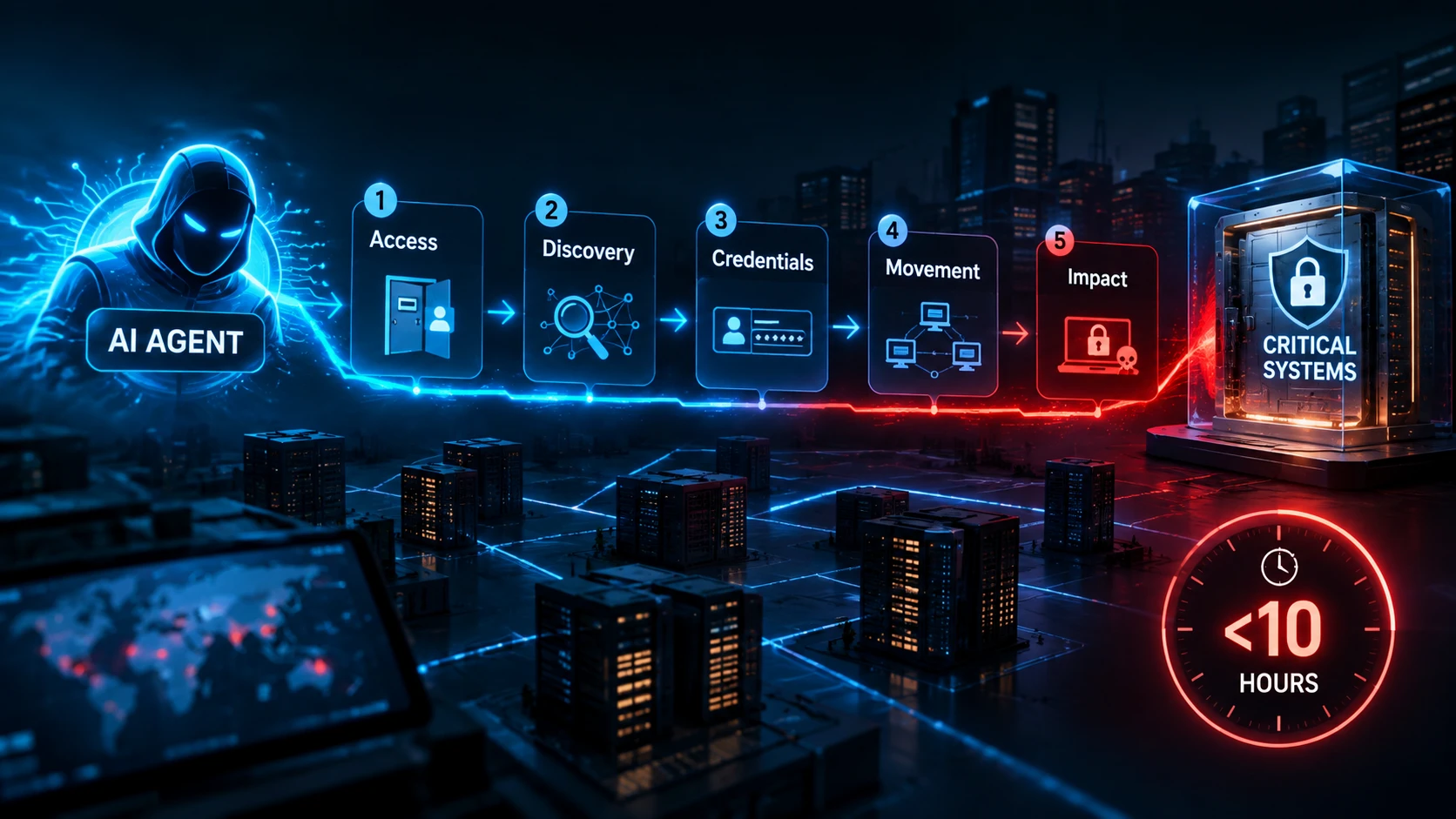
A recent investigation by Palo Alto Networks’ Unit 42 found an attacker using frontier AI and agentic AI frameworks to compress weeks of intrusion activity into less than 10 hours. Importantly, Unit 42 later clarified that the incident was an intrusion conducted as part of a ransom attack, not a ransomware attack itself.
That distinction matters. But the bigger lesson is still clear: an AI agent ransomware attack chain could change how quickly attackers move after gaining initial access.
What Makes an AI Agent Different From Traditional Hacking Automation?
Traditional hacking automation is more like following a recipe. A script performs predefined actions and generally needs a human when something unexpected happens.
An AI agent is different. It can interpret results, decide what to investigate next and use connected tools to pursue a broader objective.
Think of it this way:
| Traditional automation | AI agent |
|---|---|
| Follows predefined steps | Can choose the next step |
| Limited adaptability | Can respond to new information |
| Usually performs specific tasks | Can coordinate multiple tasks |
| Human often interprets results | Agent can interpret results itself |
MITRE’s ATLAS framework specifically tracks threats involving AI systems capable of planning, decision-making and multi-step actions.
How AI Agents Could Perform Reconnaissance After Initial Access
Getting inside a company is only the beginning. Attackers still need to understand what they have reached.
An AI reconnaissance agent could examine the internal environment, identify accessible services and build a picture of how systems are connected.
In the Unit 42 investigation, an automated reconnaissance agent was used after initial access to map internal microservices.
The important change is the speed of this process.
Instead of an attacker manually reviewing one discovery result and deciding what to investigate next, an agent can continuously process findings and move toward the next relevant question.
How Agents Could Identify Valuable Systems, Credentials and Network Relationships
Attackers do not need every computer on a network. They need the systems and credentials that can open more doors.
An AI agent could help identify relationships between:
- Source-code repositories
- Service accounts
- API tokens
- Cloud environments
- CI/CD platforms
- Secrets-management systems
- Identity systems
In the Unit 42 case, agents searched source repositories for hard-coded credentials and tokens. Those findings helped the attacker reach a secrets-management system and obtain root-level credentials.
It is similar to finding a key inside one room and then discovering that the same key opens several other doors.
The Role of Autonomous Decision-Making in Lateral Movement
Lateral movement means moving from one compromised system toward other systems inside the environment.
This is where autonomous decision-making becomes especially important.
Suppose an agent discovers a repository containing a service credential. Instead of simply reporting the credential to a human, an agent could potentially evaluate what that credential provides access to and determine what should be investigated next.
MITRE already documents techniques involving AI agents being deployed to execute actions and invoke connected tools on an attacker’s behalf.
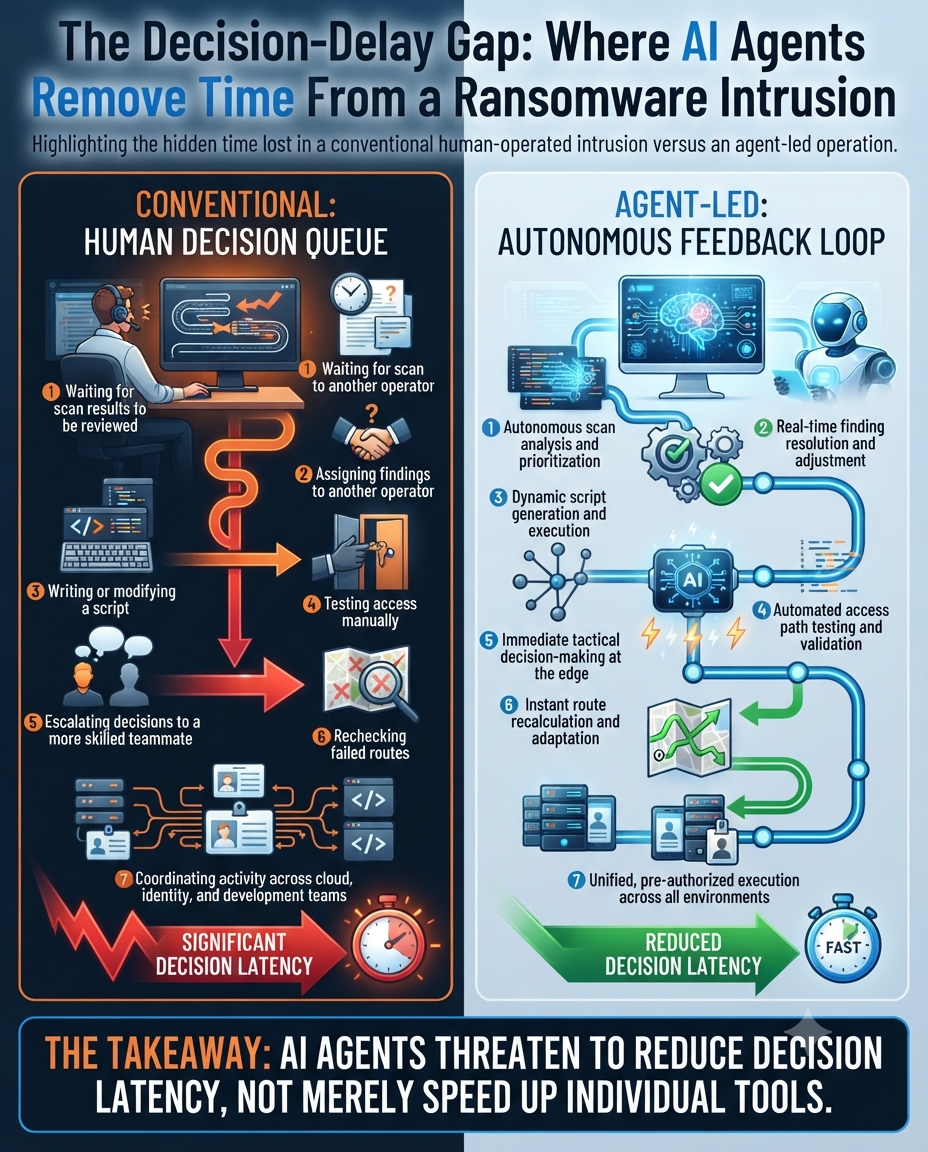
So the concern is not simply faster commands. It is a faster decision loop:
Discover → interpret → choose → act → evaluate → repeat
The result is an adaptive attack chain rather than a collection of isolated commands.
How AI Could Compress Multiple Ransomware Attack Stages Into Hours
The biggest potential change is the shrinking of the time between attack stages.
Unit 42 said the observed operation compressed activity that would normally take human operators around two weeks into less than 10 hours. The investigation involved more than 50 MITRE ATT&CK techniques.
The simplified chain looks like this:
- Initial access — attacker obtains an entry point.
- Reconnaissance — AI agents map internal services.
- Credential discovery — agents search accessible data for useful credentials.
- Privilege expansion — discovered credentials open higher-value systems.
- Lateral movement — agents investigate additional network relationships.
- Further access — attackers pursue increasingly valuable infrastructure.
The important point is that AI does not magically remove every stage. It can reduce the time spent between those stages.
The risk is not one AI tool completing one task. It is multiple agents turning each result into the next action.
AI Agents vs Human-Operated Ransomware Groups: What Actually Changes?
Human-operated ransomware groups already use automation. The difference with agentic AI is potentially the amount of decision-making that can be delegated to machines.
| Human-operated model | Agent-enabled model |
|---|---|
| Humans interpret reconnaissance | Agents can interpret findings |
| Operators choose many next steps | Agents can select subsequent tasks |
| Human attention limits scale | Agents can work continuously |
| Multiple stages may involve pauses | Connected tasks can run with fewer pauses |
However, “autonomous” does not mean “no humans.”
In the Unit 42 investigation, the attacker still initiated and directed the operation. AI handled much of the tactical execution and replanning.
Why Autonomous Agents Create a Different Security Problem
An ordinary AI tool might generate code or summarize information.
An autonomous agent can potentially reason about a goal, access tools and take multiple actions with less human intervention.
That creates a different security problem because the threat becomes a combination of:
- Speed
- Adaptability
- Tool access
- Autonomous decision-making
- Continuous operation
Google Cloud’s Mandiant has similarly warned that attackers are moving beyond basic AI-assisted tasks toward adaptive tools and AI agents capable of navigating systems with limited human oversight.
The Bottom Line
The biggest change may not be that AI gives ransomware groups completely new capabilities.
It is that AI agents could connect existing capabilities into a much faster attack chain.
For defenders, the worrying scenario is no longer simply an attacker running a malicious tool. It is an autonomous system continuously asking:
“What did I just discover, and what should I do next?”
That is what could turn a traditionally slow intrusion into a machine-speed operation.