
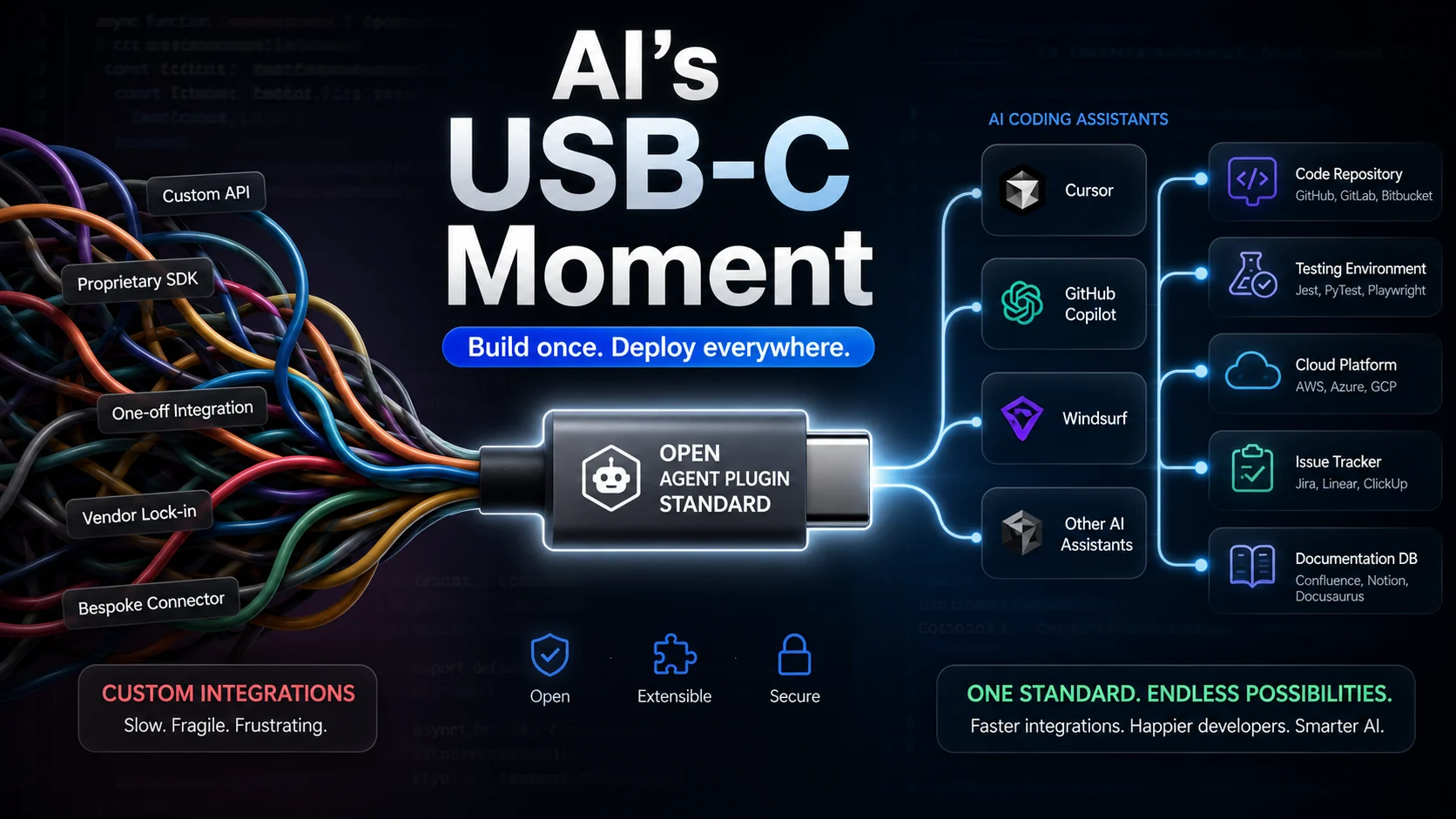
AI’s plugin wars may have finally hit a ceasefire. A new open standard for agent plugins promises to let developers connect tools to multiple AI coding assistants instead of rebuilding the same integration for every platform.
AI’s Plugin Wars Hit a Ceasefire
Developers today face multiple assistants, separate tool APIs, and repeated integration work for nearly identical capabilities. But will this standard become AI’s USB-C moment, or will competing platforms quietly preserve their own connector ecosystems?
The stakes are high: build once, deploy across assistants, and reduce the fragmentation that has made agent development slower, costlier, and harder to maintain.
Recent industry figures show that over 95% of software engineers use AI coding tools weekly, making integration consistency an urgent priority.
If a tool works for one agent, why must it be rewritten for another? The old approach forces teams to fragment their codebases and waste countless engineering hours.
Why Developers Keep Rebuilding the Same Integrations
Building AI agent tools used to mean navigating a maze of custom connectors. Every time a new coding assistant gained popularity, developers had to rewrite their backend integrations from scratch.
- A developer builds a custom connector for Assistant A.
- The exact same connector is rebuilt for Assistant B.
- Authentication, permissions, error handling, and updates must be maintained separately.
| Before the standard | With a common standard |
|---|---|
| Separate integrations for each assistant | One core plugin interface |
| Repeated authentication work | Reusable connection patterns |
| Platform-specific maintenance | Shared maintenance across compatible tools |
| Higher switching costs | Easier experimentation and portability |
| More fragmented documentation | Common conventions for developers |
The real cost is not writing the first integration—it is maintaining the fifth, tenth, or fiftieth version.
What Build Once, Deploy Everywhere Means
Major tech ecosystems—including platforms from OpenAI, Amazon, Microsoft, and Cursor—have collaborated on a shared open standard for agent plugins.
Can a unified framework truly support every specialized workflow without losing advanced features?
A portable plugin built under this standard might allow an AI coding assistant to:
- Search and modify repositories safely.
- Run automated tests or inspect server logs.
- Query project documentation instantly.
- Open tickets or create pull requests.
Build a plugin once and use it across compatible agent clients.
— OpenAI Developers (@OpenAIDevs) August 6, 2026
Introducing Agent Plugins, an open standard developed with @awsdevelopers, @cursor_ai, @github, @code, and @vercel that packages Agent Skills and supports MCP server configurations in a shared format. pic.twitter.com/JOQe4sc40N
The Business Case for a Common Standard
Adopting a unified standard changes the economics of software development across different organizational tiers:
- Independent developers: Build a plugin for a database or deployment service once without maintaining separate forks.
- Startups: Adopt new coding assistants freely without abandoning established internal toolchains.
- Enterprises: Standardize access controls while giving engineering teams the freedom to use their preferred AI tools.
Security Is the Hard Part
The standard can simplify connection plumbing, but it cannot automatically solve trust. A portable plugin that connects directly to production databases can also create a portable security risk if permissions are misconfigured.
Teams must carefully manage authentication, token scopes, sandboxing, and audit logs to prevent unintended data exposure. Will security certifications emerge to separate safe plugins from risky shortcuts?
Where the USB-C Analogy Breaks Down
Comparing this standard to USB-C helps explain physical interoperability, but AI agents are vastly different from hardware cables.
- Why it works: Developers get a familiar interface, and tool makers can target multiple compatible platforms simultaneously.
- Where it fails: Plugins execute complex actions and handle sensitive data, meaning minor compatibility gaps can cause unpredictable behavior.
The Questions the Industry Must Answer
The announcement does not eliminate competition among AI coding assistants. It may, however, move the competition to a healthier layer: model quality, developer experience, reliability, and trust—rather than forcing teams to build another proprietary connector.
- Will major assistants adopt every facet of the specification fully?
- Can enterprise security teams trust third-party agents with production systems?
- Will commercial incentives drive vendors toward proprietary extensions?
Until production environments prove the system’s resilience under stress, the true test of agent interoperability remains ahead.