
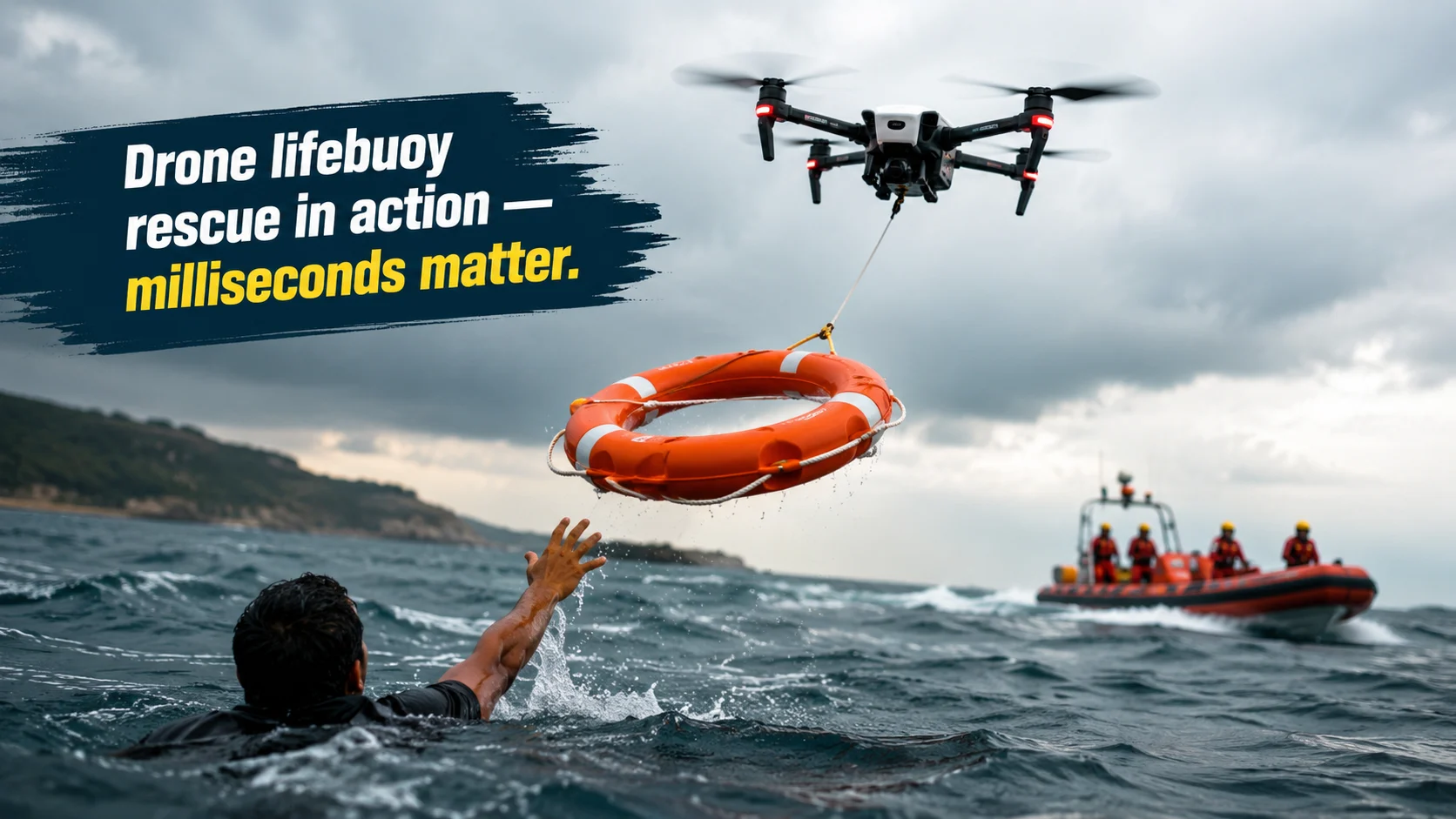
A drone just snatched a struggling swimmer from death’s edge. Drowning kills over 236,000 people every year, and rescue boats can take 8–12 minutes to reach open-water incidents — long enough for life-threatening hypoxia.
In recent tests, autonomous drone lifebuoy rescue systems have reached victims in under 90 seconds, cutting response time by as much as 80%. Could this tech tilt the survival odds?
This article breaks down how autonomous navigation and rapid drone-boat pairing are reshaping emergency water safety.
Quick Summary
This post explores the mechanics of cutting-edge drone lifebuoy rescue technology. We examine how centimeter-level RTK navigation, edge AI computer vision, and tandem drone-boat deployment are transforming modern maritime safety and drastically shrinking emergency response times.
Why Response Time Matters
When a swimmer goes under, the window for a successful rescue without permanent neurological damage is agonizingly narrow. Traditional manned rescue boats face physical barriers like shoreline traffic, heavy wakes, and acceleration lag. Minimizing the time to floatation directly expands the critical survival window before irreversible hypoxia sets in.
The System Components
Modern water-rescue architectures integrate specialized aerial hardware with intelligent payloads to guarantee reliability in marine environments:
- Airframe & Payload: Waterproof multirotors carrying sealed, CO2-inflatable lifebuoy canisters or flying buoyancy units.
- Navigation Stack: Centimeter-accurate RTK GNSS combined with inertial measurement units (IMUs) and low-altitude LiDAR.
- Perception: CNN-based computer vision running on edge processors to spot human forms against churning water.
- Communications: Low-latency 5G links and encrypted VHF radio fail-safes for beyond-visual-line-of-sight (BVLOS) control.
How Autonomous Navigation Saves Seconds
Seconds lost manually steering a drone can cost a life. Autonomous flight controllers use pre-computed intercept calculations that factor in wind speed and current vectors. Through predictive drift compensation, the flight stack plots a direct intercept path, releasing the flotation device precisely where the victim will surface.
Advanced obstacle avoidance sensors continuously scan for bridge pylons, coastal cliffs, or low-flying sea birds, allowing dynamic replanning mid-flight without human operator intervention.
Rapid-Deployment Drone-Boat Pairing
The most effective deployments rely on a tandem operational model combining aerial speed with surface-vessel stability.
- 0–20s: Automated alert triggers shoreline launch from pre-positioned weather-proof boxes.
- 20–90s: Drone transits rapidly to coordinates, locking onto the target via thermal or visual sensors.
- 90–120s: The device drops or deploys the lifebuoy, establishing continuous communication and broadcasting location telemetry to nearby rescue boats.
- 2–8 minutes: Autonomous surface vehicles (ASVs) or manned marine police boats arrive to complete final extraction.
Real-World Constraints and Safety
Deploying robotics over open water introduces brutal operational hurdles. Sudden coastal gales, salt-spray corrosion, and heavy rain test structural waterproofing ratings. To mitigate risks, systems feature redundant return-to-home programming, geofencing limits, and mandatory human-in-the-loop verification before final payload release.
Case Study: China’s High-Tech Drills
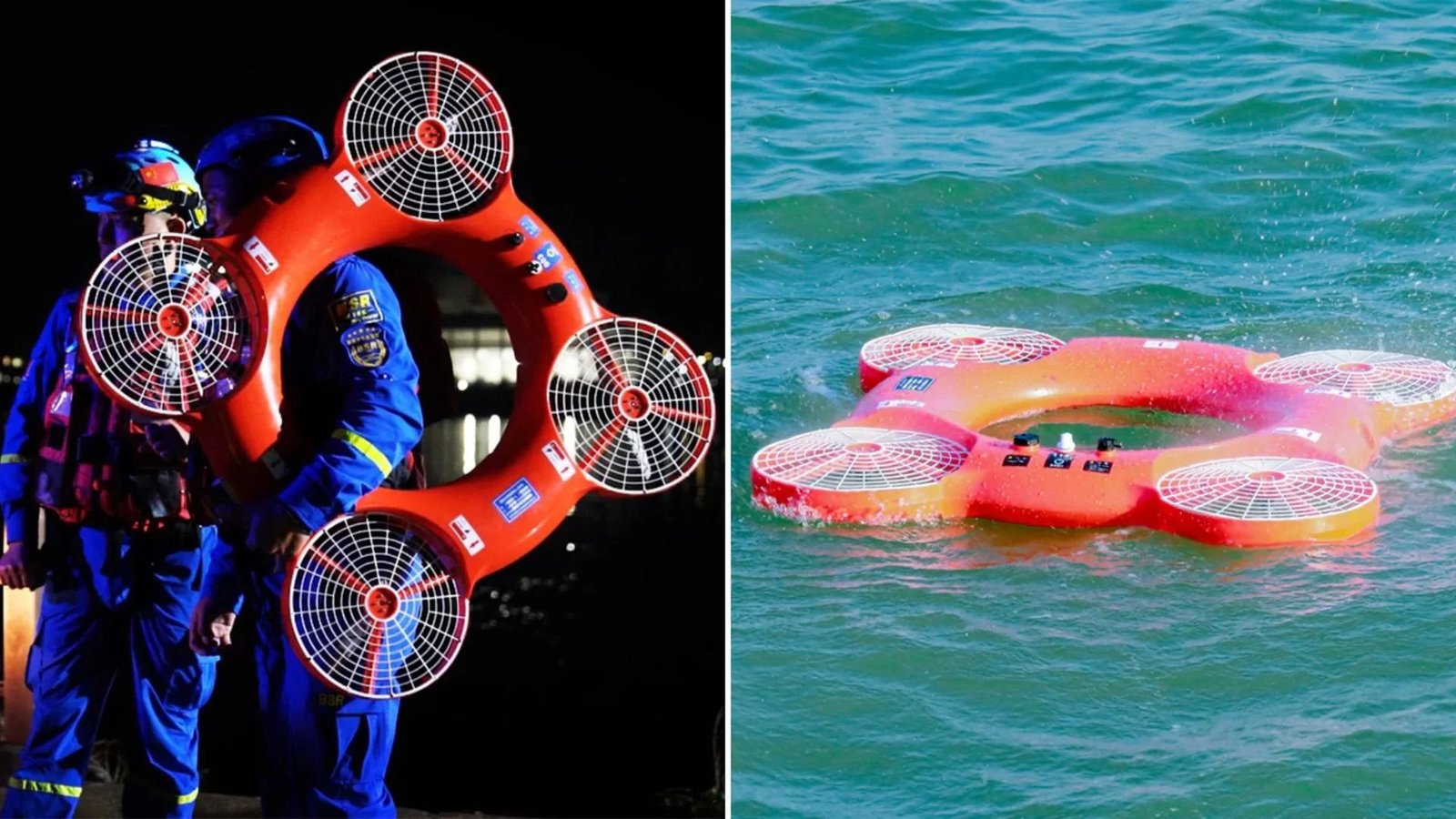
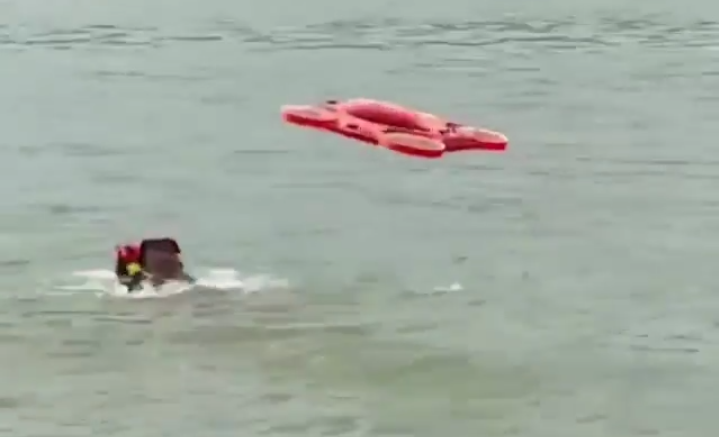
Recent public safety exercises in cities like Hangzhou have showcased the operational viability of these systems. During multi-agency maritime drills, AI-powered “flying lifebuoy” robots successfully located distressed swimmers, landed on the water’s surface to provide stable buoyancy, and autonomously returned to shore. These real-world trials highlight how automated aerial deployment bridges the critical gap before traditional crews arrive.
China unveiled a flying AI lifebuoy that can save drowning people on its own. pic.twitter.com/4bNIHpC9wd
— Daily Loud (@DailyLoud) August 22, 2026
FAQs
Can drones replace human lifeguards?
No. They act as high-speed first responders that buy crucial time, but physical extractions and medical triage still require trained human professionals.
What happens if the lifebuoy misses the target?
Units are engineered with onboard propulsion or high-visibility markers, while paired rescue boats use live drone telemetry to immediately adjust their interception vectors.