

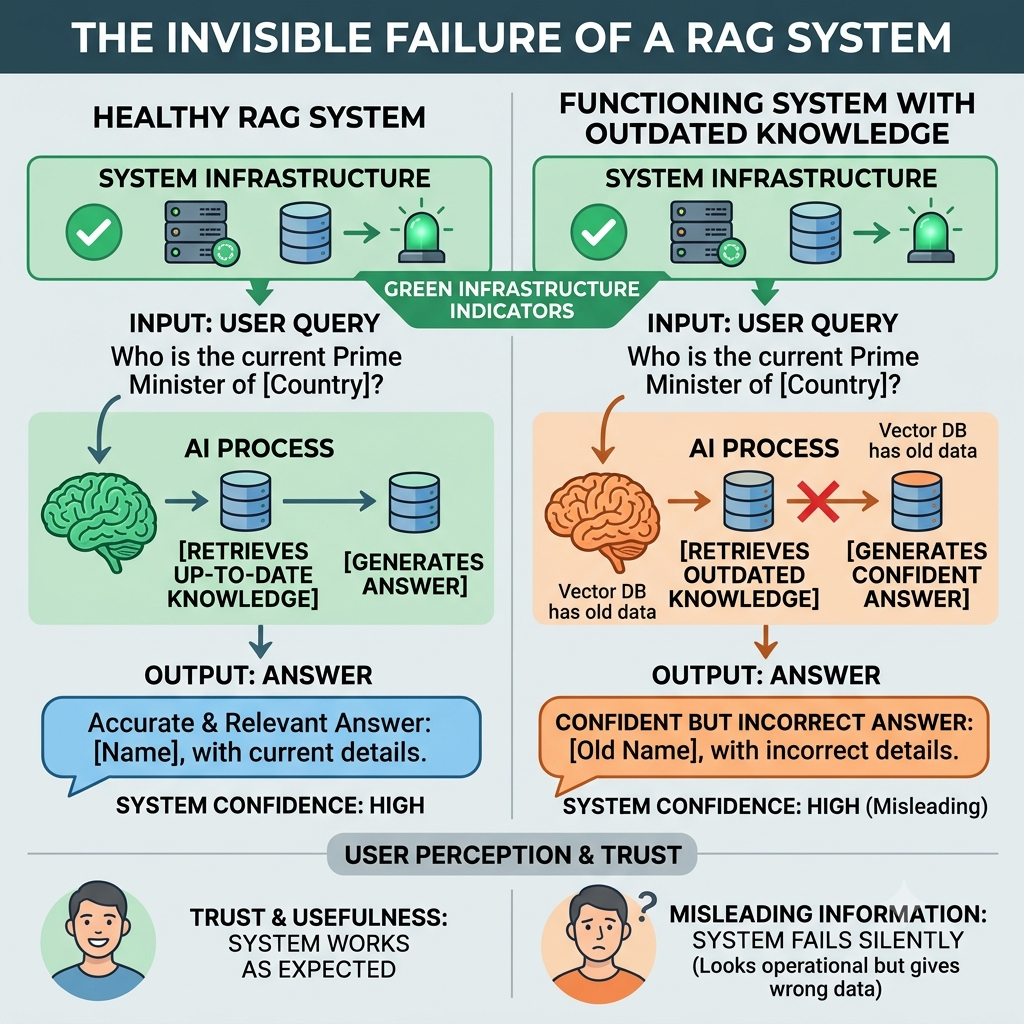
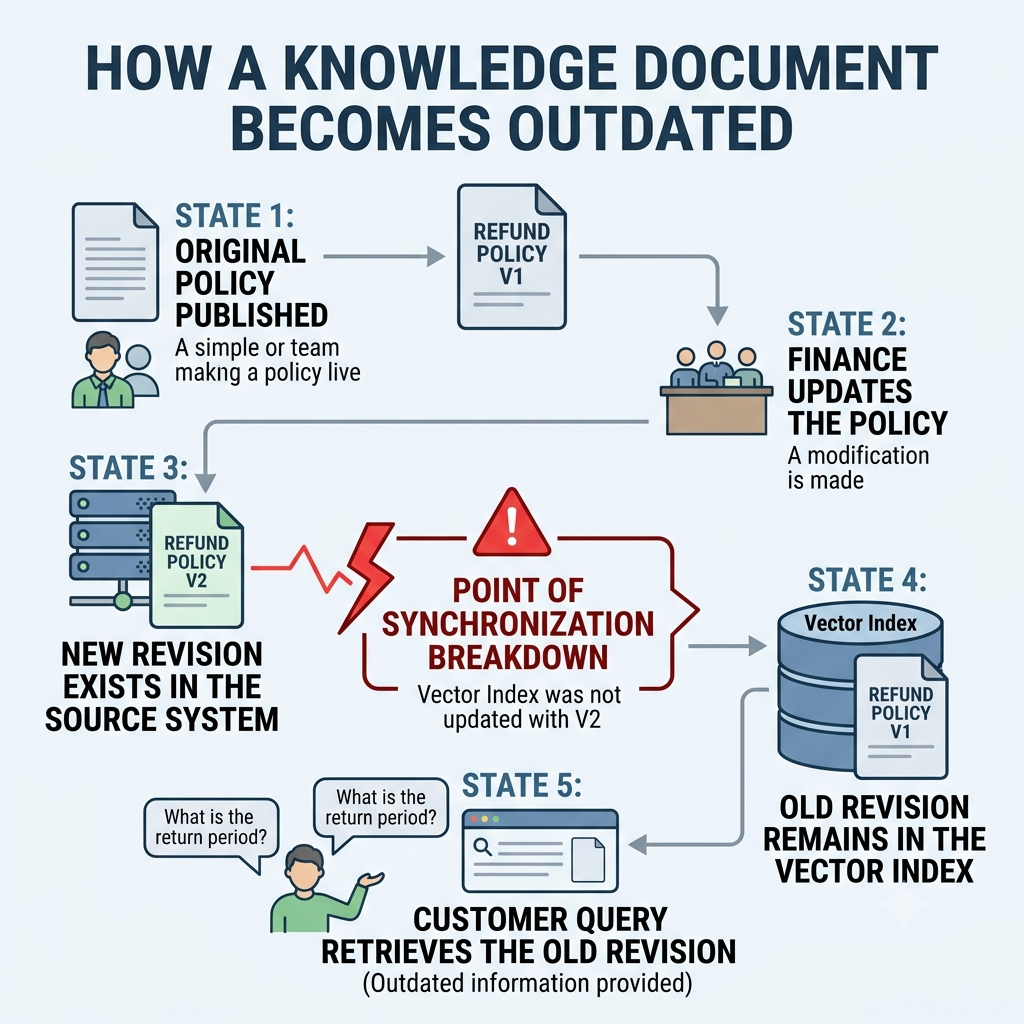
Picture a support bot that answers 40,000 questions a week. Latency is fine, the vector database is up, and the index size hasn’t moved in a month. Then someone in finance mentions that the bot is still quoting last quarter’s refund policy.
Nothing crashed, so no alert fired. The knowledge base drifted, and nobody was watching for it.
Knowledge base drift is a material change in source content, metadata, embeddings, index composition, or retrieval behavior that reduces the usefulness of the context a RAG system retrieves. The tricky part is that standard infrastructure metrics don’t see it. Uptime, latency, and index size can all look perfect while semantic quality quietly slips.
This article gives you a framework for catching that slide early, before it turns into a wrong answer, a compliance problem, or a support escalation.
What this article doesn’t cover: how the agent should behave once retrieval is bad (fallback responses, confidence thresholds, remediation UX, alignment). That belongs to the agent-calibration layer, which I’ll cover separately. Here we stay in the data and retrieval layer: sources, ingestion, metadata, chunking, embeddings, and the index.
The drift surface area
Most teams hear “drift” and think “old documents.” Stale content is one cause, but a production knowledge base can fail in at least seven independent ways, and each one has a different owner and a different detection signal.
| Drift type | What changes | Typical symptom | Where to detect it |
|---|---|---|---|
| Content | Facts, policies, product details, APIs, procedures | Outdated answer despite successful retrieval | Source systems, timestamps, content hashes |
| Corpus | Documents added, removed, replaced, duplicated | Retrieval misses, conflicting chunks, topic imbalance | Ingestion logs, document counts, source coverage |
| Metadata | Owner, version, effective date, language, tenant, access labels go wrong | Wrong scope, stale policy, permission errors | Metadata validation, catalog checks |
| Chunking | Boundaries, overlap, or preprocessing change | Relevant fact split or diluted across chunks | Chunk-level evaluation, ingestion versioning |
| Embedding | Model, preprocessing, or vector representation changes | Similar queries return different results | Embedding distributions, probe sets, retrieval metrics |
| Index | Reindexing, deletion, corruption, mixed model versions | Sudden retrieval regression | Index version, vector health, score trends |
| Query | Users ask new things or use new terminology | Low similarity, no-answer, poor recall | Query embeddings, zero-result rate |
The point of the table is accountability. “AI reliability” is a vague thing to monitor. “Metadata drift in the payments collection, owned by the payments docs team” is something you can alert on and fix. Good monitoring covers corpus statistics, embedding distributions, retrieval quality, and freshness, not just whether the pipeline job succeeded.
Map the failure chain
Drift rarely starts where you see it. Here’s the usual path from cause to symptom:
- A source system changes a policy, product page, or API reference.
- The ingestion pipeline fails, lags, overwrites, duplicates, or ingests malformed metadata.
- The chunker produces fragments that no longer carry the operative fact.
- The embedding step runs under a different model version or preprocessing rule.
- The index ends up with stale, missing, duplicated, or incompatible vectors.
- Retrieval returns context that looks plausible but is outdated or off-topic.
- The LLM writes a confident answer that’s wrong or unsupported.
The agent is usually the last place the failure becomes visible, not the first place it happens. A partial reindex after a model upgrade is a good example: old and new vectors end up mixed in one index, and query latency and index size look completely normal.
Source systems
   ↓  Did the source change?
Ingestion & normalization
   ↓  Was ingestion complete?
Metadata & freshness checks
   ↓  Is metadata valid?
Chunking
   ↓  Are chunks stable?
Embedding generation
   ↓  Are embeddings compatible?
Vector index / retrieval
   ↓  Is retrieval still accurate?
LLM agent
Each arrow is a monitoring question. If you can’t answer one of them today, that’s your first gap.
Instrument the source and ingestion layer
Drift detection starts before any embedding exists. If you can’t tell what changed upstream, you’ll spend incident reviews guessing.
Document identity and versioning. Give every document a stable ID, source URL, revision ID, content hash, effective date, and last-verified timestamp.
Change-event capture. Track created, updated, deleted, archived, replaced, and permission-changed events. Deletions and permission changes are the ones teams forget.
Ingestion completeness. Compare source-system counts to indexed counts. Watch failed jobs, retries, dead-letter records, and ingestion lag.
Metadata validation. Enforce required fields, valid owners, language, tenant, access controls, document type, and expiration rules.
Freshness policy by content class. A pricing page might need daily freshness. An architecture decision record might only need an annual review. One global “stale after 90 days” rule will be wrong for both.
Duplicate and conflict detection. Look for near-duplicate chunks, superseded policy versions that are still live, and sources that contradict each other.
Treat freshness as a catalog-level property, not a one-time check at ingestion. Asset-level signals such as last_verified and owner-confirmation dates work best when combined with retrieval-level signals, like how old the documents are that actually get retrieved.
Here are the fields worth storing:
| Field | Example | Why it matters |
|---|---|---|
source_system |
Confluence, Zendesk, GitHub | Shows where a failure originated |
document_id |
policy-123 |
Enables lineage and targeted reindexing |
content_hash |
SHA-256 of normalized text | Separates changed from unchanged content |
document_version |
v14 |
Supports rollback and auditability |
effective_date |
2026-11-01 |
Separates policy validity from crawl date |
last_verified_at |
2026-10-28 |
Drives owner review workflows |
owner |
payments-docs-team |
Routes alerts to an accountable team |
embedding_model_version |
embed-v3.1 |
Prevents incompatible vectors in one index |
index_version |
kb-2026-11-09 |
Enables safe reindex and rollback |
Also version your index and tag every retrieval request with the index and embedding-model versions. When quality drops, that tagging is what lets you tell a corpus change from a model or indexing regression.
Measure semantic drift in the vector layer
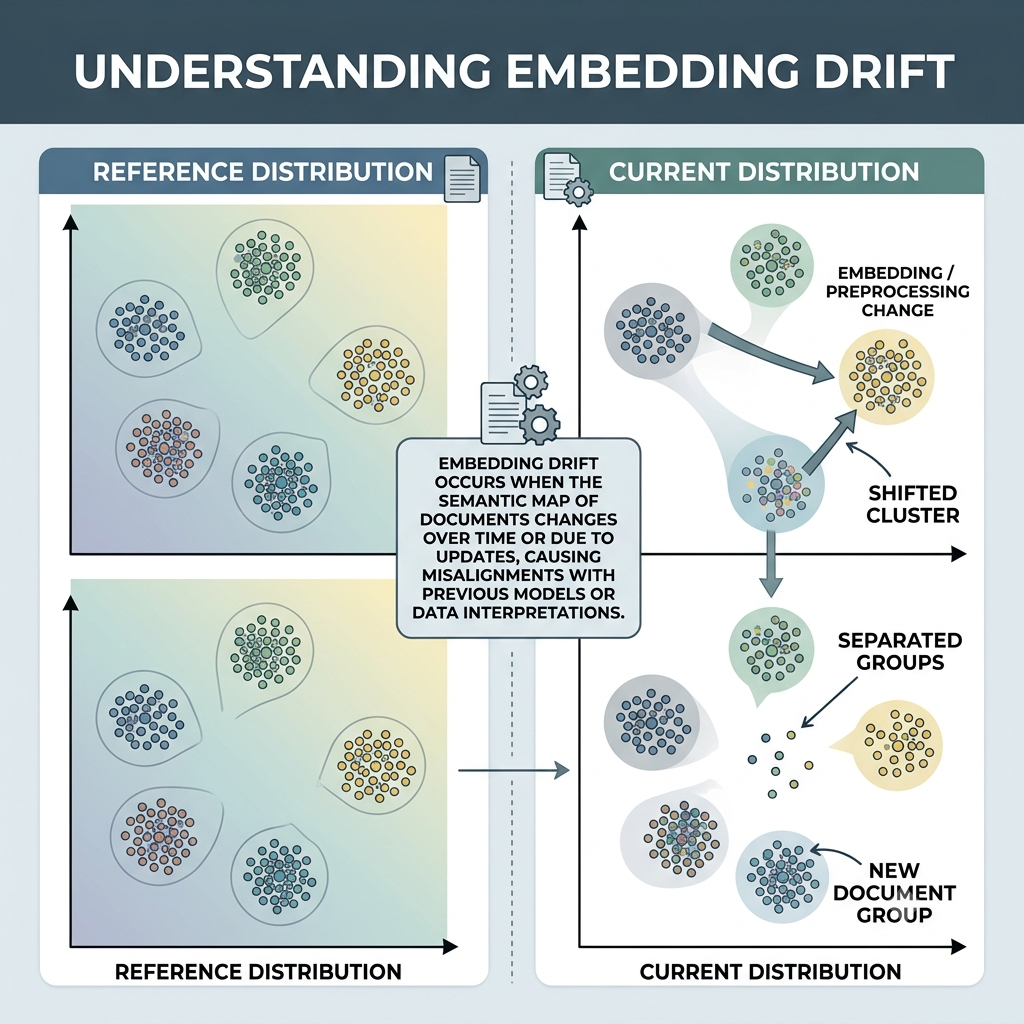
This is the technical core. Don’t just check that embedding jobs finished; monitor embeddings as a distribution.
- Reference-window baselining. Keep embeddings from a known-good period and compare current batches against them.
- Centroid shift. Track how far a collection’s average embedding moves over time. It’s good at catching broad semantic or preprocessing changes.
- Norm and variance monitoring. Sudden changes can point to rescaling, a model swap, or inconsistent ingestion.
- Distribution tests. Use per-dimension KS tests, PSI, or dimensionality-reduced multivariate methods.
- Cluster divergence. Watch the share of each topic cluster. New products, languages, or document types will shift it.
- Probe-set monitoring. Periodically embed a stable set of representative queries and known-relevant documents, then check that their similarity holds steady.
- Cross-encoder agreement. Rerank a sample of production retrievals with a separate model. Persistent disagreement can reveal semantic misalignment.
No single one of these is enough. Centroid shift, mean norm, per-dimension drift, and norm-distribution divergence each catch a different kind of failure, so run them together.
| Metric | What it detects | How to read an alert |
|---|---|---|
| Centroid distance | Broad semantic shift | Check source mix, preprocessing, model version |
| Mean embedding norm | Rescaling or instability | Check model version and normalization |
| Embedding variance | Inconsistent preprocessing, mixed corpora | Inspect ingestion and chunking changes |
| PSI / KS score | Distributional change | Find the affected collections or segments |
| Probe-query similarity | Retrieval alignment loss | Review affected topics, re-embed if needed |
| Cluster share change | Topic imbalance, coverage gaps | Add, refresh, or rebalance content |
| Mixed model-version rate | Incompatible vectors in one index | Stop incremental writes; rebuild or migrate |
Version consistency deserves special attention. An uncontrolled embedding-model update can change retrieval behavior across the whole corpus, and a version mismatch usually calls for a full reindex, not minor tuning.
Monitor retrieval quality, not just vector health
Embedding statistics can tell you something changed. They can’t tell you whether retrieval is still useful. For that you need retrieval-level evaluation.
- Golden query set. A curated, versioned list of real user questions with known relevant chunks or documents.
- Recall@k. Did a known-relevant document show up in the top k?
- Precision@k / context precision. Are the top results actually relevant?
- MRR and nDCG. Are relevant results ranked high enough to be used?
- Top-score distribution. Track the median and the tail of similarity scores over time.
- No-answer rate. How often does retrieval fail to produce usable context?
- Segment-level analysis. Break everything down by product, tenant, language, document type, and topic. Averages hide local failures.
- Retrieved-document age. Measure the age of what’s actually retrieved, not the age of the whole corpus.
- Regression suite. Run a small human-labeled set after every ingestion, embedding, chunking, or index change.
Log chunk IDs, similarity scores, document versions, and retriever strategy for each request, so retrieval traces can be tied to generation quality. A falling MRR or hit rate right after a deploy is a strong hint of an embedding-version mismatch or another breaking change.
A starter dashboard:
| Panel | Metric | Healthy | Investigate when |
|---|---|---|---|
| Retrieval quality | Recall@5 on golden set | Stable or improving | Sustained decline after a change |
| Ranking quality | nDCG@10 | Stable | Gradual decline across runs |
| Confidence | Median top-1 cosine similarity | Stable baseline | Sharp drop or widening variance |
| Coverage | Zero-result query rate | Low and stable | Rising no-result or low-score rate |
| Freshness | Median retrieved-doc age | Within domain policy | Age climbs as newer content is excluded |
| Corpus health | Indexed vs. source count | Within tolerance | Missing, duplicated, or orphaned docs |
| Compatibility | Embedding-version mix | One approved version | Any mixed-version rate above zero |
Build automated drift audits
Metrics only help if they feed a routine. A four-stage audit works well:
- Snapshot. Capture corpus counts, hashes, metadata distributions, embedding versions, and retrieval metrics.
- Compare. Measure change against both a fixed baseline and a rolling recent window.
- Classify. Separate expected content updates from anomalous drift. A product launch should move your metrics; that isn’t an incident.
- Route. Send a prioritized alert to the right owner, with the affected collection, likely cause, and recommended action.
A sample alert:
Alert: High semantic drift — payments-knowledge-base
Severity: High
Affected collection: payments_policies
Signal:
- Centroid distance: 0.14 vs. 0.03 baseline
- Probe-set recall@5: 71% vs. 92% baseline
- Mixed embedding versions: 18% of vectors
Likely cause:
- Partial reindex after embedding-model upgrade
Recommended action:
- Freeze incremental writes
- Re-embed affected document versions
- Rebuild and validate replacement index
Owner: payments-knowledge-platform
Hourly or daily batch runs are enough for most systems. Save real-time checks for high-risk ingestion events and business-critical collections. Tune thresholds empirically so you balance sensitivity against alert fatigue.
Set thresholds and severity
There are no universal numbers here. A centroid distance of 0.14 might be alarming for one corpus and routine for another. Use a framework instead:
- Baseline first. Establish a stable reference period before you set any thresholds.
- Trend plus level. One bad batch may be noise. A sustained shift across several windows deserves action.
- Segment your thresholds. Regulated, safety-critical, and revenue-critical content gets stricter limits.
- Separate warning from critical. Warnings trigger investigation. Critical states can block promotion or force a reindex.
- Scale severity with blast radius. Drift in one low-traffic collection isn’t the same as drift in your main support corpus.
| Severity | Example condition | Response |
|---|---|---|
| Info | New documents ingested, metrics in range | Log and continue |
| Warning | Small but sustained embedding or score shift | Investigate source and ingestion changes |
| High | Recall, ranking, or freshness degrades across a segment | Re-run evaluation, inspect documents, prepare reindex |
| Critical | Model-version mismatch, index corruption, recall collapse, stale compliance content | Halt ingestion, rebuild index, notify owner, consider a retrieval degradation mode |
The goal isn’t to stop embeddings from ever moving. Knowledge is supposed to evolve. The goal is to tell expected evolution apart from unmanaged degradation.
Remediation: repair the knowledge supply chain
Keep fixes in the data and retrieval layer.
- Quarantine suspicious documents so unvalidated content stays out of production retrieval.
- Re-embed selectively when the problem is localized to specific document versions.
- Do a full reindex when the embedding model, preprocessing, or chunking strategy changes.
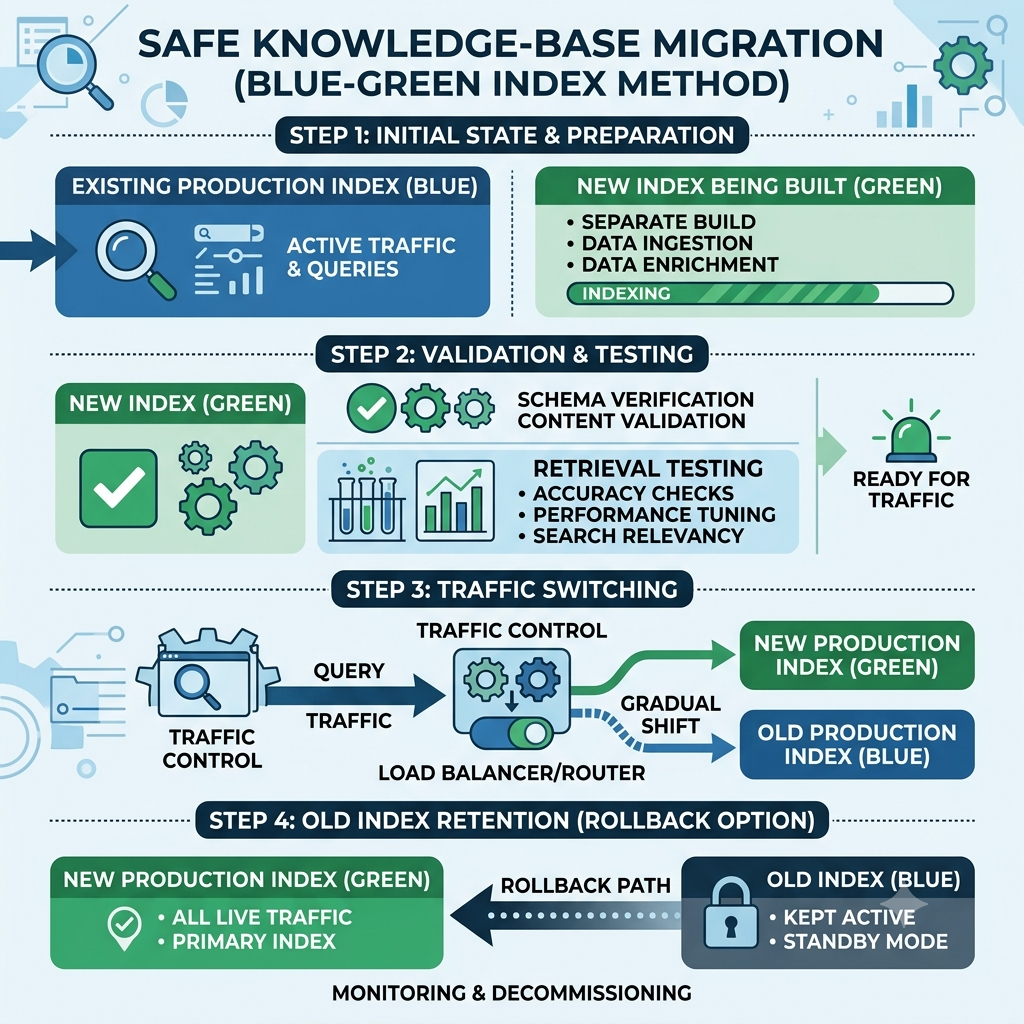
- Version indexes and deploy blue-green. Build the new index, validate it, switch traffic, and keep rollback available.
- Use a source-owner workflow. Stale or conflicting documents go to the accountable team to confirm, update, or deprecate.
- Supersede instead of deleting. Archive replaced documents so retrieval history stays auditable.
- Evaluate after the incident. Rerun the golden set and compare pre-incident and post-fix metrics.
Governance matters as much as detection. A stale entry needs a clear route to its owner, followed by a refresh or removal. Without that, alerts just pile up.
A vendor-neutral reference architecture
- Source connectors: CRM, ticketing, documentation, data warehouse, file storage, APIs.
- Ingestion orchestrator: scheduled and event-driven jobs, retry policy, dead-letter queue.
- Data-quality service: schema validation, freshness checks, duplicate detection, content hashing.
- Embedding service: pinned model versions, preprocessing version, batching and retry controls.
- Vector store: versioned collections or indexes, metadata, backup and restore.
- Evaluation service: golden queries, synthetic probes, retrieval metrics, sampled human review.
- Observability layer: metrics, traces, logs, dashboards, alerts.
- Governance layer: ownership, approvals, incident routing, audit trail.
Observability should combine infrastructure and semantic signals: vector database health, ANN recall, latency percentiles, embedding distributions, retrieval metrics, and document-version metadata. Either half alone leaves you blind.
Implementation checklist
- Assign an owner and review cadence to every critical knowledge collection.
- Store document ID, source, version, content hash, effective date, last-verified date, and embedding-model version.
- Alert on ingestion lag, failed jobs, source-to-index count mismatch, duplicate rate, and metadata-validation failures.
- Maintain a golden retrieval set covering each major topic.
- Track recall@k, precision@k, MRR or nDCG, top-score distribution, zero-result rate, and retrieved-document age.
- Baseline embedding distributions and monitor centroid shift, norm shift, variance, and distributional drift.
- Pin embedding-model and preprocessing versions, and treat upgrades as planned migrations.
- Version vector indexes and use blue-green reindexing with rollback.
- Segment monitoring by tenant, language, product area, and document type.
- Route drift alerts to content owners, not only engineering on-call.
- Re-run retrieval evaluations after every ingestion, chunking, embedding, or index change.
RAG systems rarely fail loudly. They fail by getting a little less right each week while every green dashboard says otherwise. Instrument the pipeline from source to index, measure retrieval against a stable baseline, and give every alert an owner, and you’ll find drift while it’s still a data problem instead of a customer problem.