
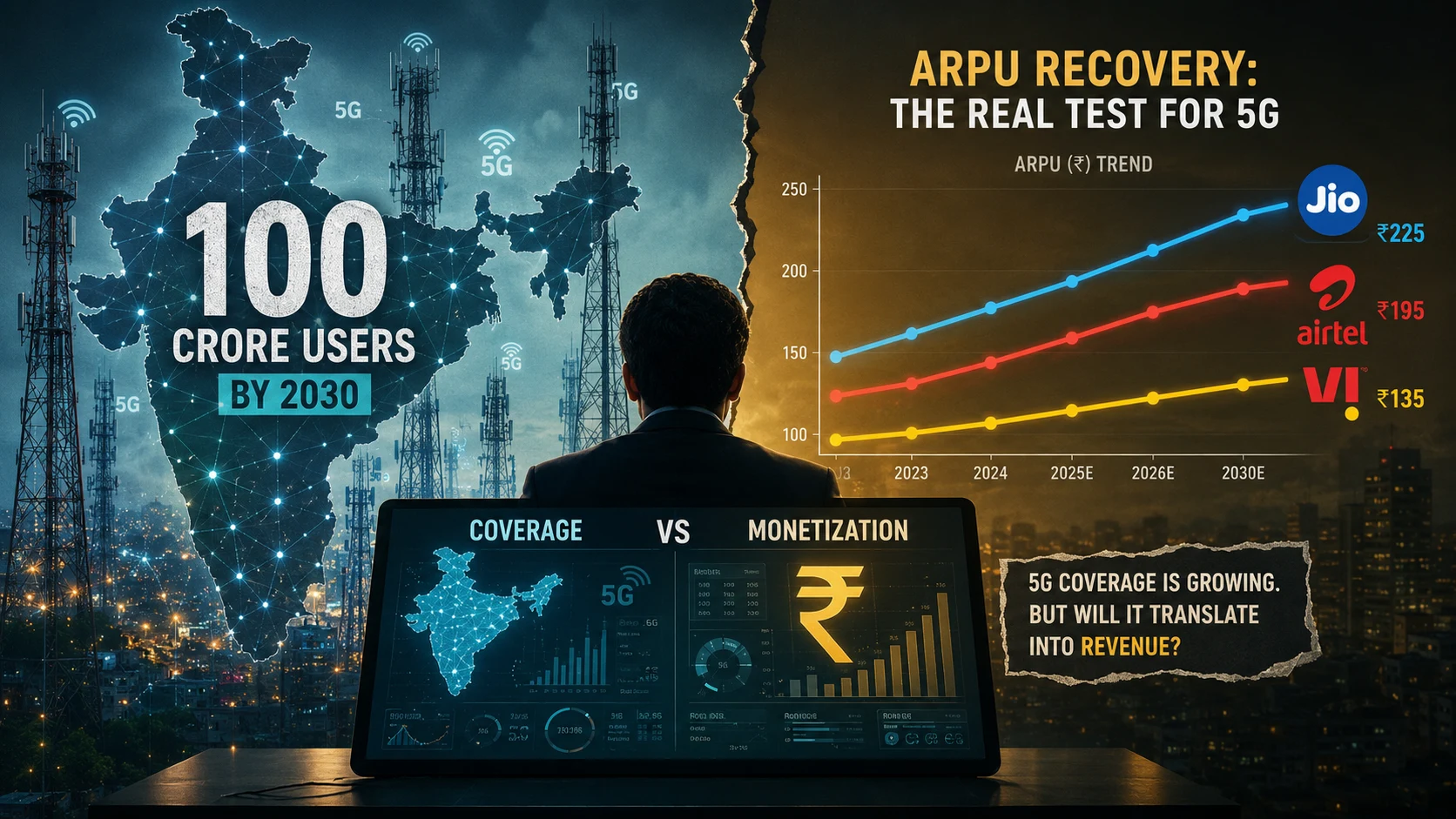
India’s telecom landscape shook today as government leaders accelerated the nation’s biggest digital mandate yet. Union Minister Jyotiraditya Scindia announced a bold target to connect 100 crore 5G subscribers by 2030.
But as operators race across 767 districts, a vital question haunts the industry: Can Reliance Jio, Bharti Airtel, and Vodafone Idea turn massive scale into profitable average revenue per user (ARPU)? Without urgent tariff realignments and enterprise adoption, this expansion risks becoming a multi-billion-dollar profit trap.
Key Highlights
- Scale Target: Expanding from ~50 crore 5G users to 100 crore subscribers by 2030.
- Capital Intensity: Over ₹4.5 lakh crore (€50+ billion) spent installing more than 5 lakh 5G towers nationwide.
- The Revenue Tension: Current user growth outpaces monetized data, forcing telcos to rethink pricing models.
Telecom Reality: Why Coverage Alone Is Not Enough
India’s 5G deployment broke speed records, but network scale does not automatically create bankable cash flow. Operators poured ₹4.5 lakh crore into infrastructure, yet consumer ARPU remains heavily constrained under basic data bundles.
Without sustained tariff adjustments and monetization pathways, the weight of network maintenance could crush operational margins.
Can a 100 crore-user network still disappoint investors?
If subscriber growth continues while monthly bills stay low, telcos will struggle to fund next-gen standalone 5G and early 6G research. Consequently, closing the gap between user growth and cash generation is now an existential priority.
Business Model Shift: Beyond Free Unlimited Data
To survive this expansion phase, operators are moving away from volume chasing to value capture. The upcoming monetization engine relies on four crucial building blocks:
- 5G Advanced & Network Slicing: Allocating dedicated, ultra-low latency bandwidth for premium gamers and critical industrial tasks.
- Enterprise Private Networks: Connecting smart factories, automated ports, and healthcare facilities with private infrastructure.
- Edge Computing & AI Services: Processing complex data locally to power real-time AI capabilities for enterprise clients.
- Fixed Wireless Access (FWA): Expanding home broadband reach into semi-urban and rural areas using 5G airwaves.
“The next phase of 5G is not about coverage alone; it is about monetizing latency, reliability, and enterprise-grade service.” — Senior Telecom Analyst
Operator Breakdown: Who Wins and Who Struggles?
The impact of this 100 crore subscriber push differs significantly across India’s major telecom operators:
| Operator | Strategic Upside | Main Risk |
|---|---|---|
| Reliance Jio | Dominant scale, vast ecosystem bundling, and aggressive 5G Standalone (SA) coverage. | Monetizing mass-market users quickly enough to justify huge capex. |
| Bharti Airtel | Strong high-ARPU user base and market leadership in corporate enterprise solutions. | Balancing ongoing capex demands against net margin expansion. |
| Vodafone Idea (Vi) | Gradual 5G rollout helps retain high-tier subscribers in core circles. | Severe capital funding pressure and slower overall network upgrade capacity. |
Will enterprise 5G save telcos before consumer ARPU does?
While enterprise contracts deliver high margins, consumer tariff increases will remain the primary driver to lift overall sector ARPU.
#WATCH | Delhi: On the theme launch of the 10th edition of India Mobile Congress (IMC) 2026 organised by the Department of Telecommunications (DoT) and Cellular Operators Association of India (COAI), Union Minister for Communications Jyotiraditya Scindia says, “The information… pic.twitter.com/hRU3jygxtH
— ANI (@ANI) July 29, 2026
Key Takeaways for Investors and Industry Watchers
- Track the ARPU Trajectory: Watch whether ARPU climbs toward the industry’s target threshold of ₹200–₹250.
- Monitor Tariff Reforms: Look for structured tiering where ultra-fast 5G commands a distinct premium over 4G.
- Evaluate 6G Readiness: Track how policy frameworks like the IMC 2026 Theme Announcement and Government Press Releases on 5G Scale transition 5G infrastructure toward 6G standards.
- Follow Equipment & Manufacturing: Monitor progress in domestic hardware through updates detailed in ETTelecom Coverage.
Is India building a global usage boom or a profitability trap? The next two years will show whether telcos can turn massive 5G volume into sustainable revenue.