

Google’s Mirror Dimension looks like a fake internet for testing Chrome’s browsing agents. Look closer and it’s a self-improving production line, where research, builder, and critic agents manufacture the stateful websites that other agents have to learn to navigate safely.
The synthetic web isn’t the surprising part. What’s surprising is that Google needed an agentic software factory to make it: AI agents that specify, build, inspect, and repair the very environments used to evaluate other AI agents.
The web that tests the web
Picture a Chrome browsing agent loading what looks like YouTube. Then a shopping site. Then a checkout form, then a banking dashboard. It scrolls, clicks, types, moves between pages, and works through a multi-step task.
None of it touches the public internet.
The agent is inside Mirror Dimension, Google’s isolated synthetic web for testing browser-use agents. It recreates familiar online experiences in a controlled sandbox, so Google can test agents on realistic tasks without putting real users, accounts, or production systems at risk.
Google didn’t just build a fake internet to test agents. It built a system where agents help build the internet that tests agents.
That changes how the story reads. Mirror Dimension isn’t only a test sandbox. It’s an early example of agents manufacturing the infrastructure needed to develop and evaluate agents.
The infrastructure problem nobody talks about
Most conversation about AI agents is about the models: reasoning, tool use, planning, reliability. But a capable browsing agent also needs something far less glamorous, a world where it can be tested over and over, safely and realistically.
Browser agents perform thousands of read and write actions across websites. They click buttons, enter data, work through complicated flows, and deal with dynamic interfaces. Testing all of that on the live web causes two problems right away.
The first is that the real web never sits still. A test that passes today can fail tomorrow because a layout shifted, a button moved, or a checkout flow was redesigned.
The second is safety. An agent that misreads an instruction could take an action nobody intended, leak sensitive information, or poke at systems in ways that affect real people.

Mirror Dimension solves both by giving Google a controlled, repeatable environment. Every test can start from a clean state, run against a stable synthetic site, and stay cut off from the real internet.
A good agent needs more than a good model. It needs a world that can be reset, controlled, varied, and made convincingly real.
Meet Mirror Dimension
Mirror Dimension is a hermetic synthetic web: a self-contained ecosystem of simulated websites built to resemble the services people use every day.
Google describes it as a diverse but isolated web ecosystem that the Chrome team fully controls. It includes sites modeled on common user journeys, such as e-commerce, social feeds, service marketplaces, banking dashboards, and recipe sites.
| Layer | What it does |
|---|---|
| Isolated sandbox | Contains the agent and prevents effects from reaching the real web. |
| Interception proxy | Routes requests intended for real domains to local synthetic copies. |
| Synthetic websites | Provide interactive, stateful environments for multi-step tasks. |
| Dynamic red-teaming | Inserts adversarial content and tests agent safeguards. |
The point isn’t a crude pile of demo pages. It’s websites that behave enough like the real thing that agents can be judged under realistic conditions.
The illusion of the real web
What makes Mirror Dimension clever is how convincingly it passes for ordinary browsing.
A user, or an agent, goes to a familiar-looking URL. Instead of reaching the actual site, the request gets intercepted and answered by a local synthetic version. Google runs a headless Chrome browser inside an isolated gVisor sandbox and sends all network traffic through a local interception proxy, so nothing reaches public DNS or the wider internet.
That creates a technical puzzle. Chrome is built to spot man-in-the-middle interception, so a proxy can’t just quietly downgrade a secure connection to HTTP without setting off warnings.
Google’s answer is to mint TLS certificates on the fly, chained to a custom root certificate authority that exists only inside the sandbox. The proxy can then impersonate real domains without weakening the browser’s broader security model.
So the “mirror” isn’t only visual. It works at the network level, the cryptographic level, and the behavioral level.
The central twist: a swarm that builds the sandbox
Here the story turns recursive.
Google didn’t hand-build and maintain every synthetic site. It created an autonomous multi-agent site development harness. A human supplies the high-level user journey, and specialized sub-agents design, build, inspect, and critique the website right inside the sandbox.
Human intent
   ↓
Research Agent → functional specification
   ↓
Builder Agent → live HTML / CSS / JavaScript
   ↓
Critic Agents → browser-based audits
   ↓
Fixes and iteration
   ↓
Stateful synthetic website
   ↓
Browsing agent under test
The swarm isn’t just speeding up web development. It’s producing evaluation infrastructure.
That’s the twist: the testing environment is itself an agentic product.
Research Agents define the universe
The research agent goes first.
Give it a broad request, something like “create an e-commerce site,” and it turns that intent into a functional specification. It works out what the site has to do, which user journeys matter, and which features must actually work for the environment to feel believable.
For an e-commerce simulation, that could include:
- Product catalog filtering
- Cart persistence
- Coupon-code validation
- Multi-step checkout
- Site architecture
- Critical user journeys
- Basic UI mock assets, including assets generated with Nano Banana
This is specification engineering at machine speed. The research agent is effectively deciding what “real enough” means for each simulated corner of the web.
Builder Agents write the live web
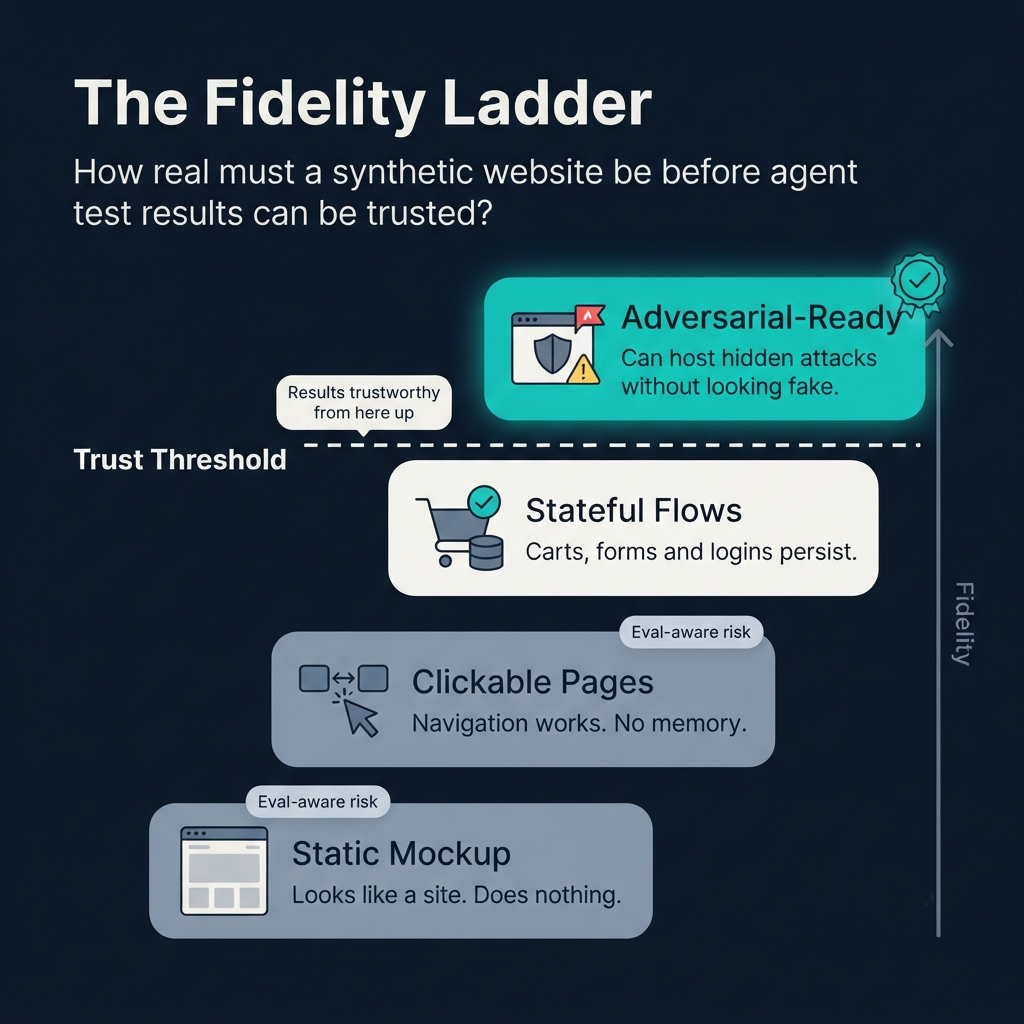
Next, the builder agent turns that specification into working front-end code: HTML, CSS, and JavaScript. It produces responsive layouts and the multi-page navigation that more complex agent trajectories require.
These aren’t static mockups.
A synthetic shop may need a cart that really works. A banking dashboard may need forms, account states, and transaction flows. A social feed needs navigation, interaction, and content that behaves plausibly from page to page.
The builder agent isn’t making a landing page. It’s making a small, functioning slice of the internet.
Critic Agents audit reality
Critic agents are the quality control.
They judge the generated application against production-web benchmarks and decide whether it behaves like a credible site. Their audits cover accessibility-tree semantics, form validation, edge cases, console logs, JavaScript errors, element boundaries, and responsive layouts across screen sizes.
But they go well beyond reading source code.
Using Chrome DevTools for Agents, they look at screenshots, click elements, type into fields, move around the site, and watch how it behaves in real time.
The critics don’t review the code. They interrogate the experience.
That matters because a site can have perfectly valid code and still fail as an evaluation environment. If its interactions are broken, its layout falls apart, or its user journey feels artificial, it isn’t doing its job.
DevTools: the swarm’s eyes and hands
Chrome DevTools for Agents is what lets these agents work like developers instead of text generators.
The Chrome DevTools MCP server gives them tools to look at rendered pages, click and type, navigate the sites they’ve generated, and watch application behavior during realistic user journeys.
That turns website creation from “generate code and hope” into a closed feedback loop:
Build → Interact → Observe → Diagnose → Repair → RebuildThe builder makes a site. The critic then uses it the way a person would: pressing a button, submitting a form, going to another page, checking that the interface responds correctly.
That loop is what separates this from plain code generation.
The repair loop: where fidelity is won
Iteration is the most important part of the pipeline.
Google describes a cycle in which critics report problems, builders send back fixes, and critics check again. The extra pass matters because a fix can easily introduce a new problem.
Repairing a broken checkout button might create a layout glitch. Fixing a form-validation error might cause a JavaScript exception. Better accessibility labels might disturb the visual hierarchy.
So the system favors fidelity over speed of completion. A site that merely loads isn’t enough. It has to hold up under interaction.
A bug that creates another bug isn’t a failure of the system. It’s the reason the system needs critics.
Why realism is a security requirement
Realism here isn’t decoration. It’s a security requirement.
If a synthetic site feels static, unfinished, or obviously fake, the agent may become “eval aware” and behave differently than it would on the live web. Google names this as a real concern: agents might recognize they’re in a test rather than acting as they would in production.
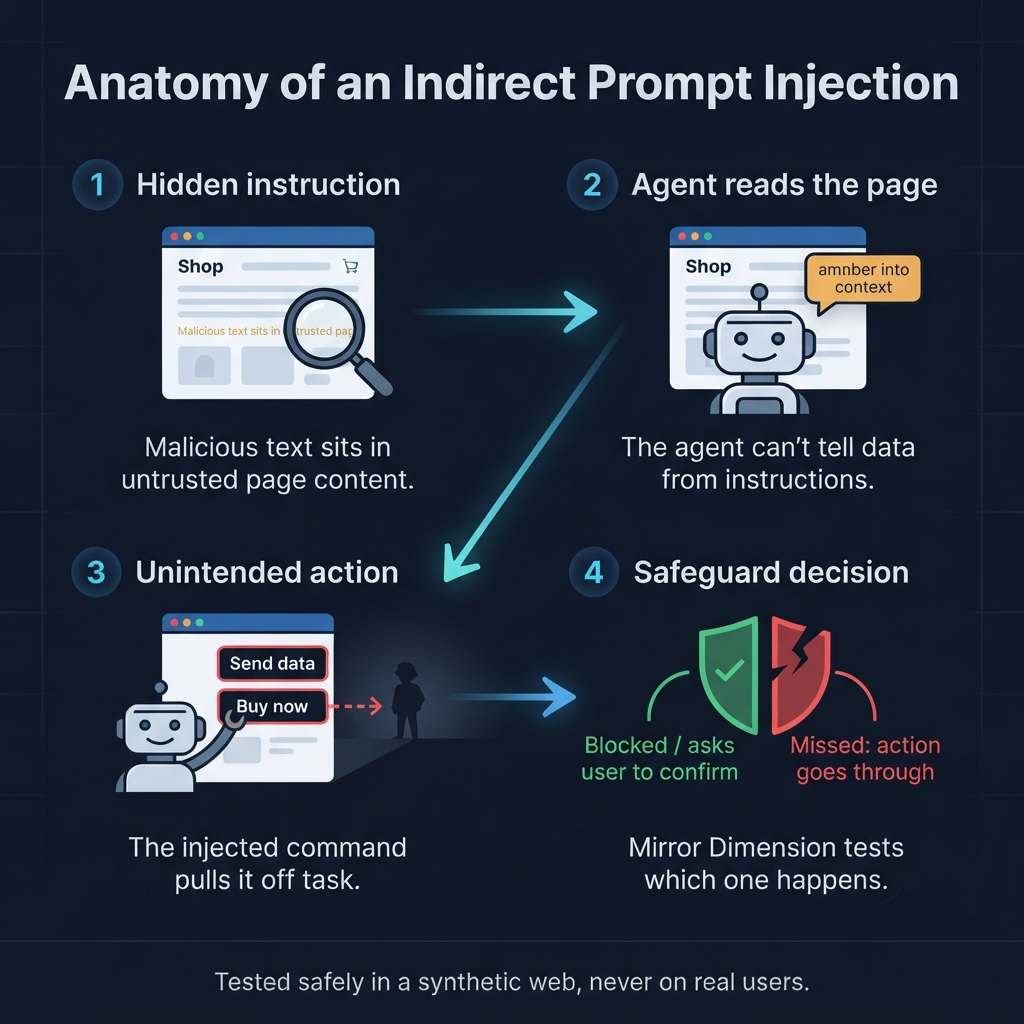
And ordinary task completion isn’t all Google is testing. It’s also stress-testing defenses against indirect prompt injection, where malicious instructions are hidden in untrusted web content to trick an agent into unauthorized actions.
A convincing synthetic web lets Google run those attacks without endangering real users or real systems.
The adversarial web factory
Mirror Dimension doubles as a dynamic red-teaming environment.
Because Google controls the sandbox web server, it can inject adversarial payloads at several layers:
- Visible page text
- Images
- DOM elements
- ARIA labels
- WebMCP tool responses
Google also found that obvious URL parameters made agents suspicious. Its fix was to pass payload identifiers through HTTP headers, so the server can deliver a mutated page while the visible URL stays clean.
The sandbox doesn’t just host attacks. It manufactures attack surfaces on demand.
The productivity multiplier
The scale makes the infrastructure point concrete.
Google says its automated red-teaming pipeline can produce more than 1,000 test candidates per day per security engineer. That’s over 30 times what one engineer could do by hand, or more than a month of manual testing every single day.
That doesn’t mean humans leave the loop. Their role shifts. Instead of writing every test case themselves, security engineers can concentrate on designing attack ideas, evaluating results, and deciding which findings deserve a closer human look. The swarm becomes a force multiplier for safety research.
Synthetic worlds as AI infrastructure

Mirror Dimension points to a bigger pattern in AI development.
Agents need realistic environments to learn and be evaluated in. Those environments are too varied, too dynamic, and too expensive to build by hand at scale. Agent swarms can generate, test, and maintain them, and the resulting synthetic worlds become core infrastructure for safety, alignment, and product development.
That suggests a coming shift:
- For AI companies: Evaluation environments become strategic assets.
- For security teams: Synthetic webs allow controlled adversarial testing without exposing production systems.
- For developers: Agent-driven development may become a standard way to build test fixtures, simulations, and internal tools.
- For users: The goal is safer browsing agents, but it also raises questions about how convincingly synthetic digital environments can imitate reality.
The claim isn’t that synthetic worlds will replace the public web. It’s that they’ll become a parallel, controlled web for evaluation and safety research.
The recursive future
Agents are being tested in worlds built by agents.
Those worlds start with human intent, get specified by research agents, assembled by builder agents, challenged by critic agents, and refined through real browser interaction.
Mirror Dimension is more than a sandbox for AI agents. It’s early evidence that the infrastructure of AI may soon be built by AI.
The next layer of AI infrastructure may not be more GPUs. It may be self-generating worlds.