
- [1] Microsoft Security Blog – Defending against AI-driven email threats and phishing – Microsoft Security
- [2] Google Threat Analysis Group – Threat analysis reports on generative AI use – Google Security Blog
- [3] Proofpoint – Annual State of the Phish and Threat Reports – Proofpoint Resources
- [4] Mimecast – Threat Center intelligence on social-engineering automation – Mimecast Resources
- [5] Darktrace – AI-powered email anomaly detection case studies – Darktrace Research
- [6] MITRE ATT&CK – Enterprise framework for credential access and spear-phishing – MITRE ATT&CK
- [7] NIST – Guidelines on identity verification and phishing-resistant authentication – NIST Publications
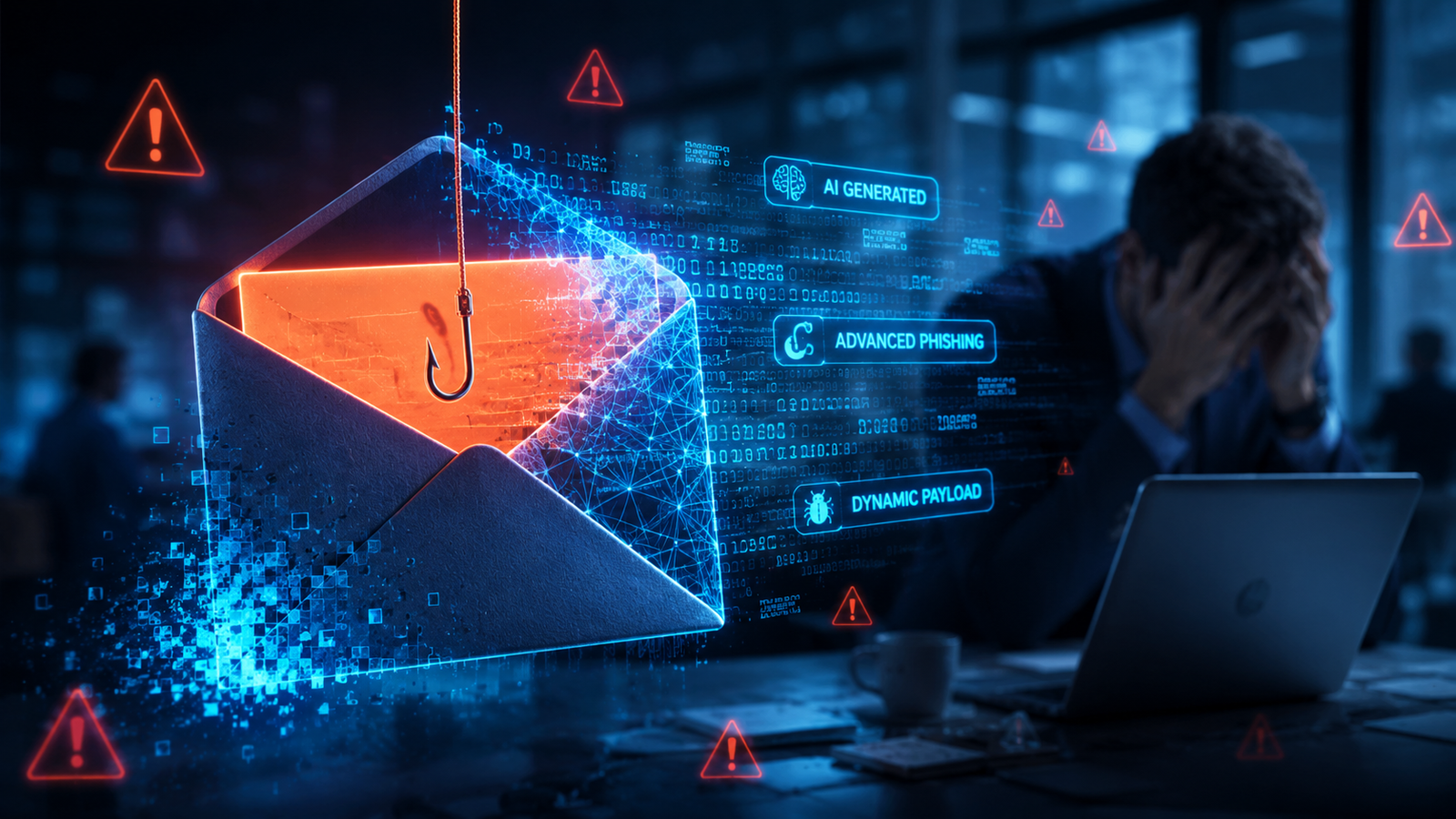
Hackers are using AI to perfectly impersonate coworkers—and it terrifies security teams. In 2025, security vendors reported a 300% rise in realistic spear-phishing attempts using generative models, while reported credential theft from email scams climbed 60%.
How can defenders stop attackers who write like your CEO? Traditional spam filters that relied on spelling mistakes, odd phrasing, and broken grammar are now completely outpaced by generative models trained on corporate tone and templates.
The Automated Trap: What Changed
- Focus Keyword Integration: This analysis of AI phishing attacks explores how generative AI eliminates traditional red flags to bypass secure email gateways.
- Core Takeaway: Attackers have replaced clumsy grammatical errors with flawless, context-aware writing that mimics internal communication styles effortlessly.
- Immediate Action: Audit your email gateway rules and assess whether your current detection tools evaluate conversation provenance alongside raw content.
Why Traditional Spam Filters Fail
Traditional secure email gateways rely heavily on signature-based detection, blacklists, and lexical rules designed to catch obvious anomalies. When an attacker uses an LLM to generate unique phrasing and dynamic subject lines for every target, signature matching results in dangerous false negatives.
- Lexical Evasion: Generative models rewrite standard phishing templates constantly, preventing static hash signatures from flagging malicious payloads.
- Feature Drift: Security models trained on historical spam datasets fail to recognize novel, highly polished social-engineering automation techniques.
- Context Mimicry: Attackers inject authentic organizational jargon, making malicious emails indistinguishable from internal HR or IT notices.
Real-World Examples and Case Studies
Corporate networks face a barrage of targeted credential-harvesting schemes disguised as urgent executive requests. Recent incident reports highlight how seamless deepfake email campaigns successfully bypassed perimeter defenses by referencing internal company restructuring projects.
- CEO Impersonation: Attackers study executive writing styles via public posts to command immediate wire transfers or payroll updates.
- Vendor Invoice Fraud: Compromised supplier accounts generate authentic-looking payment redirection notices that slip past standard filters.
- IT Credential Scams: Fake multi-factor authentication resets trap employees with flawless landing pages and zero spelling errors.
The New Defense Stack: From Perimeter to Behavior
Defending against modern threats requires moving beyond static perimeter checkpoints toward continuous behavioral analytics and anomaly detection. Organizations must implement layered visibility that monitors the relationship between communicating parties rather than just scanning message bodies.
- Establish Behavioral Baselines: Track normal communication volumes, linguistic patterns, and response latencies for every role across the enterprise.
- Monitor Conversation Provenance: Verify whether an incoming message aligns with the historical relationship between the sender and recipient.
- Enforce Phishing-Resistant MFA: Protect enterprise accounts with hardware-backed security keys that neutralize credential-harvesting risks entirely.
People, Process, and Training
Advanced security awareness training must evolve to reflect AI-driven spear-phishing 2.0 tactics rather than basic typo-spotting drills. Employees need clear protocols for verifying out-of-band requests before executing sensitive financial or administrative tasks.
- Simulate AI Phishing: Run regular, AI-generated phishing simulations to test how staff respond to hyper-personalized social engineering.
- Enforce Out-of-Band Verification: Mandate secondary verification channels (like an internal phone call or secure chat) for all urgent financial changes.
- Involve HR and Legal: Build rapid escalation playbooks that allow employees to report suspicious interactions without fear of penalty.

Technology Roadmap and Vendor Checklist
CISOs evaluating security upgrades must scrutinize vendor capabilities to ensure robust protection against sophisticated email attacks.
| Evaluation Criteria | Key Question / Capability | Target Standard |
|---|---|---|
| Conversation Context | Does the gateway analyze historical communication provenance? | Deep relationship mapping |
| Behavioral Baselines | Can the engine flag anomalous sender behavior per user role? | Automated machine learning |
| SIEM Integration | Does it export actionable alerts directly to your SOC dashboard? | Native API connectors |
| Model Retraining | How frequently are detection models updated against new LLM threats? | Continuous automated updates |
Also Read: The 50,000 Bitcoin Hoax: How Hyper-Realistic AI Clips Are Fueling a New Wave of Crypto Scams
Action Plan for Security Teams
Security leaders should execute a phased roadmap over the next 90 days to close gaps left by traditional email filters.
- First 30 Days: Audit existing secure email gateway policies and identify gaps in conversational visibility.
- Next 60 Days: Deploy behavioral analytics tools and integrate email anomaly alerts with your primary SIEM platform.
- Next 90 Days: Conduct AI-driven phishing simulations and update corporate out-of-band verification policies.
30 new cyber stories. Here’s what hit this week:
— The Hacker News (@TheHackersNews) August 27, 2026
🔴 296K IoT devices compromised
💧 100+ U.S. water systems targeted
⚠️ SharePoint RCE chain probed
🤖 AI enters botnet workflows
☠️ Malicious MCP server on GitHub
⛓️ Blockchain-powered C2
🎣 Live phishing operators
📱 Banking… pic.twitter.com/ZSsbgyXAlT
Sources
- [1] Microsoft Security Blog – Defending against AI-driven email threats and phishing – Microsoft Security
- [2] Google Threat Analysis Group – Threat analysis reports on generative AI use – Google Security Blog
- [3] Proofpoint – Annual State of the Phish and Threat Reports – Proofpoint Resources
- [4] Mimecast – Threat Center intelligence on social-engineering automation – Mimecast Resources
- [5] Darktrace – AI-powered email anomaly detection case studies – Darktrace Research
- [6] MITRE ATT&CK – Enterprise framework for credential access and spear-phishing – MITRE ATT&CK
- [7] NIST – Guidelines on identity verification and phishing-resistant authentication – NIST Publications