
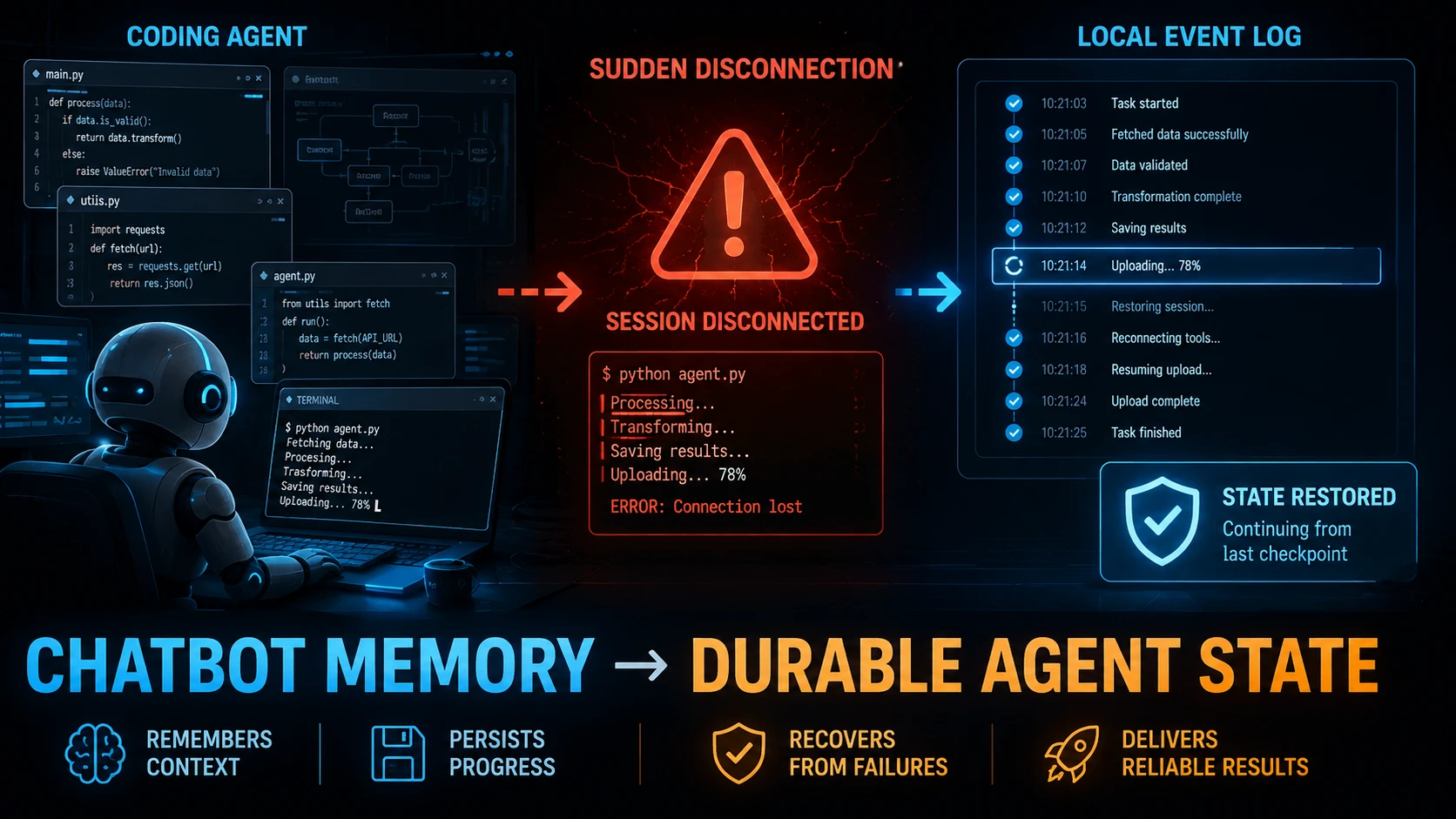
A new architecture from Meta aims to solve the biggest frustration with autonomous coding agents: losing hours of complex work after a simple session crash.
The Problem: Agents Forget Where They Were
Autonomous coding agents are getting smarter, handling tasks that involve dozens of files, hundreds of terminal commands, and complex dependencies. However, they have a dangerous weak point: session state.
When a terminal disconnects or an agent crashes, the model loses the exact sequence of actions already performed. It may remember the broad goal, but it forgets the execution path.

Why session loss is expensive
- Multi-file changes become difficult to reconstruct.
- Terminal commands may have partial or unknown results.
- Tests can be left running or interrupted halfway through.
A coding assistant that produces excellent code but cannot recover from interruption creates significant operational risk. Reliability is not just about generating the right answer; it is about preserving the path taken to reach it.
The Twist: A Write-Ahead Event Log
Meta’s design centers on a local event log that records an agent’s actions before the system considers them durable. This functions like a “write-ahead log” used in fault-tolerant software systems: record the intended state change first, then execute the operation.
This approach ensures that if a crash occurs mid-execution, the recovery system can identify incomplete work and decide whether to retry, verify, or request human input.
The log captures structured, recoverable states, such as:
| Event type | Example recorded action |
|---|---|
| Task creation | “Refactor authentication module” |
| File operation | “Edit auth.ts” |
| Command execution | “Run database migration” |
| Test result | “Unit tests failed: 3 errors” |
| Checkpoint | “Files 1–4 updated and verified” |
The log becomes the agent’s external memory.
“For autonomous coding agents, durable state is as important as code generation. Without a reliable execution record, recovery becomes guesswork.” — Software Reliability Specialist
From Chat History to Recoverable State
Traditional coding agents rely on conversation history as their main source of context. This works for short interactions, but it becomes fragile when a task spans hours.
A local event log changes the model from asking, “What do I remember from the conversation?” to “What is the verified state of the workspace, and which events led to it?”
A typical recovery sequence involves:
- Reloading the event log after a disconnect.
- Checking the current workspace state against the last recorded state.
- Resuming, retrying, or rolling back the interrupted step.
This process prevents the most damaging recovery mistake: assuming that an interrupted operation either fully succeeded or never happened.

Why This Matters More Than Another Benchmark
Coding benchmarks usually measure whether an agent solves a defined task under controlled conditions. While useful, they rarely capture the messy reality of production development containing flaky tests, long-running builds, network failures, and human edits made during execution.
A system that performs slightly better on a benchmark may still be difficult to trust if it cannot recover safely from interruptions. Operational resilience is becoming the real competitive advantage.
The Safety Benefits
A state-retaining log improves more than convenience. It makes autonomous coding easier to audit by providing:
- Reproducibility: Developers can inspect the exact sequence of operations.
- Rollback support: Systems can identify safe checkpoints before risky changes.
- Human review: Developers can approve sensitive steps based on the logged plan.
What Developers Should Watch
If Meta’s architecture becomes widely adopted, developers should evaluate coding agents on recovery behavior, not just code quality. When assessing an agent, watch for these capabilities:
- Can it resume after a terminal or network failure?
- Does it distinguish completed, failed, and uncertain actions?
- Can it verify the workspace state before continuing?
- Can developers inspect and approve the event history?
A convincing demonstration is not a clean benchmark run, but a live task interrupted halfway through—followed by a correct, explainable recovery.
The Bigger Shift in Autonomous Coding
The introduction of a write-ahead event log points to a broader change in how coding agents are designed. The next generation of agents will need durable memory, explicit state transitions, and safe recovery procedures.
This moves autonomous coding away from the simple chatbot model toward transactional software workers—systems that plan, execute, record, verify, and recover.
Releasing Muse Code in beta today. It’s a terminal coding agent that takes on complete software engineering tasks across large repos: planning changes, writing code, validating the results. Powered by Muse Spark 1.2, a coding-focused model update. pic.twitter.com/xqavk41w6v
— Mark Zuckerberg (@finkd) August 5, 2026
The question is no longer only whether an AI agent can write code. Can it remain trustworthy when everything goes wrong?