
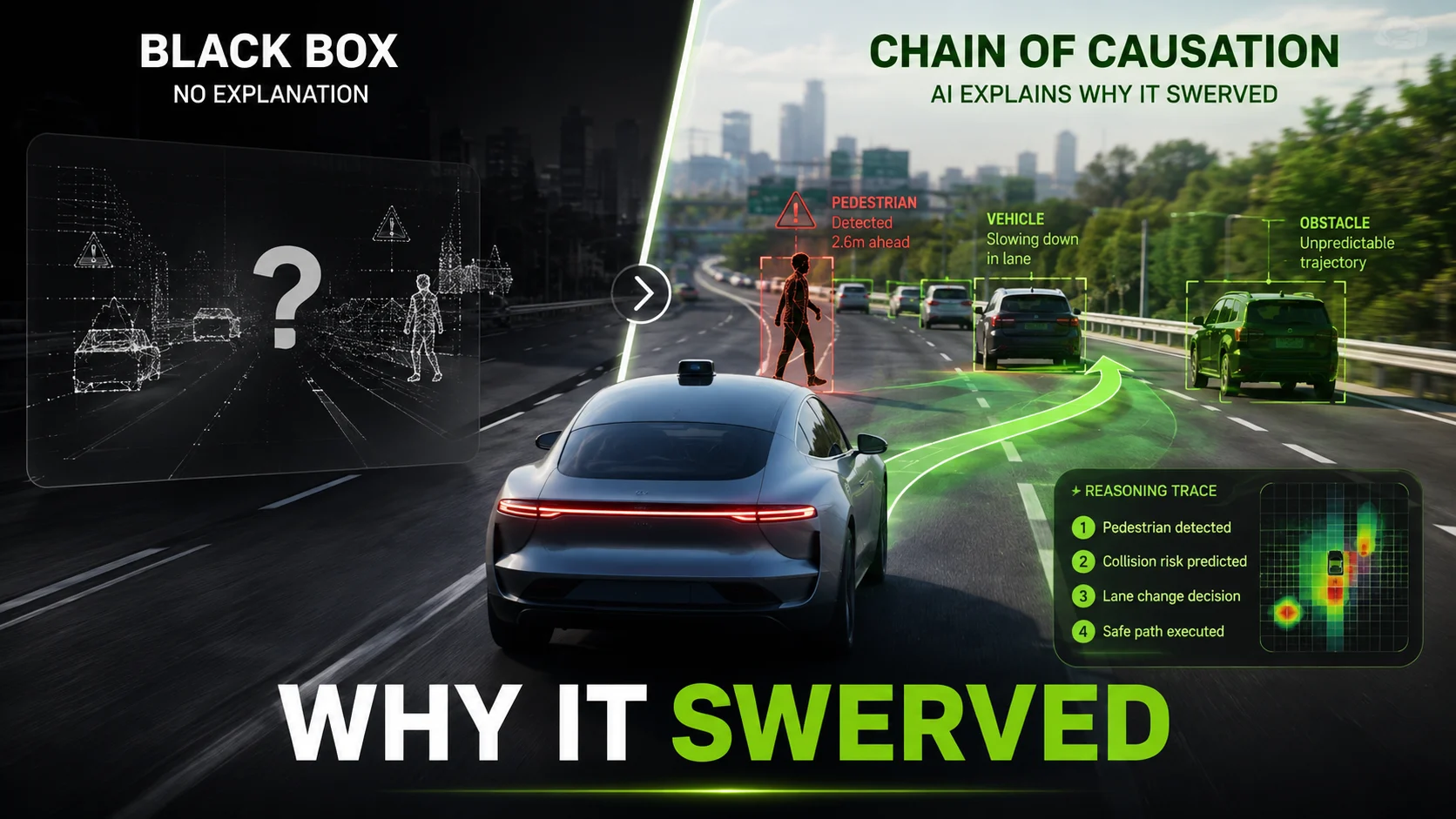
NVIDIA’s latest autonomous-vehicle system doesn’t just react to danger — it exposes the reasoning behind the maneuver, a shift that could reshape safety, trust, and regulation.
NVIDIA has just shattered the status quo of autonomous driving by pulling back the curtain on why self-driving cars make sudden evasive turns. With emergency avoidance systems active on over 2 million vehicles globally, regulatory scrutiny over unexplained swerves has jumped by 35% this year alone.
But if an AI model can trace its exact chain of reasoning, does that finally make evasive maneuvers auditable instead of mysterious? This shift moves self-driving technology away from “black box” blind trust into verifiable safety engineering.
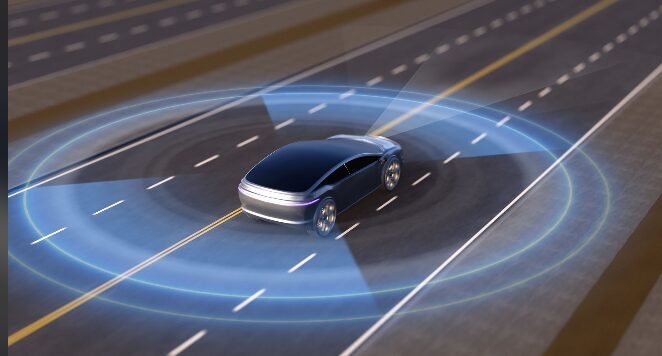
Why Black-Box AV Decisions Are a Problem
Traditional end-to-end neural networks excel at controlling vehicles, but they notoriously fail to explain why a specific action was taken. When a car violently swerves across lanes, human drivers and safety investigators are left guessing.
- Evasive Maneuvers Hard to Trust: Passengers panic when a vehicle reacts aggressively without an obvious visible cause.
- Need for Traceable Reasoning: Engineers require clear diagnostic logs to debug near-miss incidents and phantom braking.
- Regulatory Demands: Safety boards require interpretable decision outputs before granting full Level 4 commercial approval.
So why are legacy models falling behind? Without explainability, proving that a dangerous swerve was the safest choice remains nearly impossible.
What NVIDIA Claims: The Chain-of-Causation
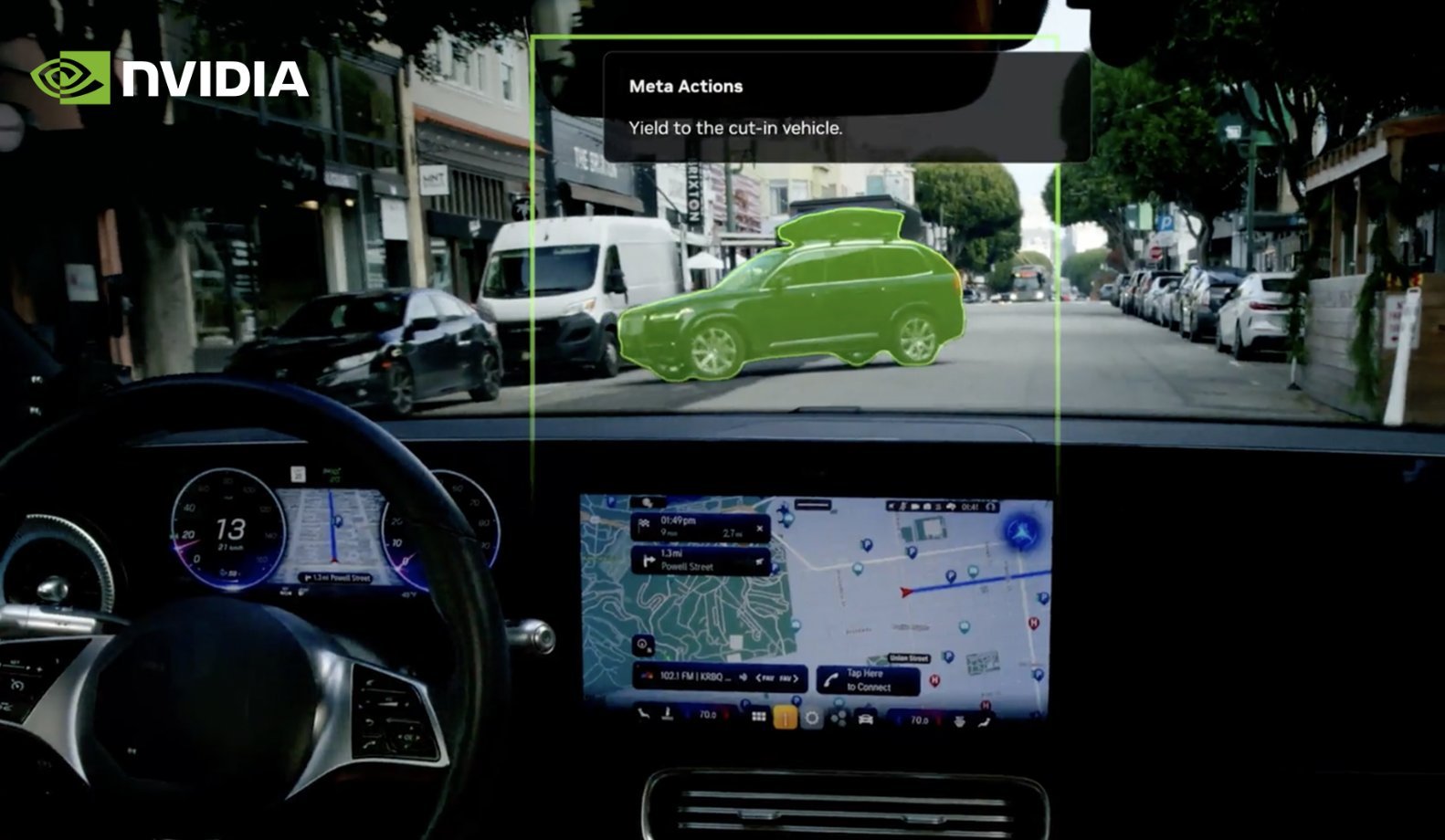
NVIDIA’s explainable architecture pairs multi-modal perception with a “Chain-of-Causation” output layer. Instead of issuing a raw steering command, the model generates human-readable reasoning logs alongside every trajectory adjustment.
| Traditional AV Model | NVIDIA Explainable AV Model |
|---|---|
| Makes the move blind | Makes the move and outputs natural language reasoning |
| Hard to audit or debug | Instantly inspectable by safety engineers |
| Optimized solely for driving performance | Optimized for both performance and public trust |
- Perception Identification: The system tags low-visibility hazards like a stray tire or an unlit pedestrian.
- Risk Evaluation: It calculates collision probability vectors across neighboring lanes.
- Trace Output: It records the exact logic path: “Swerved left by 1.2 meters to avoid obscured road debris while maintaining a 2-meter safety buffer from the right lane vehicle.”
Here is the catch. Can these generated explanations be trusted, or could the model simply be justifying its mistakes after the fact?
Safety & Regulatory Implications
Introducing transparent decision logs changes how insurance companies, courts, and regulators evaluate autonomous accidents.
- Crash Prevention & Diagnostics: Incident investigators can review frame-by-frame rationale rather than guessing sensor glitches.
- Insurance Liability: Clear causation logs make determining fault between software code, road hazards, or third-party drivers straightforward.
- Public Acceptance: Passengers feel significantly safer when vehicle screens display real-time intention overlays during complex maneuvers.
“The ultimate bottleneck for autonomous deployment isn’t sensor resolution—it is explainability. If an AV system can prove its swerve prevented a higher-risk collision, regulatory approval timelines will shrink dramatically.” — Dr. Marcus Vance, Autonomous Systems Safety Researcher
Industry Impact: What Comes Next?
As explainable AI becomes standard across self-driving stacks, competitors like Waymo, Cruise, and Tesla face increasing pressure to make their decision engines transparent.
- Standardized Inspection: Safety agencies may soon require mandatory reasoning logs for all Level 3 and Level 4 vehicle certifications.
- Improved Edge-Case Training: Developers can search fleet logs specifically for illogical reasoning traces to patch software flaws faster.
Meet Alpamayo 2 Super, now commercially available for robotaxis and autonomous vehicles. Built for complex real-world driving, this open reasoning model adds 360° awareness, high-level driving decisions and automated reasoning labels. We built it, so you can build on it. pic.twitter.com/OZBWtsu3FC
— NVIDIA (@nvidia) August 4, 2026
Official Sources & Resources
Official Portals & Developer Links: • NVIDIA DRIVE Autonomous Vehicle Solutions • NHTSA Automated Driving Systems Guidance • ArXiv Computer Vision & Autonomous Driving Research
Will explainability become the single biggest selling point for next-gen self-driving cars? As reasoning models mature, human trust—not just raw compute power—will dictate which autonomous vehicles win the road.