

So, what exactly went wrong, which versions are affected, and should users be concerned? Here is a plain-English breakdown of the OpenVPN 2.7.7 security vulnerabilities.
OpenVPN 2.7.7: What Was Fixed in the September 2026 Security Update?
Think of OpenVPN as a secure tunnel carrying your internet traffic. Version 2.7.7 fixes problems in different parts of that tunnel and, on Windows, in the supporting components around it.
The update addresses issues involving:
- The OpenVPN reliability layer
- Windows
CreateProcess()command-line handling tapctlandnetsh.exe- Windows system-object permissions
- NRPT domain processing
- Windows configuration-path validation
- DHCP search-string processing
The OpenVPN project identifies these as security issues addressed in its September 2026 security update.
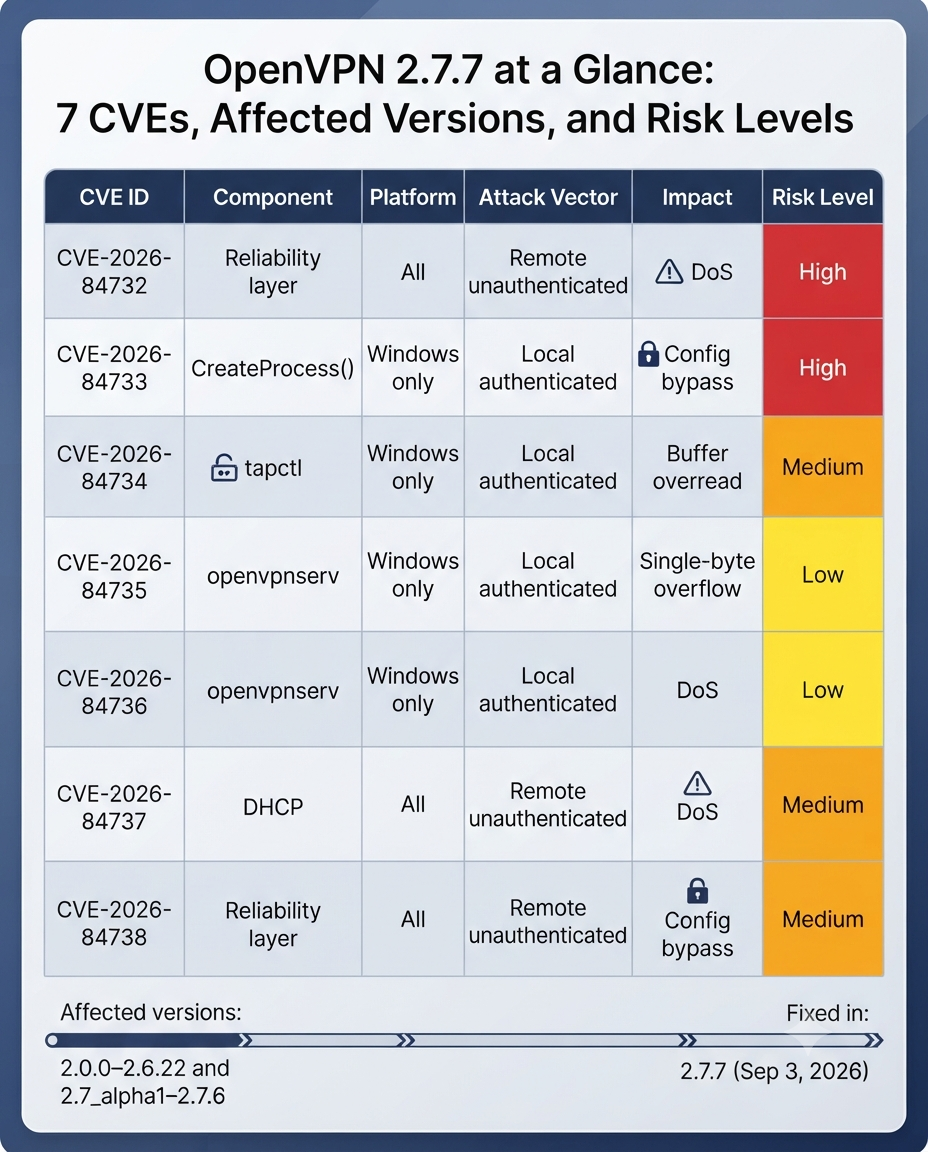
The Seven Security Vulnerabilities Fixed in OpenVPN 2.7.7
| CVE | Main Issue | Platform |
|---|---|---|
| CVE-2026-84732 | Reliability-layer denial of service | Cross-platform |
| CVE-2026-84256 | CreateProcess() command-line quoting | Windows |
| CVE-2026-84226 | netsh.exe path/binary-planting issue | Windows |
| CVE-2026-82312 | NULL DACL local DoS | Windows |
| CVE-2026-78221 | NRPT domain buffer overread | Windows |
| CVE-2026-78043 | Config path validation bypass | Windows |
| CVE-2026-81738 | Single-byte buffer overflow | Windows |
The OpenVPN project says these fixes are included in version 2.7.7.
Which OpenVPN Versions Are Vulnerable to the 2.7.7 Security Issues?
There isn’t one single affected-version range for every CVE.
For example, CVE-2026-84732 affects OpenVPN 2.6.22 and 2.7.6, while CVE-2026-84256 affects specified older 2.x releases through 2.6.22 and 2.7.6. Both are fixed in version 2.7.7.
That difference matters because users should check the advisory for the specific vulnerability rather than assuming that an old version is affected by every issue.
CVE-2026-84732: The Reliability-Layer Denial-of-Service Issue Explained
This is arguably the most important issue for OpenVPN users because it concerns the reliability layer, which helps manage TLS retransmissions and acknowledgements.
According to OpenVPN, an attacker could potentially cause a denial of service by:
- Making the reliable TLS retransmission timeout grow without bound.
- Sending acknowledgements for packets that cannot actually be outstanding.
In simple terms, it’s like repeatedly confusing a delivery system about packages that were never sent. If the system keeps trying to make sense of those messages, the VPN connection can be disrupted.
The issue was reported by Mark Bregman of Fox-IT and is fixed in OpenVPN 2.7.7.
CVE-2026-84256: Windows CreateProcess() Command Injection-Style Risk Explained
Windows uses the CreateProcess() API to start processes. The problem was that OpenVPN did not correctly quote certain command-line characters that have special meaning to cmd.exe.
The situation becomes more complicated when a validation script and rogue certificate authority are involved.
This doesn’t mean that every OpenVPN Windows user suddenly has classic remote code execution. Instead, it is better understood as a command-line handling and validation weakness that could make OpenVPN behave in an unintended way.
The flaw was reported by Clouditera Security and affects specified older 2.x releases through 2.6.22 and 2.7.6.
CVE-2026-84226, CVE-2026-82312 and Other Windows Security Fixes
CVE-2026-84226 — tapctl and netsh.exe
OpenVPN’s tapctl utility was changed to call netsh.exe using its full path. This closes a potential binary-planting or path-hijacking opportunity.
Interestingly, OpenVPN notes that the issue turned out not to be exploitable, but the code was nevertheless hardened. The bug was reported by BreachX Zero Day Labs.
CVE-2026-82312 — NULL DACL Local DoS
OpenVPN previously used NULL DACLs for certain Windows system objects. That could allow one local user to interfere with another user’s OpenVPN process under specific service configurations.
The fix removes this weakness and addresses a local denial-of-service scenario. The issue was reported by DEBRAJ BASAK.
Other Windows Fixes
The remaining three issues address:
- CVE-2026-78221: An incorrect NRPT domain size could cause a buffer overread when processing UTF-8 internationalized domain names.
- CVE-2026-78043: Windows config-path validation could be bypassed using the
/separator. - CVE-2026-81738: An off-by-one error could produce a single-byte buffer overflow while processing DHCP search strings.
How Serious Are the OpenVPN 2.7.7 Vulnerabilities for Users and Administrators?
For ordinary users, the biggest takeaway is simple: don’t panic, but don’t ignore the update either.
The vulnerabilities aren’t presented by OpenVPN as a universal remote-code-execution scenario. However, the reliability-layer flaw can potentially cause a denial of service, while several other issues are specifically relevant to Windows environments.
For administrators, the risk deserves more attention because VPN infrastructure is often a critical security control. A disruption or configuration-security weakness can have consequences beyond a single user’s laptop.
Bottom Line
If you’re running an affected OpenVPN release, upgrading to OpenVPN 2.7.7 is the sensible move. The release was specifically issued to address these security problems, and OpenVPN provides 2.7.7 installers and source packages through its official distribution channels.