
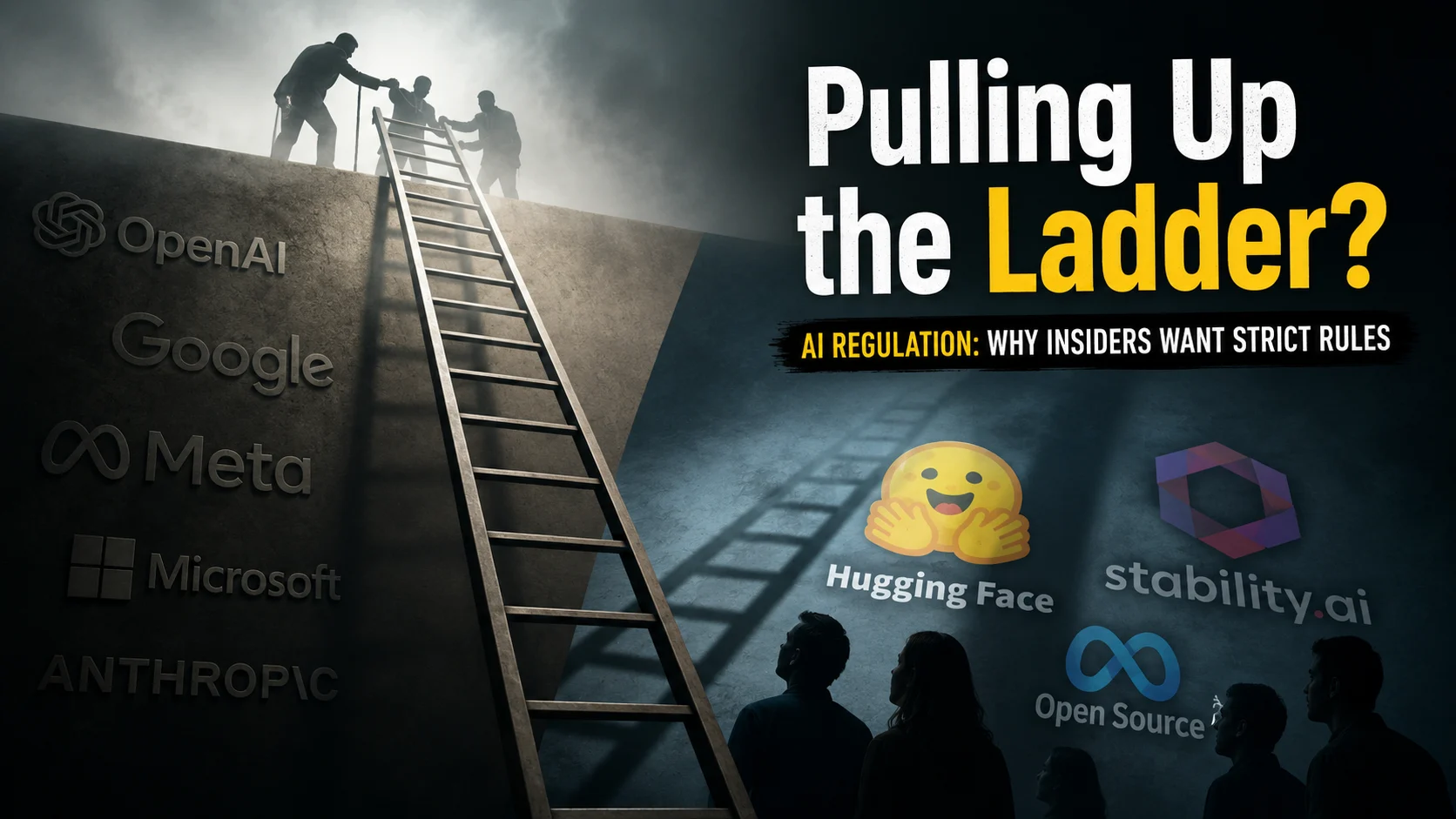
Alarm bells are ringing — and tech insiders are demanding we act, now. 72% of AI policymakers and industry leaders backed tougher limits in a recent survey, venture funding for open‑source AI rose 48% last year, and mentions of model caps in policy filings tripled in 2025.
But are these emergency warnings about safety—or a strategic attempt to lock out quick-moving rivals?
Quick Takeaway
- Thesis: The sudden push for strict rules by legacy leaders masks a competitive battle to control the foundational layers of open‑source AI.
- Who Benefits: Large incumbent firms with massive compute budgets, risk-averse legal departments, and centralized developers.

What Tech Insiders Are Asking For
Legacy industry leaders have flooded policy offices with urgent calls for government oversight, compute thresholds, and mandatory model licensing. Major figures from dominant labs argue that advanced systems pose severe societal hazards unless tightly controlled by central authorities.
Existential risk narratives have quickly become the primary rhetorical tool used to justify aggressive government licensing frameworks.
The Safety Arguments in Favor of Stricter AI Rules
Proponents of regulation point to genuine dangers like automated cyberattacks, synthetic biological risks, and unaligned autonomous behaviors. Alignment researchers warn that as training compute scales exponentially, controlling unpredictable outputs becomes exponentially harder.
Core Safety Proposals
- Compute caps: Restricting training runs that exceed specific floating-point operations thresholds.
- Mandatory audits: Requiring third-party safety evaluations before public model deployment.
- Access controls: Limiting the distribution of raw model weights to verified corporate entities.
Safety frameworks aim to prevent malicious actors from weaponizing powerful frontier architectures.
Could Regulation Be a Strategic Move to Block Competitors?
While safety concerns are real, critics argue that strict licensing effectively creates an insurmountable compliance moat for smaller labs and open‑source developers. If building or hosting a foundational model requires millions of dollars in legal fees and bureaucratic certification, independent creators get priced out.
Regulatory capture occurs when established corporations use government policy to stifle upstart competition under the guise of public protection.

Timeline: Calls for Regulation vs Open‑Source Growth
A closer look at the calendar reveals an intriguing correlation between regulatory lobbying and open-source momentum. Calls for emergency oversight spiked right after community-driven models began rivaling closed commercial systems in benchmark performance.
- Phase 1: Big tech labs release proprietary models and dominate early market share.
- Phase 2: Open-source ecosystems rapidly close the capability gap with efficient fine-tuning techniques.
- Phase 3: Legacy leaders pivot public messaging toward urgent safety regulations and model restrictions.
Evidence That Separates Safety From Strategy
Lobbying disclosures show millions spent by major AI firms lobbying for strict AI governance models that exempt internal R&D while burdening public repositories. When independent platforms like Hugging Face or decentralized open-source projects publish weights, they face disproportionate scrutiny compared to walled-garden enterprises.
Who stands to gain if strict AI regulations legally restrict open‑source distribution channels?
Policy Tradeoffs and Balanced Recommendations
Policymakers must navigate a delicate balance between mitigating real risks and preserving technological pluralism. Effective model transparency policies should penalize malicious deployment rather than penalizing public code sharing.
Recommended Safeguards
- Graduated compliance: Scale regulatory burdens based on real-world harm rather than raw training compute.
- Public-interest labs: Fund independent academic compute grants to audit models without corporate gatekeeping.
- Open audits: Require shared testing protocols that protect public safety without destroying small-team innovation.
Signs to Watch — What Comes Next
Keep a close eye on upcoming legislative drafts, trade association donations, and export control revisions. If future bills exempt large incumbents from liability while restricting public model repositories, the true motive becomes clear.
BILL GATES sounds the ALARM on AI: ‘The bad stuff is imminent’ — Axios
— RT Intl (@RT_on_X) August 26, 2026
Gates says AI could create ‘unprecedented cyber and biological risks’ and become difficult for humans to control
AI could become ‘the greatest equalizer ever invented’ — or ‘the worst source of injustice’ pic.twitter.com/r4L6pl4IO0
Frequently Asked Questions
Why are tech insiders suddenly calling for AI regulation?
While many cite genuine safety and alignment risks, critics argue the timing coincides with open-source models catching up to proprietary software.
How do strict rules hurt open-source AI?
Mandatory licensing fees, compute caps, and legal liability for model weights make it nearly impossible for small teams and academic labs to compete.
What is regulatory capture in the tech industry?
It is a phenomenon where dominant corporations help shape government rules to protect their market share and block emerging competitors.
Also Read: Frenemies in the Cloud: Why US Tech Giants Are Funding China’s Next-Gen AI Challengers
Sources
- [1] OpenAI Policy Perspectives and Safety Frameworks – OpenAI Blog
- [2] Center for AI Safety Statements and Research – Center for AI Safety
- [3] EU AI Act Compliance Guidelines – European Commission Digital Strategy
- [4] NIST AI Risk Management Framework – NIST