
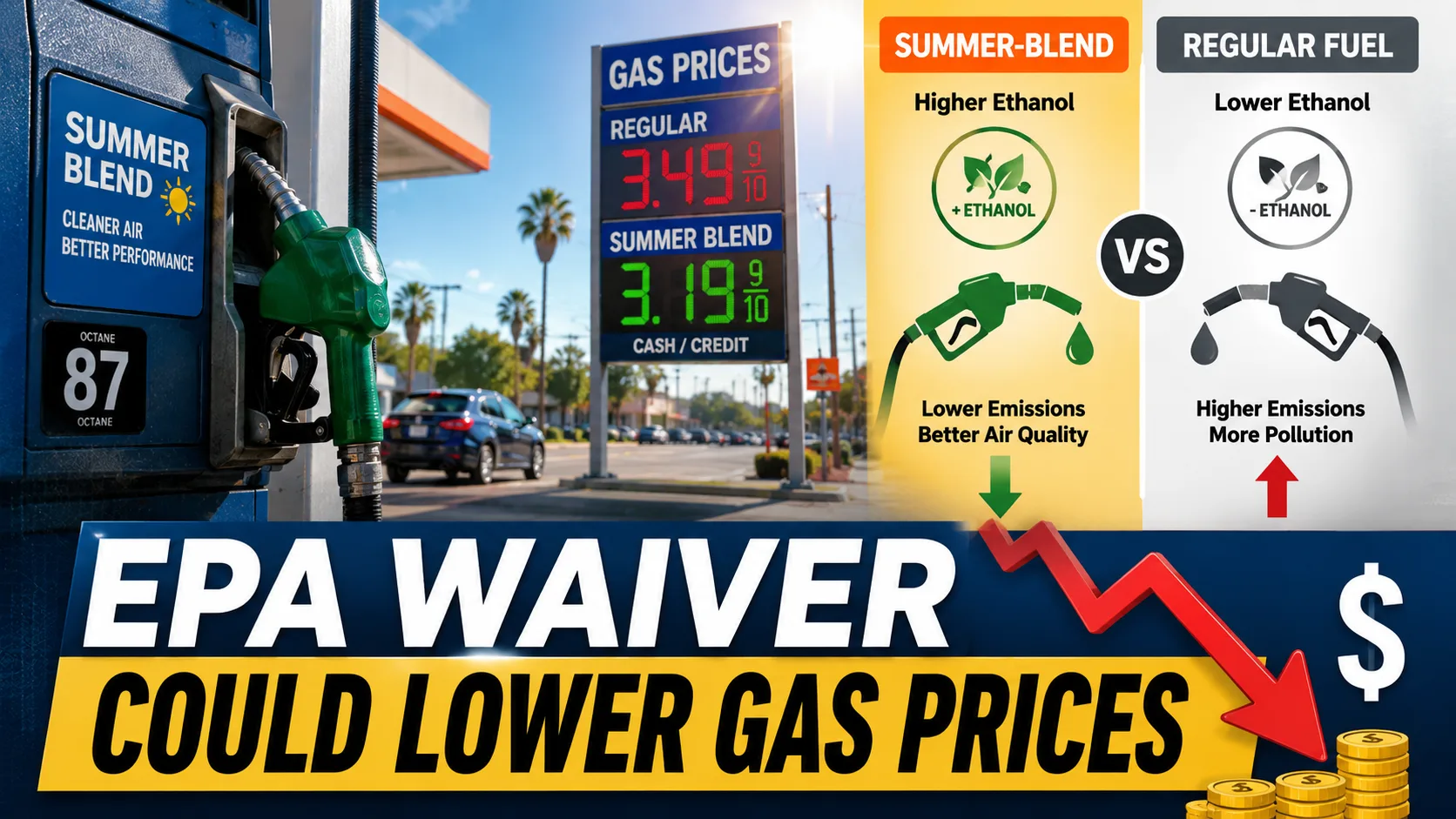
“Relief may be on the way for drivers feeling the squeeze at the pump. The EPA has moved early to relax summer-blend gasoline rules, but will that actually lower gas prices where you live?”
With fuel expenditures taking a heavy toll on household budgets, the U.S. Environmental Protection Agency (EPA)—in consultation with the Department of Energy (DOE)—has issued a temporary emergency fuel waiver. This regulatory shift aims to ease supply constraints heading into the fall.
Before assuming overnight savings, it helps to understand what summer-blend rules are, why the waiver was triggered, and how market realities influence what you pay at the local station.
What Summer-Blend Gasoline Rules Do
Summer-blend gasoline is specially formulated to reduce fuel evaporation during hot weather.
- Reid Vapor Pressure (RVP): The EPA enforces strict RVP limits during the summer control season to restrict how easily fuel vaporizes.
- Environmental Impact: These rules help curb the formation of ground-level ozone and urban smog.
- Production Complexity: Refining and distributing lower-volatility fuel requires specialized handling, which often drives up production costs and places a ceiling on how much fuel refiners can seamlessly move through the supply chain.
As the old industry adage puts it: “Summer-blend fuel is cleaner in hot weather, but it can also be more expensive to make and move.”
Why the EPA Waiver Was Issued Early
To combat elevated fuel costs, federal regulators took preemptive action. The EPA’s emergency waiver effectively ends the summer-blend gasoline requirement ahead of its normal expiration.
- Increasing Supply: Starting September 1, the waiver allows the sale of E10 (gasoline blended with 10 percent ethanol) at a higher Reid Vapor Pressure, alongside extensions for E15 fuel availability.
- Boosting Volume: Federal estimates suggest this flexibility will inject hundreds of thousands of additional barrels of gasoline into the domestic market daily.
- Targeted Extensions: The policy spans the remainder of the summer control season and addresses state-level controls in regions like Texas, Arizona, and California where tighter rules typically linger.
How This Could Affect Gas Prices at Local Stations
While federal officials project that expanding the fungible supply pool will help compress prices, immediate savings can vary dramatically based on your location and market conditions.
| Factor | Why it matters for your wallet |
|---|---|
| Local Supply Chains | Regions with tighter regional inventories may see a more noticeable stabilization in prices. |
| Refinery Flexibility | Removing strict blending bottlenecks allows terminals to transition faster to winter-grade components. |
| Station Competition | Highly competitive local markets tend to pass wholesale savings along to consumers much faster. |
| Taxes and Freight | State fuel taxes, distribution costs, and environmental fees still establish a high price floor in certain states. |
What Drivers Should Expect Next
Drivers should look out for gradual relief rather than an overnight collapse in prices. Commuters, delivery drivers, rideshare operators, and rural households relying heavily on local fuel stations will benefit most as extra barrels clear distribution bottlenecks.
However, policy decisions involve trade-offs. While waivers provide short-term economic relief for drivers, they temporarily loosen the strict air-quality safeguards designed to limit summer smog. Because these measures are temporary emergency interventions, they serve as a stopgap rather than a permanent rewrite of clean-air standards.
Federal regulators approved a fuel waiver to help lower gas prices amid the ongoing war with Iran. The action temporarily permits the sale of gasoline containing up to fifteen percent ethanol and ends summer blending rules two weeks ahead of schedule. https://t.co/Jhh5ECwv02
— The Washington Times (@WashTimes) August 21, 2026
FAQs
What are summer-blend gasoline rules? They are seasonal fuel regulations enforced by the EPA to lower vapor pressure and reduce smog-forming emissions during hot summer months.
Will the EPA waiver lower gas prices immediately? Not necessarily right away. While increasing supply helps ease wholesale pressures, local retail prices depend heavily on regional transport costs, station competition, and state taxes.
Does this affect E15 and E10 fuel? Yes. The actions provide regulatory relief allowing higher vapor pressure limits for E10 and extend availability windows for E15 ethanol blends.
Why do gas prices vary so much by city? State-specific environmental requirements, local fuel taxes, proximity to refineries, and regional distribution costs create large price disparities between different parts of the country.