
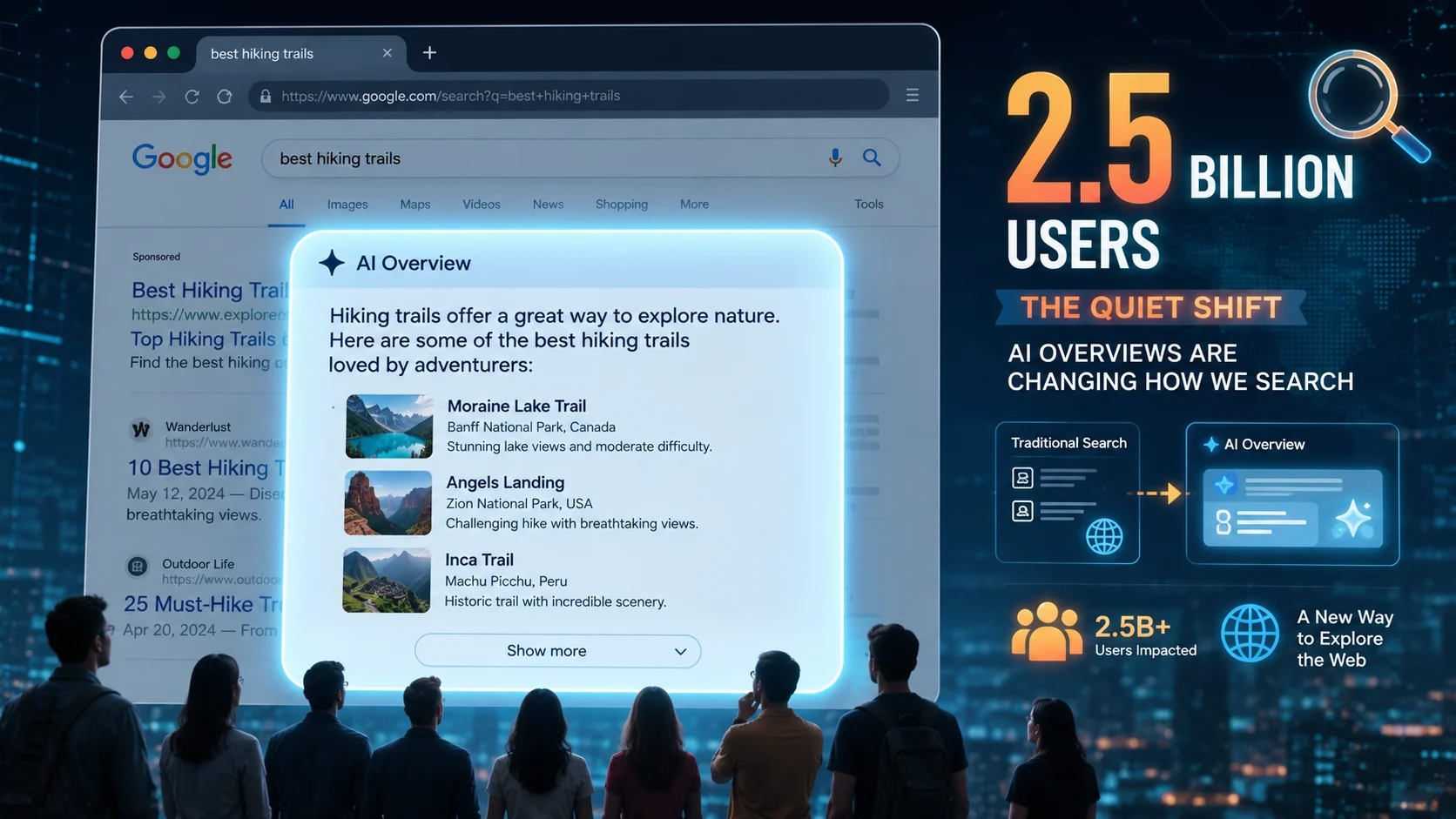
Millions of web pages just became invisible — and it hurts. Google’s AI Overviews now reach roughly 2.5 billion users each month, condensing search results into single-screen summaries that can cut clicks by 30–60% on targeted queries. What does it mean when a few lines decide what millions read? Readers feel relieved by clarity; creators feel alarmed by lost traffic.
Google’s AI Overviews now touch roughly 2.5 billion users worldwide each month. What happens when a single AI summary replaces the paragraph you wrote? The change is happening right now, and publishers, readers, and browsers must adapt fast.
What are AI Overviews in Search?
AI Overviews (formerly known under early testing phases within the Search Generative Experience) represent a fundamental transformation in how search engines answer user queries. Instead of presenting a simple list of blue links, Google uses generative AI to synthesize information from across the web into an immediate, conversational snapshot right at the top of the SERP.
This knowledge synthesis combines multiple web pages into a single, cohesive answer block. It shifts search from an exploratory index to an immediate answer engine.
Have you noticed short AI summaries atop your search results? These snippets change the entry point of the open internet entirely.
The Behavioral Shift: How 2.5 Billion Users Now Digest Information
Faster Consumption, Less Clicking
Studies and platform telemetry show task completion happens up to 2x faster when an AI summary satisfies the query immediately. Consequently, organic click-through rates (CTR) on traditional blue links drop by 30% to 60% for affected informational keywords.
- Faster consumption: Users spend less time evaluating multiple sources.
- Reduced clicks: The SERP itself acts as the destination rather than a gateway.
Would you rather read one clear answer or sift through five different source links?
New Attention Patterns (Scroll vs. Click)
Instead of deep-diving into long-form guides for straightforward questions, users now rely on micro-reading habits. They scan the generated overview card, extract the core data point, and bounce or refine their query without ever visiting a publisher’s domain.
Trust and Skepticism Dynamics
While everyday searchers appreciate the friction-free speed, power users and researchers remain cautious. Blindly trusting aggregated conversational search blocks introduces risks regarding accuracy, citation attribution, and hidden bias in model training sets.
What This Means for Traditional Browsing
The End of Habitual Clicking?
The classic web browsing loop—query, review options, pick a site, read, and explore links—is fracturing. Search behavior shifts mean fewer users venture past page folds or engage in serendipitous discovery across niche blogs.
The Rise of “Answer-First” Sessions
Web traffic is becoming increasingly polarized. Informational queries are absorbed entirely on search engine results pages, while transactional, high-intent, or deeply specialized expert content retains its value.
Impact on Publishers, Creators, and SEO
Traffic and Monetization Effects
Independent publishers, recipe sites, tech how-to blogs, and product review platforms are bearing the brunt of this transition. When Google answers the question directly on the results page, ad impressions and affiliate conversions drop sharply.
Attribution and Copyright Questions
The ethical and legal debate centers on content scraping and lack of direct compensation. Creators argue that training LLMs on open-web articles without proportional traffic referral creates an unsustainable digital ecosystem.
Practical Creator Tactics
To survive and thrive in an AI-first search landscape, creators must adapt their strategies:
- Optimize content structure to capture featured snippets and inline citations.
- Produce distinctive, first-party data, original reporting, and interactive tools that AI cannot easily replicate.
- Implement robust schema markup to ensure explicit machine readability.
- Diversify acquisition channels via newsletters, direct social communities, and email lists.
Trust, Transparency, and Regulatory Pressure
As search engines evolve, upholding strict Experience, Expertise, Authoritativeness, and Trustworthiness (EEAT) standards is paramount. Regulators worldwide are scrutinizing platform dominance, pushing for clearer disclosure rules and fair licensing agreements between tech giants and content creators.
Expert commentary from legal scholars and digital rights organizations highlights a growing demand for transparent data-sourcing practices and fair revenue-sharing models.
The Future of Browsing — Four Possible Pathways
- Search-first equilibrium: AI features mature alongside robust, transparent source attribution that preserves publisher traffic.
- Fragmented browsing: Users migrate toward closed, walled-garden ecosystems and specialized chat assistants.
- Creator resurgence: Audiences shift toward premium, subscription-first communities and trusted independent creators.
- Regulatory reset: Strict legal frameworks mandate explicit consent and financial compensation for training data usage.
Tactical How-To for Publishers and Marketers
| Problem | Actionable Solution |
|---|---|
| Falling organic traffic from informational queries | Pivot toward original data, expert commentary, and unique proprietary insights. |
| Loss of SERP real estate | Optimize for inline citations within AI Overviews using structured data and concise summaries. |
| Over-reliance on Google search | Diversify traffic acquisition through owned media, newsletters, and community building. |
Gemini 3.7 Flash smashed previous Gemini growth records in its first week, making it our fastest growing model yet. Great to see the huge excitement from our developer community! Now running in Search and @Geminiapp too. https://t.co/IPbBu5Jdto
— Sundar Pichai (@sundarpichai) August 22, 2026