

The riskiest AI system in a bank isn’t necessarily the smartest one. It’s the one that’s allowed to move money.
For years, banks have thought about AI chatbots mainly as a consumer-protection issue. Does the bot answer accurately? Does it say it’s an AI? Can a customer get to a real person? Those questions still matter, but they’re no longer the frontier.
The frontier is agency. A passive chatbot can give you a wrong answer. An agentic system can start a payment, release a fraud hold, change an account, make a credit decision, or trade in a market. Once AI can act instead of just advise, the question shifts from “Is the output correct?” to “What happens if it acts incorrectly, and can anyone stop it in time?”
That’s the thinking behind the OCC’s November 2026 supervisory framework on banks’ use of “Super Intelligence,” which covers generative and agentic AI. The OCC doesn’t treat AI as its own separate risk category. Instead, it says the intensity of controls can rise with the potential consequences of an AI agent failing or being misused. How a system gets classified can depend on those consequences, on how much agency has been handed over, and on how much human oversight remains, not just on how technically sophisticated the model is.
Chatbots and consumer harm
The usual worry is a legitimate one. A customer-service chatbot that gives bad information, botches a dispute, hides the route to a human, or makes an unfair decision creates real compliance and reputational trouble.
But focusing there can point banks at the wrong line. What matters isn’t whether a system faces customers. It’s whether the system can take an action that touches money, credit, access to funds, or a customer’s legal position.
A chatbot that gives the wrong answer is a service failure. An agent that executes the wrong transaction is an operational event.
The OCC’s framework spans credit decisioning, payments, fraud detection, customer service, operations, risk management, and market activities. It acknowledges that AI can improve efficiency, fraud detection, and access to financial services when the right controls are in place. It also says banks have to make sure their implementations are fit for purpose, safe, sound, and lawful.
Intelligence is not agency
Banks tend to evaluate AI by asking whether the model is accurate, explainable, well governed, and free of bias. Those are necessary questions. They just aren’t enough anymore.
The sharper question is: What is this system allowed to do without a human decision in the loop?
| Risk dimension | Passive assistant | High-agency agent |
|---|---|---|
| Primary function | Search, summarize, draft, answer | Decide, transact, update, release, execute |
| Human role | Reviews output | Monitors, approves, intervenes, or remediates |
| Failure mode | Bad advice or misleading response | Unauthorized or erroneous action |
| Reversibility | Often high | Often low once money moves or a hold is released |
| Core control question | Is the answer accurate and fair? | Can the action be prevented, contained, and reversed? |
A simple rules-based agent that’s authorized to initiate transactions can be riskier than a very sophisticated generative model that only drafts internal documents. The OCC says this directly: risk classification may depend on consequences, transfer of agency, and human oversight rather than technical sophistication.
Put another way, intelligence describes what a system knows. Agency describes what it’s allowed to do.
The Tier 1 trigger
The OCC’s framework includes an illustrative tiering method for control risk. It isn’t a one-size-fits-all mandate, and the OCC notes that banks aren’t required to use the document to assess their own AI risk management. Still, it gives examiners, and by extension bank risk teams, a handy lens for deciding where controls need to be strongest.
| Tier | Profile | Illustrative examples |
|---|---|---|
| Tier 1: Critical | Direct action, low reversibility, high financial or customer impact, autonomous or partially autonomous operation | Autonomous payment agent, real-time credit decisioning, fraud-hold release, market access |
| Tier 2: High | Significant consequence or limited reversibility, but narrower scope or stronger human control | High-value workflow actions with approval gates |
| Tier 3: Moderate | Meaningful internal or customer impact, but more recoverable | Customer-service workflows with human review |
| Tier 4: Low | No direct action, limited data exposure, human-controlled use | Internal productivity and drafting tools |
A powerful model alone doesn’t trigger Tier 1. It takes a combination of four things:
- Direct action: The system can execute something, not just recommend it.
- Low reversibility: Once it happens, undoing it may be hard, slow, or impossible.
- High consequence: Money, credit, market exposure, customer access, or fraud controls are affected.
- Limited human oversight: The system can act before a person reviews, approves, or interrupts it.
That’s why an autonomous payment agent is a cleaner Tier 1 example than a clever customer-support chatbot. A wrong chatbot reply can be corrected. A wrong payment may already be gone.
The same goes for automated fraud-hold release. Letting a hold go can send funds out the door and expose the bank to loss, and fixing it then depends on recovery processes, not a simple undo button.
The engineering stack for high-agency nodes
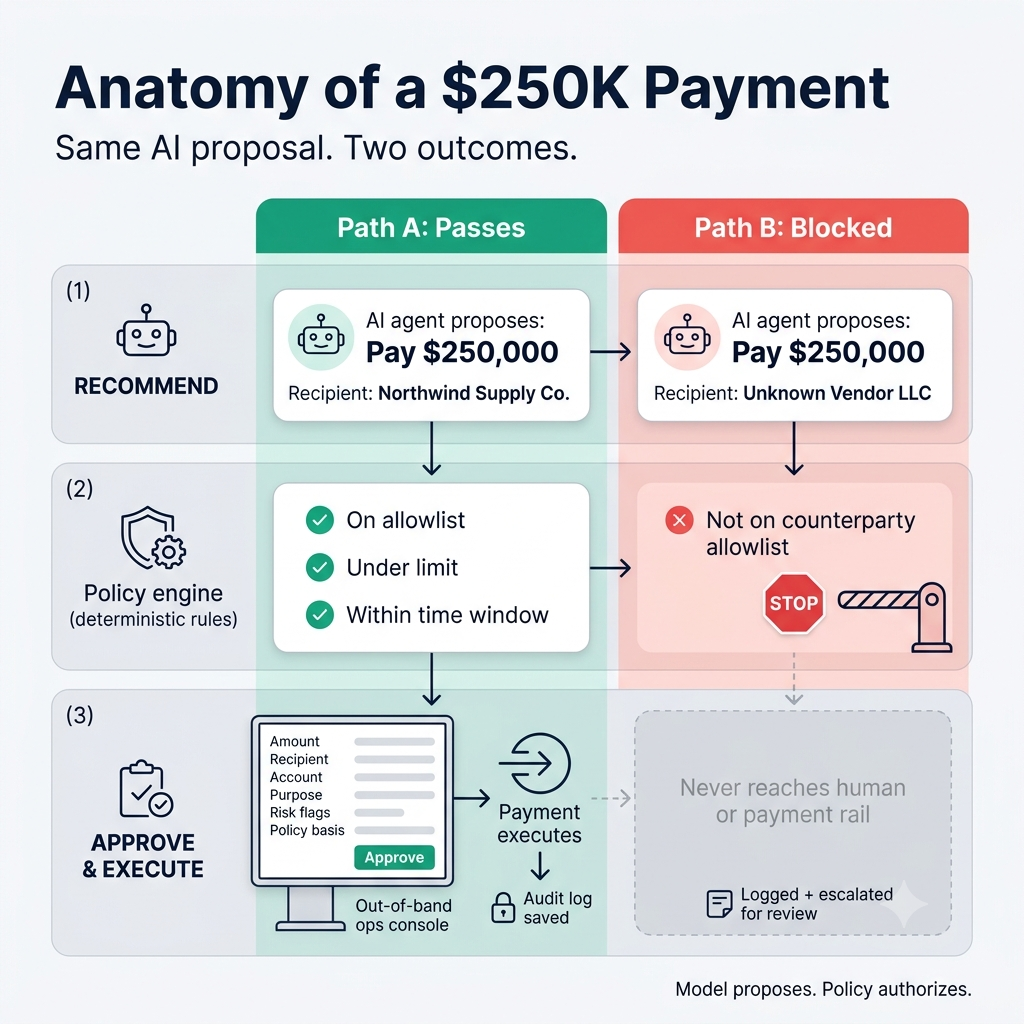
A Tier 1 system needs more than a responsible-AI policy, a model card, and a human-review checkbox. It needs an execution architecture built on the assumption that the agent will, at some point, get something wrong.
Deterministic guardrails
The model’s own reasoning should never be the only thing standing between an agent and a consequential action.
A solid design splits the work into three layers:
- The recommendation layer: The AI looks at the context and proposes an action.
- The authorization layer: Deterministic business rules decide whether that action is allowed.
- The execution layer: A narrowly scoped system carries out the action, but only after authorization.
Deterministic guardrails can include transaction ceilings, counterparty allowlists, geographic restrictions, time-window limits, velocity thresholds, lists of prohibited actions, and hard stops for unusual account states.
The OCC specifically names deterministic rules and least-privilege permissions among the tools that can help spot and contain an agent that’s acting incorrectly.
The principle fits in one line: the model may propose, but the policy engine must authorize.
Inline transaction friction
People usually treat friction as a UX problem. For high-agency systems, it’s a control.
The amount of friction should scale with the stakes:
- Confirmation prompts for sensitive actions.
- Cooling-off periods for high-value transactions.
- Step-up authentication for unusual counterparties or account changes.
- Velocity limits to stop runaway loops or duplicate execution.
- Thresholds that require human approval before anything executes.
- Clear escalation paths when the agent hits ambiguity.
The OCC separates human-in-the-loop controls, where a person takes part in the decision or action, from human-on-the-loop controls, where a person watches and can step in.
For Tier 1 actions, the real question isn’t whether friction slows the workflow. It’s whether the friction keeps an irreversible mistake from turning into a financial loss.
Out-of-band human approval
When an action is high-value, unusual, or hard to reverse, approval shouldn’t live only inside the agent’s own chat thread.
“The agent asks the customer to confirm” doesn’t cut it for a Tier 1 action. A confused customer, a manipulated prompt, or a compromised session can turn an approval flow into one more attack surface.
Stronger designs use approval paths that sit outside the agent’s workflow:
- A privileged operations console.
- Dual authorization for high-risk transactions.
- A separate risk or fraud system.
- Out-of-band customer verification for sensitive account actions.
- Immutable audit records showing who approved what, under which policy version, and with what supporting evidence.
Approval should also be tied to the exact action, not a vague “proceed” button. If an agent proposes a $250,000 payment to a particular counterparty, the approver should see the amount, recipient, account, purpose, risk flags, and the policy basis.
Real-time kill switches at the protocol perimeter
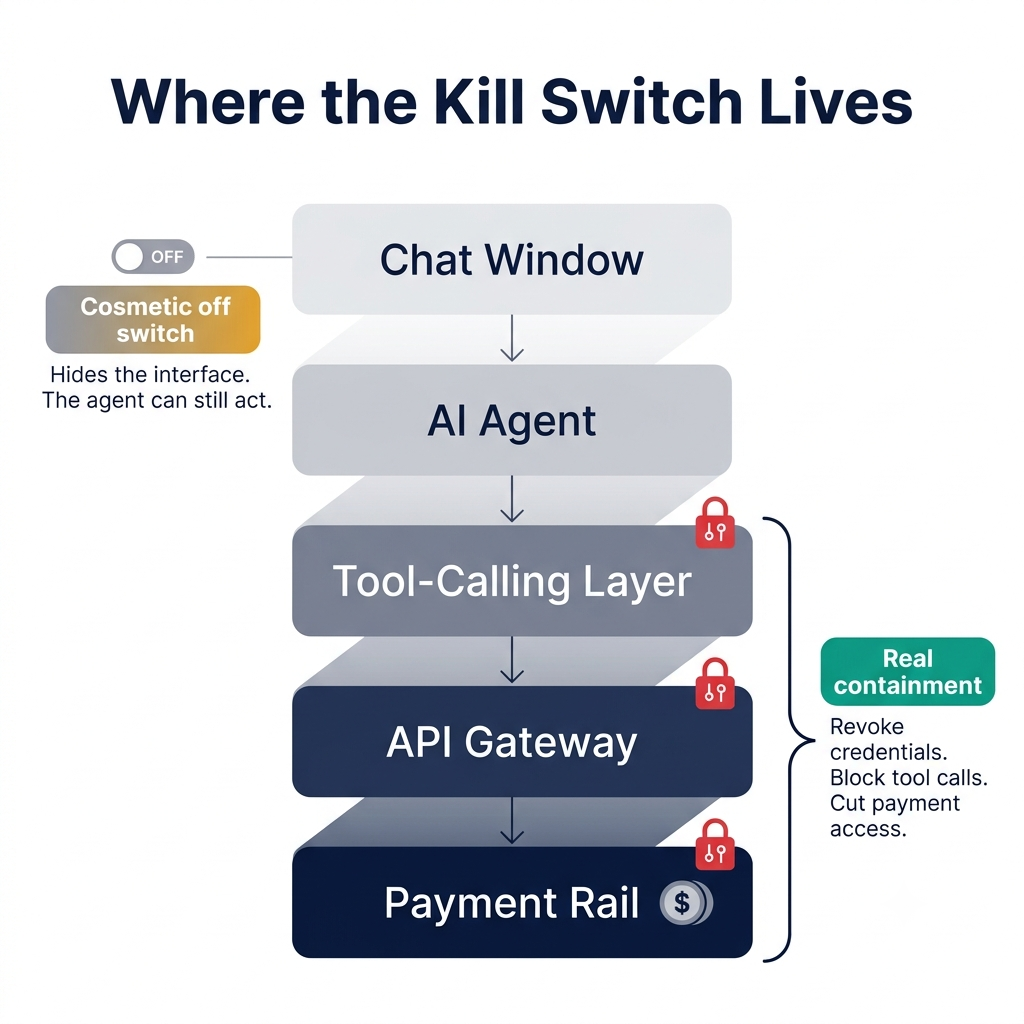
A kill switch isn’t “turn off the chat window.”
A real one revokes the agent’s ability to authenticate, call tools, reach systems, or execute transactions. It should work at the protocol perimeter: the API gateway, the tool-calling layer, the service mesh, the payment-rail interface, or the vendor integration.
This matters because containment can’t depend on the agent politely deciding to stop. If an agent is looping, working from bad data, or responding to a prompt-injection attempt, the control has to sit outside the agent.
The OCC lists monitoring, observability tools, control agents, deterministic rules, circuit breakers, rate limits, least-privilege permissions, and kill switches as mechanisms that could help identify and contain an agent that’s running but acting incorrectly.
A practical Tier 1 containment design should include:
- A kill switch that immediately suspends the agent’s credentials and tool access.
- Circuit breakers that halt a workflow after defined error, anomaly, or velocity thresholds.
- Rate limits that prevent mass execution.
- Control agents that can isolate a misbehaving primary agent.
- A tested fallback process, whether that’s trained staff, a narrower fallback agent, or another approved method.
A kill switch is not “turn off the chat window.” It’s “revoke the agent’s ability to call the payment API.”
The testing gap: a switch that has never been pulled
A kill switch only counts if it works under production-like conditions.
Banks should test the whole failure path, not just show that an administrator can disable an application. The OCC’s framework stresses the ability to detect, contain, recover from, and fix AI failures while keeping critical business processes running.
Good test scenarios include:
- A runaway agent issuing repeated transaction requests.
- Duplicate execution after a partial system failure.
- A compromised credential trying to reach payment APIs.
- A vendor model change that alters agent behavior.
- A hallucinated counterparty or account detail.
- An incorrect fraud-hold release.
- A downstream payment-rail outage in the middle of a live transaction.
- A prompt-injection attempt that tries to expand the agent’s permissions.
A readiness checklist should ask:
- Can operations halt the agent without taking down the entire bank?
- Can the bank identify every customer and transaction affected?
- Can it reconstruct the agent’s decisions, tool calls, and approvals?
- Can it reverse, claw back, freeze, or otherwise remediate the harm?
- Does the fallback process work when the AI vendor is unavailable?
- Are permissions revoked immediately when an agent is suspended?
- Has the kill switch been tested against the actual payment or fraud-control interface?
That last question is what separates a control document from a control that actually works.
Third-party agents: the perimeter you do not own
Plenty of banks won’t build their agents. They’ll buy them from a core-system provider, a fintech vendor, a cloud provider, or a customer-engagement platform.
That doesn’t put the agent outside the bank’s risk perimeter.
If a vendor’s AI agent can call the bank’s payment API, update customer records, or release a fraud hold, it belongs inside the bank’s agent-risk perimeter. The bank should have contractual and technical visibility into:
- Which actions the agent can perform.
- Which systems and credentials it can access.
- How the model or agent’s behavior can change.
- How the bank can monitor, suspend, and revoke access.
- Who’s responsible for errors, disputes, remediation, and customer harm.
- How audit logs, decision records, and incident notifications will be delivered.
The OCC’s framework lists third-party and vendor risk, internal audit, independent challenge, testing, documentation, and auditability among its assurance components.
The rule of thumb is simple: if an external agent can call your payment API, it’s part of your payment-control environment.
What banks should do now
The passive chatbot era rewarded banks for making AI sound helpful. The agentic era will reward them for making AI stoppable.
Banks getting ready for agentic AI should:
- Build a complete inventory of AI systems and agentic capabilities, including features embedded in vendor products.
- Classify systems by consequence, reversibility, autonomy, and financial or customer impact, not by model brand or benchmark score.
- Treat payment execution, real-time credit decisioning, fraud-hold release, and market access as Tier 1 candidates that need the strongest containment design.
- Put in place deterministic authorization, least-privilege permissions, transaction friction, out-of-band approvals, and perimeter-level kill switches.
- Test containment and remediation before deployment, then keep monitoring for drift, misuse, and excessive agency.
- Make sure human accountability survives automation. Someone has to own the agent, its permissions, its failures, and its recovery path.
The OCC’s framework doesn’t create new supervisory expectations or enforceable standards. But the logic behind it is clear: the more an AI system can do on a bank’s behalf, the more its controls should look like those for a privileged employee with access to money, not those for a chat window.
The future of AI in banking won’t be decided by which model is the most fluent. It’ll be decided by which systems are best constrained when they act.