
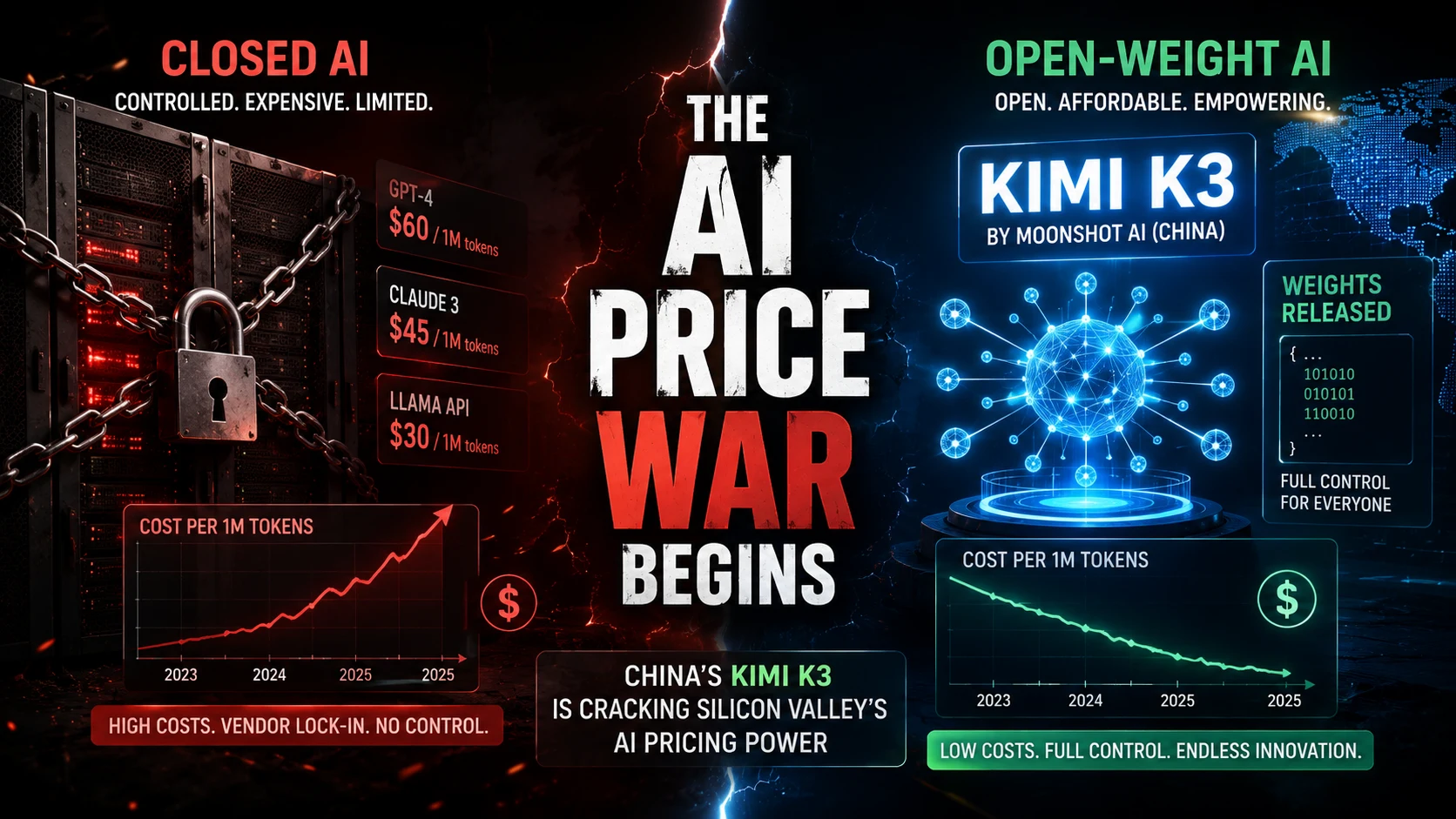
China’s Kimi K3 is slamming the old AI playbook. By releasing a massive 2.8-trillion parameter open-weight model with a 90% prompt-caching discount, Moonshot AI is forcing US tech giants to confront a brutal economic reality.
If enterprise developers can access frontier intelligence without paying closed API markups, who keeps the margins? With 30% to 46% of US enterprise LLM traffic already routing through open-weight gateways, Silicon Valley’s pricing power is fracturing.
What Kimi K3 Changed
Moonshot AI’s Kimi K3 isn’t just another incremental model update; it is the world’s first open 3T-class frontier model.
Unlike proprietary closed-source models that keep their inner weights strictly hidden behind subscription paywalls, Kimi K3 makes its model weights publicly accessible for enterprise deployment and local hosting.
- 2.8 Trillion Parameters: Features a Mixture-of-Experts (MoE) architecture activating 104 billion parameters per pass.
- 90% Caching Discount: API input costs drop from $3.00 down to $0.30 per 1M tokens when prompt caching is triggered.
- 1 Million Token Window: Handles massive codebases, video, and complex documents at a completely flat rate.
Why does this matter right now? For the past three years, Western labs relied on closed API access to command steep subscription premiums. Kimi K3 proves that frontier reasoning capabilities can be distributed openly.
Why US AI Margins Are Now Under Pressure
When top-tier reasoning capabilities become open-weight, the “closed model tax” becomes nearly impossible for corporate enterprise buyers to justify.
If a company can host an open model internally or run cached workloads at 1/10th the normal input cost, closed API subscriptions face instant margin compression.
| Market Player | Pressure They Face | Strategic Realignment |
|---|---|---|
| Closed-Model Labs | Pricing power weakens | Forced to cut API rates or bundle extra tooling. |
| API Aggregators | Margins compress | Must offer deeper caching discounts and faster throughput. |
| Enterprise Buyers | Gain massive leverage | Shift workloads to open weights or demand big API discounts. |
| AI Startups | Cheaper build costs | Can build continuous 24/7 autonomous agents far cheaper. |
The Bigger Twist: AI Is Becoming Cheap Piping
Frontier AI is rapidly transforming from a scarce, luxury software product into standardized digital infrastructure.
When intelligence becomes reproducible and freely distributed, the competitive battlefield shifts away from raw model capability toward distribution, orchestration, and workflow integration.
“Open weights don’t just change access — they change bargaining power. Once capability becomes cheaper and reproducible, pricing shifts from premium to pressure.” — AI Infrastructure & Economics Analyst
Will closed AI labs be forced to open their models too? If proprietary margins continue to shrink, the business model for multi-billion-dollar training clusters will require complete reinvention.
🚨BREAKING: Moonshot AI raises $3.5 BILLION at $35 BILLION valuation
— NIK (@ns123abc) July 29, 2026
Targeted $2B. Got $3.5B.
>$300M ARR in June (up from $200M in April)
>daily sales up 6x after K3 launch
>Kimi K3 is printing money
Already approaching investors for ANOTHER round at $50B pre-money
Hong Kong… pic.twitter.com/KmR6AfH7CL
What Happens Next in the AI Market
- Enterprise Workloads Shift: More businesses will migrate routine long-context processing to open-weight models.
- API Price Slashing: Western providers will likely expand prompt-caching discounts to retain high-volume developers.
- Focus Shifts to Tooling: Success will depend on software integration, security controls, and agentic workflows rather than raw parameter counts alone.
- Faster Model Commoditization: The gap between open-source capabilities and closed proprietary APIs will continue to shrink.
Detailed technical documentation can be reviewed on Moonshot AI’s Hugging Face Repository, while benchmark scores and provider pricing are tracked live on OpenRouter.
As open-weight models close the performance gap, can closed AI providers justify charging premium prices for much longer?