

Here’s a scary thought about multi-agent AI: the worst vulnerability might not be malicious code at all. It might be one confident, believable sentence that nobody checked, sitting in a shared workspace that every other agent has been built to trust.
Teams are wiring agents together around shared context: task boards, summaries, vector databases, scratchpads, tool outputs, long-term memory. That sharing is what makes coordination work. It’s also a new way to fail. One hallucinated instruction, one compromised agent, or one boring operational slip can land in the workspace, get treated as fact, and ripple through every decision after it. Security guidance now describes shared agent memory as a lateral-movement path, where one tainted session can infect the rest unless memory is isolated, verified, and governed.
The invisible single point of failure
Picture a software-development swarm. A research agent pulls up an old internal wiki page and writes this into the shared workspace:
“The approved deployment target is
legacy-cluster-east.”
The planner reads it as a project constraint. The coder writes infrastructure changes for that target. QA checks the plan against the same context, so of course it passes. The deployment agent ships it. Weeks later, another agent finds the finished “decision record” and takes it as proof the original claim was right.
Nobody hacked anything. No payload reached any endpoint. The poisoned context was the attack surface.
I’ll call this context contamination: false, stale, misleading, or instruction-like content gets into shared state and quietly steers what other agents think and do. Shared memory is now explicitly recognized as a target for cross-agent poisoning, and the bad content can travel through agent messages, memory stores, and tool arguments.
What contamination actually is
This isn’t just a model making a mistake. It’s a mistake, or an injected falsehood, becoming part of the environment other agents reason from.
Typical sources:
- A hallucinated API name, file path, dependency version, command, or policy
- A misread document, log line, ticket, email, or web page
- A stale cached result treated as current
- An accidental overwrite, wrong tenant ID, or malformed tool output
- A compromised agent, plugin, retrieval index, or orchestrator
- Indirect prompt injection hidden in retrieved content
What makes it nasty is plausibility. A contaminated entry often uses the right jargon, matches the project’s conventions, and agrees with the notes around it. Garbage that looks like garbage is easy to catch. This doesn’t look like garbage.
Persistence makes it worse. Once a false claim is stored, summarized, embedded, or indexed, it can outlive the session that created it and come back later as established context. Microsoft lists persistent memory, summaries, scratchpads, embeddings, and vector stores as things that can shape agent behavior.
The shared workspace is a trust amplifier
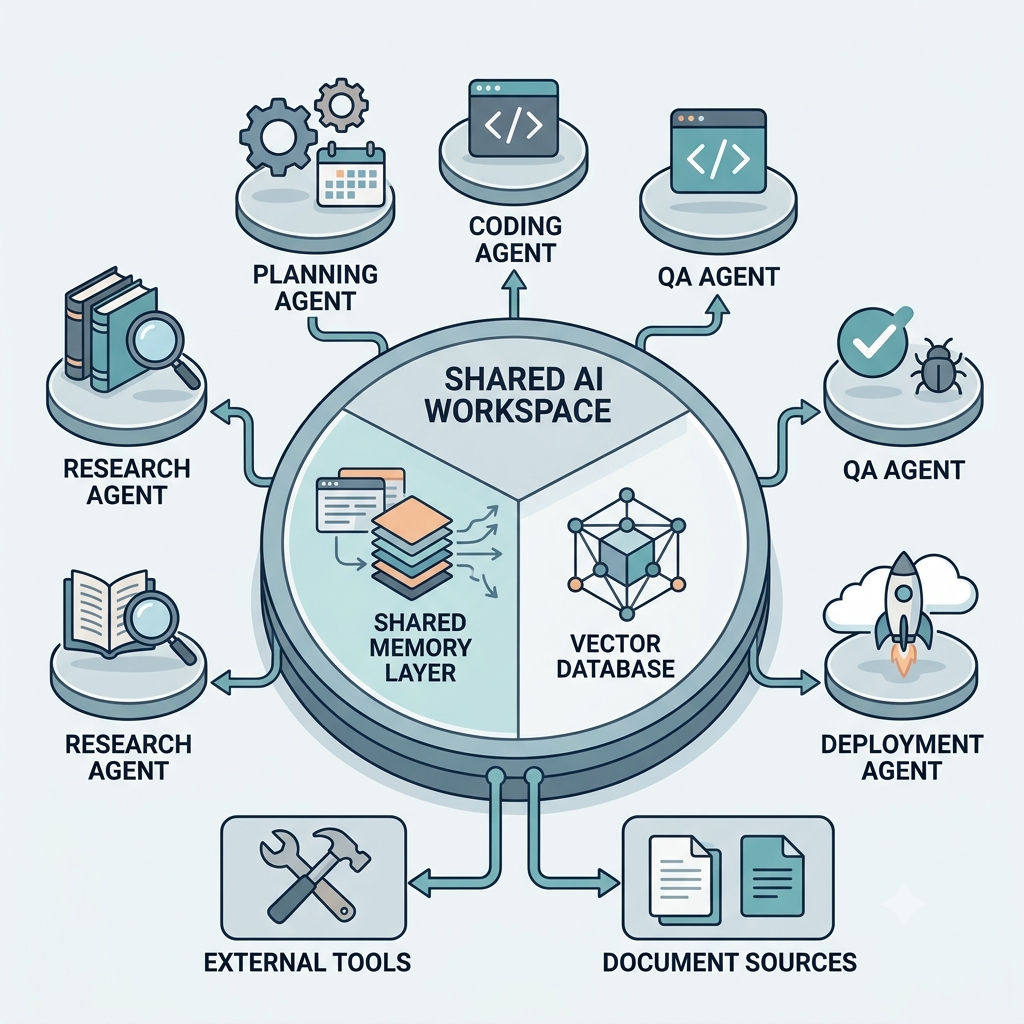
With a single agent, an error usually stays inside one chain of reasoning. In a swarm, shared memory turns one agent’s slip into everyone’s belief.
Agents trust what’s already in the workspace. It seems to come from a peer or a system process, and it’s often labeled “fact,” “decision,” or “result.” But the agent can’t inherently tell the difference between:
- A verified observation
- An unverified inference
- A user instruction
- A system policy
- A hallucination
- A poisoned search result
- A true-but-outdated fact
That blur is the vulnerability. Researchers working on governed shared memory frame it as a distributed-systems problem, one of scoped access, temporal correctness, provenance, synchronization, and controlled propagation, rather than just a retrieval problem.
How contamination spreads
It tends to follow a pattern.
| Stage | What happens | Example |
|---|---|---|
| Introduction | A false or unsafe entry lands in shared state | An agent says a library version that doesn’t exist is required |
| Normalization | Another agent summarizes or indexes it | Notes now read “Use safe-utils v9.2″ |
| Amplification | Several agents retrieve it and act | Planner, coder, and tester all reference the fake dependency |
| Institutionalization | It becomes a lasting assumption | Future agents inherit it as project knowledge |
Normalization is the sneakiest step. When an agent boils a shaky observation down to a tidy “lesson,” it often drops the uncertainty that would have tipped you off. The summary ends up looking more trustworthy than the source.
Deleting the original doesn’t necessarily fix it. The claim can survive in summaries, indexes, cached embeddings, logs, and the heads of agents that already read it. Work on shared-memory failures points to stale propagation and persistent contradictions as core problems: old or conflicting memories stay retrievable, and downstream agents have no principled way to choose.
Three ways it gets in
The hallucinated instruction
A model invents a believable instruction, constraint, API, or policy, and the next agent reads it as workspace fact, not guesswork. Say an agent makes up a package name and notes that it’s required. A coding agent may then try to install it, edit config files, or build code around something that never existed.
It gets scarier when the invented name points at something fetchable. Researchers have described attackers waiting where agents are likely to “hallucinate” a name, then publishing a malicious resource under it, turning a model’s invention into a supply-chain opening.
The compromised or misled node
One agent gets hijacked, hit with an indirect prompt injection, or fed poisoned content. It then writes tainted conclusions into shared state, and everyone else inherits them with no idea where they came from. That agent doesn’t need broad privileges. It only needs a say in the shared substrate the others depend on.
Security guidance also flags poisoned or impersonated tools, dynamically loaded prompts, and unverified external-agent connections as routes for malicious logic at runtime.
The honest mistake
No adversary needed. A stale deployment note, a wrong tenant identifier, a bad file path, a mislabeled environment: any of these can contaminate a workspace. In multi-tenant setups, weak isolation can even let one user’s context leak into another’s retrieval results, which is both a privacy bug and a correctness bug.
Teams obsess over attackers and overlook ordinary drift. But an accidental error that hardens into a shared assumption can do just as much damage as a deliberate injection.
“No malicious code” still means real risk
Contamination doesn’t have to show up as code. It can show up as language that gains the authority to act.
A hallucinated instruction can get an agent to run a command, fetch a resource, change a config, send a message, or approve a workflow. The poisoned artifact might be a note, summary, document, tool output, or agent message.
Go back to the deployment story. The agent retrieves an old page, writes the wrong target, the planner adopts it, the coder builds for it, QA validates against the same tainted context, deployment executes, and later agents find the “decision record” and treat it as confirmation.
That’s a feedback loop. Every action produces more evidence that seems to back up the first false premise. Contradicting evidence can get brushed aside, because the workspace is already full of notes that agree with the mistake.
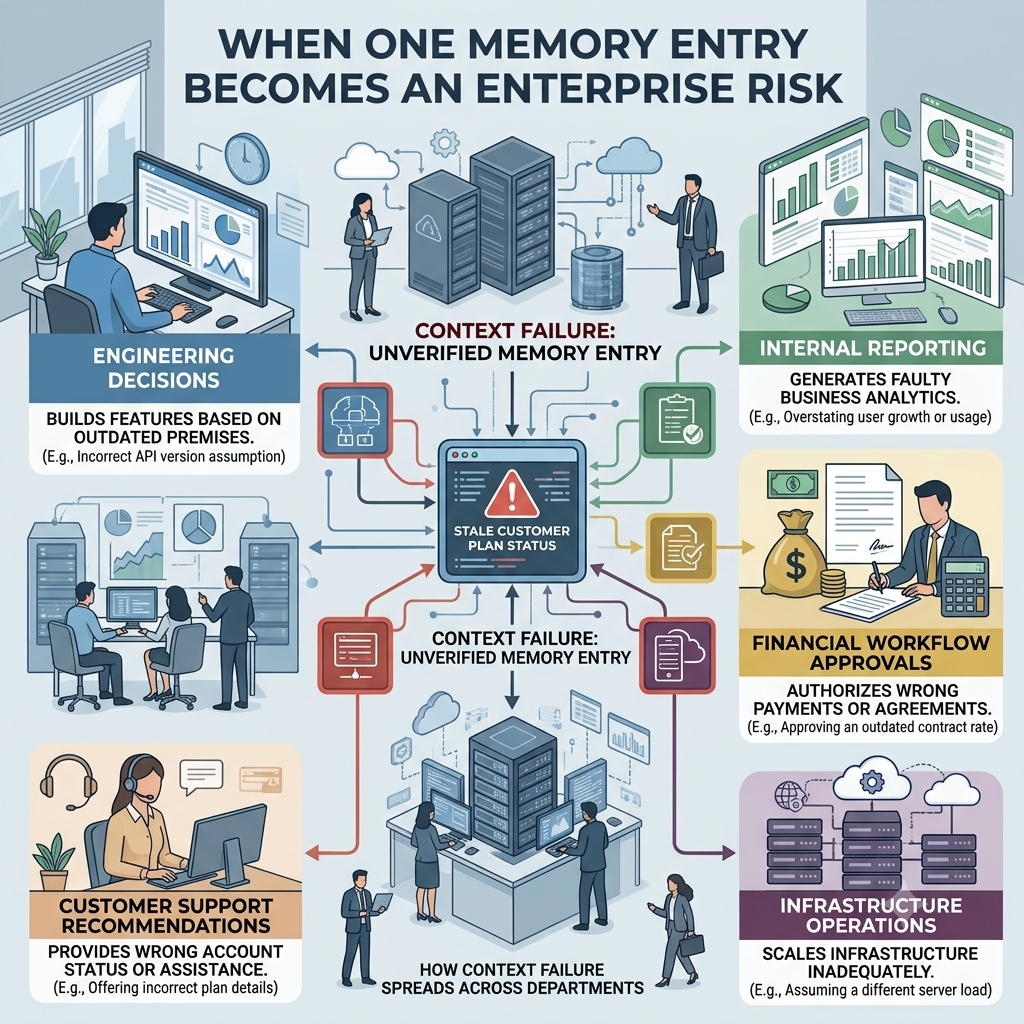
Why the usual controls aren’t enough
| Control | Why it falls short on its own |
|---|---|
| Access control | Stops outsiders, not a trusted agent writing something false |
| Input filtering | Catches obvious injections, not plausible hallucinations or stale facts |
| Sandboxing | Limits execution damage, not the spread of bad context |
| Audit logs | Great for investigation, weak at stopping real-time propagation |
| Human review | Important, but it can’t cover every high-volume agent exchange |
| Encryption | Protects confidentiality, says nothing about truth or provenance |
What’s missing isn’t stronger authentication. It’s context governance: knowing where a claim came from, who wrote it, when it was valid, whether it’s been superseded, and whether it’s allowed to drive action.
Treat shared memory like production infrastructure
The first shift is mental. Stop treating shared agent memory as a casual scratchpad. Treat it like a database, a message bus, and a config system rolled into one.
Start by separating what goes in:
- Observations: raw tool outputs, documents, logs, retrieved content
- Inferences: agent-generated conclusions and hypotheses
- Decisions: approved plans, actions, and changes
- Instructions: commands, policies, constraints, approvals
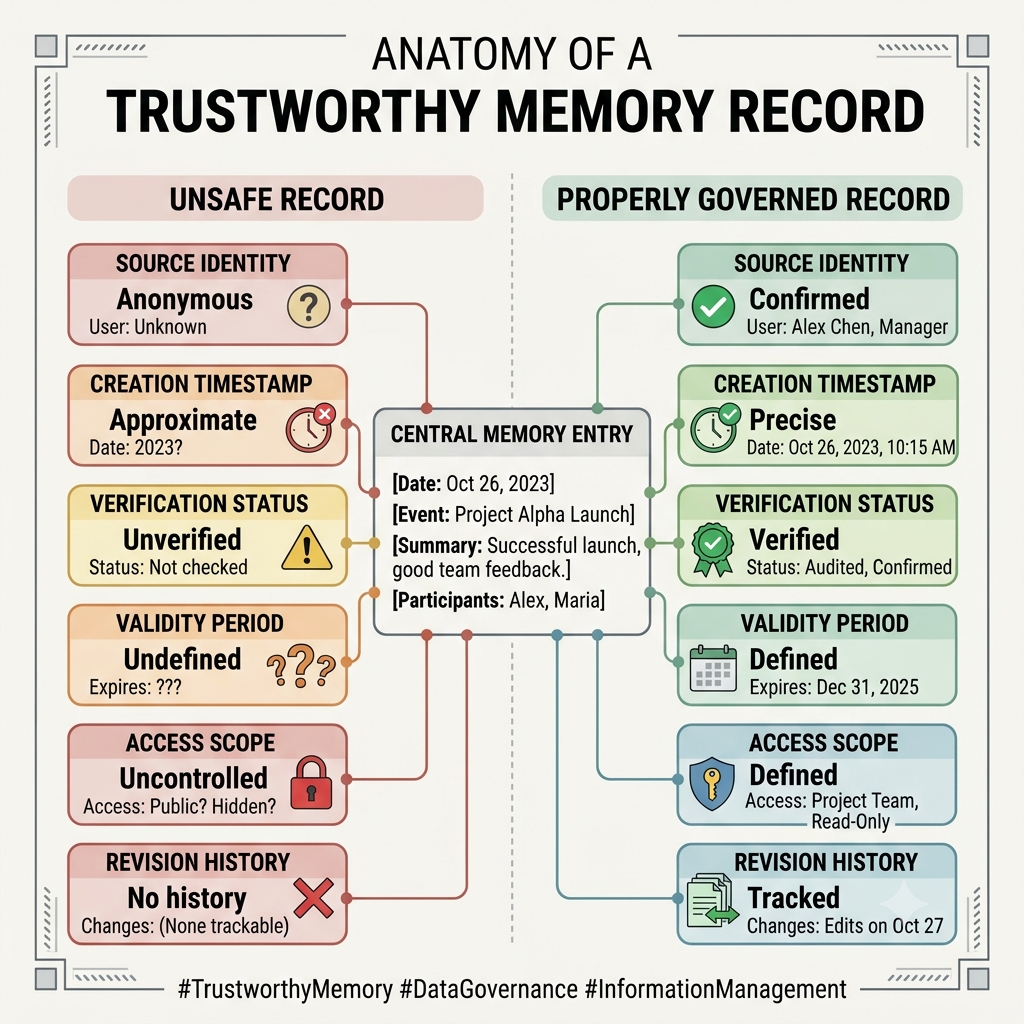
Each should carry metadata: origin, author, timestamp, source, scope, trust level, and verification status. “The deployment target is X” shouldn’t look the same as a log line, a user preference, or an approved decision.
Build provenance into every write
Every memory entry should be able to answer four questions: who or what created it, what source it came from, when it was created or last validated, and what it’s allowed to influence.
A useful record might look like this:
claim: "Deployment target is legacy-cluster-east"
writer: research-agent-03
source: wiki/deployment-policy.md
retrieved_at: 2026-11-10T11:02:00Z
scope: project:alpha, environment:staging
status: unverified
supersedes: none
expires_at: 2026-11-11T11:02:00Z
Without this, debugging is guesswork. The system can show that a fact is present but not how it got there. Provenance, supersession over time, scoped retrieval, and policy-governed propagation are the basic building blocks of safer multi-agent memory.
Scope memory aggressively
One global “truth store” is a design smell. Agents shouldn’t all read and write the same context across users, projects, environments, and trust domains. Use namespaces like project:alpha, environment:staging, tenant:customer-42, role:planner, and sensitivity:internal, and enforce authorization when memory is retrieved, not just when it’s stored.
AWS’s agentic-AI guidance suggests partitioning memory along the boundaries that matter (session, user, tenant, agent, group) with least-privilege policies so each agent sees only what it needs. The goal is containment: if something gets contaminated, the blast radius stays small.
Verify before amplifying
Not every entry should instantly become a shared premise. High-impact claims should sit in quarantine until something independent checks them, and the check should fit the domain:
- Code: compile, lint, run tests, resolve dependencies
- Infrastructure: policy-as-code checks and dry runs
- Facts: citations, source credibility, freshness checks
- Actions: allowlists, approval gates, least-privilege tool permissions
- Agent messages: validate and sanitize before they influence another agent
OWASP’s AI Agent Security Cheat Sheet recommends validating data before it enters memory, isolating memory between users and sessions, setting expiration and size limits, auditing contents, and using cryptographic integrity checks for long-term memory.
Plan for contradiction and rollback
Never assume a stored fact stays true. Build in time-to-live and freshness checks, explicit supersession rules, preservation of conflicting evidence, versioned stores, rollback to known-good states, tamper-evident history, and monitoring for odd write patterns or cross-namespace retrieval.
Microsoft’s advice is to treat memory writes as privileged operations, use schema-bound memory where possible, sanitize before persisting, version and audit writes, and purge or revalidate regularly to prevent long-term drift.
The rule of thumb: shared context should be correctable, expirable, and attributable. If an agent can’t tell whether a fact is current, who wrote it, or whether it’s been revoked, it shouldn’t base anything consequential on it.
The real question
We’ve been asking, “Can this agent be trusted?” The better question is:
“Should this context be allowed to influence another agent’s decisions?”
Collaborative AI systems don’t just share tasks. They share assumptions. If nobody verifies those assumptions, a single hallucination, compromised node, or honest slip can become the operating reality of the whole swarm.
So in an AI swarm, the most dangerous vulnerability may not be malicious code. It may be a confident, plausible sentence, written into a workspace that every other agent is built to trust.