
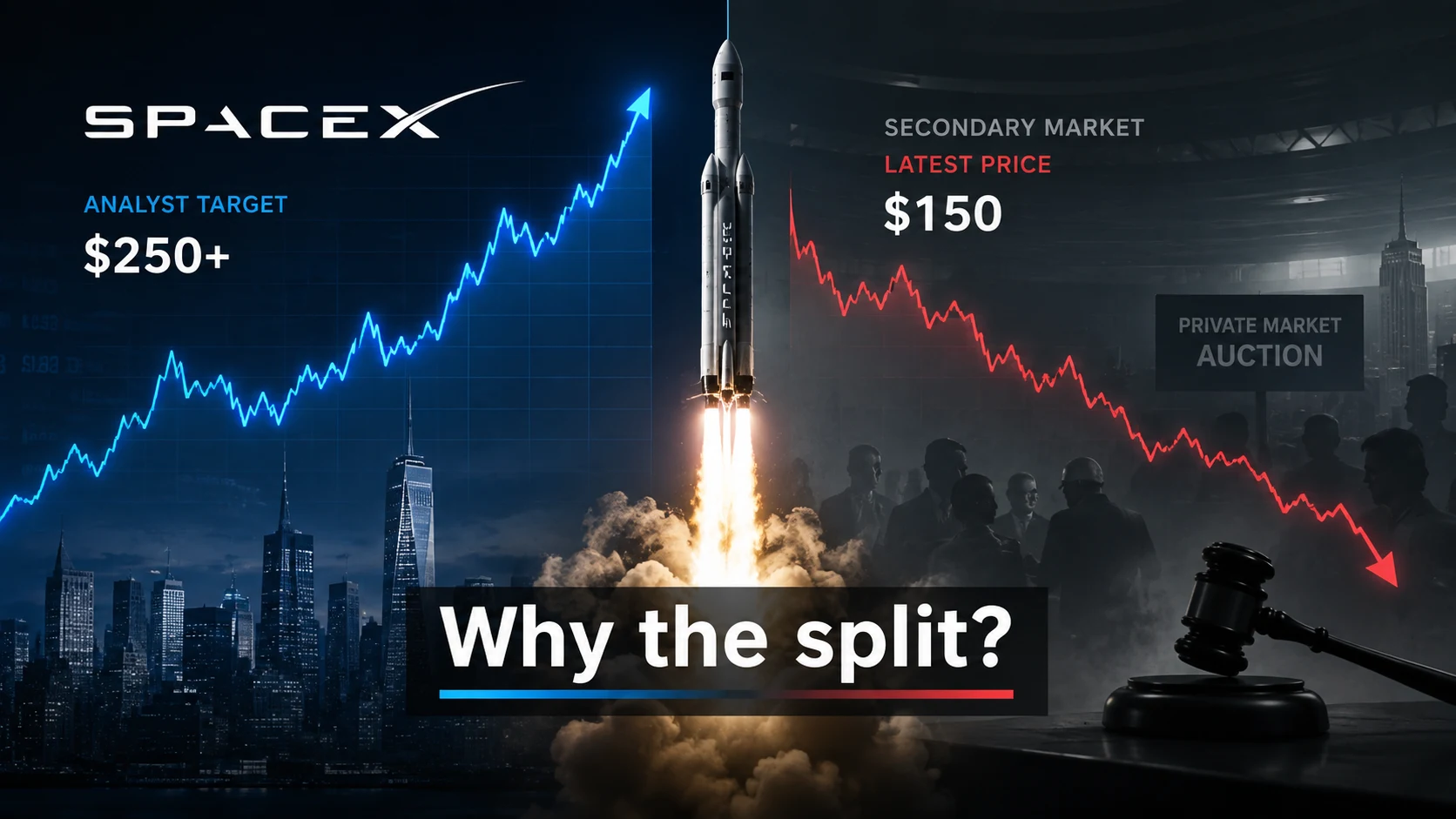
SpaceX is defying gravity again — but this time, the fight is in valuation. While secondary market transaction activity has slipped by 15% during a recent illiquidity period, institutional analysts are surging ahead with updated forecasts.
With Starlink revenue hitting $12.3 billion and global active subscribers crossing 10 million, Wall Street targets now reach as high as $1.4 trillion. So which market price is the real one?
Why the split? Private secondary trades react to immediate investor cash needs, while Wall Street institutional models price in multi-decade orbital dominance.

What Changed in SpaceX Valuation
Recent private secondary share transactions revealed a noticeable cooling in short-term pricing after months of rapid acceleration. Early employees and venture holders facing lockup expirations have sought fast cash, pressing down spot prices on private marketplaces.
But here’s the twist. Short-term private trades primarily reflect immediate liquidity constraints rather than underlying enterprise health. When secondary order books thin out, bid-ask spreads widen dramatically.
- Spot price pressure: Secondary market shares dropped from peak tender figures as trading volume slowed.
- Liquidity freeze: Accredited investors are demanding steeper illiquidity discounts before deploying fresh capital.
- Transaction timing: Most seller volume comes from early insiders seeking portfolio rebalancing rather than institutional liquidations.
Is the secondary market signaling caution, or just short-term illiquidity? Private equity traders emphasize that secondary market softness is purely a function of current order execution mechanics.

Why Analysts Are Still Raising Targets
Institutional research teams at major investment banks are actively re-rating SpaceX upward. Wall Street analysts focus on high-margin cash flows rather than temporary order-book imbalances.
That’s not the whole story. The primary catalyst behind these bullish revisions is the compounding profitability of the Starlink broadband network.
- Recurring cash flow: Starlink generated over $4.4 billion in operating profit, proving the constellation model works at scale.
- Launch monopoly: SpaceX completed over 165 Falcon launches in a single year, dominating global launch capacity.
- Starship optionality: Next-generation launch capabilities promise to cut payload costs by 80%, unlocking massive margin expansion.
According to reporting from Forge Global, private market pricing frequently lags institutional models during transition periods prior to major corporate liquidity events.
Secondary Markets vs. Institutional Models
The real gap is how different market participants evaluate risk and time horizons.
| Lens | What It Reflects | Why It Matters |
|---|---|---|
| Secondary Markets | Current cash liquidity, buyer appetite, immediate transaction timing | Moves fast and can look overly volatile |
| Analyst Models | Multi-year revenue growth, unit margins, and market share assumptions | Filters out short-term price noise to focus on fundamentals |
| Institutional Valuation | Discounted future cash flows and orbital sector monopoly status | Essential for strategic, long-term portfolio allocation |
Why are analysts comfortable paying up when private trades are softening? Because institutional frameworks model revenue potential out to 2030, where consensus estimates hover around $330 billion to $470 billion annually.

What This Means for Investors
For late-stage venture funds and private market buyers, this valuation split creates both risk and opportunity. Discounted secondary shares offer attractive entry points for buyers willing to absorb illiquidity.
“The underlying fundamentals of space connectivity have disconnected from private market liquidity cycles. Investors evaluating SpaceX today must ask whether they are buying a launch vendor or a global utility network.” — Senior Space Sector Equity Analyst
So why are analysts ignoring the pullback? The answer comes down to time horizon. Short-term private traders price execution risk today, while institutional research values the unmatched competitive moat SpaceX holds over traditional aerospace competitors.
What to Watch Next
As market participants weigh these conflicting signals, several upcoming triggers will determine which valuation framework wins out.
- New tender offer announcements: Watch for official company-backed share buybacks at updated per-share prices.
- Subscriber ARPU trends: Track whether recent price adjustments boost average revenue per subscriber above $81/month.
- Starship orbital milestones: Successful payload deployments will further validate long-term valuation targets.
JUST IN: JP Morgan raises $SPCX price target from $225 to $240. pic.twitter.com/H384EerH75
— Whale Insider (@WhaleInsider) August 5, 2026
Is SpaceX priced like a company, or like a platform with multiple future markets? For detailed background on previous tender transactions, see reporting by SatNews and Sacra’s Financial Analysis.
Will the secondary market catch up to Wall Street’s targets, or will analysts be forced to revise downward? Investors tracking private tech valuation trends should watch the next round of tender offers closely as institutional capital continues to test private market limits.