

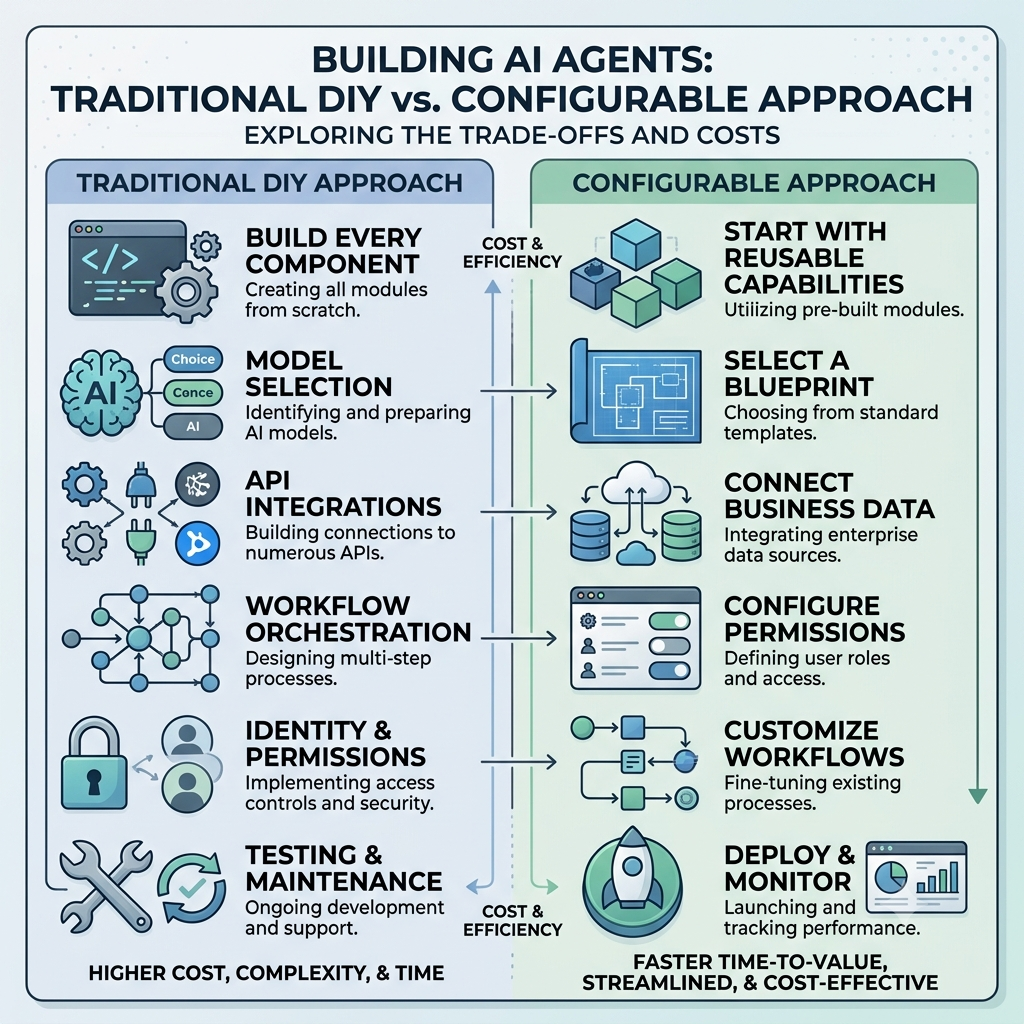
For about two years, most companies have treated agentic AI as an engineering project. Hire the data scientists, wire up the APIs, write the orchestration logic, lock down permissions, and cross your fingers that the pilot survives its first week in production.
IBM and Microsoft think there’s a better way. Their new platform, Imagine Enterprise, pairs IBM Consulting’s library of more than 6,000 pre-built AI agents and assets with Microsoft’s cloud, identity, data, security, and governance tools. The pitch is that enterprise AI could shift from custom-coded bots to configurable digital workers.
That doesn’t mean everyone will drop custom development tomorrow. But it does change where the value sits. Building an agent is no longer the hard part. The hard part is picking the right one, connecting it to data you can trust, keeping its actions in check, and scaling it without losing control.
Expensive Era of DIY Agents
The early promise sounded simple: give an AI model access to your internal systems and let it automate a workflow. Then reality showed up.
Take a “simple” customer-service agent. It might need to talk to your CRM, knowledge base, ticketing system, billing platform, and identity provider. A claims agent needs document extraction, policy rules, approval workflows, audit trails, and a way to escalate. A finance agent needs tight access controls, reconciliation logic, exception handling, and a defensible record of every decision it makes.
So a lot of teams ended up spending more time on the scaffolding than on the actual business problem. They built one-off integrations, rebuilt the same governance controls over and over, and learned the hard way that a slick demo isn’t a production-grade digital worker.
Imagine Enterprise is aimed squarely at that from-scratch burden. According to IBM, organizations start with pre-built agents, assets, and industry expertise, then adapt them to their own needs instead of assembling every piece themselves.
What IBM and Microsoft Actually Launched
The two companies announced Imagine Enterprise on November 10, 2026. It’s an agentic platform meant to help enterprises build, run, and govern AI agents for industry-specific processes.
Here’s who brings what:
- IBM Consulting: More than 6,000 AI agents and assets built on IBM Consulting Advantage, plus industry expertise and delivery experience.
- Microsoft: The AI, data, cloud, identity, and security layer, including Microsoft Foundry, Copilot Studio, Fabric, Entra, Purview, Defender, Sentinel, and Azure.
- Joint delivery: Forward-deployed engineers from both companies for qualifying engagements, meant to get customers from experiment to production.
- Initial focus: Frameworks for financial services, insurance, and retail, with manufacturing, energy, public sector, and mobility flagged as possible next areas.
A quick note on that “6,000” figure. IBM says “agents and assets,” which isn’t the same as 6,000 independent, ready-to-run bots. The library probably includes agents alongside workflow components, templates, and other reusable pieces. Still, the point stands: IBM is packaging years of delivery experience into a starting kit.
From Building Bots to Buying Capabilities
The partnership itself is the less interesting part. What matters is how it changes the way enterprises buy software.
Until now, most companies approached agents like custom software. Define a use case, build the agent, integrate the systems, test it, and maintain the whole stack in-house. Imagine Enterprise suggests a different default: start with a proven industry blueprint, configure it, and save your custom engineering for the parts that actually set your business apart.
IBM sums up the appeal in three ideas:
- Instant expertise: You start with pre-built agents, assets, and industry knowledge, not a blank page.
- Enterprise fit: It’s designed to plug into your existing data, processes, and systems.
- Intelligence multiplier: It carries organizational knowledge and context to both people and agents, so AI works inside the business instead of next to it.
In other words, the question changes. It used to be “How do we build this agent?” Now it’s “Which pre-built digital worker fits this process, and what do we need to customize to make it safe and effective?”
What Gets Commoditized
The most important part of the announcement is what it turns into routine work.
Agent scaffolding. Prompting patterns, tool connections, orchestration, and system integration become less of a custom engineering job. IBM’s Process Studio, Context Studio, and Advantage Core are meant to help design, deploy, and govern tailored agents, while Microsoft Foundry and Copilot Studio coordinate agents and enterprise systems.
Industry process knowledge. Banking, insurance, and retail workflows are being turned into reusable blueprints. A bank doesn’t have to reinvent customer onboarding or dispute resolution, and an insurer doesn’t have to design claims handling from zero. The work shifts toward fitting those patterns to your products, data, risk appetite, and regulations.
Governance plumbing. Adoption has often stalled not because the models weren’t good enough, but because companies couldn’t safely put autonomous systems into production. Imagine Enterprise leans hard on controls, observability, compliance support, identity, and security, with Entra, Purview, Defender, and Sentinel acting as the layer that keeps digital workers inside policy.
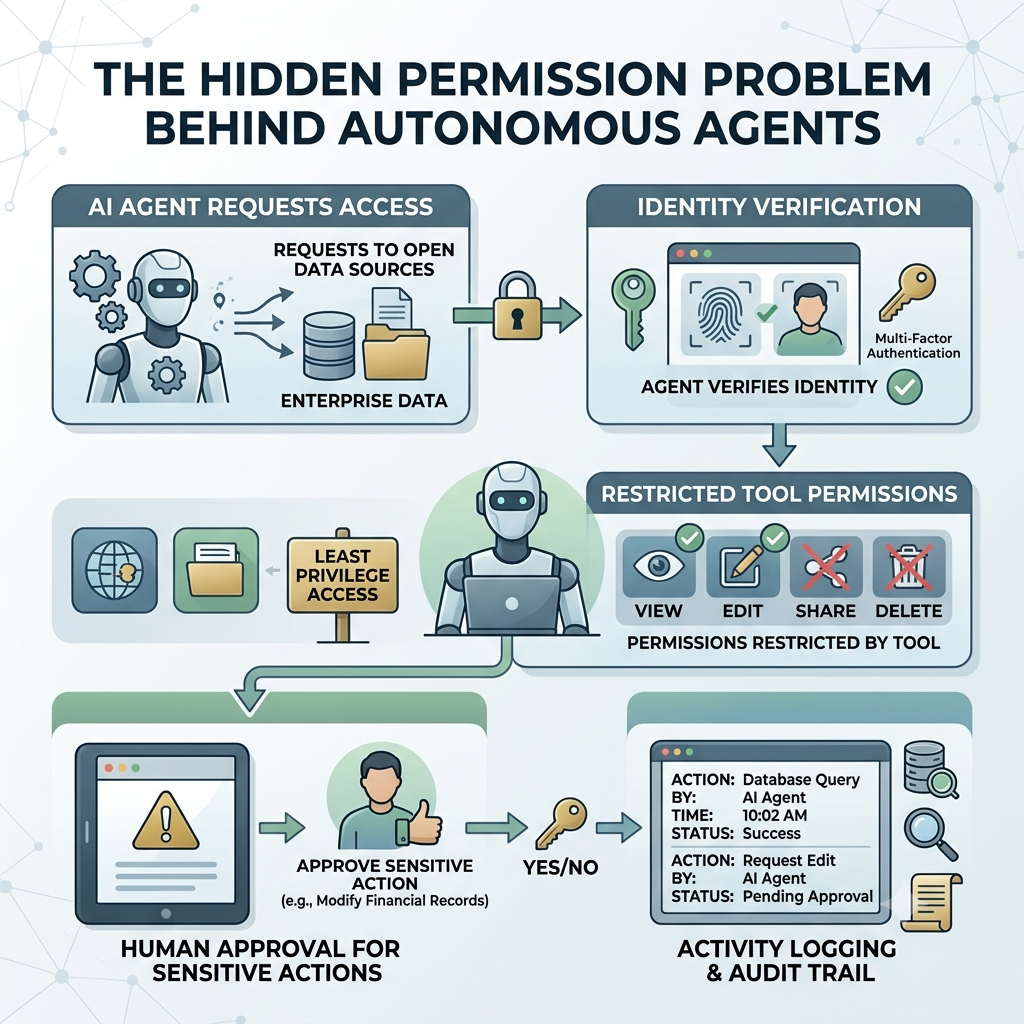
Integration work. Microsoft supplies the cloud, data, identity, and security foundation so agents can operate across the enterprise. That means less custom middleware for each buyer just to make AI usable in their environment.
Why Banking, Insurance, and Retail Come First
These industries weren’t chosen at random. They sit where repeatable processes, high volume, and heavy governance requirements overlap.
Financial services deals with regulated decisions, sensitive customer data, complex approvals, and serious audit demands. An agent doing operations work has to be governed as carefully as it’s designed.
Insurance is document-heavy, full of policy logic, claims handling, fraud detection, and customer communication. It’s exactly the kind of place where a badly governed agent can cause real operational and reputational damage.
Retail runs on high-frequency workflows across customer service, merchandising, supply chain, and store operations. Here the upside is scale. A small improvement in a process that repeats thousands of times adds up fast.
IBM calls these initial frameworks repeatable blueprints that can extend to other sectors later. That suggests this isn’t a pile of demos. It’s an attempt to industrialize how agentic AI gets delivered.
The Counterargument: Customization Still Wins
It would be easy to overstate the “death of custom-coded bots.” Let’s not.
Every enterprise has proprietary data, unique policies, legacy systems, competitive workflows, and edge cases no vendor can fully predict. A generic claims agent won’t automatically understand one insurer’s underwriting rules, fraud thresholds, regional regulations, and escalation habits. A retail agent can’t replace a company’s merchandising strategy or brand voice.
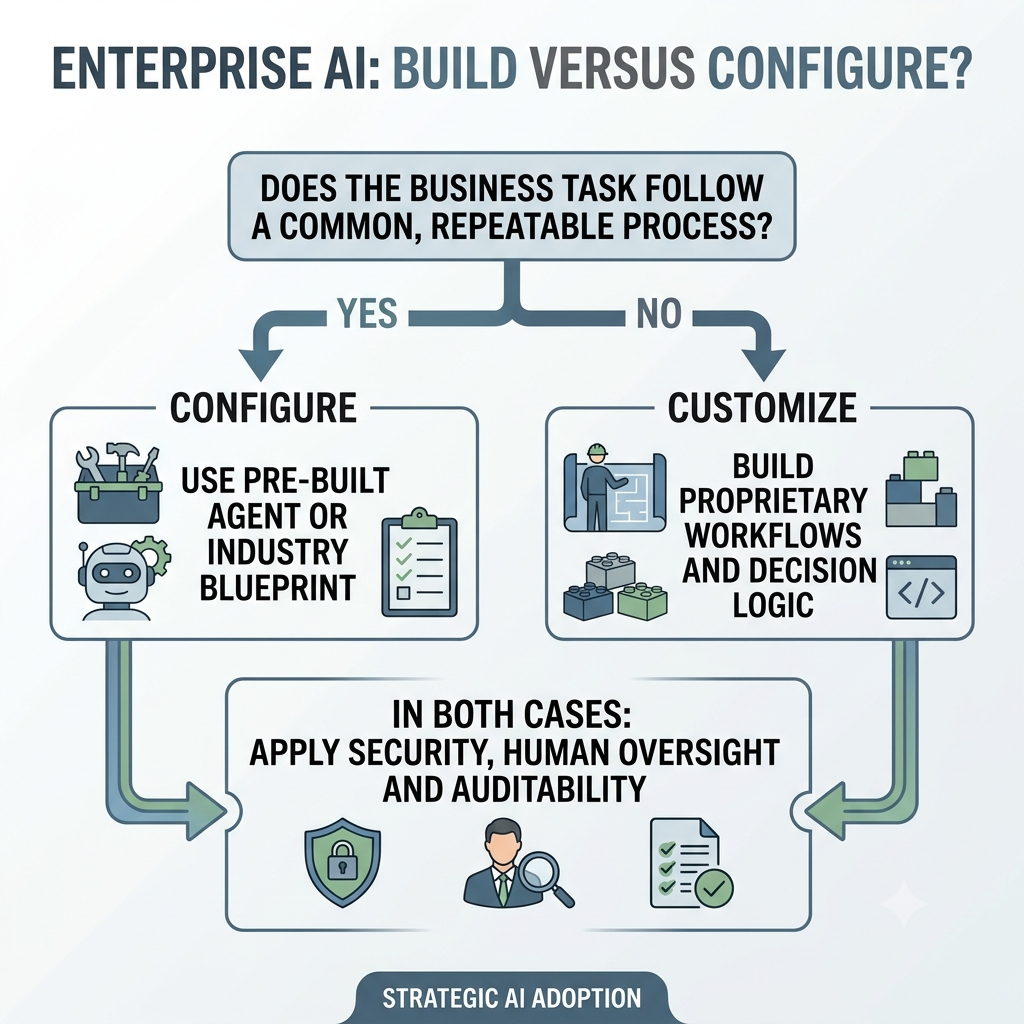
The more realistic future is configure first, customize where you differentiate. In practice, that looks like this:
- Use pre-built agents for commodity work like document summarization, knowledge retrieval, routine service requests, and standard handoffs.
- Customize for proprietary decision logic, sensitive data flows, regulatory requirements, and anything customers see as your edge.
- Keep humans accountable where mistakes are costly, decisions carry weight, or trust has to be provable.
- Don’t get so tied to one vendor’s agent library that you lose control of your data, your processes, and your exit options.
IBM seems to agree. It says customers can start with pre-built capabilities and adapt them to their needs, and that the platform is built to work with existing systems rather than force a full replacement.
The New Enterprise Bargain
Most large organizations can build an AI agent. That’s no longer the question.
The real question is whether you should build it, buy it, govern it, and scale it.
Imagine Enterprise is a bet that the answer will increasingly be: buy the foundation, adapt it to your business, and put your own talent into the parts that create advantage. IBM calls the platform a “digital talent agency” for the enterprise, one that holds digital workers to the same standards as human ones: clear responsibilities, skills, controls, compliance, and accountability.
That framing matters because it turns AI from a set of clever demos into an operating model. The winners probably won’t be the companies with the biggest internal AI teams. They’ll be the ones that can deploy standardized digital workers quickly while keeping hold of their data, decisions, risk, and differentiation.
Also Read: The Code Generation Paradox: When Writing Code Stops Being the Hard Part
The DIY era isn’t ending because custom AI has become impossible. It’s fading because the economics shifted. When 6,000 agents and assets are available as a starting point, building every enterprise bot from scratch starts to look less like innovation and more like an expense you didn’t need.