
Section 1: Why AI Agents Are Suddenly Everywhere
Why Everyone Is Talking About AI Agents in 2026
The Rise of Agentic AI
If you’ve been trying to understand what is an AI agent lately, you’ve probably noticed how fast the conversation has shifted. Agentic AI is essentially the next stage beyond generative AI — describing systems that are semi-autonomous or fully autonomous, capable of perceiving, reasoning, and actually acting on their own, rather than just responding to a prompt.
The growth here has been hard to ignore. The global agentic AI market hit $10.86 billion in March 2026, up from $7.55 billion in 2025 — that’s 44% year-over-year growth. And investment has accelerated right alongside it.
A few numbers explain why this topic is everywhere right now:
- $8 billion in autonomous AI systems funding during Q1 2026 alone
- $18.4 billion in total venture capital invested in agentic AI startups through Q1 2026
- 340% year-over-year growth in enterprise spending on agentic AI between 2025 and 2026
- 67% of Fortune 500 companies have active agentic AI programs in 2026
- By end of 2026, 40% of enterprise applications are expected to include embedded, task-specific AI agents — up from less than 5% in 2024
From Chatbots to Autonomous Systems
The shift toward AI agents isn’t just a software upgrade. It’s a fundamental change in what these systems can actually do. Traditional chatbots are built for single-turn questions and scripted interactions. AI agents, on the other hand, are designed around multi-step goal completion.
| Dimension | Chatbot | AI Agent |
|---|---|---|
| Task type | Single-turn Q&A, scripted flows | Multi-step goal completion |
| Memory | Session only | Persists across sessions |
| Tool use | None or limited retrieval | Full read and write across integrated systems |
| Autonomy | Responds when asked | Can initiate, plan, adapt, and complete tasks |
| Error handling | Returns errors or escalates | Can retry, reroute, and ask clarifying questions |
In simple terms: chatbots respond, large language models think, and AI agents act. ChatGPT itself started as an interface built around an LLM — but it now includes agent capabilities like web browsing, code execution, and tool use.
Why Businesses Are Investing in AI Agents
Businesses have moved quickly on this, and it’s largely because the benefits are becoming measurable. According to IBM’s 2025 study, improved decision-making was the most frequently cited advantage — with 69% of executives placing it at the top of their list.
Cost reduction through automation came in close at 67%. Other reported benefits include:
- Greater operational efficiency
- Better, faster decision-making
- Workforce augmentation by automating repetitive tasks
McKinsey research shows that 23% of organizations are already scaling an agentic AI system somewhere in their operations, while another 39% are actively experimenting. That means more than 60% are at least in testing mode. Deloitte expects that 23% moderate-use figure to climb to 74% over the next two years.
Organizations deploying AI agents are projecting productivity improvements averaging 30%. At the same time, these systems are expected to generate as much as $450 billion in economic value by 2028 through higher revenue and lower costs.
Why AI Agents Matter More Than Ever
Productivity Revolution
Part of what makes understanding what is an AI agent so important right now is the real-world impact these systems are having on productivity. Their core promise is reducing transaction costs and helping people make better decisions and get more done.
That’s not just theoretical anymore. Two-thirds of senior leaders surveyed — 66% of respondents — say AI has already delivered meaningful productivity improvements across their organizations.
Automation Beyond Traditional Software
Traditional automation depends on rigid, predefined workflows. AI agents work differently. Instead of following fixed paths, they emit events that allow downstream agents or systems to pick up and continue processes where needed.
That makes them particularly useful for workflows involving three or more steps across multiple systems — the kind where manual handoffs get expensive and inefficient fast.
How AI Agents Are Changing Work
McKinsey research suggests existing technologies could theoretically automate around 57% of work hours in the United States. It’s worth noting that figure reflects technical capability — not inevitable job displacement.
The more likely future involves collaboration between people, agents, and robots, all working together with AI support. One early signal of that shift: AI fluency has become the fastest-growing skill appearing in U.S. job listings over the last two years, increasing sevenfold.
Section 2: Understanding the Basics
What Exactly is an AI Agent?
Simple Definition for Beginners
At its simplest, what is an AI agent? It’s a system that uses an AI model to decide what to do next, take actions on its own, and keep working toward a goal — across multiple steps — without needing instructions at every turn.
Think of it this way: a robot vacuum is a good analogy. A passive system can tell you your floors are dirty. An agentic system actually goes and cleans them. That gap — between observing and doing — is essentially the difference between passive AI and an AI agent.
Technical Definition
Formally, an AI agent is a system or program capable of autonomously performing tasks on behalf of a user or another system — designing its own workflow and using whatever tools are available to get there.
The simplest definition shared across the industry is:
Agent = Model + Tools + Loop + Goal
In practice, an AI agent is a language model placed inside a control loop. It observes its environment, reasons through possible actions, calls tools when needed, and keeps going until either the goal is reached or a stopping condition is met.
AI Agent Meaning Explained in Plain English
Put simply, an AI agent is a system that can sense, think, and act on its own. It reacts to inputs, makes decisions using logic or language models, and carries out actions through tools or APIs.
Large language models are primarily built to generate language. AI agents use that same capability — but only as one part of a larger system that also includes:
- Memory
- Reasoning
- Planning
- Action
What Makes an AI Agent Different from Traditional AI?
| Aspect | Traditional AI | AI Agent |
|---|---|---|
| Intelligence | Pattern recognition and static models | Reasoning through LLMs and dynamic decision-making |
| Memory | Limited or no context retention | Short-term and long-term memory with vector databases |
| Decision-Making | Predefined rules | Goal decomposition and task prioritization |
| Independence | Requires human trigger | Acts independently toward goals |
Intelligence
Traditional AI systems mostly rely on pattern recognition and static models. AI agents, by contrast, use large language models for reasoning — dynamically interpreting signals to figure out what to do next. Rather than following fixed instructions, they evaluate information and adapt as conditions change.
Memory
Traditional AI generally has little to no ability to retain context between interactions. AI agents can remember previous tool usage, past behaviors, and earlier decisions. That stored experience can be used for self-reflection and future planning — making the system more context-aware over time.
Decision-Making
Traditional AI typically runs on predefined rules. AI agents take a different approach — breaking goals into smaller tasks and prioritizing them. They can use decision trees, search graphs, and dynamic planners to figure out the most appropriate sequence of actions.
Ability to Act Independently
Traditional AI systems usually need a person to kick off every action. AI agents can initiate, plan, adapt, and complete tasks on their own while pursuing a goal — no hand-holding required at every stage. They keep working until the objective is done.
What Are the Main Characteristics of an AI Agent?
Autonomy
Autonomy is one of the defining traits of what is an AI agent. Agents can act on behalf of a user or system and handle tasks with minimal human supervision — pursuing objectives without needing constant guidance.
Reasoning
Large language models serve as the reasoning engine behind most AI agents. They interpret instructions, evaluate options, and support decision-making — working through available alternatives using goals, policies, or machine learning models to land on the right action.
Planning
Planning is what allows agents to break larger objectives into smaller, more manageable subtasks. Instead of just reacting to immediate inputs, they:
- Sequence actions logically
- Anticipate potential obstacles
- Operate strategically while working toward a goal
Learning
AI agents can improve through feedback and experience. Learning agents use advanced algorithms and reinforcement learning to adapt over time — getting better as they gather more information from interactions and outcomes.
Goal-Oriented Behavior
AI agents are built around goals, not individual responses. They keep working until a goal is achieved or a stopping condition is reached. That focus on multi-step completion is what separates them from systems that only handle single-turn exchanges.
Section 3: How AI Agents Work Behind the Scenes
How Does an AI Agent Work?
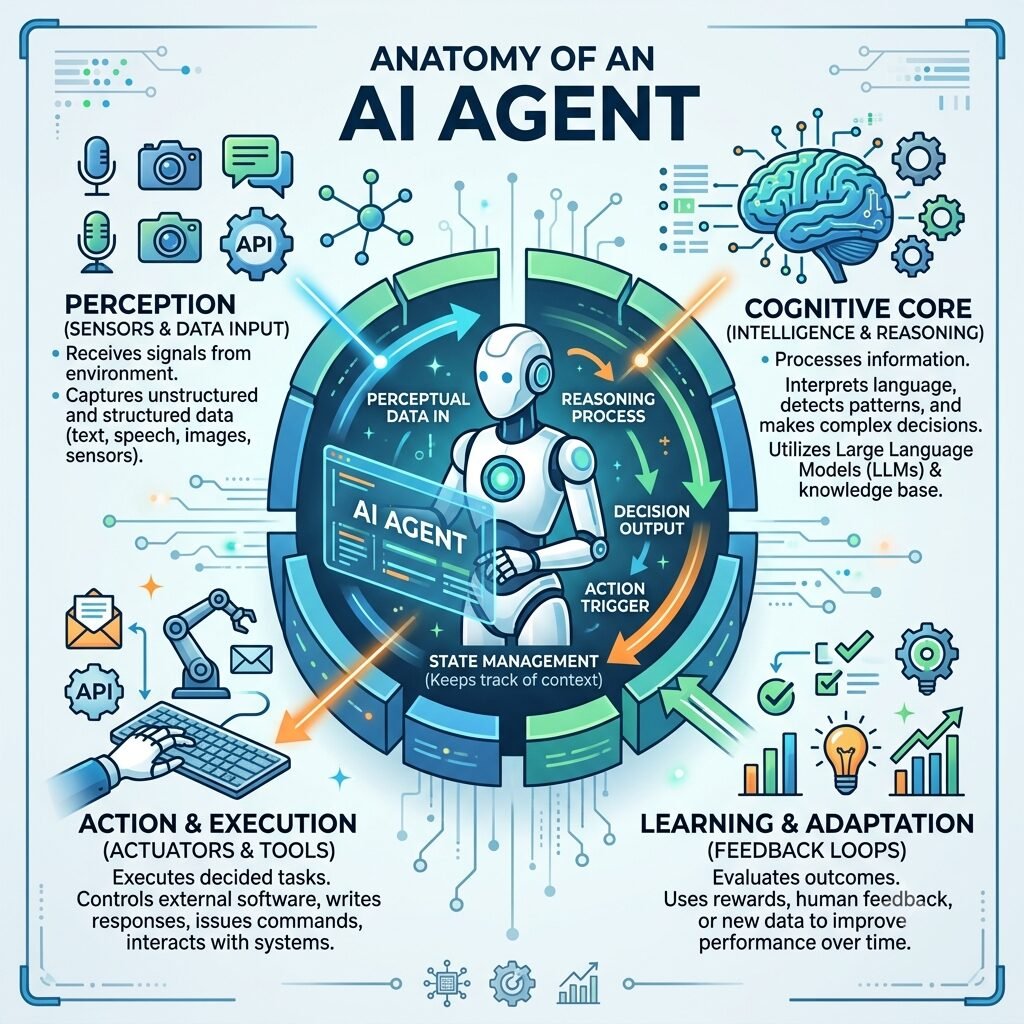
AI agent architecture runs on a perception-decision-action loop — a set of modular components that interact with each other in a way that loosely resembles human cognitive processes. The system gathers information, reasons about it, and then acts.
The internal mechanics can get complex, but the overall process generally follows five stages: perception, memory, reasoning, planning, and action.
Step 1 – Perception: Gathering Information
Sensors and Inputs
Perception is essentially the sensory system of an AI agent — it’s how the agent figures out what’s happening in its environment. Information arrives through events, which provide structured, real-time inputs the system can actually work with.
The perception layer pulls data through APIs, sensors, and data streams, then transforms that raw information into structured formats — processed text, time-series signals, and so on — making it usable for the next stage.
Data Collection
AI agents can process a surprisingly wide range of inputs, including:
- Visual data
- Auditory data
- Other forms of sensory information
Whatever the source, that collected information becomes the foundation for everything that follows — directly shaping the agent’s reasoning and decisions.
Step 2 – Memory: Storing Context
Short-Term Memory
Short-term memory handles session context. It tracks recent interactions and maintains continuity during a single conversation or task, so the agent understands what’s already happened and can respond appropriately within the current session.
Long-Term Memory
Long-term memory stores learned experiences and user profiles — the kind of information that supports consistent, personalized decisions over time. Past interactions and behaviors are retained and used to inform future actions, improving continuity across sessions.
Vector Databases
Long-term memory is typically supported by vector databases. These enable contextual recall and help reduce the risk of incomplete or lost interactions. By retrieving relevant information when it’s needed, vector memory improves consistency and makes decision-making more reliable.
Step 3 – Reasoning: Understanding Problems
Large Language Models
Large language models are essentially the brain of a modern AI agent. They serve as the reasoning engine — interpreting instructions, evaluating options, and supporting decision-making. In practice, agents reason through available options by drawing on goals, policies, and machine learning models to determine the most suitable next step.
Context Understanding
Incoming events and signals drive the decision-making process. Agents dynamically interpret those signals to figure out how to proceed. Memory plays an important supporting role here — richer memory generally means better planning, because past experiences add context that helps guide future decisions.
Step 4 – Planning and Decision Making
Goal Decomposition
The planning unit breaks goals into smaller, executable subtasks. Depending on the system, this can rely on:
- Decision trees
- Search graphs
- Dynamic planning systems
Planning determines which actions come first, what follows next, and how individual tasks connect to the overall objective.
Task Prioritization
Planning also allows AI agents to prioritize tasks and map out the sequence needed to reach the desired outcome. That’s why agents tend to operate strategically rather than reactively — they’re always considering the bigger picture, not just the immediate moment.
Step 5 – Taking Actions
APIs
Tools like APIs, databases, search engines, and calculators are what connect AI agents to the outside world. Without them, an agent can reason and plan — but can’t actually do anything. These tools are what allow agents to move beyond thinking and start interacting with external systems.
External Tools
Tool integration can include APIs, code execution environments, and search capabilities. Agents use these to perform actions and communicate with downstream systems. By emitting events, they also enable other agents or systems to pick up and continue workflows where needed.
Workflow Automation
Action is ultimately what separates an AI agent from a chatbot. Without it, you’ve got a very capable conversational interface — and not much more.
The action layer executes tasks, calls tools, and produces outcomes. It’s where plans and decisions become real-world results — completing the perception-decision-action loop that defines what is an AI agent at a fundamental level.
Section 4: Anatomy of an AI Agent
What Components Make Up an AI Agent?
An AI agent isn’t a single piece of technology — it’s a system built from five key components working together:
- The large language model that serves as the brain
- Memory systems that preserve context
- Tools that connect to the outside world
- Planning mechanisms that organize tasks
- Action modules that execute work
Together, these components allow AI agents to observe, reason, plan, and act toward a goal.
Large Language Model (LLM)
The LLM is the reasoning engine at the center of any AI agent. It interprets instructions, processes information, and helps determine the next course of action. That said, it doesn’t operate in isolation — it works alongside memory, tools, and planning to get things done.
A few of the models commonly powering agents today:
GPT Models
OpenAI’s GPT models provide the foundation for many modern AI agents. ChatGPT Agent, for example, combines reasoning with tool use to handle tasks like research, bookings, and creating slideshows — bringing together language understanding and decision-making in one system.
Claude Models
Anthropic’s Claude models are also widely used as reasoning engines. They’re particularly recognized for their emphasis on safety and nuanced decision-making, making them a natural fit for agents where reliability matters.
Gemini Models
Google’s Gemini models power Google Gemini agents built for everyday task automation. They supply the reasoning capabilities needed to interpret requests and carry out actions efficiently.
Memory Systems
Memory is what keeps an AI agent from starting from scratch every time. Modern agents typically combine short-term and long-term memory to maintain continuity and support better decisions over time. Without it, agents couldn’t retain context or build on earlier experiences.
Context Windows
Context windows determine how much information an LLM can process at once. This directly affects reasoning quality — the model can only work with what fits inside its available context, so the size of that window matters.
Vector Memory
Vector memory enables efficient storage and retrieval of past interactions. It supports continuity across sessions and helps agents improve over time by pulling in relevant information exactly when it’s needed.
Tools and APIs
Tools are what allow AI agents to actually interact with the real world. APIs, databases, search engines, and calculators extend the LLM’s capabilities well beyond text generation — letting agents access information, run computations, and complete tasks end to end.
Web Browsing
OpenAI’s Operator transforms ChatGPT into a web-browsing agent capable of completing real-world tasks directly in a browser. That includes things like:
- Booking restaurants
- Ordering groceries
- Finding flights
- Comparing prices
- Filling out forms
Code Execution
GitHub Copilot shows how code execution can be integrated into an AI agent for software development assistance — moving the agent beyond conversation and into active participation in coding workflows.
Database Access
AI agents can connect to databases to retrieve information, update records, and run analysis. This kind of access is what makes agents genuinely useful in broader workflow automation, where structured data plays a central role.
Knowledge Base
Knowledge bases give AI agents access to information beyond their original training data. That additional context improves accuracy and allows for more situation-specific responses — especially in fast-moving domains where training data alone isn’t enough.
RAG Systems
Retrieval-Augmented Generation — commonly called RAG — allows agents to pull from external knowledge sources on demand. By combining retrieval with generation, RAG systems improve accuracy and help reduce hallucinations, which is one of the more persistent challenges in AI systems generally.
External Documents
Agents can also use external documents as supplementary context. A good example: agents used in interview preparation can retrieve current interview questions and weave that information directly into their responses.
Planning and Reasoning Engines
Planning and reasoning work closely together to guide agent behavior. The planning module breaks large objectives into smaller, manageable tasks. The reasoning engine determines which actions should come next.
Many agents rely on the ReAct approach — a method that combines reasoning and action. This enables agents to evaluate information, make decisions, and move toward goals through a connected sequence of steps, rather than treating each action in isolation.
Section 5: Types of AI Agents Explained
What Are the Different Types of AI Agents?
There are five main types of AI agents: simple reflex agents, model-based reflex agents, goal-based agents, utility-based agents, and learning agents. Each one approaches decision-making differently — and each is suited to different kinds of tasks.
Some agents simply react to their environment. Others learn from experience, or collaborate with other agents to tackle problems too complex for any single system to handle alone.
Reactive Agents
Reactive agents — also called simple reflex agents — respond directly to current inputs without considering past events or stored experiences. They operate only on the present state of the environment, which makes them fast, but also limits the complexity they can handle.
Characteristics
- Respond only to the current state of the environment
- No memory of previous interactions
- Fast response times
- Limited ability to handle complex situations
Examples
- Basic rule-based chatbots
- Simple thermostat controllers
- Traffic light systems
These systems follow predefined responses based on immediate inputs, not long-term goals.
Goal-Based Agents
Goal-based agents are built to achieve specific objectives. Rather than just reacting to inputs, they work toward defined outcomes — planning multiple steps along the way and keeping the target goal in focus throughout execution.
Characteristics
- Work toward clearly defined goals
- Plan multiple steps to reach objectives
- Handle complex, multi-stage workflows
- Maintain awareness of the goal state during execution
Examples
- AutoGPT for automated task completion
- Travel planning agents
- Customer service agents managing multi-step support workflows
In practice, these systems pursue objectives rather than responding to isolated requests — a meaningful distinction from reactive agents.
Utility-Based Agents
Utility-based agents evaluate several possible actions and select whichever option maximizes the desired outcome. Instead of following a single path, they compare alternatives and determine which action delivers the greatest benefit — including when goals are in conflict.
Characteristics
- Evaluate multiple possible actions
- Use utility functions to maximize outcomes
- Handle conflicting goals
- Choose among alternatives to make optimal decisions
Examples
- Trading bots that optimize portfolio returns
- Route optimization systems
- Resource allocation agents
These systems are essentially built for situations where “good enough” isn’t the point — the goal is to find the best available option.
Learning Agents
Learning agents improve over time through experience. Rather than staying fixed, they adapt their behavior based on feedback and outcomes — which allows them to perform better in changing environments.
Reinforcement Learning
Learning agents typically rely on reinforcement learning to improve. By observing outcomes and incorporating feedback, they gradually refine how they make future decisions.
Adaptation
Learning agents can adapt to complex workflows and shifting environments, drawing on previous experiences to improve future performance. That capacity for adaptation is what sets them apart from systems that rely entirely on predefined rules — they evolve, rather than just execute.
Multi-Agent Systems
Multi-agent systems consist of multiple agents working together to solve problems that are simply too complex for any single agent to handle. These agents coordinate their activities, share responsibilities, and pursue broader objectives collectively.
Collaborative Agents
In cooperative multi-agent systems, agents work together toward shared goals. By collaborating, they can coordinate actions and accomplish tasks more effectively than any isolated agent could on its own.
Swarm Intelligence
Swarm intelligence is what emerges from the interactions of multiple agents working in parallel. This collective behavior enables forms of problem-solving that go well beyond what individual agents are capable of — essentially, the group becomes more capable than the sum of its parts.
Section 6: AI Agent vs Other AI Technologies
AI Agent vs Chatbot
Key Differences
The terms “AI agent” and “chatbot” get used interchangeably a lot — but they’re built for genuinely different purposes. Chatbots are designed primarily for single-turn conversations and scripted interactions. AI agents are built for multi-step goal completion. That’s a meaningful gap.
The distinction becomes clearest when you look at four areas: memory, autonomy, goal execution, and the ability to work across systems.
Memory
Traditional chatbots typically retain information only within a session. Once the conversation ends, that context is usually gone.
AI agents can maintain persistent memory across sessions — preserving context and continuing to work toward long-term objectives even after a conversation has closed.
Autonomy
Chatbots respond when prompted. Their behavior is largely reactive and depends on human input at each step.
AI agents can initiate tasks, adapt to changing conditions, and keep operating without needing instructions at every stage.
Goal Execution
Chatbots are mostly suited to single-turn questions and answers — one input, one response.
AI agents are designed for multi-step goal completion, breaking larger objectives into smaller tasks and working through them sequentially.
Real-World Tasks
Chatbots generally follow scripted flows and have limited interaction with external systems.
AI agents can execute tasks across multiple systems and use tools to complete real-world objectives — not just respond to them.
AI Agent vs Generative AI
Similarities
Both AI agents and generative AI systems rely on large language models as their underlying technology. Both can produce outputs like text, images, or code — which is why they’re often discussed in the same breath.
Differences
Generative AI focuses on creating content. It generates text, images, and code, but it doesn’t independently take actions.
AI agents use those same generative capabilities as one component of a broader system that also includes planning, memory, tools, and action. The purpose extends beyond content creation to actual task completion.
Which One Is More Powerful?
Honestly, it depends on the task:
- For single-system, single-turn interactions, an LLM chatbot is often faster, cheaper, and easier to work with
- For workflows involving three or more steps across multiple systems, AI agents pull ahead — autonomous planning and tool usage add real value where simpler systems fall short
AI Agent vs Large Language Models
Large language models specialize in generating language. Their core function is to process a prompt and produce a response — and they do that extremely well.
AI agents use language generation as only one part of a larger capability set. They combine language models with tools, memory, planning, and action to pursue goals autonomously. In simple terms, an LLM is an ingredient — what is an AI agent is the full recipe.
AI Agent vs AI Assistant
AI assistants like Siri and Alexa are generally user-initiated helpers. They perform tasks when asked, but they depend on direct human interaction to get started — and typically to keep going.
AI agents are different in a fundamental way. They’re autonomous systems that can work independently toward goals with minimal supervision — planning and completing tasks without requiring continuous input from the user. The assistant waits to be asked. The agent gets to work.
Section 7: Real-World Examples You Already Use
Examples of AI Agents in Everyday Life
You don’t have to look far to find AI agents in action. Several tools people already use daily — or have at least heard of — are built on agentic principles. Here’s a closer look at some of the most recognizable examples.
ChatGPT Operator
OpenAI’s Operator transforms ChatGPT into a web-browsing agent that can complete tasks on a user’s behalf. Powered by the Computer-Using Agent (CUA) model, it can handle things like:
- Booking restaurants
- Ordering groceries
- Finding flights
- Comparing prices
- Filling out forms
It’s a good illustration of how AI agents move beyond conversation and into actual real-world task execution.
AutoGPT
AutoGPT was built to make AI automation more accessible. Rather than responding to a single request, it works through sequences of actions to accomplish broader objectives — things like:
- Transcribing videos
- Identifying impactful quotes
- Generating summaries
- Publishing content to social media
In practice, it’s less of a conversational tool and more of an autonomous workflow engine.
GitHub Copilot
GitHub Copilot shows how AI agents can support software development in meaningful ways. It goes well beyond basic code suggestions — assisting with programming tasks and acting as an intelligent coding companion throughout a developer’s workflow. Code execution capabilities are what push it into agent territory.
Tesla Full Self-Driving
Tesla’s Full Self-Driving system is one of the clearest examples of AI agents operating in the physical world. It perceives visual and auditory information from the surrounding environment and translates those inputs into real actions through vehicle controls. That’s what is an AI agent applied to robotics — sensing, reasoning, and acting in the real world, not just on a screen.
Siri
Siri is one of the earlier AI assistants capable of handling tasks like setting reminders, making phone calls, and sending messages. Compared to more modern AI agents, though, it operates with more limited autonomy and still depends heavily on user instructions to function.
Alexa
Alexa has become one of the most widely recognized examples of agent-like technology, offering consumer-facing automation through smart home controls, music playback, and task management. Its ability to perform actions based on requests — rather than just answering questions — is what gives it that agentic quality.
Google Gemini
Google Gemini incorporates agent capabilities for everyday task automation, built on Google’s large language model technology. These capabilities allow it to support users well beyond simple conversational interactions — handling more complex, multi-step requests as part of daily use.
Customer Service Agents
Modern AI-powered customer service agents can manage multi-step support workflows from start to finish. Sales teams are also using them for cold outreach and follow-up communication. By handling sequences of interactions — rather than isolated, one-off requests — these systems offer a clear picture of how AI agents are becoming a real part of business operations.
Section 8: Why Businesses Love AI Agents
Benefits of AI Agents
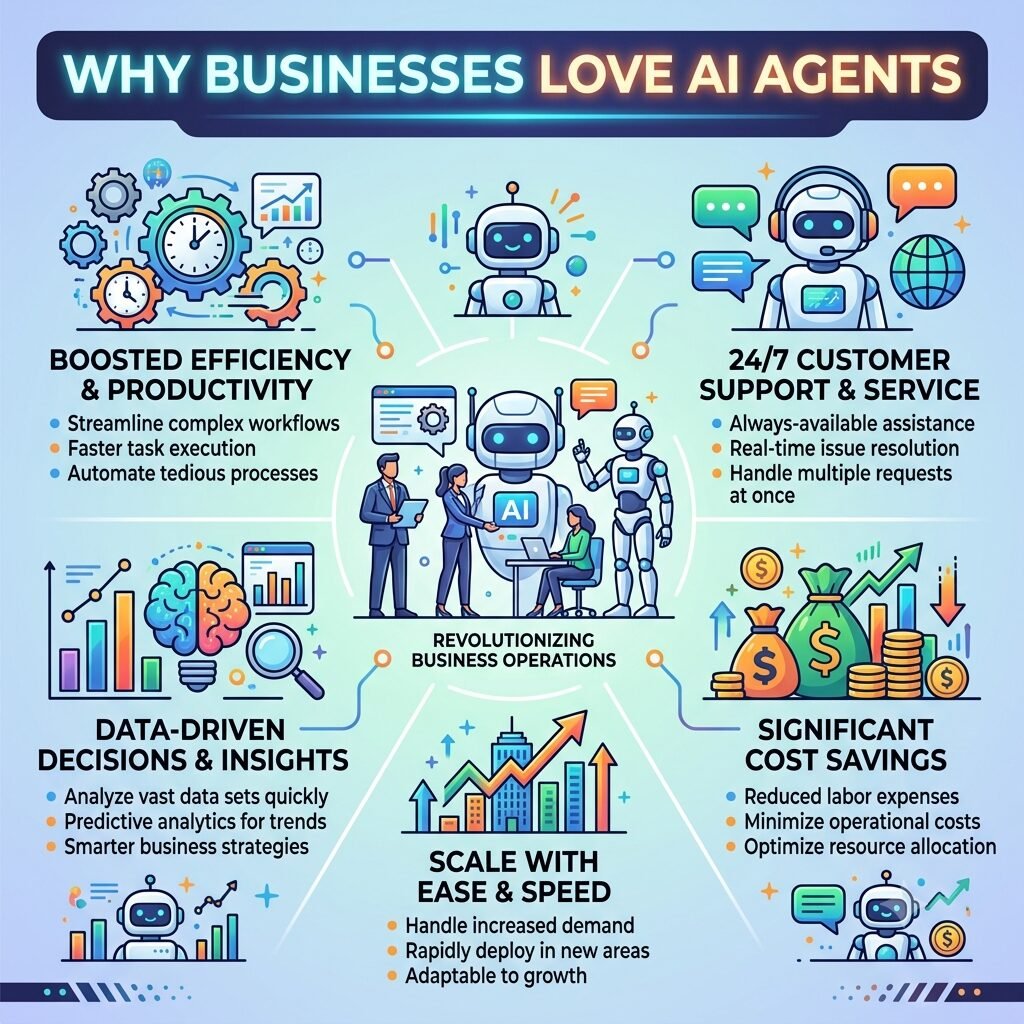
Businesses are increasingly adopting AI agents because they can automate complex workflows, improve efficiency, and support better decision-making. As organizations move past the experimentation phase, the measurable benefits are becoming harder to ignore.
The expected impact goes well beyond cost savings — touching productivity, customer experience, and personalization in ways that are starting to show up in real data.
Increased Productivity
One of the biggest draws of AI agents is what they do for productivity. Organizations deploying these systems expect an average productivity increase of 30%, driven largely by the automation of complex, multi-step workflows.
Senior leaders are already seeing results — 66% say AI has delivered significant productivity improvements across their organizations.
Workflow Automation
AI agents are built to handle tasks that span multiple systems and stages, making them a natural fit for organizations looking to reduce manual effort and streamline operations.
Confidence in the technology is notably high. 92% of leaders expect agentic AI to deliver measurable ROI within the next two years — which helps explain why adoption is accelerating so quickly.
Lower Operational Costs
Cost reduction is one of the most frequently cited reasons businesses are investing in AI agents. 67% of executives identify it as one of the most important benefits.
Some organizations are already reporting real results:
- Around 1 in 5 respondents say they’ve achieved ROI goals related to cost reduction
- 41% specifically cite savings in this area
Better Customer Experiences
The benefits of AI agents aren’t limited to internal efficiency. Organizations are also reporting improvements in customer satisfaction and employee experience — two areas that often get overlooked in conversations about automation.
Among surveyed leaders:
- 43% cite increases in Net Promoter Score
- 42% point to higher employee satisfaction levels resulting from productivity gains
24/7 Availability
Unlike human workers, AI agents can operate continuously — no time zones, no shift changes, no downtime. That makes them particularly useful for automating repetitive activities that need to run around the clock.
48% of respondents identify the automation of repetitive tasks as one of the major advantages of AI adoption, and consistent availability is a big part of that appeal.
Personalized Recommendations
AI agents can deliver more personalized experiences by combining long-term memory with user profiles. Because they retain context across interactions, they can make decisions based on previous behavior and accumulated history — not just the current session.
The result is a more consistent, individualized experience over time. For businesses, that kind of continuity is increasingly difficult to deliver through traditional systems alone.
Section 9: Challenges Nobody Talks About
Limitations and Risks of AI Agents
AI agents are genuinely capable — but they come with real limitations and risks that deserve honest attention. Their ability to operate autonomously introduces challenges that go well beyond what you’d encounter with a traditional chatbot.
Issues around reliability, security, privacy, and accountability all become more significant as agents interact with multiple tools and systems simultaneously.
Hallucinations
One of the most fundamental risks with AI agents is error propagation across multi-step workflows. With a chatbot, if something comes back wrong, you see it immediately and can correct course.
With an AI agent, it’s a different story. A mistake made in step three of a fifteen-step process can quietly compound through every subsequent step — by the time it surfaces, the damage is already done.
Beyond that, AI agents face the same challenges as other AI systems:
- Hallucinations — generating confident but incorrect information
- Bias — inheriting skewed outputs from training data or connected systems
- Model drift — gradual degradation in reliability over time
All of these can affect both safety and performance in meaningful ways.
Security Risks
Greater autonomy creates new attack surfaces. The OWASP Top 10 for Agentic Applications, formalized in 2026, identifies security risks that simply don’t exist in traditional chatbot deployments. These include:
- Delegated identity abuse
- Cross-agent prompt injection
- Tool misuse
- Uncontrolled autonomy
When governance and safeguards aren’t sufficient, greater autonomy and accessibility increase exposure to these risks considerably.
Privacy Concerns
AI agents often process sensitive information while moving across multiple systems — which creates real opportunities for data to end up where it shouldn’t. A few specific concerns worth noting:
- Confidential data can be exposed through observable outputs
- Private information can inadvertently end up in API calls to external services
- Sensitive context can be unintentionally shared in multi-tenant environments
- Unauthorized use of unapproved tools can increase the risk of data leaks
In practice, privacy risks scale with how many systems an agent touches.
Bias and Fairness
AI agents can inherit bias from several different sources — not just one. These include:
- Training data biases baked into the underlying language model
- Historical biases in external systems, particularly where records reflect past discrimination
- Workflow design itself, which can inadvertently encode unfair assumptions
Because agents operate independently through nonhuman identities, questions around accountability, fairness, and bias carry extra weight — especially in high-stakes domains like finance and healthcare.
Reliability Problems
AI agents deliver the most value when tasks span multiple tools and systems. For simpler, single-system interactions, a traditional LLM chatbot is often faster, cheaper, and easier to maintain.
That’s worth remembering: what is an AI agent isn’t automatically the right answer for every use case. When workflows are straightforward, adding agentic complexity can create more problems than it solves.
Ethical Concerns
When decisions are made autonomously, understanding how and why those decisions were reached becomes increasingly important — and increasingly difficult. Independent operation raises real questions about transparency and accountability.
Without that transparency, determining responsibility when something goes wrong becomes genuinely complicated. That’s not a minor concern — it’s one of the more consequential open questions in AI deployment right now.
Human Oversight Requirements
Even as autonomous capabilities improve, human oversight remains essential — particularly in critical applications. Unsupervised AI agents can amplify risks when shadow configurations or inadequate governance are in place.
The honest reality is that autonomy and oversight aren’t opposites. The most effective deployments generally treat human involvement not as a limitation, but as a necessary layer of safety and reliability.
Section 10: Industries Already Using AI Agents
How Different Industries Use AI Agents
AI agents are already being adopted across a wide range of industries. Their ability to automate workflows, process information, and support decision-making has made them useful in areas as varied as healthcare, finance, logistics, and software development.
The specific applications differ by sector — but the underlying goal is generally the same: improve efficiency and handle increasingly complex tasks without adding proportional headcount.
Healthcare
Healthcare organizations are using AI agents to process patient data securely and support clinical workflows. A few of the most notable applications:
- Clinical documentation — reducing documentation time by as much as 70%
- Disease diagnosis and monitoring — analyzing patient data to assist with detection and ongoing care
- Medical workflow automation — handling administrative tasks that would otherwise fall to clinical staff
In practice, the documentation use case alone has significant implications for how much time clinicians can spend with patients.
Finance
Financial institutions have found a range of uses for AI agents, particularly in areas that require processing large volumes of structured data quickly and accurately:
- Fraud detection — studies show reductions of 60–70% in false positives
- Compliance and transaction reviews
- Invoice reconciliation
- Loan risk assessment
- Know Your Customer (KYC) compliance
- Automated trading systems using real-time market analysis
The fraud detection numbers are particularly striking — fewer false positives means less time spent chasing down legitimate transactions.
Marketing
Marketing teams are using AI agents for cold outreach, follow-up communication, and broader content operations. Some organizations are reporting around five times greater content velocity after deploying these systems — meaning they’re producing significantly more content without a proportional increase in team size.
Customer Support
AI-powered customer service agents are increasingly handling multi-step support workflows from start to finish. Organizations are also deploying automated follow-up systems and response management tools to provide more consistent, around-the-clock assistance — improving both efficiency and customer experience.
Software Development
GitHub Copilot is probably the most widely recognized example here — an AI-powered coding assistant that helps developers write, review, and improve code. Beyond that, AI agents are also being used for:
- Automated testing
- Documentation generation
- Handling other repetitive development tasks that tend to slow teams down
Education
Educational applications are starting to take shape in two main areas:
- Personalized learning assistants that adapt to individual student needs
- Automated grading and feedback systems that reduce manual administrative work for educators
The personalization angle is particularly interesting — these systems can theoretically adjust to each student’s pace and learning style in ways that would be difficult to scale with human instructors alone.
Manufacturing
Manufacturing organizations are turning to AI agents for quality control and supply chain optimization. Both applications help improve operational efficiency — catching defects earlier and keeping materials and products moving more smoothly through complex production environments.
Logistics
In logistics, AI agents are used for supply chain automation and route optimization. Their ability to coordinate workflows and optimize transportation processes makes them genuinely valuable in operations where even small efficiency gains can add up quickly across large networks.
E-Commerce
E-commerce is one of the more consumer-visible use cases. AI agents are being used for tasks like booking flights, ordering groceries, and comparing prices — as well as delivering personalized recommendations that help surface more relevant products and experiences for individual shoppers.
Section 11: Can AI Agents Replace Humans?
Will AI Agents Replace Human Jobs?
Questions about automation and employment have followed every major technological shift — and AI agents are no exception. Their ability to perform tasks autonomously has understandably raised concerns about job displacement. But current research points more toward transformation and collaboration than outright replacement.
The impact is expected to vary significantly across industries and job functions. Some tasks will become automated. Others will continue to depend heavily on human capabilities in ways that are genuinely difficult to replicate.
Jobs Most Likely to Change
Research suggests that existing technologies could theoretically automate around 57% of work hours in the United States.
That number sounds significant — and it is — but it’s worth understanding what it actually means. It reflects technical potential at the task level, not guaranteed job losses. It describes what technology may be capable of doing, not what organizations will necessarily choose to automate.
Jobs AI Cannot Easily Replace
Roles that depend on human empathy, complex creativity, and ethical judgment remain considerably less susceptible to automation. These are areas where human involvement plays a critical role — and where AI agents, for all their capabilities, still face meaningful limitations.
In simple terms: AI agents are generally good at structured, repeatable, multi-step tasks. They’re much less suited to the kinds of judgment calls, emotional nuance, and contextual reasoning that define many human-centered roles.
Human-AI Collaboration
Research suggests that generative AI is actually creating new demand in augmentation-oriented roles — rather than simply eliminating existing ones. The more likely future involves collaboration between humans, AI agents, and robots working together, rather than AI operating entirely in place of people.
That shift is already visible in how organizations are restructuring workflows — not removing humans from the process, but changing where human attention and judgment are most needed.
Skills That Will Become More Valuable
As AI adoption expands, AI fluency is emerging as one of the most valuable skills a person can develop. Over the last two years, it has become the fastest-growing skill appearing in U.S. job listings — with demand increasing sevenfold.
That growth reflects something important: organizations don’t just need AI agents. They need people who understand how to work alongside them, direct them effectively, and recognize when human judgment needs to step in. That combination — human expertise plus AI capability — is increasingly where the value lies.
Section 12: Build Your Own AI Agent
How to Build an AI Agent
So you understand what is an AI Agent in theory — now how do you actually build one? In practice, it comes down to combining reasoning ability with memory, tools, and feedback loops. Implementations vary quite a bit from project to project, but the process generally follows five core steps.
Each piece plays its own role in helping the agent pursue goals and get better over time.
Step 1 – Define the Goal
The first step is defining the agent’s role, its goal, and its backstory.
Of these three, the backstory matters more than people expect. It shapes how the agent behaves and the way it approaches tasks — essentially setting the personality it’ll operate from.
Step 2 – Choose an LLM
Next comes picking a large language model. Common choices include:
- GPT
- Claude
- Gemini
Which one you go with typically depends on a mix of factors:
- Capability — how well it handles the task at hand
- Safety requirements — how much oversight or guardrails you need
- Cost — what makes sense for your budget at scale
Step 3 – Add Memory
Memory is what lets an AI agent hold onto context and stay consistent over time. Without it, every interaction would essentially start from zero.
Most modern agents blend short-term and long-term memory, often backed by vector databases, to retain information and apply it to future interactions.
Step 4 – Connect Tools and APIs
Tools are what let an AI agent reach beyond just generating text and actually interact with the outside world. Think of it this way: the LLM is the brain, and tools are the hands.
Common integrations include:
- APIs
- Databases
- Search engines
- Calculators
These connections give agents access to real information and let them carry out real-world tasks, not just talk about them.
Step 5 – Test and Improve
Improvement comes from feedback and experience — agents generally don’t get better just by sitting idle. Reinforcement learning, in particular, allows agents to learn from outcomes and adjust their future behavior accordingly.
Ongoing testing is what helps an agent adapt and sharpen its performance over time. This step never really ends.
Best AI Agent Frameworks
A handful of frameworks have popped up to make building AI agents easier. They generally handle the infrastructure side — memory, tool integration, planning, and coordinating multiple agents — so you’re not building everything from scratch.
LangChain
LangChain is one of the leading frameworks out there for building AI agents.
It offers extensive support for tool integration and has become something of a foundation that many other agent-based applications are built on top of.
CrewAI
CrewAI is built around role-based collaboration between multiple agents.
It’s designed specifically to support coordinated workflows, where several agents work together toward a shared objective rather than operating solo.
AutoGen
AutoGen is Microsoft’s framework for building multi-agent conversations and managing more complex workflows.
It lets agents communicate and cooperate with one another while handling sophisticated, multi-step tasks.
Semantic Kernel
Semantic Kernel is another Microsoft-developed framework for AI agent development.
It provides the tools needed to integrate language models with external systems and existing workflows.
LangGraph
LangGraph takes a graph-based approach to support complex agent workflows.
That structure makes it a good fit for applications involving multiple interconnected tasks and branching decision paths.
Programming Languages for AI Agents
The programming language you choose affects both development flexibility and how much ecosystem support you’ll have. A few languages dominate AI agent development, though some offer noticeably broader libraries and tooling than others.
Python
Python is still the go-to language for building AI agents, by a wide margin.
Its extensive ecosystem and library support are exactly why it remains the most widely used choice for agent development.
JavaScript
JavaScript has picked up real momentum for AI agent development, particularly in web environments.
Given how dominant it already is in web applications, it’s a natural fit for browser-based and interactive agent systems.
TypeScript
TypeScript brings type safety to enterprise applications and AI agent development alike.
That more structured approach makes it easier to support larger projects and more complex systems — the kind where catching errors early really matters.
Section 13: The Future of AI Agents
What Is the Future of AI Agents?
The rapid growth of agentic AI tells you pretty much everything you need to know: AI agents are moving past the experimentation phase and into broader, real-world adoption. Enterprise investment has picked up considerably, and organizations are folding autonomous systems into their operations at a pace that would’ve seemed ambitious just a couple of years ago.
Current trends point toward agents that are more capable, more collaborative, and more deeply woven into software ecosystems across the board.
Autonomous AI
The shift toward autonomous AI is essentially the next stage beyond traditional generative AI. Unlike systems that just sit there waiting to respond to a prompt, AI agents are built to perceive, reason, and act with growing independence.
That shift shows up clearly in the numbers. The global agentic AI market reached $10.86 billion in March 2026, up from $7.55 billion in 2025 — a jump that’s hard to ignore.
Multi-Agent Collaboration
Looking ahead, future systems are expected to lean more and more on multiple agents working in tandem rather than going it alone.
- Cooperative multi-agent systems let agents coordinate their actions and tackle problems as a group
- Through this kind of collaboration, teams of agents can take on tasks that would be genuinely difficult for a single agent to manage by itself
Physical AI and Robotics
It’s not just software, either — AI agents are extending into the physical world too. Physical AI systems take in visual and auditory information from their surroundings and turn that input into action.
Tesla’s Full Self-Driving system is a good example here. It shows how an agent can interact directly with the physical world, rather than staying confined to a screen.
Personalized AI Employees
Long-term memory and user profiles are what let AI agents offer more personalized experiences over time.
As those capabilities mature, agents are expected to get noticeably better at delivering consistent, individualized support — the kind that holds up across multiple interactions instead of resetting each time.
Enterprise Adoption Trends
Enterprise adoption keeps accelerating, and the numbers back that up:
- By the end of 2026, 40% of enterprise applications are expected to contain embedded, task-specific AI agents — up from less than 5% in 2024
- 23% of organizations are already scaling an agentic AI system
- Another 39% are still in the experimentation phase
- Deloitte projects that moderate adoption, currently sitting at 23%, could climb as high as 74% within the next two years
That’s a pretty steep curve for a technology that was still mostly theoretical not long ago.
Market Growth Predictions
Investment trends tell a similar story of continued expansion:
- Enterprise spending on agentic AI grew by 340% between 2025 and 2026
- Venture capital investment in agentic AI startups hit $18.4 billion through Q1 2026
- Autonomous AI systems alone pulled in $8 billion in funding during that same quarter
- Organizations deploying AI agents expect productivity gains averaging around 30%
- These systems are projected to generate as much as $450 billion in economic value by 2028, through a mix of higher revenue and lower costs
Taken together, it’s clear the momentum isn’t slowing down anytime soon.
Section 14: Frequently Asked Questions
Frequently Asked Questions About AI Agents
What is an AI agent in simple words?
Put simply, an AI agent is a system that uses an AI model to figure out what to do next, take action, and work toward a goal across multiple steps. Unlike a system that just answers a question and stops, an AI agent can plan, use tools, and keep going until the task is actually finished.
In simple terms: large language models generate language. AI agents take that language ability and pair it with memory, planning, and action to actually get things done.
Is ChatGPT an AI agent?
ChatGPT started out as an interface built around a large language model — essentially a really good conversational tool. Over time, though, it’s picked up real agent capabilities, through features like web browsing, code execution, and tool use.
Those additions let it do things beyond just chatting, though it’s worth noting the underlying language model is still just one piece of a larger system.
What is the difference between AI and AI agents?
Traditional AI is mostly built for pattern recognition and predefined tasks — it does what it’s designed to do, nothing more. AI agents, on the other hand, add reasoning, memory, planning, and action on top of that, so they can pursue goals on their own.
The big difference is this: traditional AI generally needs a human to kick off each task, while an AI agent can adapt, plan, and carry out multi-step work with minimal hand-holding.
Are AI agents the same as chatbots?
No, and this is a common mix-up. Chatbots are typically built for single-turn conversations and scripted back-and-forth.
AI agents, by contrast, are built for multi-step goal completion. They can:
- Retain memory across sessions
- Use tools
- Perform actions across multiple systems
- Adapt as conditions change
Can AI agents think like humans?
Not exactly. Modern AI agents use large language models as their reasoning engine, and they can genuinely evaluate options, plan tasks, and make decisions.
That said, they operate through goals, policies, machine learning models, and whatever context is available to them — not through anything resembling human consciousness. Their abilities come down to perception, memory, reasoning, planning, and action, which is a fundamentally different thing from human cognition.
Can AI agents learn over time?
Yes. Learning agents typically get better through feedback and accumulated experience.
Using reinforcement learning and other advanced algorithms, they adapt to changing environments and refine how they make decisions based on what’s worked (or hasn’t) in the past.
Are AI agents dangerous?
There are real risks worth being aware of: hallucinations, security gaps, privacy concerns, bias, and reliability issues. The fact that agents can operate autonomously also raises legitimate questions around transparency and accountability.
Because of all this, human oversight and proper governance still matter quite a bit — especially in sensitive, high-stakes applications.
Will AI agents replace jobs?
Research suggests existing technology could theoretically automate around 57% of work hours in the United States. That said, this is a measure of technical capability, not a guarantee of job loss — there’s an important difference between “could” and “will.”
The current evidence points more toward collaboration — humans, AI agents, and robots working alongside each other — with AI fluency emerging as one of the fastest-growing skills in the labor market today.
What programming language is best for AI agents?
Python remains the most widely used language for AI agent development, mostly thanks to its extensive ecosystem and library support.
JavaScript and TypeScript see plenty of use too, particularly for web applications and enterprise-grade systems.
What are some examples of AI agents?
Some well-known examples of AI agents include:
- ChatGPT Operator
- AutoGPT
- GitHub Copilot
- Tesla Full Self-Driving
- Google Gemini
- Customer service agents
- Siri
- Alexa
These systems show just how varied the application of AI agents has become — handling tasks, interacting with tools, and supporting workflows across both digital and physical environments.
Section 15: Conclusion
What Is an AI Agent and Why Does It Matter?
Understanding what is an AI Agent has become genuinely important, as these autonomous systems move out of the lab and into mainstream use. Unlike traditional chatbots or standalone large language models, AI agents combine reasoning, memory, planning, and action to pursue goals across multiple steps — not just one-off answers.
Their growing popularity reflects a broader shift: from systems that simply generate content to systems that actually go and complete tasks. Businesses are pouring money into agentic AI because of what it promises — better productivity, automated workflows, and new forms of economic value. By the end of 2026, embedded AI agents are expected to be a common fixture in enterprise applications, which says a lot about how fast adoption is moving.
At the same time, AI agents bring their own set of challenges that shouldn’t be glossed over:
- Hallucinations
- Security risks
- Privacy concerns
- Bias
- The ongoing need for human oversight
These systems tend to shine most when workflows span multiple tools or systems and require planning, memory, and coordination — rather than just answering a simple question.
What’s striking about this moment is that we’re still early. Multi-agent collaboration, physical AI, and increasingly personalized systems all point toward capabilities that are only going to expand from here. Whether they’re helping write code, automating business processes, or interacting with the physical world, AI agents are gradually becoming a bigger part of how work actually gets done.
The big difference? Earlier generations of AI mostly stopped at producing information. AI agents are increasingly designed to do something with it. As organizations and individuals keep exploring these systems, understanding what is an AI Agent is becoming less about learning a buzzword and more about understanding where AI itself is headed.