

Generative AI is remarkably good at working out what a customer means. It copes when they explain things badly, change their mind halfway through, or cram three requests into one message. But in insurance, banking, healthcare, telecom, and other high-stakes industries, understanding intent only gets you so far. The company still has to verify who it’s talking to, apply policy the same way every time, enforce limits, get approvals, and leave a record someone can audit later.
That’s the core dilemma of enterprise AI: LLMs are probabilistic, but compliance-critical processes have to be deterministic. The answer isn’t to squeeze the model until it turns into a rigid script. It’s to give the AI a deterministic “spine”: fixed, rule-based steps that run outside the model and decide what the agent is allowed to do.
That’s the idea behind Zingtree’s Zing Engine, which pairs agentic reasoning for language and judgment with deterministic flows for the steps that must happen identically every time.
The enterprise AI trust gap
Enterprise leaders don’t just want a chatbot that answers FAQs. They want an agent that can take on a frustrated policyholder, spot the disputed claim, pull the right context, explain what happens next, and send the case to the right place.
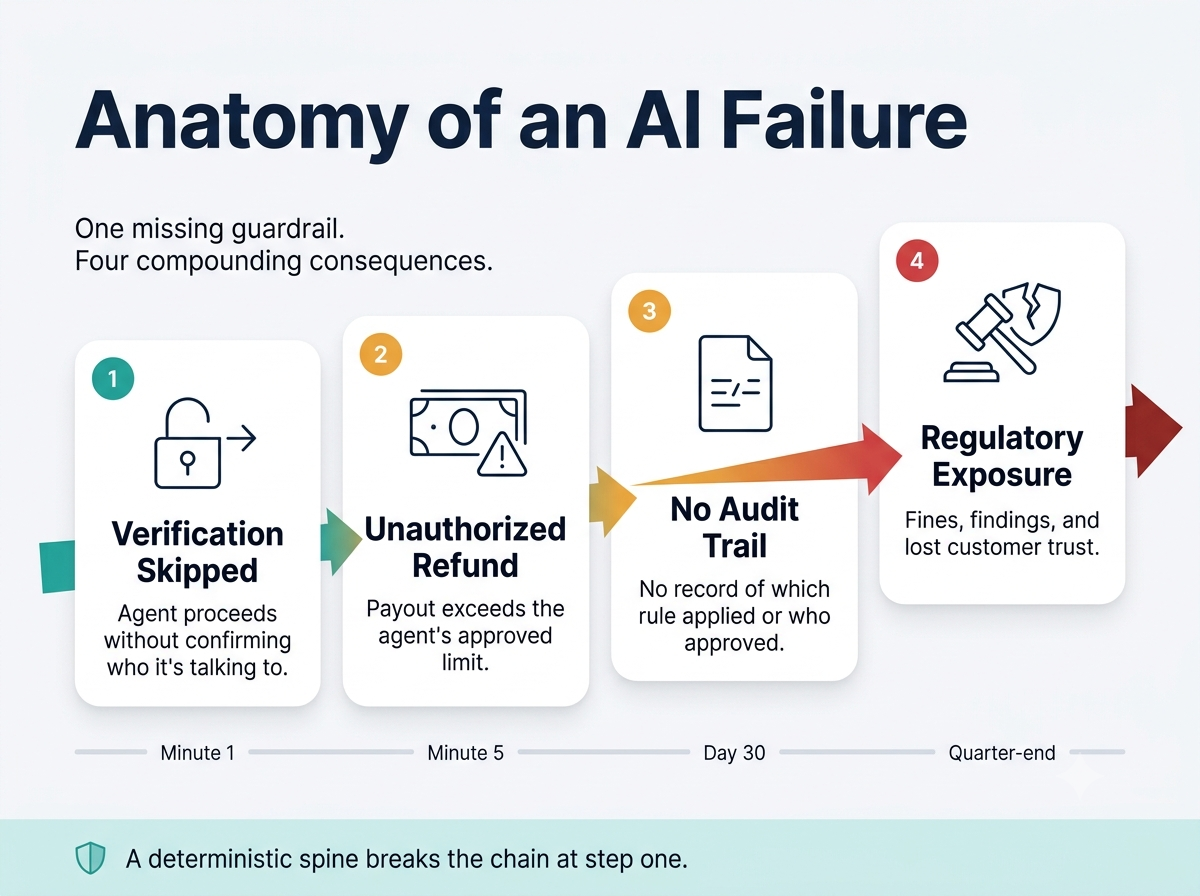
The trouble is that the flexibility that makes an LLM useful is the same thing that makes it risky. It might read a policy one way on Monday and another way on Tuesday. It might skip a verification step. It might promise something nobody approved, or suggest a refund that blows past the limit.
In a high-stakes setting, those aren’t small quality problems. They’re compliance failures, financial exposure, and the kind of mistakes that break customer trust. Zingtree frames the challenge as governing AI agents across systems and channels while keeping them grounded in the company’s source-of-truth business context, decision logic, and compliance requirements.
Why LLM reasoning breaks under compliance pressure
LLMs generate responses from patterns in language and context. That’s what makes them so good at understanding natural language, but it also means the same input doesn’t always produce the same output.
In an enterprise workflow, that shows up in some predictable ways:
- Policy drift: The model summarizes or applies a rule differently from one conversation to the next.
- Skipped steps: The agent presses on without finishing identity verification or an eligibility check.
- Overreach: It proposes a refund, cancellation, account change, or disclosure that’s beyond its authority.
- Inconsistent language: Required disclosures, legal wording, or approved explanations shift without anyone intending them to.
- Weak auditability: It’s hard to show which rule was applied, why an action happened, and who signed off.
The important point is this: feeding a model deterministic input doesn’t give you deterministic output if the model is the one making the decision. You can hand it the exact same policy document every time, and it may still reason differently about an ambiguous case. Zingtree’s guidance on deterministic steps draws this same line.
The false choice: rigid scripts vs. unconstrained agents
For years, companies got predictability from rigid scripts, decision trees, and workflow rules. They were reliable, but they fell apart the moment a customer didn’t talk in neat, predefined branches.
LLM agents fixed that rigidity but created a new problem. If a model can reason freely about policy, it can also improvise around it.
| Capability | Rigid workflow | Unconstrained LLM agent | Hybrid engine |
|---|---|---|---|
| Natural-language understanding | Weak | Strong | Strong |
| Ambiguity handling | Weak | Strong | Strong |
| Policy enforcement | Strong | Variable | Enforced outside the model |
| Required-step sequencing | Strong | Can be skipped or reordered | Fixed and non-skippable |
| Auditability | Strong | Harder to prove | Step-level and replayable |
| Complex-journey scalability | Limited | High, but risky | High with guardrails |
So the real answer isn’t choosing between flexibility and control. It’s separating the two on purpose.
The deterministic “spine”
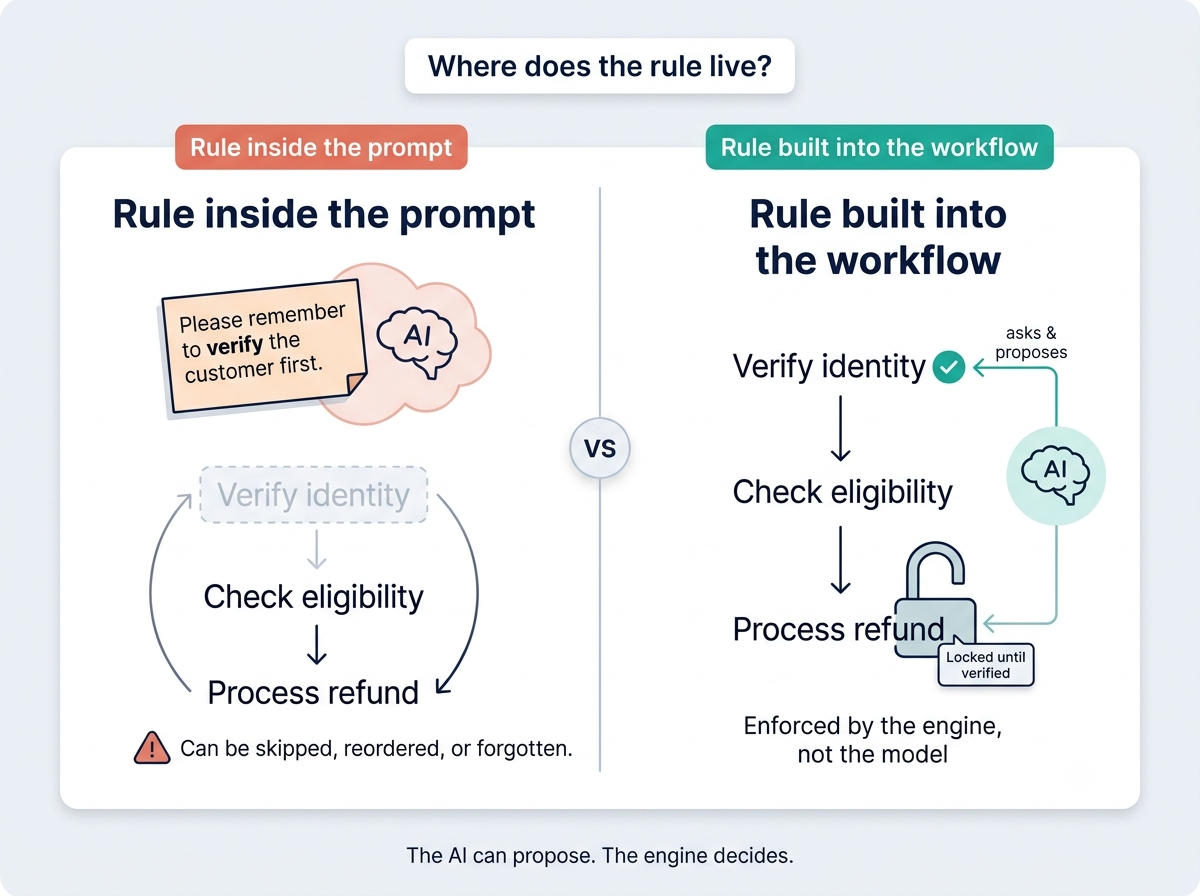
Think of the spine as the set of mandatory steps that must happen before the company takes any consequential action. It’s like a compliance checklist, except the system enforces it instead of trusting a prompt to remember it.
A typical spine includes:
- Identity verification
- Account, policy, or entitlement lookup
- Eligibility and coverage checks
- Refund, credit, cancellation, or transaction limits
- Required disclosures and locked wording
- Approval thresholds and human review
- System-of-record updates
- Complete audit logging
None of this should live inside the LLM as an instruction like “always verify the customer first.” It should run as hardcoded, rule-based automation outside the model. In Zing Engine, deterministic flows run in the engine, not in the AI. The AI can ask, explain, and propose, but it can’t reorder or skip a required step.
It’s the difference between asking an employee to remember the rules and building the rules into the workflow itself.
Inside Zingtree’s hybrid engine
Zing Engine splits the work between a few complementary pieces:
- Agentic skills handle the conversation: interpreting intent, working through ambiguity, explaining options, drafting responses, and deciding on the next best action.
- Deterministic flows handle execution: identity checks, eligibility rules, limits, locked wording, approvals, and system actions.
- Guardrails look at what the customer says, what the engine is about to do, and what the AI replies, then allow, modify, block, or escalate accordingly.
- Auditability records every step, rule, version, and decision, so teams can review and replay the full path.
The model is still essential, but it’s no longer the only decision-maker. It becomes the conversational intelligence working inside a governed environment.
Zingtree calls this an agentic-deterministic hybrid. The engine shifts how much autonomy the AI has mid-conversation, using it for language and judgment while checking every step, acting in enterprise systems, and recording the outcome.
A worked example: claims dispute resolution
Say a policyholder writes: “My claim was denied, but I think the adjuster missed something. Can someone reopen it?”
A hybrid engine handles that in four broad stages:
- Understand the request. The AI interprets the free-form dispute, asks clarifying questions if it needs to, and identifies the relevant claim and policy.
- Verify identity. A deterministic flow runs the same identity checks every time, outside the model.
- Assess the dispute. The AI reviews the claim against the policy information and explains what it finds in plain, customer-friendly language.
- Execute the decision. A deterministic flow reopens and routes the claim according to configured rules. If reopening a closed claim crosses a defined threshold, the engine pauses and waits for supervisor approval.
This is the claims-dispute pattern Zingtree itself uses to illustrate the approach: agentic skills manage the conversation and the claim review, while deterministic flows verify the policyholder and reopen and route the claim. The engine then updates connected systems, notifies the policyholder, and records every step.
The key thing is that the AI can’t decide on its own to skip verification, change locked wording, or reopen a claim outside the configured flow.
Where to draw the line
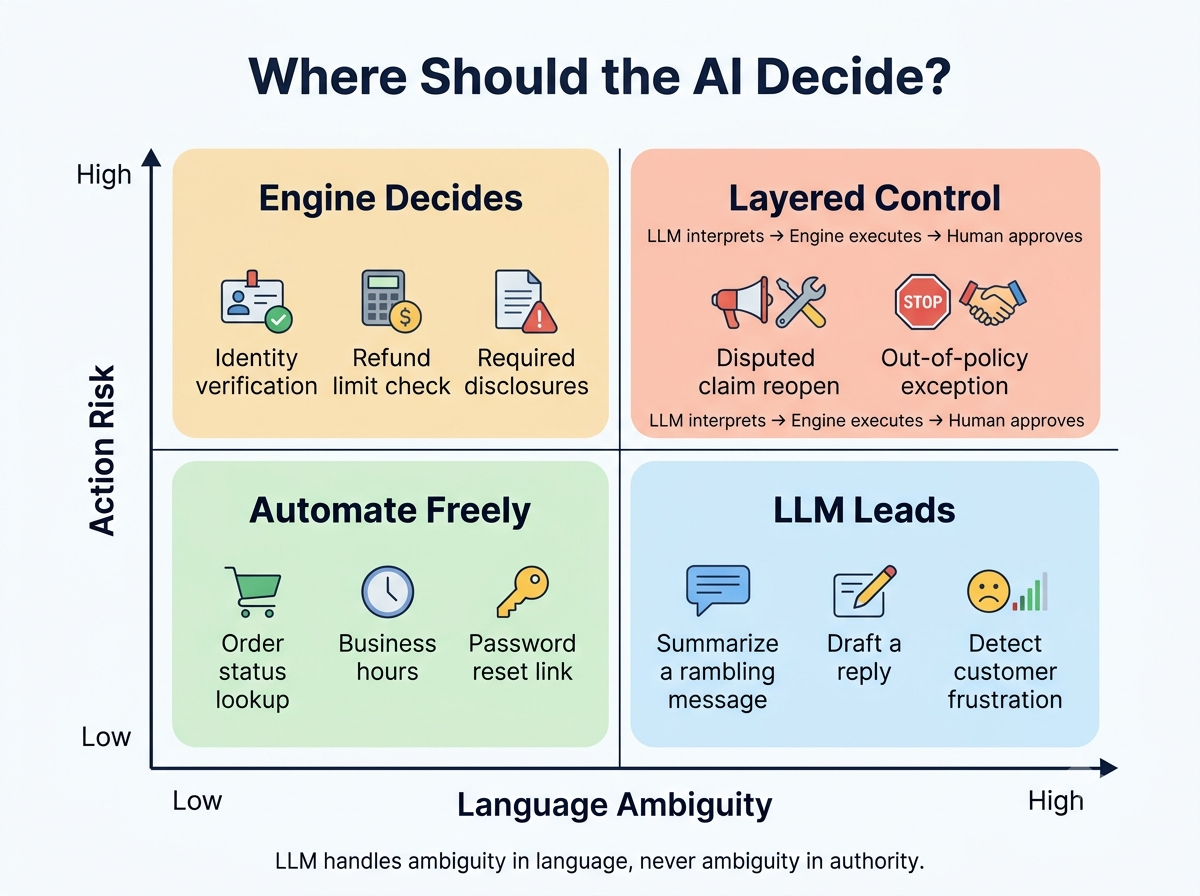
Every enterprise has to answer the same practical question: which decisions belong to the model, and which belong to the engine?
| Give the LLM | Give the deterministic engine | Give humans |
|---|---|---|
| Intent recognition | Identity verification | High-risk approvals |
| Tone and urgency assessment | Eligibility and coverage checks | Exceptions outside policy |
| Clarifying questions | Refund and transaction limits | Contested decisions |
| Response drafting | Required disclosures | Escalation judgment |
| Summarization | System-of-record updates | Novel or ambiguous edge cases |
| Next-best-action recommendations | Approval thresholds | Final accountability |
A handy rule of thumb: let the LLM deal with ambiguity in language, but never ambiguity in authority. The model can work out what the customer wants. The deterministic engine decides what the company is actually permitted to do about it.
Compliance becomes architecture, not an afterthought
Plenty of AI programs treat compliance as the last layer. Add a disclaimer, tell the model to follow policy, and hope it does. That approach doesn’t scale.
In a hybrid architecture, compliance is built into the structure:
- Rules and flows are version-controlled.
- Guardrails run before consequential actions.
- Sensitive steps require verification or approval.
- Every conversation, action, and decision is logged.
- Teams can replay the exact path behind any outcome.
- Models can be swapped out without rewriting the underlying policy logic.
Zing Engine’s guardrails run outside the AI at three points: the customer’s input, the action the engine is about to take, and the AI’s response. Each check ends in one of four outcomes: allow, modify, block, or escalate.
That turns compliance from a hope baked into a prompt into something the system actually enforces.
The business case for hybrid AI
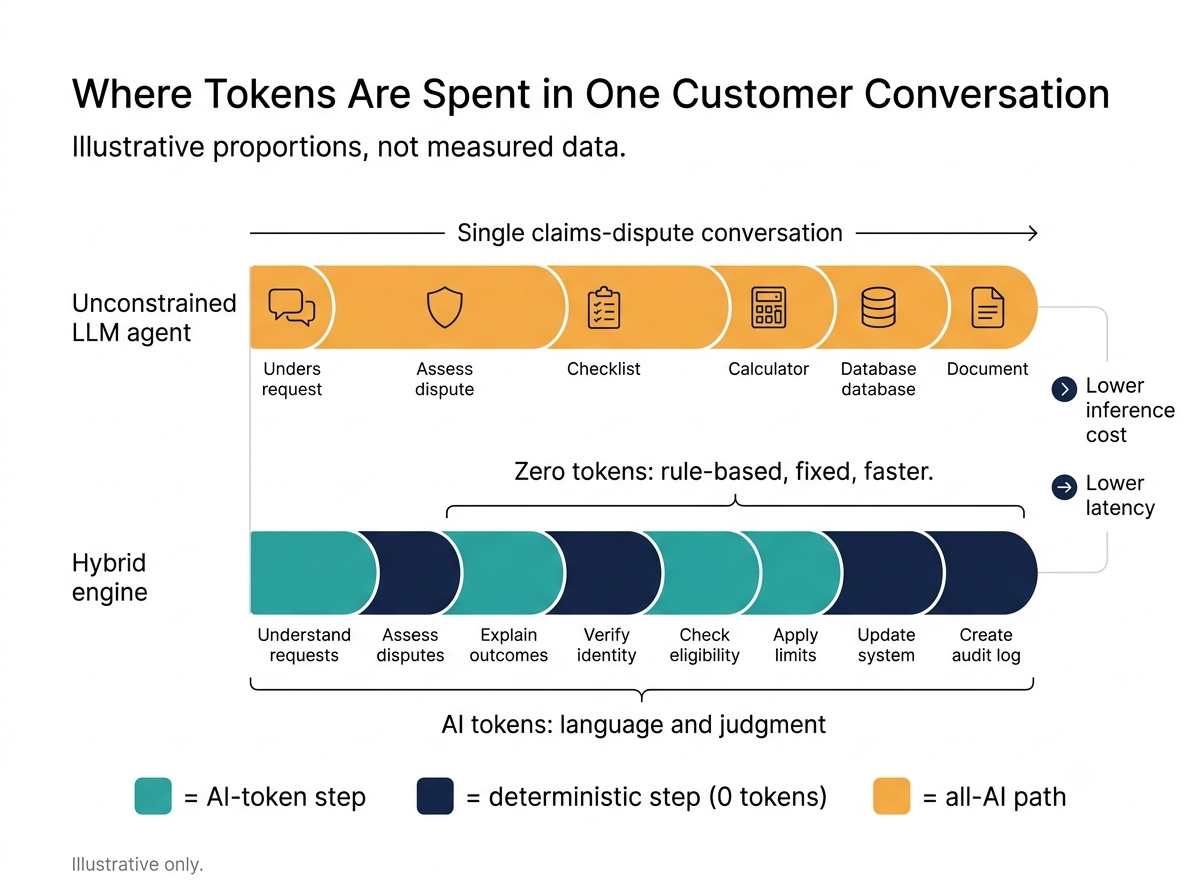
A deterministic spine does more than cut risk. It also makes AI automation more practical, both operationally and financially.
- Predictable outcomes: Required steps run the same way every time.
- Lower cost and latency: Fixed, rule-based steps don’t use AI tokens, which cuts inference cost and speeds things up.
- Broader automation coverage: Teams can safely expand what the agent is allowed to do.
- Fewer exceptions: Guardrails stop many policy violations before they happen.
- Better customer experience: Customers get a natural conversation without losing reliable execution.
- Faster enterprise adoption: Leaders are more willing to approve AI that can act, because its boundaries, evidence, and escalation paths are visible.
What you end up with is an agent that works at enterprise scale without turning into either a brittle script or an uncontrolled autonomous system.
Autonomy needs boundaries
The future of enterprise AI isn’t “more model” or “less model.” It’s a cleaner separation of responsibilities.
Let the LLM understand the customer. Let the deterministic engine decide what the company will do. Let guardrails, approvals, and audit trails make sure every action can be explained later.
Also Read: How Weaponized AI Agents Ran Hundreds of AWS API Probes in Under 30 Minutes
That’s how the hybrid engine dilemma gets resolved: probabilistic reasoning inside a deterministic spine. Zingtree’s approach puts agentic reasoning where it adds value and deterministic control where trust, policy, and compliance demand it.