

Most enterprise AI agents fail in the same place. The agent keeps working until it gets unsure, then passes the case to a human. By that point the damage may be done: an account has been changed, a refund has gone out, or a customer has been promised something the business can’t deliver.
Zoho’s new Blended Agents in Zoho Desk take a different approach. Instead of treating human oversight as something that starts after an escalation, Zoho lets representatives pause the AI mid-execution and review or approve an action before it goes through. Oversight stops being cleanup and becomes prevention.
That’s the difference between a chatbot handoff and an execution gate.
The blind handoff problem
“Human in the loop” gets thrown around a lot, but in many deployments the human is really after the loop. The agent finishes its workflow, the customer sees the result, and only then does someone review what happened.
That’s fine for low-risk conversations. It gets dangerous once an agent can act across business systems.
A support agent might need to pull order data, check inventory, update a customer record, trigger a workflow, notify another team, and tell the customer it’s resolved. Zoho describes Blended Agents as able to retrieve information across connected apps and do things like look up order details, check stock, and update customer accounts.
So the question isn’t whether an AI agent can answer a support query anymore. It’s whether the company can stop one specific next action before it changes anything in production.
What Zoho actually launched
Zoho introduced Blended Agents as part of a broader Zoho Desk update. They run on Zoho’s Zia Agents platform and are meant to combine AI execution with human judgment in customer service workflows.
Blended Agents can:
- Retrieve information from connected business applications
- Use context from uploaded documents and third-party tools
- Retrieve order details and check stock
- Update customer accounts
- Hand over a conversation, with its history and context, when human judgment is needed
- Be paused by a representative so an action can be reviewed or approved before it runs
That last one deserves a closer look. Zoho says representatives can pause AI execution to review or approve an action before it proceeds, so teams can use AI for defined tasks and keep control over anything that needs a human’s call.
This goes beyond “AI answers tickets, humans handle exceptions.” The AI does real operational work, and humans keep a live control point over selected actions.
The overdone angle
The obvious headline is that Zoho launched AI agents to automate customer service while keeping humans involved. That’s accurate, but it’s only part of the story.
| Common framing | Why it misses the bigger shift |
|---|---|
| “Zoho launched AI agents for customer support.” | True, but agentic support is rapidly becoming a category rather than a differentiator. |
| “AI handles routine tickets; humans handle complex cases.” | This describes escalation, which conventional chatbots and help desks have offered for years. |
| “Humans remain in the loop.” | Too vague. The important question is: at which point in the loop? |
| “Zoho enables automation with oversight.” | The sharper insight is that oversight can occur before execution, not only after escalation. |
The usual model asks, “Can the agent escalate?” Zoho’s model asks something more useful: “Can we pause a proposed action before it becomes irreversible?”
The Granular Execution Gate
I’ll call this a Granular Execution Gate: a checkpoint between an agent’s decision and its effect on a business system.
Agent proposes an action → gate evaluates it → human approves, rejects, or redirects → system executes.
The gate doesn’t need to interrupt every step. It earns its keep by sitting where an action becomes consequential. Think of things like:
- Updating a customer record
- Changing account status or entitlement
- Calling an external API
- Triggering a workflow in another system
- Issuing a refund, credit, or discount
- Sending a customer-facing confirmation
- Closing a ticket after a financial or operational change
Zoho’s wider Zia Agents platform already supports human-in-the-loop execution for things like drafting emails, updating records, and scheduling tasks. It also includes approval workflows, execution limits, contextual validation, restricted boundaries, and traceable action logs. The new pause capability in Zoho Desk makes that control visible inside a live customer-service workflow.
Why “bot or human” is the wrong binary
Traditional automation gives you a blunt choice: the system acts on its own, or a person takes over. That doesn’t hold up with agentic AI, because one customer request often mixes safe steps with risky ones.
Take this request:
“Please update my billing address and apply the loyalty discount.”
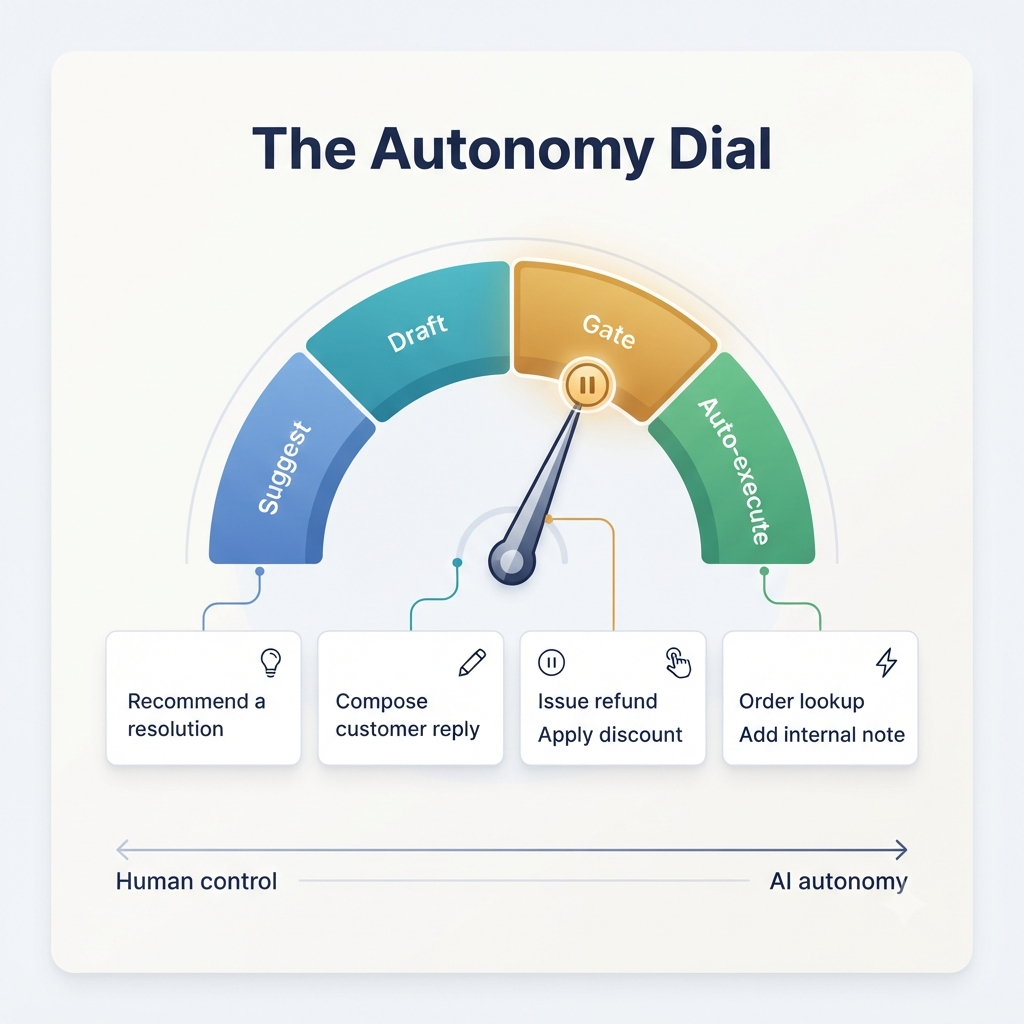
Not every step deserves the same level of control.
| Step | Risk level | Appropriate control |
|---|---|---|
| Retrieve customer profile | Low | Automate |
| Verify entitlement | Low to medium | Automate, with policy checks |
| Update address | Medium | Gate or policy-based validation |
| Apply discount | High | Human approval gate |
| Send confirmation | Medium | Approval or template guardrail |
| Close ticket | Low | Automate after verification |
A binary handoff either burns human time on low-risk steps or leaves the business exposed by automating high-risk ones. Execution gates let teams automate the safe parts and keep people in charge of the parts that matter.
Zoho’s own workflow guidance suggests planning ahead for critical-action failures: retry, alert a person, or route to an alternative path. An execution gate takes that same thinking and applies it before something goes wrong, not just after.
The real problem: multi-step agent drift
Agent drift happens when an agent starts with a reasonable reading of a request, then makes a string of small assumptions that pile up into the wrong outcome.
Say a customer asks for a refund on a damaged order.
- The agent pulls the order and sees the return policy allows it.
- It assumes the customer wants a full refund rather than a replacement.
- It updates the order status.
- It triggers a refund workflow.
- It sends a confirmation email.
- Only now does it escalate, because the refund is over a threshold.
By step 6, escalation is too late. The business has already committed, changed system state, and told the customer it’s done.
A mid-execution gate could stop things before step 3 or 4. The representative would see the proposed refund, the order update, and the draft customer message before any of it happens.
That’s the difference between reviewing an incident and preventing one.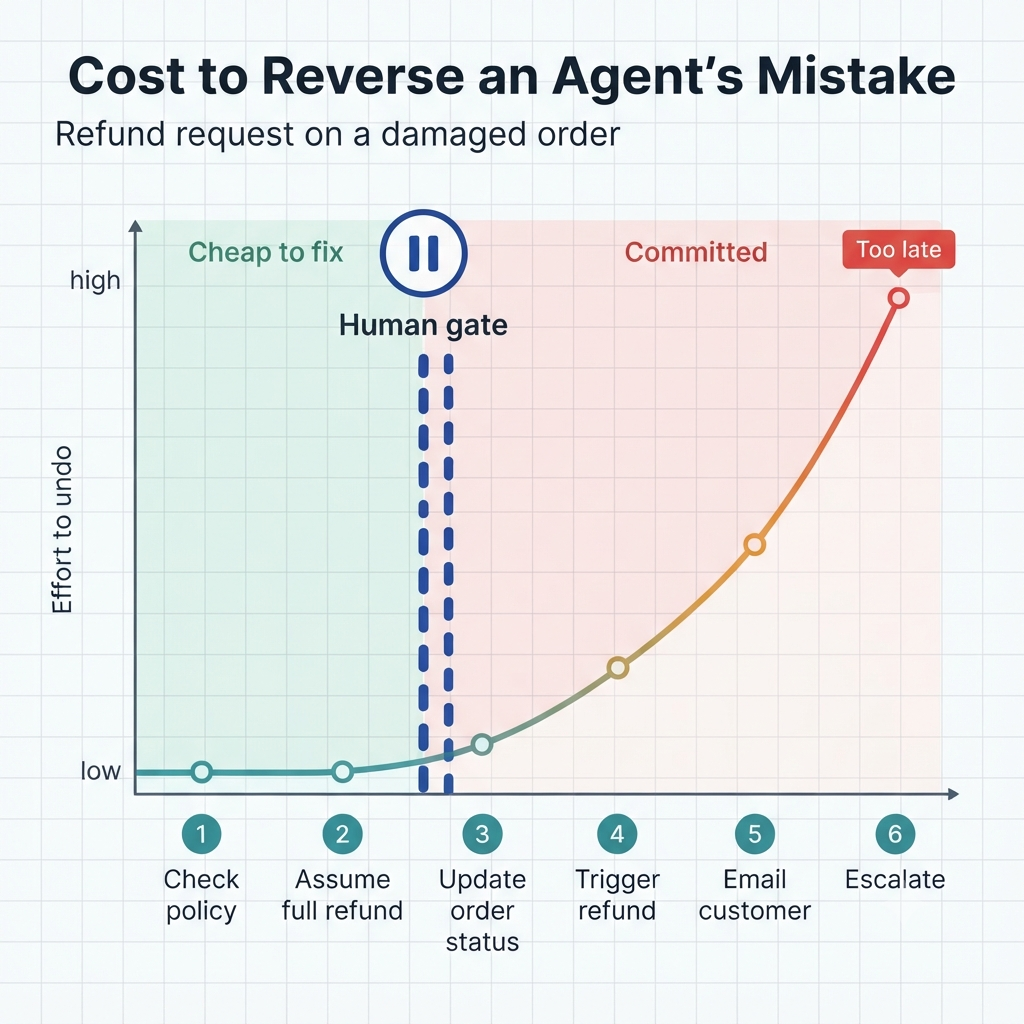
What mid-flight oversight changes
Escalation-centric oversight
In an escalation-first setup, the agent runs until it hits uncertainty. A human then inherits a finished or half-finished case and has to work out what went on.
The problems are easy to predict:
- The customer may already have experienced a wrong action
- A CRM, ERP, billing, or inventory system may now hold bad data
- The team spends its time repairing state instead of solving the issue
- The audit trail explains the outcome only after the fact
- Trust in automation wears down after a few visible mistakes
Execution-centric oversight
With an execution gate, the agent pauses before a designated consequential action. The human sees the proposed action in context and can approve, reject, edit, or reroute it.
Downstream steps stay controlled, and the approval history becomes part of the operational record.
Zoho says Zia Agents gives visibility into each execution step, including reasoning, actions, approvals, and observability metrics. So the pause button isn’t only a customer-experience feature. It’s also a governance tool.
The architecture behind the pause button
Picture the agent as a decision engine and the gate as a policy-aware transaction boundary. A practical setup has these layers:
- Intent layer: what the customer asked for
- Reasoning layer: what the agent thinks it should do
- Action plan: the proposed sequence of system operations
- Policy layer: what the agent may do without approval
- Gate layer: where execution pauses for review
- Identity and permissions layer: who can approve what
- Audit layer: what was proposed, approved, rejected, and executed
Zoho says Zia Agents can restrict agent actions, require approval, inherit role-based access controls, log recommendations and actions, and provide execution-level observability. Its Agent Studio documentation also says enterprises can define which systems an agent can access, which actions need approval, and what the agent should never touch.
So the pause button isn’t a standalone feature. It’s the part of a larger control architecture that users actually see.
A practical enterprise design pattern
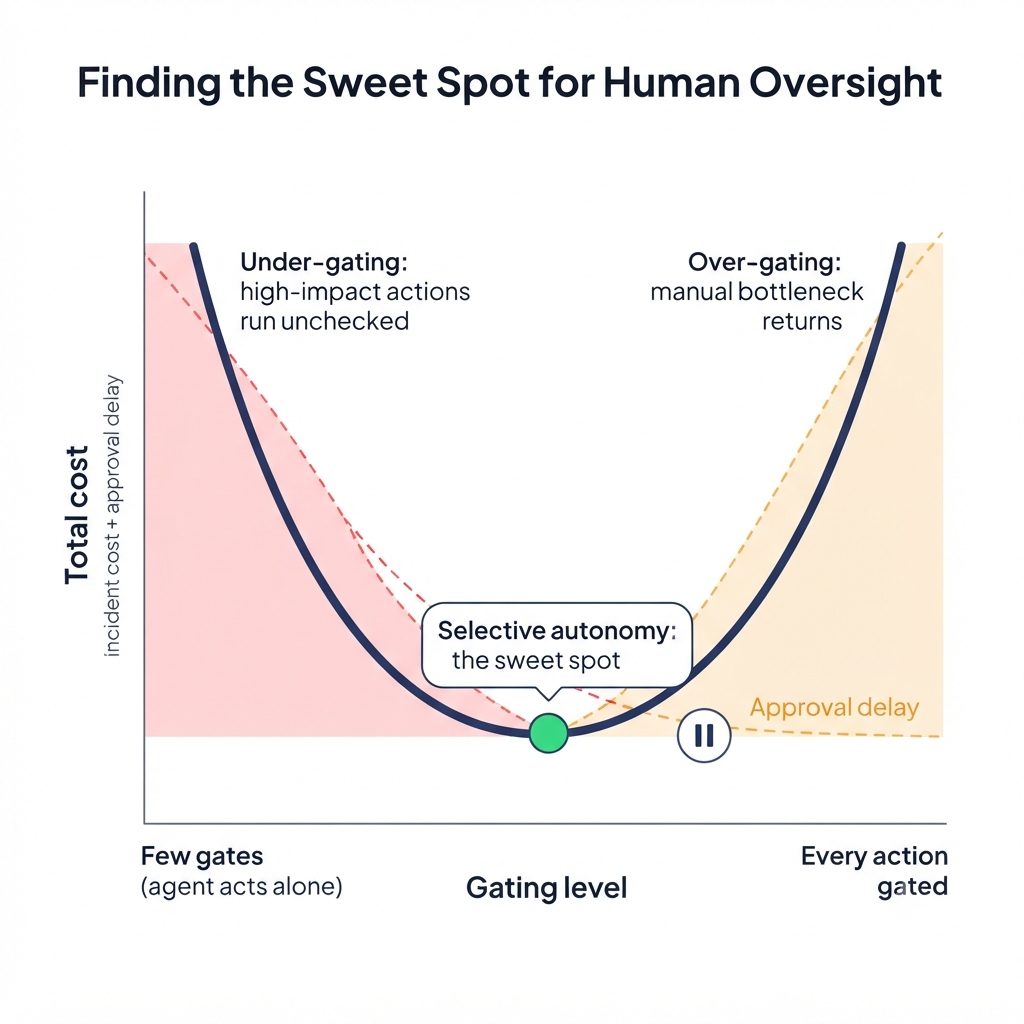
The most useful rule is a simple one: don’t gate every action. Gate the first action that is expensive to reverse, customer-visible, financially material, or cross-system.
| Action class | Examples | Recommended control |
|---|---|---|
| Read-only | Order lookup, stock check, knowledge search | Automate |
| Low-risk write | Add a note, update a non-financial field | Automate with validation |
| Customer-visible action | Send email, change contact preference | Approval or template constraint |
| Financial action | Refund, credit, discount, billing change | Mandatory human approval |
| Account-state change | Deactivate account, change ownership, alter entitlement | Mandatory approval |
| Cross-system action | CRM update plus ERP update plus notification | Gate at the first irreversible step |
This helps you avoid two failure modes:
- Over-gating: every action waits for approval, and you’ve rebuilt the manual bottleneck AI was supposed to remove.
- Under-gating: the agent takes a high-impact action on its own that should never have left human hands.
The aim isn’t less automation. It’s selective autonomy.
Why this matters for customer experience
The pause gate isn’t anti-automation. It’s what makes higher autonomy commercially workable.
Customers benefit because routine, low-risk requests move fast. Agents can finish multi-system work instead of just answering questions. And humans step in where empathy, negotiation, and judgment count most, which is the strength Zoho emphasizes in how it positions Blended Agents.
For the business, the payoff is just as real: fewer unrecoverable actions, clearer accountability, and a more believable path to putting agents into systems that touch revenue, customer data, and operations.
Autonomy without intervention points is not trust. It is hope with an API key.
The limitations
A pause gate isn’t a complete governance strategy. How well it works depends on the system around it.
Enterprises still have to answer some hard questions:
- Which actions are consequential enough to need approval?
- Who has the authority to approve each class of action?
- How fast do approvals need to happen to protect the customer experience?
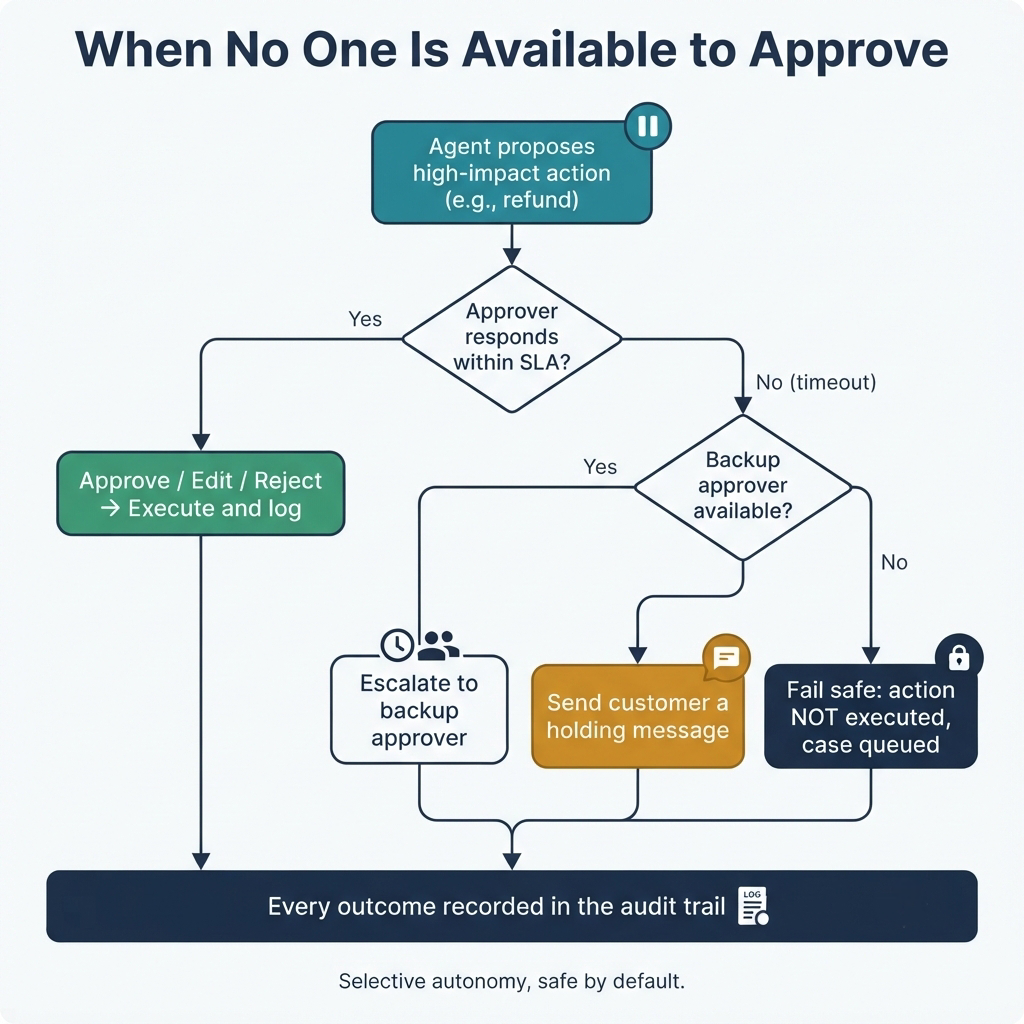
- What happens if the approver is unavailable?
- How do you present a proposed action so a human can actually understand it?
- What evidence gets kept when an action is approved or rejected?
- How do you version policy changes as business rules evolve?
A pause button adds latency. Used everywhere, it brings back the manual-review queue automation was meant to kill. Used selectively, it becomes the control point that makes broader automation defensible.
Zoho’s handoff also carries over conversation history and context, so customers don’t have to repeat themselves. But that context is only as good as the data, permissions, and workflow design underneath it.
What competitors should learn
Zoho’s Blended Agents offer a useful lesson for anyone building agentic AI for the enterprise:
- Escalation is not oversight. A handoff after the action is incident response.
- Approval is not autonomy. Requiring sign-off on every step wipes out the value of agents.
- Granularity is the product. The winning pattern is selective intervention at consequential boundaries.
- Context is the interface. Nobody can responsibly approve an action they can’t understand.
- Auditability is a feature, not a compliance afterthought. Proposed actions, approvals, rejections, and results should all be traceable.
From copilot to controlled operator
Zoho’s Blended Agents matter less because they automate support tickets and more because they show a practical control model: AI can act across systems, and humans can stop the right action at the right moment.
The future of enterprise AI won’t be decided by which agent does the most without people. It’ll be decided by which systems let people step in before an agent’s next action turns into a business problem.
That’s the real promise of the mid-execution gate. Not a slower AI, but a safer one.