
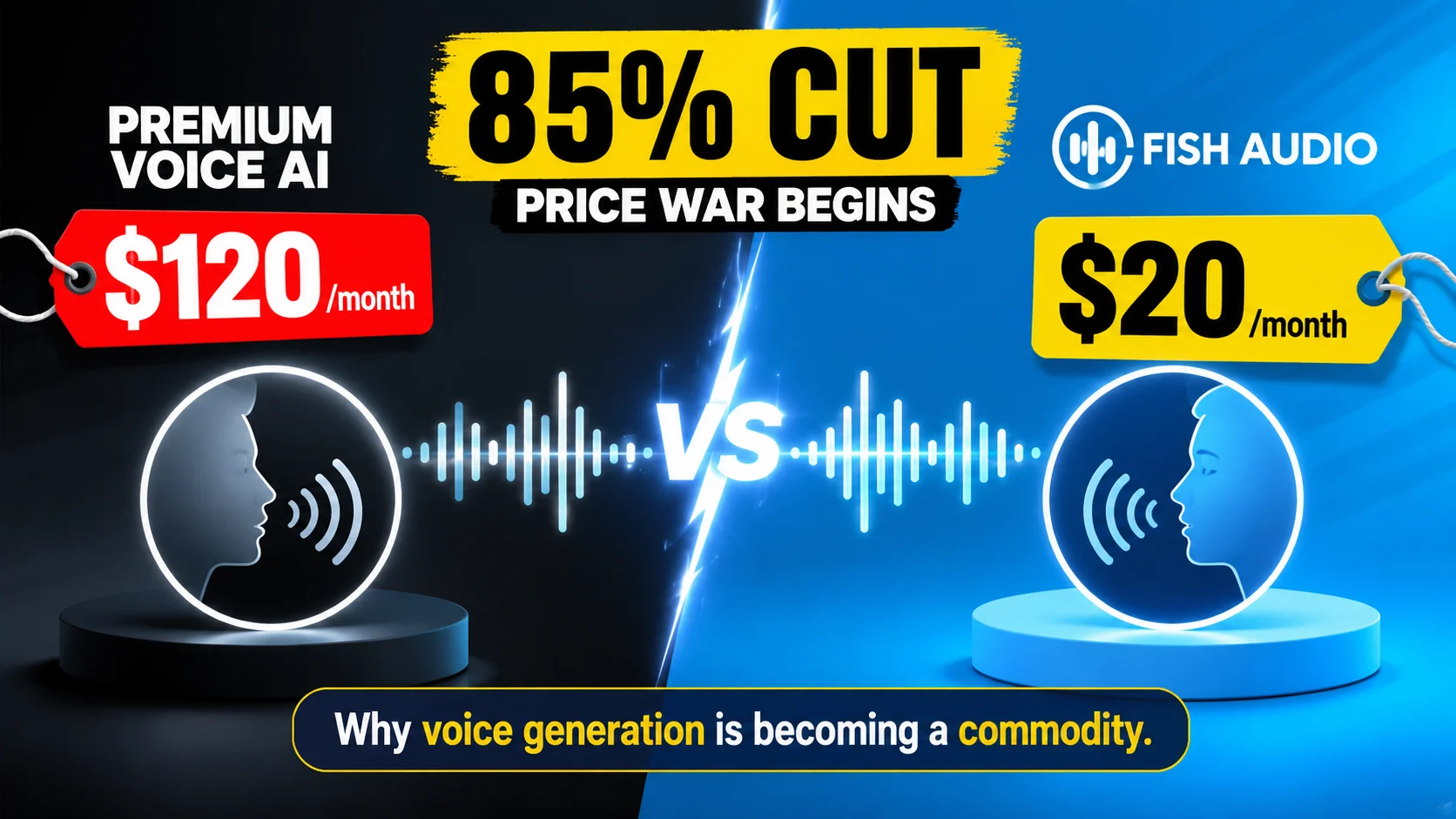
Fish Audio’s low-cost voice synthesis is pushing high-fidelity TTS toward commodity pricing, and startup founders building always-on AI agents may be the first to feel the impact.
Fish Audio blasting open the economics of voice AI has sent a shockwave across the synthetic audio industry. With a state-of-the-art voice model delivering an 85% cost reduction—slashing inference expenses down to 1/6th the price of premium competitors—the company is triggering an urgent price war just as 8 million developers race to deploy 24/7 autonomous agents. Will incumbents survive by offering higher quality, or will cheaper voice generation reshape the entire market forever?

What Fish Audio Changed
Fish Audio’s new inference architecture slashes the baseline cost of running real-time, emotional text-to-speech. Instead of charging high character-based rates, Fish Audio brought API costs down toward $0.015 per 1,000 characters (or ~$15 per million characters).
That is roughly 1/6th of the standard $0.10 per 1K characters charged by top-tier voice providers like ElevenLabs for standard high-fidelity voice output.
- It turns voice into infrastructure: Voice synthesis is no longer a luxury feature; it is becoming cheap piping.
- It enables real-time scale: AI voice agents can now maintain ongoing conversations without blowing up API budgets.
- It resets market expectations: Builders no longer accept premium rates without clear differentiation.
Why the Pricing Shock Matters
As conversational agents take over customer service, sales outreach, and interactive gaming, speech generation is migrating from static recording to always-on voice streams. Running voice models 24 hours a day means unit economics determine whether a startup scales or burns out.
| Key Factor | Impact on AI Startups & Developers |
|---|---|
| 85% Cost Drop | Makes running continuous voice agents economically viable. |
| ~100ms Latency | Enables fluid, natural back-and-forth conversations without delays. |
| Open Weights | Gives developers local hosting options through Fish Speech repositories. |
| Commodity Pricing | Forces legacy AI vendors to defend high software margins. |
Is voice AI becoming the next commodity layer in conversational infrastructure? When voice quality gaps narrow, paying a 6x markup becomes nearly impossible to justify.
The Pressure on Premium Voice Vendors
Market leaders like ElevenLabs have built massive valuations by offering unmatched expressive voice control and pristine audio fidelity. However, cost compression puts immense pressure on premium positioning.
“When inference cost drops this fast, product strategy stops being about audio quality alone and starts being about who can scale profitably.” — AI Infrastructure Analyst
When voice generation costs plunge 85%, enterprise buyers begin asking tough questions. If voice quality is now cheap, what still justifies premium pricing?
Today we’ve raised $52M Seed and we are announcing the public launch of S2.1 Pro.
— Fish Audio (@FishAudio) July 28, 2026
>It can clone a voice from 5 seconds of audio
>2x faster than Cartesia & 1/6th the cost of Eleven Labs
>most expressive model with word level control over emotion, intonation, pacing etc
We… pic.twitter.com/fxC0reL4nZ
What Builders Should Do Next
Startup founders and engineers building voice apps need to rethink their technology stack immediately. Here is how to navigate the price war:
- Audit your unit economics: Calculate how much lower TTS costs will increase your gross profit margins.
- Deploy multi-vendor routing: Use smart routing APIs to send simple, high-volume calls to low-cost models while reserving premium providers for flagship interactions.
- Avoid single-vendor lock-in: Maintain flexible prompt and voice cloning pipelines so you can switch backends as prices continue falling.
- Focus on workflow differentiation: Stop relying solely on a realistic voice; build superior context handling, memory, and task execution.
Will founders choose the best voice, or the best economics? For most high-scale applications, margin beats perfection every single time.
The Real Question Behind the Price War
The synthetic speech ecosystem is rapidly mirroring what happened to LLMs: open weights and inference optimization are driving operational costs toward zero.
Fish Audio’s 1/6th price point is not an anomaly—it is a preview of the new industry floor. As voice AI shifts from an impressive demo to default enterprise infrastructure, the real winners won’t just be the companies with the sweetest sound, but those who power the most conversations at scale.
Technical benchmarks can be further evaluated on Fish Audio’s Developer Hub, while competitive analyses are tracked on Smallest AI Research.