
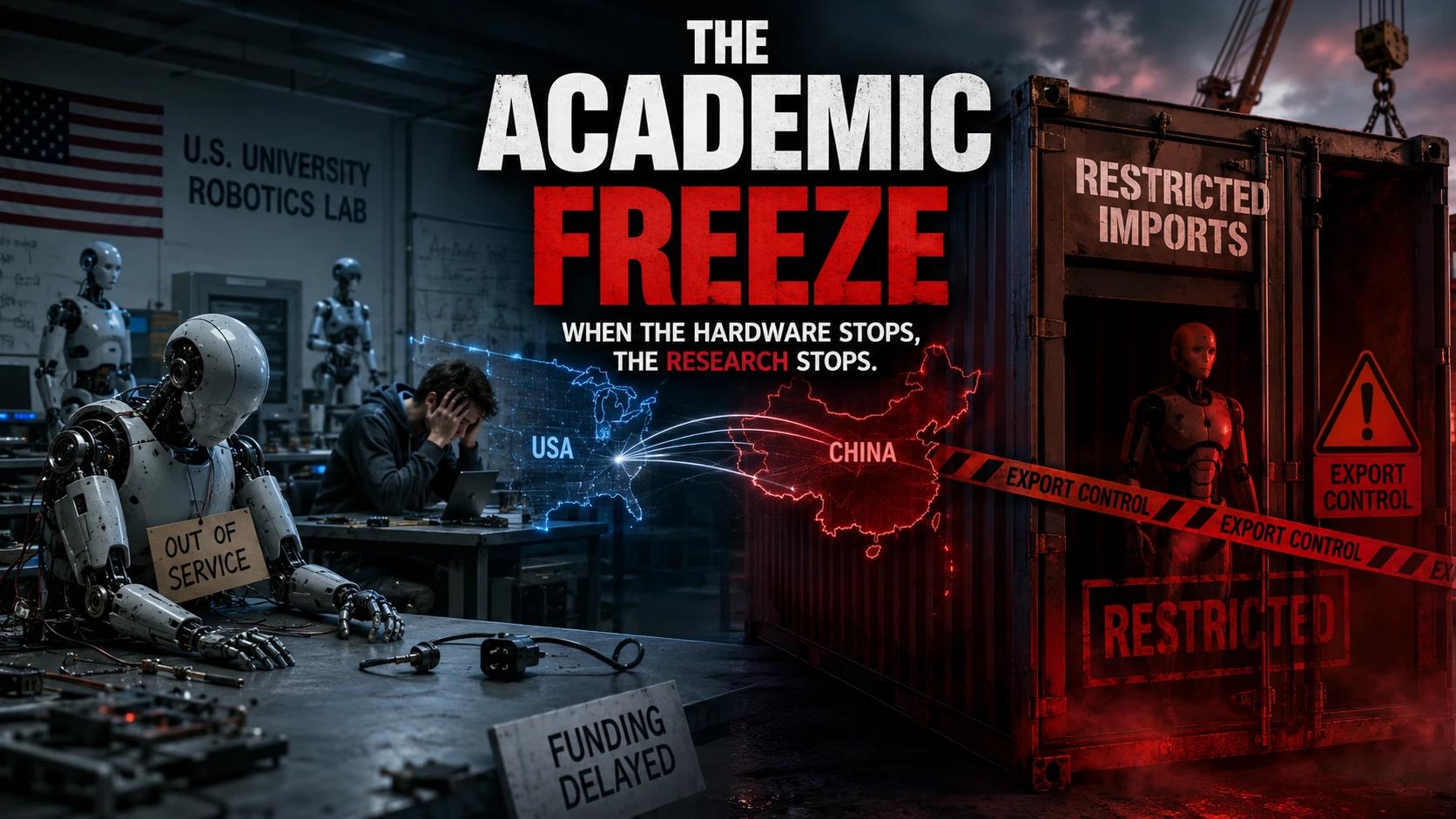
The ban just froze something bigger than trade: America’s AI research pipeline. The Federal Communications Commission added foreign-made humanoid and quadruped robots to its Covered List, barring new imports over national security risks.
With Chinese manufacturers holding an estimated 85% of global humanoid market share and selling testbeds for as low as $13,500, can American university labs train spatial AI without access to affordable robots? As budget-constrained robotics departments face a sudden hardware embargo, researchers are scrambling to prevent a complete standstill in embodied AI.
Why the Ban Hits Labs First
The federal mandate targets new foreign-made advanced robotic devices, citing risks of surveillance, data collection, and remote hijacking. While the policy aims to safeguard critical supply chains, university research facilities have become immediate collateral damage.
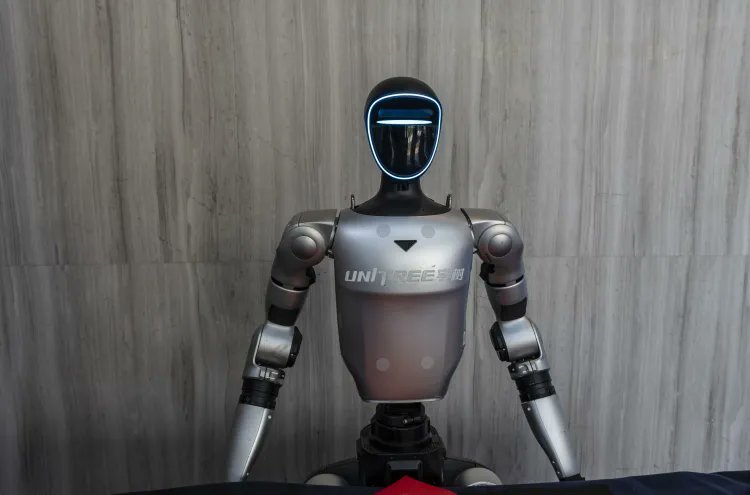
Most academic budgets cannot absorb the price of domestic prototypes, which often cost upwards of $50,000 to $150,000. Chinese platforms like the Unitree G1 offered low-cost hardware access that allowed university researchers to deploy multiple physical testbeds simultaneously.
- Massive Cost Gap: Chinese research units cost $13,500 compared to $50,000+ Western counterparts.
- Deployment Deficit: Chinese firms shipped over 10,000 humanoids in 2025, while US rivals shipped under 1,000 combined.
- Supply Choke Point: Federal security restrictions halt new hardware imports overnight.
Is this a national security win, or a research self-own? Without low-cost physical hardware, US academic labs face an immediate operational bottleneck.
The Cost Gap That Changes Everything
| Category | Chinese Humanoid Platforms | US & Western Competitors |
|---|---|---|
| Average Unit Cost | $13,500 – $20,000 | $50,000 – $150,000+ |
| Annual Production Scale | 15,000+ units shipped | Under 1,000 units shipped |
| Primary Lab Use | Affordable physical AI testing | Limited pilot deployments |
| Import Status | Banned under FCC Covered List | Approved for domestic procurement |
What Humanoids Actually Train
Humanoid hardware is not just a robotic demo; it serves as the essential physical environment for embodied AI and spatial reasoning. Real-world neural network models require constant physical interaction to master balance, object manipulation, and terrain navigation.
When physical platforms disappear, researchers must rely heavily on synthetic simulations. While digital environments accelerate initial training, they suffer from the “reality gap”—where algorithms that perform flawlessly in code fail upon hitting physical ground.
“When access to physical platforms disappears, simulation cannot fully replace the learning loop for embodied AI.” — Robotics Research Director
Should universities get carve-outs when the hardware ban slows innovation? Without affordable physical chassis, American students and researchers risk falling behind international peers who retain full hardware access.
“The Trump administration on Tuesday announced a ban on new foreign-made humanoid robot imports to the US over “unacceptable risks” to America’s national security.https://t.co/ImP4cbDVFV The move applies to advanced robots – including humanoid and four-legged machines. Many of… pic.twitter.com/nT6FCYSJu1
— Amit Paranjape (@aparanjape) July 29, 2026
Security or Stagnation?
The federal policy highlights a growing tension between protecting national infrastructure and maintaining domestic research capacity. Proponents argue that foreign robots equipped with LiDAR, cameras, and thermal sensors pose real data collection risks.
However, isolating American developers from the most widely adopted research platforms creates an unintended competitive disadvantage.
The Next Fight Over Exemptions
- Academic Lobbying: University consortia are preparing petition drives seeking educational exemptions for non-networked lab environments.
- Push for Domestic Subsidies: Pressure is mounting on Washington to subsidize US robotics makers to bridge the cost gap for higher education.
- Pivot to Quadrupeds & Simulation: Labs are redirecting grant money toward advanced digital twin simulations until hardware alternatives emerge.
For US artificial intelligence labs, this import freeze forces a tough choice: pay premium rates for scarce domestic hardware, or watch the next wave of spatial AI development move overseas.
Official policy notices can be read on the FCC Covered List Database, while industry reporting on import impacts is covered by Quartz and The Guardian.