
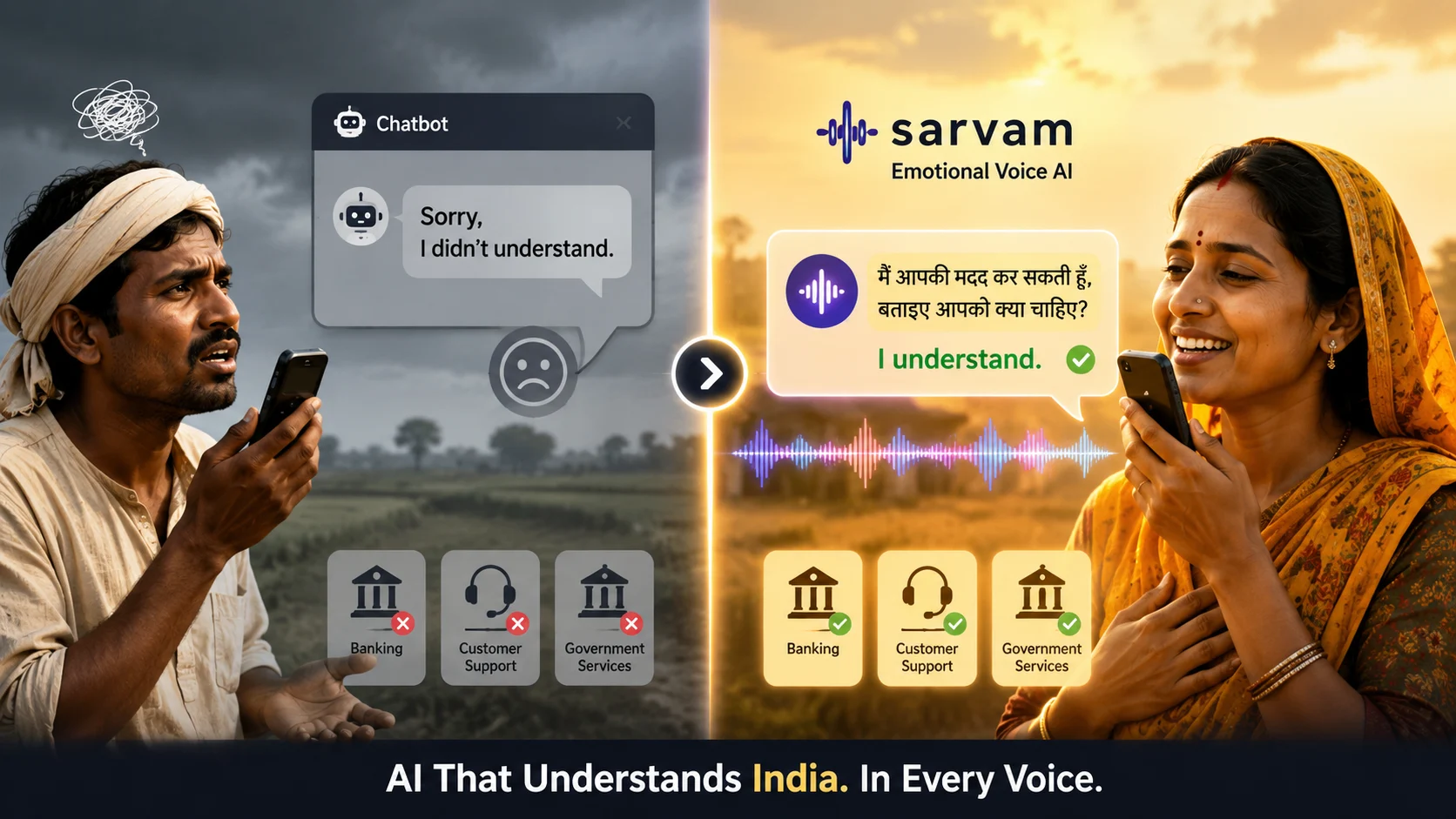
Sarvam is trying to do what most AI companies still haven’t solved: make machines sound emotionally human in the languages India actually speaks. India has over 500 million regional language users who struggle with English-centric digital apps.
What happens when voice AI speaks with authentic regional accents, 35+ unique voices, and sub-250ms streaming latency? Can a natural voice interface finally close the access gap? This shift promises to unlock vast markets, humanize digital services, and transform how rural users interact with online networks.
The Real Problem With Chatbot-Era AI
For millions of first-time internet users across tier-2, tier-3, and rural India, typing text into rigid search boxes or English forms remains a constant barrier.
What if the interface itself is the problem? Traditional Western speech models frequently fail when confronted with local dialects, improper punctuation, or regional stress patterns. Most customer support bots sound mechanical, struggle with Hinglish code-switching, and disconnect when users switch languages mid-sentence.
Why Emotional Voice Changes Everything
Sarvam’s Bulbul text-to-speech engine focuses heavily on natural prosody, emotional nuance, and regional voice inflections.
- Authentic Prosody: Applies regional stress, rhythm, and intonation rather than forcing English speech patterns onto Indian grammar.
- Seamless Code-Switching: Handles mixed phrases like Hinglish, Tanglish, or Benglish in a single speech pass without jarring voice shifts.
- Context-Aware Expressiveness: Inflects tone dynamically for customer onboarding, emergency announcements, or conversational support.
That’s where the real market opens up. When speech carries genuine warmth and emotional clarity, user trust rises dramatically during automated financial or healthcare calls.

Bulbul Engine and the Local-Language Gap
By training directly on native Indic speech datasets across 11 key languages, Sarvam bypasses traditional translation pipelines.
- Native Speech Data: Models trained on authentic regional speakers in Hindi, Tamil, Telugu, Marathi, Bengali, and Gujarati.
- Text Normalization: Accurately converts rupee amounts, dates, and local addresses into naturally spoken phrases.
- Telephony Optimization: Streams audio with sub-250ms first-byte response times over standard 2G/4G mobile networks.
Is this the first serious native alternative to English-first Western APIs?
Where Indian Enterprises Can Use This First
| Sector | Why Voice AI Matters | Example Outcome |
|---|---|---|
| Rural Financial Services | Eliminates complex text forms for loan applicants. | 2x higher completion rates on digital banking onboarding. |
| Customer Support | Solves complex queries in regional dialects. | Sub-250ms streaming response for voice agents. |
| Public Sector Services | Delivers accessible civic updates to non-literate citizens. | Broader citizen reach across rural government programs. |
India’s next digital leap won’t be typed. It will be spoken natively.
Western APIs vs Native Indian Voice Stacks
Global speech stacks like OpenAI or ElevenLabs struggle with complex Indian name pronunciations, local slang, and mixed-script text.
- Lower Cost Infrastructure: Sarvam offers India-optimized pricing, making large-scale voice agent deployments economically viable.
- Superior Telephony Performance: Built to maintain high listener preference rates on standard 8kHz phone lines.
- Cultural Adaptation: Naturally pronounces PIN codes, local landmarks, and honorifics without misinterpretation.
“The next wave of AI adoption in India will depend less on model size and more on whether the interface feels natural, local, and trustworthy.” — AI Infrastructure Analyst
Can emotional speech make AI feel trustworthy enough for finance and public services?
JUST IN: 🇮🇳 India’s Sarvam announces it’s developing a trillion-plus parameter AI model from scratch that’s five times cheaper than global rivals. pic.twitter.com/Jh3bNjCiAH
— Whale Insider (@WhaleInsider) July 30, 2026
What Happens Next
As enterprise pilots expand into active deployments across banking, retail, and public delivery, local voice infrastructure will define market leadership.
- Enterprise Integration: Rapid adoption by digital platforms onboarding gig workers and customers via conversational voice agents.
- Dialect Expansion: Continuous fine-tuning for hyper-local accents in secondary cities.
- Hardware Interoperability: Deep integration into basic smartphones and low-cost IoT devices.
This is where AI stops sounding foreign and starts driving real economic accessibility across Bharat.
Official announcements and benchmarks are available on Sarvam AI Text-to-Speech Portal and Sarvam AI Developer Documentation.