
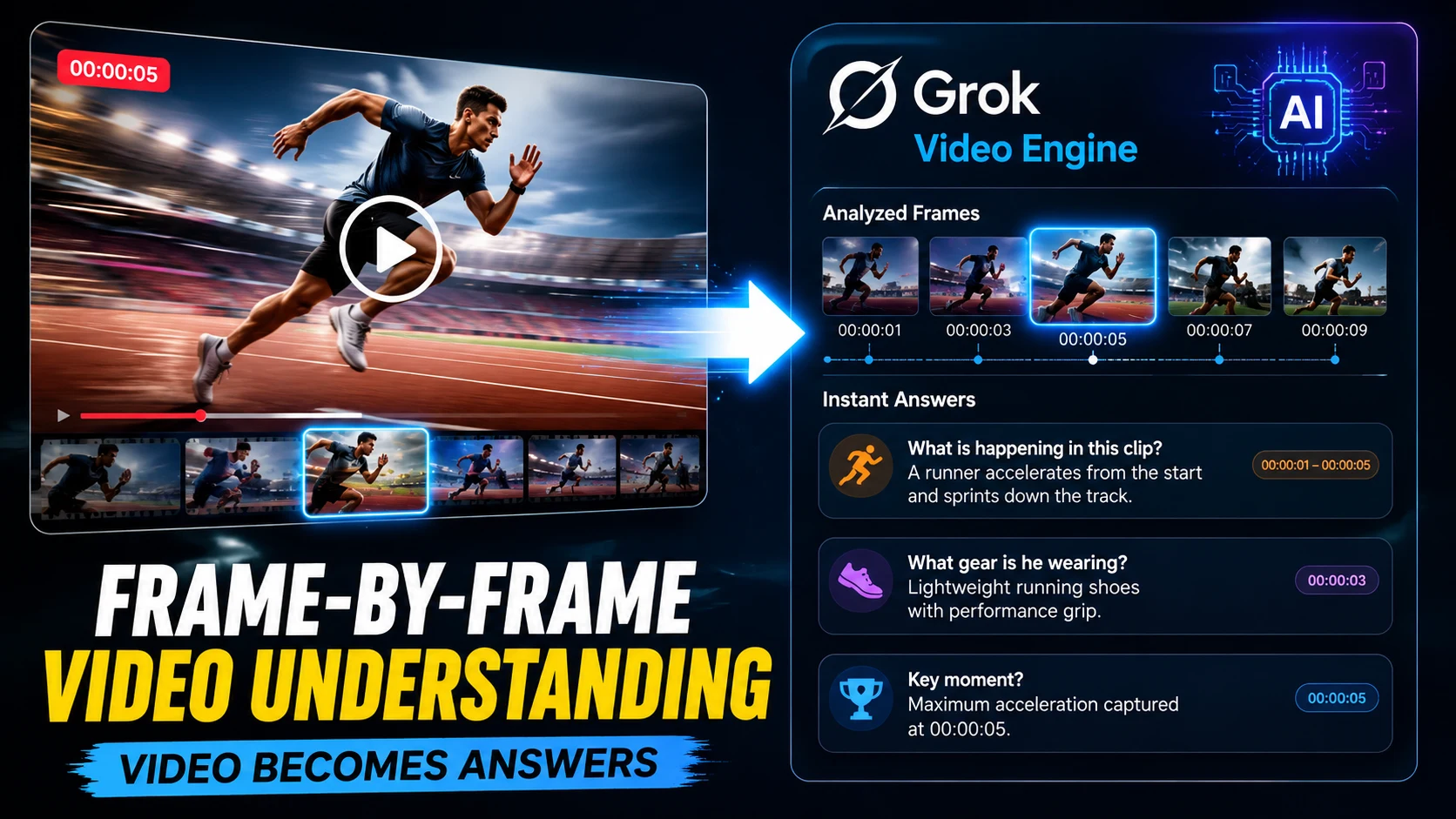
Grok just turned video into something closer to searchable evidence than a clip. Its new video engine can analyze hundreds of frames in seconds, raising a massive question: what happens when video stops being passive and starts becoming queryable?
With fast-moving sports, product demos, and breaking news flooding social feeds, this level of precision matters right now. The breakthrough lets you decode, extract, and summarize complex motion faster than ever before.
What Changed
Rather than treating a video file as one flat, unsearchable stream, Grok’s upgraded vision architecture ingests video frames paired directly with timestamps. This frame-by-frame approach allows the AI to break down rapid motion, detect split-second sequence changes, and deliver pinpoint visual answers.
- Timestamp Awareness: Every frame is mapped to exact timecodes for accurate retrieval.
- Action Summaries: Converts complex visual movement into plain-language bullet points.
- Frame-Level QA: Answers direct questions about specific seconds or objects in a clip.
A 30-second clip can contain hundreds of frames, but Grok can parse them in sequence. That structural change transforms how users interact with recorded media.

Why It Matters
The biggest benefit for everyday users is precision, speed, and context. Instead of rewatching a long video to find a single moment, you can ask the model to jump directly to the action.
- Sports & Live Events: Instantly figure out who touched a ball first or caused a turnover.
- Product Walkthroughs: Pinpoint the exact second a button was clicked or a UI setting was changed.
- Chaotic Scenes: Track moving objects across crowded or fast-moving camera angles.
How It Works
The engine uses a structured multi-step process to turn moving pixels into structured text answers:
- Frame Splitting: The incoming clip is ingested and sliced into sequential frames or keyframe clusters.
- Timestamp Mapping: Order and timing are preserved using embedded timecode metadata.
- Motion Analysis: The model tracks object trajectories, spatial changes, and scene shifts.
- Targeted Output: Answers are generated and linked directly to exact timestamps.
- Action Summary: A plain-language summary outlines the full event from start to finish.
Real-World Examples
| Use Case | What Grok Can Answer |
|---|---|
| Sports Clip | Who touched the ball first, and what happened right before the score? |
| Product Demo | Which menu option was selected, and what changed on screen after? |
| Fast Scene | What object dropped, and at what exact timestamp did it happen? |
What happens when video stops being passive and starts becoming queryable? Users spend less time scrubbing timelines and more time getting direct answers.
Grok can watch and analyze videos for you.
Just upload a video the same way you upload an image and ask Grok anything about it. pic.twitter.com/G2thUXYeBj — DogeDesigner (@cb_doge) August 2, 2026
Limitations and Questions
While frame-by-frame QA represents a major technical leap, multi-modal video understanding still faces real-world hurdles. Heavy motion blur, extreme low lighting, or rapid camera cuts can confuse frame tracking.
- Can it keep up when scenes change every second? Fast cuts and erratic camera pans can drop spatial continuity.
- How accurate is frame-by-frame reasoning in noisy footage? Low-resolution clips can lead to false object identification.
- Will timestamps make it more useful than standard video captions? Exact temporal grounding offers far deeper context than static captions.
“The real breakthrough is not just watching video — it’s giving AI the ability to reason across space and time simultaneously.” — Multimodal AI Researcher
Why Early Adopters Care
Official Technical Coverage & Resources: • xAI Official Technical Notes & News • Computer Vision Foundation Research • MIT Technology Review AI Coverage
The real shift is not in watching video — it’s in asking video questions. As multimodal engines continue to evolve, the gap between visual media and instant search is rapidly closing.