
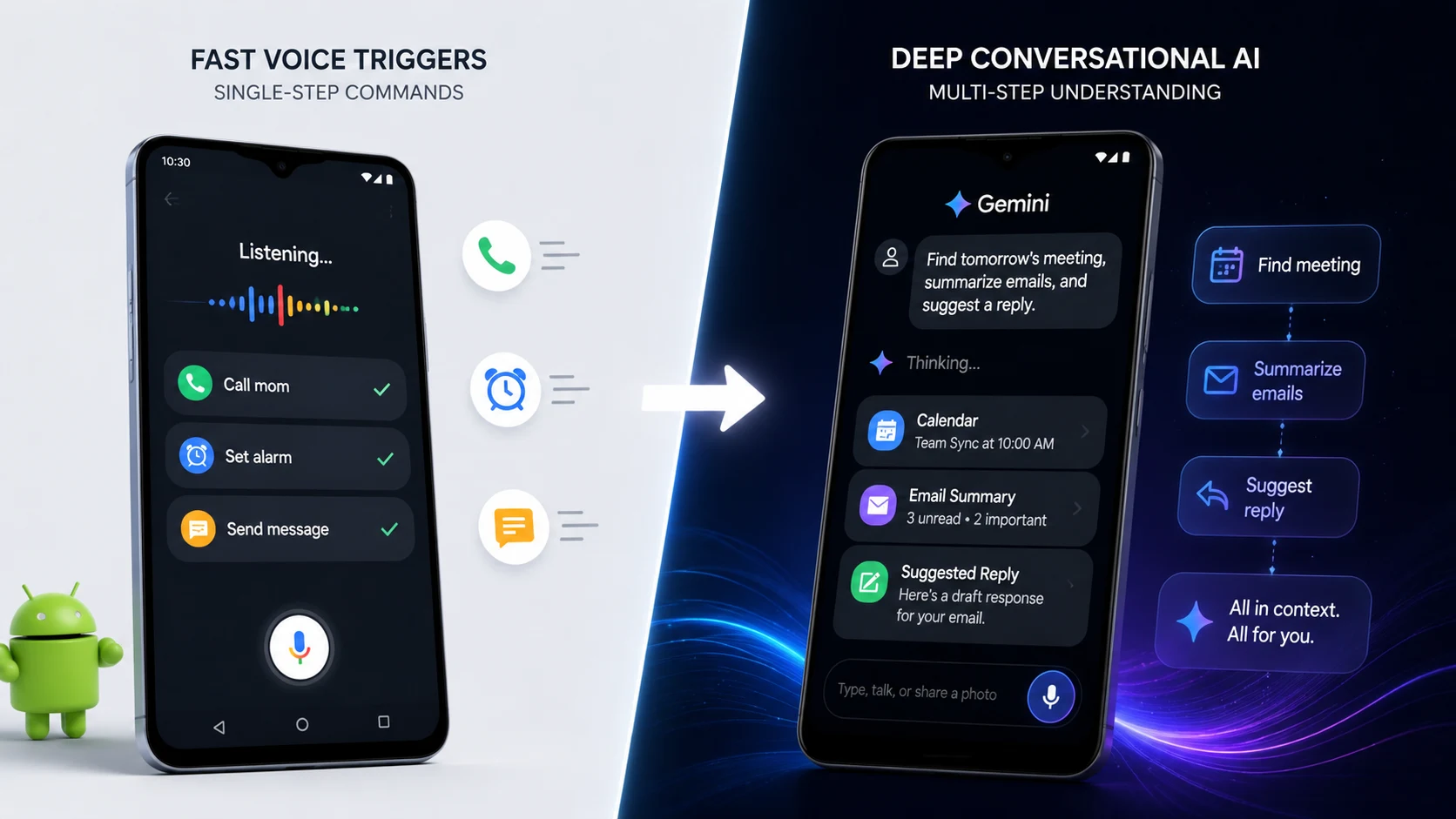
Google has officially shattered its decade-old voice interface as Gemini slashes away classic commands across 1 billion active Android devices.
With 80% of mobile users migrating ahead of the September 4, 2026 shutdown deadline, an urgent question arises: will users prefer 1-second instant triggers or multi-step AI reasoning? This sudden platform shift forces 500 million daily voice users to adapt immediately.
Why Speed vs Depth Matters Right Now
Legacy voice commands dominated mobile control by performing single tasks at sub-second speed. However, Gemini prioritizes deep contextual understanding over simple triggers.
- Legacy Commands: Optimized for instant actions like “Set an alarm for 7 AM”.
- Gemini AI: Built for multi-layered reasoning across apps.
- The Core Dilemma: Can cloud-based AI inference deliver fast enough for everyday voice shortcuts?
While simple commands execute locally on-device in under 200 milliseconds, multi-turn conversational AI often requires 1 to 2 seconds of cloud processing. But the outcome is radically different: one sets a simple reminder, while the other orchestrates your entire daily schedule.
What Changed Under the Android Hood
Starting September 4, 2026, Google Assistant will stop functioning on Android phones, Wear OS watches, and Android Auto. The long-standing Assistant infrastructure is being completely phased out in favor of Gemini.
“Gemini represents the shift from passive voice execution to active, context-aware reasoning on mobile platforms.” — Dieter Bohn, former executive editor at The Verge
How will this alter your daily phone interactions? The biggest shift lies in cross-app execution capabilities. According to official Google Gemini Live documentation, the system now streams continuous context between Gmail, Calendar, Maps, and Keep Notes hands-free.
Direct User Experience Comparison
Evaluating these two models shows a clear trade-off between instant execution and task chaining.
| Capability | Legacy Voice Commands | Gemini-Style AI |
|---|---|---|
| Response Speed | Sub-second local triggers | 1–2 second cloud synthesis |
| Task Complexity | Single isolated action | Multi-step workflow chaining |
| Conversational Ability | Rigid string matching | Natural back-and-forth context |
| Ecosystem Integration | System-level toggles | Deep Workspace & app reasoning |
As detailed by coverage in The Verge on Google Assistant’s Shutdown, the removal of Assistant leaves no fallback option once the rollout reaches your device.
Concrete Real-World Examples
To understand the practical impact, consider how everyday requests change under Gemini:
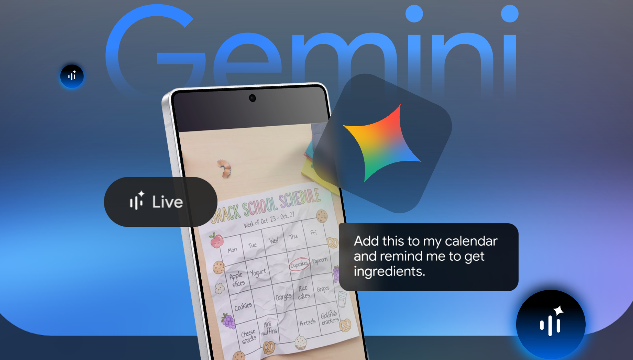
- Old Voice Trigger: “Set a reminder for my 3 PM meeting.”
- Gemini AI Request: “Check my recent emails from Alex, find the scheduled time for tomorrow’s meeting, and set a reminder while drafting a confirmation reply.”
Are users willing to wait an extra second if it saves 3 minutes of app switching? Industry analysis on SERoundtable’s Assistant Sunset report reveals that power users heavily favor multi-step automation over raw response speed.
Who Benefits Most from the Shift
The move to Gemini isn’t equally seamless for everyone:
- Power Users & Multitaskers: Gain a massive productivity boost by delegating complex, multi-app workflows.
- Casual Smart-Home Users: May experience minor friction as instant local voice shortcuts adapt to cloud inference.
- Wear OS & Headphones Wearers: Get hands-free conversational continuity on the go.
Google is discontinuing and replacing its assistant with Gemini on mobile devices beginning September 4
— Interesting AF (@interesting_aIl) August 5, 2026
Wear OS watches, headphones, and “vehicles running Android Auto projected from a user’s mobile device” will also have Google Assistant removed pic.twitter.com/j7m0LSoxUc
The next phase of Android won’t just listen — it will interpret, anticipate, and execute complex intent.
Will Gemini’s reasoning power make users completely forget the speed of legacy voice triggers? As the September deadline approaches, checking your device settings to ensure seamless migration is essential before standard assistant services officially go dark.