
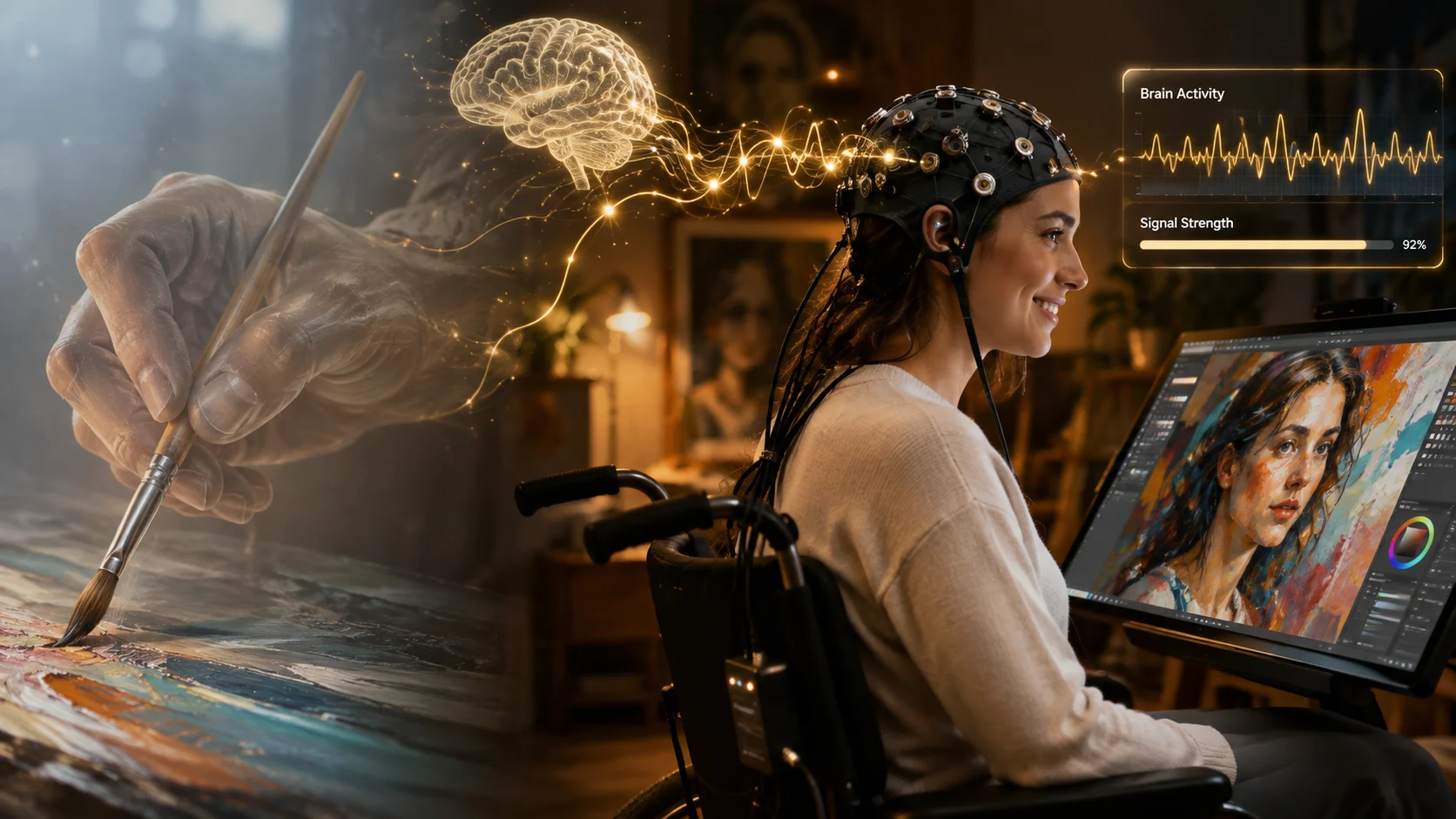
He hadn’t painted in twelve years—and when he moved his mind, the canvas shivered with life. Nearly 300,000 Americans live with spinal cord injuries, while millions globally face long-term paralysis; recent lab results show some BCI systems reach cursor-control accuracies above 90%, and pixel-level decoding improvements exceed year-over-year gains.
What does it mean when a single thought can place a pixel? Families and therapists watch, hopeful and anxious, as engineers and clinicians work to reawaken talent and reclaim agency for creators who have been silenced.
Quick Takeaway
- Thesis: The evolution of Art Beyond Paralysis highlights how brain-computer interfaces (BCIs) translate raw motor cortex signals into precise, pixel-level creative expression.
- Who Benefits: Long-term paralysis participants, digital artists, and neurorehabilitation clinics seeking advanced assistive technologies.
The Human Story: Reclaiming Creative Independence
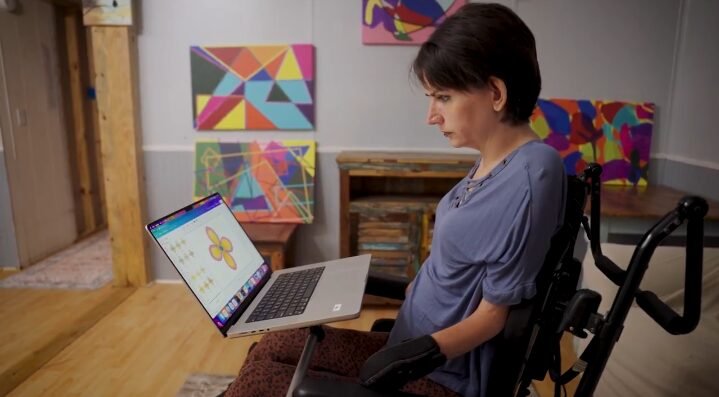
For individuals living with severe motor impairments, losing the physical ability to hold a brush or sculpt clay means losing an essential piece of their identity. Traditional assistive devices offer basic typing or cursor movement, but lack the high-resolution fluidity required for true artistic nuance. Assisted creativity changes this dynamic by transforming abstract mental intentions into vivid, tactile digital masterpieces.
- Emotional reawakening: Restoring agency helps patients rebuild self-worth and emotional expression.
- Overcoming isolation: Digital art created via neural prosthetics provides a powerful bridge back to public communities.
- Redefined capabilities: Proving that artistic vision outlives physical bodily limitations.
Creative rehabilitation restores more than motor function—it breathes life back into personal identity.
How BCIs Turn Thought Into Brushstrokes
Brain signals for planned movement live in the motor cortex; BCIs pick up those signals via implanted microelectrode arrays or surface sensors like ECoG. The system cleans and translates raw signals into patterns with machine-learning decoders, mapping imagined movement to cursor or brush commands on a digital canvas. Early systems let users move a simple cursor; newer decoders refine that movement down to precise, low-latency pixel control.
The Signal Path
- Neural Acquisition: Intracortical microarrays capture electrical firing from individual neurons in the motor cortex.
- Signal Processing: Advanced algorithms filter out noise and isolate intended movement vectors.
- Decoding & Mapping: Deep learning models convert signal patterns into actionable cursor or drawing tool instructions.
Real-time neural decoding bridges the gap between internal neurological intent and external digital action.
Pixel by Pixel: Achieving High-Resolution Control
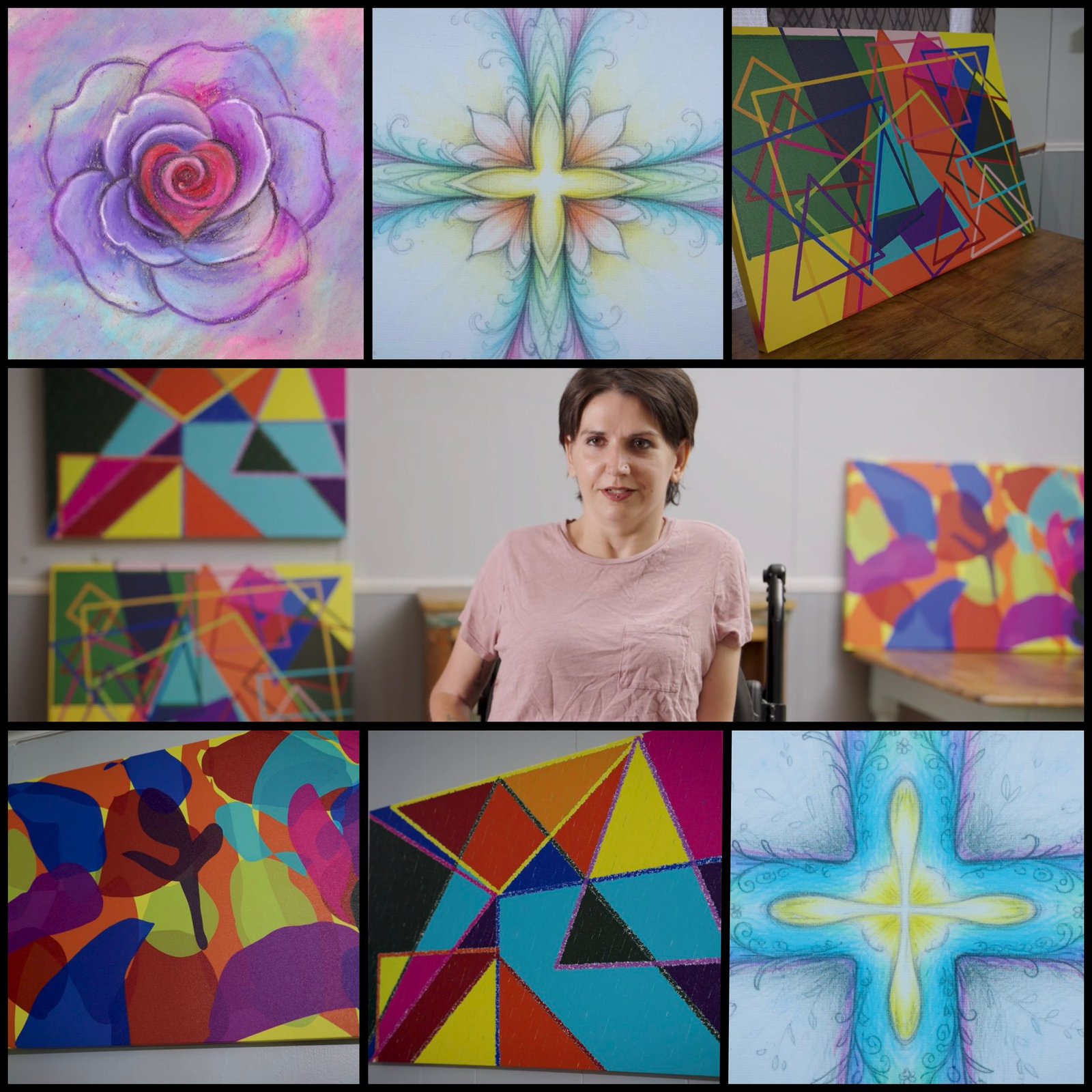
Moving a cursor across a screen is one thing, but blending colors, feathering edges, and placing individual pixels requires extraordinary precision. Researchers use adaptive algorithms and calibration loops that learn a user’s unique neural signatures over time. This process allows artists with quadriplegia to achieve pixel-level control, rivaling the fine motor skills of able-bodied creators.
- Coarse-to-fine filtering: Algorithms dynamically adjust cursor speed based on the artist’s focus level.
- Assisted snapping: Smart software assists with smooth line generation and symmetry without overriding intent.
- Custom calibration: Personalized profiles adapt to slight neural fatigue changes during long painting sessions.
Which ethical concern matters most to you regarding these devices: data privacy, high financial cost, or surgical risk?
Rehabilitation, Therapy, and the Future of Neural Art
Integrating BCIs into standard rehabilitation clinics marks a massive paradigm shift in neurorecovery. Beyond standalone creative projects, these tools exercise cognitive-motor pathways, potentially encouraging neuroplastic recovery in surviving surrounding brain tissue.
Key Benefits in Clinical Recovery
- Cognitive engagement: Active creation keeps neural pathways stimulated and engaged.
- Caregiver collaboration: Shared artistic projects deepen bonds between patients and their support networks.
- Scalable access: Transitioning experimental lab setups into accessible home-use therapy suites.
Functional independence expands dramatically when clinical tools double as outlets for personal joy. Also Read: Neuralink’s Blindsight Could Restore Vision Without Eyes — But Only in Low-Resolution at First
Barriers, Ethics, and the Road Ahead
Despite stunning technical milestones, significant hurdles remain before brain-computer interfaces become mainstream studio tools. High surgical costs, invasive procedures, and long-term implant biocompatibility require rigorous oversight from regulatory bodies like the FDA.
- Safety & Invasiveness: Balancing the risks of brain surgery against the immense quality-of-life benefits.
- Data Privacy: Protecting sensitive neural telemetry data from commercial exploitation or unauthorized access.
- Equitable Access: Ensuring advanced neurotechnologies are not restricted solely to elite medical trial participants.
With Neuralink, Audrey is creating art with her mind. pic.twitter.com/7cip08yq49
— Neuralink (@neuralink) August 26, 2026
Frequently Asked Questions
How do brain-computer interfaces capture artistic intent?
BCIs record electrical signals directly from the motor cortex when a user imagines moving their hand, translating those neural firing patterns into digital brush movements.
Is surgery required to use artistic BCI systems?
While high-precision intracortical systems require minimally invasive neurosurgery, non-invasive EEG cap alternatives are also being researched, though they offer lower signal resolution.
When will neural art tools be available outside of research labs?
Current systems remain in clinical trials and specialized research hospitals, with commercial home-use models projected for rollout over the next decade.
Sources
- [1] BrainGate Consortium Research and Clinical Trials – BrainGate
- [2] Reach and Grasp by People with Tetraplegia Using a Neurally Controlled Robotic Arm – Nature
- [3] High Performance Communication by People with Paralysis Using an Intracortical BCI – Nature
- [4] Neuralink Public Demonstrations and Neural Interface Technology – Neuralink