

Imagine ripping upward from a crowded street and soaring—thrilled and slightly terrified—on a standing eVTOL. Industry estimates project urban air mobility could reach 1–3 billion trips per year by 2035, with short hops under 30 miles forming most journeys.
Early prototypes suggest upright platforms cut vehicle weight and footprint, improving turnaround times by as much as 15%. But how will riders adapt to balance, and how quickly will regulators, insurers, and cities move to keep pace?
Quick Takeaway
- Thesis: The rise of the standing eVTOL commuter transforms urban flight from a seated, cabin-bound experience into an active, high-mobility physical stance.
- Who Benefits: Time-starved city dwellers, micro-mobility enthusiasts, and nimble urban transit operators.

Why Standing eVTOLs?
Transitioning from traditional automobiles or seated aircraft to an open-air upright flight platform represents a radical ergonomic leap. By removing heavy seats, doors, and complex cabin enclosures, these vehicles slash gross weight and drastically simplify urban landing requirements.
- Active commuting: Engages core muscles and mimics the physical intuition of surfing or snowboarding.
- Minimalist footprint: Allows multiple platforms to stage within standard automobile parking spaces.
- Rapid ingress/egress: Eliminates cumbersome belt-in cabin rituals for quick-hop city transfers.
Active posture control gives riders an unprecedented sense of kinetic connection with their flight path.
Would you choose an open-air standing stance over a traditional seated cabin for a 10-minute cross-city hop? What initial safety feeling would you need to step onto an upright air platform?
Human Factors: Ergonomics and Psychology
Piloting an open platform requires distinct physical and cognitive adaptations. Designers must carefully manage vestibular adaptation to prevent motion sickness during rapid vertical ascents and tight banking maneuvers.
Posture, Balance, and Cognitive Load
- Balance control: Riders rely on foot-actuated steering and intuitive lean inputs rather than complex yokes.
- Situational awareness: Open-air stances provide a 360-degree field of view, drastically improving peripheral visibility compared to restricted cockpit windows.
- Training and UX design: Short simulation drills help users master stabilizing reflexes within 2 to 4 practice sessions.
Spatial immersion heightens immediate threat awareness but demands robust guardrails against sensory overload.
Safety and Certification Challenges
Aviation authorities face a unique regulatory puzzle when evaluating platforms that lack traditional crash cabins. Engineers must integrate advanced crashworthiness measures, multi-redundant propulsion systems, and ballistic recovery parachutes.
Regulatory Certification Gaps
- Fall protection: Multi-point leg harnesses and waist restraints replace conventional seatbelts.
- Redundant stability: Dual-redundant flight control computers prevent single-point stabilization failures.
- Emergency recovery: Built-in low-altitude ballistic parachutes offer guaranteed safe-landing margins.
| Safety Feature | Traditional Light Aircraft | Standing eVTOL Platform |
|---|---|---|
| Enclosure | Enclosed cabin with airbags | Open-air stance with body harness |
| Control Interface | Mechanical yokes or sticks | Foot pedals, lean-sensing, and hand triggers |
| Egress Speed | Slower cabin door evacuation | Instant step-off or parachute deployment |
Redundant propulsion architecture is non-negotiable for un-enclosed aerial platforms.

Practical Urban Implications and Infrastructure
Integrating upright air surfers into crowded skylines requires completely reimagined urban infrastructure. City planners are currently evaluating how vertiport zoning and micro-hub landing pads can fit on top of existing parking garages and transit stations.
Key Urban Requirements
- Noise mitigation: Enforced acoustic flight corridors to prevent localized sonic disruption over residential zones.
- Insurance and liability: Shifting risk models toward per-trip operational coverage and automated telemetry monitoring.
- Transit integration: Direct connection points linking air-surf pads with subway lines and bike-share hubs.
Decentralized micro-vertiports prevent urban bottlenecks and distribute traffic evenly across metropolitan grids.
Also Read: The Adult ID Loophole: How China’s Facial Recognition Crackdown Is Still Failing Underage Gamers
The Future Roadmap and Market Adoption
The path from experimental concept to everyday transit depends heavily on phased regulatory approvals. Short-term trials focus on controlled coastal corridors, while long-term visions target fully automated urban commuting networks.
- 2026–2029: Controlled prototype testing, closed-course human trials, and initial regulatory framework drafting.
- 2030–2035: Commercial launch in select mega-cities with dedicated multi-modal vertiport infrastructure.
- Post-2035: Mass-market adoption, automated fleet management, and consumer-accessible subscription pricing.
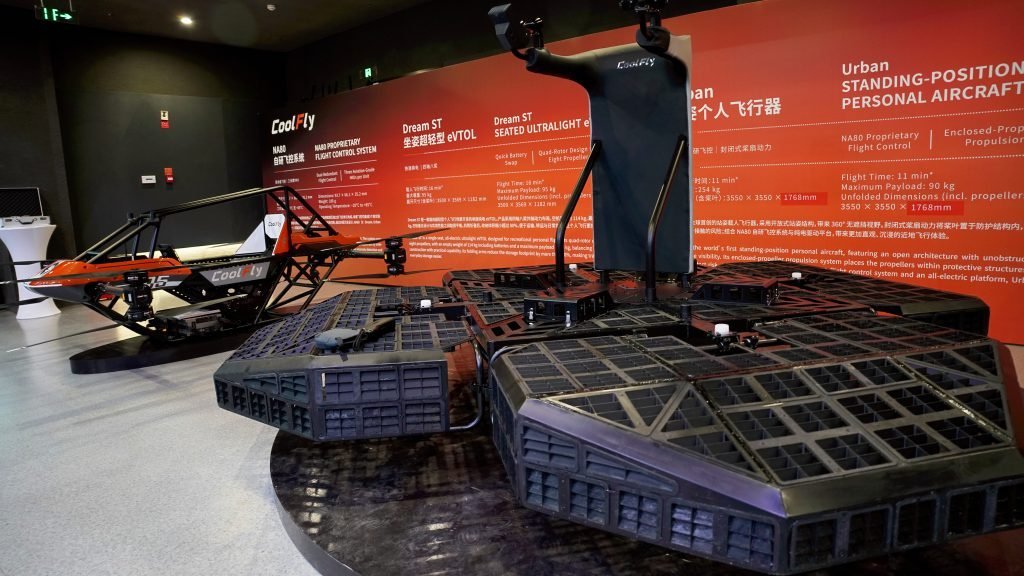
China is flying a man on a fan plate.
— Rajat Jain (@RajatJain) August 26, 2026
Chinese startup CoolFly launched Urban — a standing eVTOL “air skateboard.”
CoolFly Urban (Hangzhou):
• 90 kg payload
• 70 km/h
• 11 min flight
• AI lean-to-steer like a Segway
• No seat. No cockpit. Company says 10 min to learn. pic.twitter.com/EYJsIavvlv
Frequently Asked Questions
Are standing eVTOL platforms safe for everyday commuters?
Safety relies on rigorous multi-redundant flight stabilization, ballistic parachute systems, and mandatory user training programs established by aviation regulators.
How do riders control an upright flight vehicle?
Control inputs combine body-lean sensing, foot-actuated pedal steering, and handlebar throttle triggers designed to mimic intuitive board sports.
When can we expect commercial operations to begin?
Early commercial trials and limited-route cargo testing are projected to begin late in this decade, with passenger services rolling out through the early 2030s.
Sources
- [1] FAA Urban Air Mobility Concept of Operations – Federal Aviation Administration
- [2] EASA Guidelines for Innovative Air Mobility Solutions – European Union Aviation Safety Agency
- [3] NASA Advanced Air Mobility Human Factors Research – NASA