
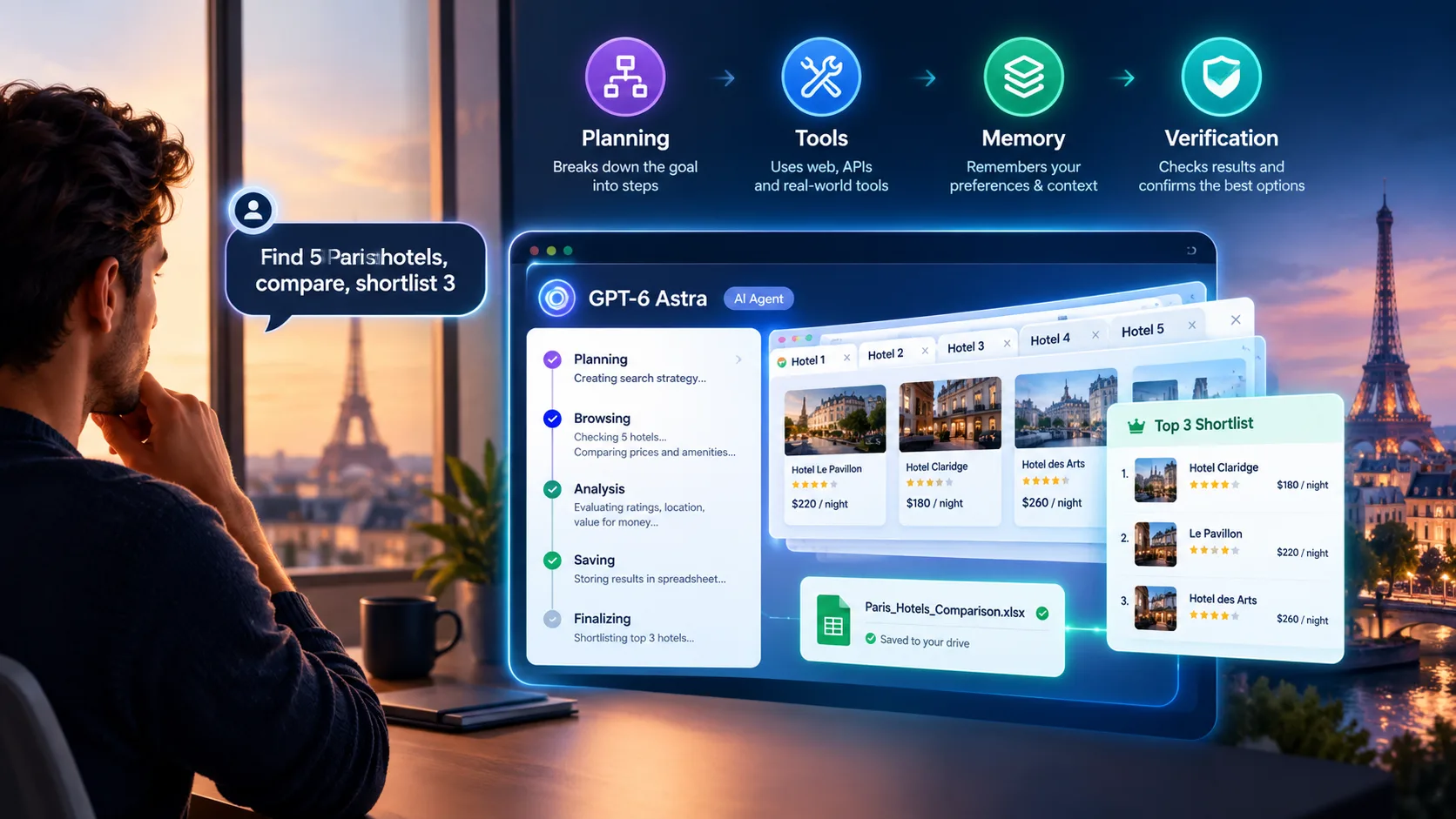
That is the key difference between a traditional chatbot and an AI agent. Think of a chatbot as a helpful adviser. An agent is closer to a digital teammate that can actually carry out a job.
What Makes GPT-6 Astra “Agentic”?
The simplest way to understand agentic AI is to look at how it handles a goal.
| Traditional chatbot | GPT-6 Astra AI agent |
|---|---|
| Answers a prompt | Works toward a goal |
| Usually responds once | Can perform multiple steps |
| Suggests actions | Can execute actions through tools |
| Limited to the current task | Can maintain context across longer work |
| May stop after an error | Can replan and try another approach |
Goal-Oriented Task Execution
Instead of asking Astra for every individual step, the GPT-6 Astra AI agent can be given an outcome. It can then determine what needs to happen to reach that goal.
For example, a complex request can be treated as a series of smaller tasks rather than one huge instruction.
Breaking Complex Goals Into Smaller Tasks
Astra’s agentic approach can break a complicated objective into manageable pieces, decide their order, and track progress.
It is similar to asking a human assistant to “prepare this report” rather than giving instructions for every click.
Autonomous Planning and Dynamic Replanning
Planning is only useful if the agent can react when reality does not match the plan.
If a tool fails, information changes, or an expected result does not appear, dynamic replanning allows the agent to reconsider the next step instead of blindly continuing.
Tool Calling: How Astra Uses Software Like a Human
Tools are what turn an AI agent’s reasoning into practical action.
Browser and Web Interaction
Astra can interact with browser-based environments, allowing it to navigate websites, read information and perform web-based steps as part of a larger workflow.
Code Execution
For technical tasks, code execution lets the agent work with programs rather than simply explaining code.
It can potentially write code, execute it, inspect the result and make changes when something does not work as expected.
API and Software Integration
APIs allow different software systems to communicate. An agent can use these integrations to move information between applications and perform actions without requiring a person to manually transfer every piece of data.
File and Document Manipulation
Documents and files are another important part of real-world work. Agentic systems can work with files as part of a broader task instead of treating them as isolated attachments.
Multi-Step Workflows
The real advantage appears when these capabilities are combined.
Goal → Browse → Collect information → Process data → Create output → Verify result
That is a multi-step workflow, rather than a simple question-and-answer interaction.
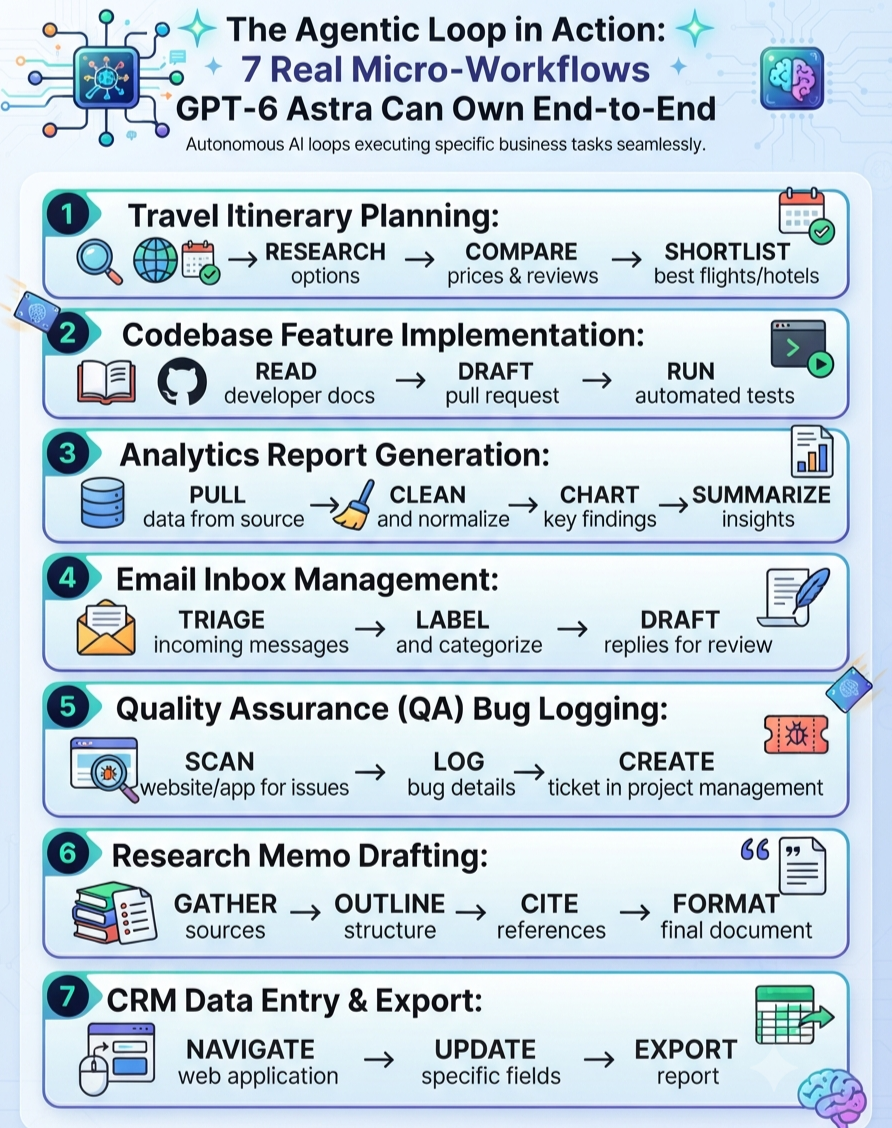
Memory and Context Handling for Long-Running Agent Tasks
An AI agent needs more than intelligence. It also needs continuity.
Imagine hiring an assistant who forgets everything every 10 minutes. Even if that assistant is extremely capable, completing a large project would be difficult.
Memory and context handling help an agent maintain awareness of what has already happened, what information matters and what still needs to be completed.
This becomes particularly important during long-running agent tasks, where the work may involve many actions and intermediate results.
The Agent Loop: Observation → Reasoning → Action
A useful way to understand agentic execution is through a repeating loop:
Observe → Reason → Act → Observe again → Verify → Replan if necessary
The agent observes the current situation, decides what to do next, takes an action and examines the result.
Verification of Completed Actions
Verification is critical. An agent should not assume that an action succeeded simply because it attempted it.
For example, clicking “submit” is not the same as confirming that the submission actually worked.
Handling Unexpected Results
Real-world software is unpredictable. Pages change, APIs return errors and information can conflict.
An agent needs to recognize unexpected results and adjust its workflow rather than continuing with a faulty assumption.
Human Approval, Permissions and Boundaries
Autonomy does not mean humans disappear.
Human approval and intervention remain important when an action could have significant consequences. Permissions and boundaries also determine which tools, files or systems an agent is allowed to access.
Think of it like giving an employee a company access card: they can do their job, but the card still limits which doors they can open.
Hallucination Risks During Autonomous Execution
One of the biggest concerns with autonomous AI is that a wrong assumption can become a wrong action.
A hallucination in a normal chatbot response might produce incorrect information. In an autonomous workflow, that same error could potentially influence several subsequent steps.
That makes reliability of autonomous actions and verification especially important.
How Astra Handles Ambiguous Instructions
People rarely give perfectly precise instructions.
When an instruction is ambiguous, an agent may be able to make reasonable assumptions for low-risk decisions. But when different interpretations could produce significantly different outcomes, asking for clarification is safer.
Also Read: Coder Launches Agent Relay to Put Cloud AI Agents Inside Self-Hosted Workspaces
Where Astra Still Needs Human Supervision
Even a highly capable GPT-6 Astra AI agent should not be treated as completely independent.
Human supervision remains valuable when:
- Instructions are unclear or high-impact.
- An action has significant consequences.
- Permissions need to be changed.
- Results require expert judgment.
- A workflow produces unexpected information.
- The final decision ultimately belongs to a person.
The Bottom Line
GPT-6 Astra’s agentic concept can be summed up simply:
Goal → Plan → Use tools → Act → Observe → Verify → Replan
That shift—from generating an answer to working toward an outcome—is what makes an AI agent fundamentally different from a conventional chatbot. But autonomy works best when paired with clear boundaries, verification and appropriate human supervision.