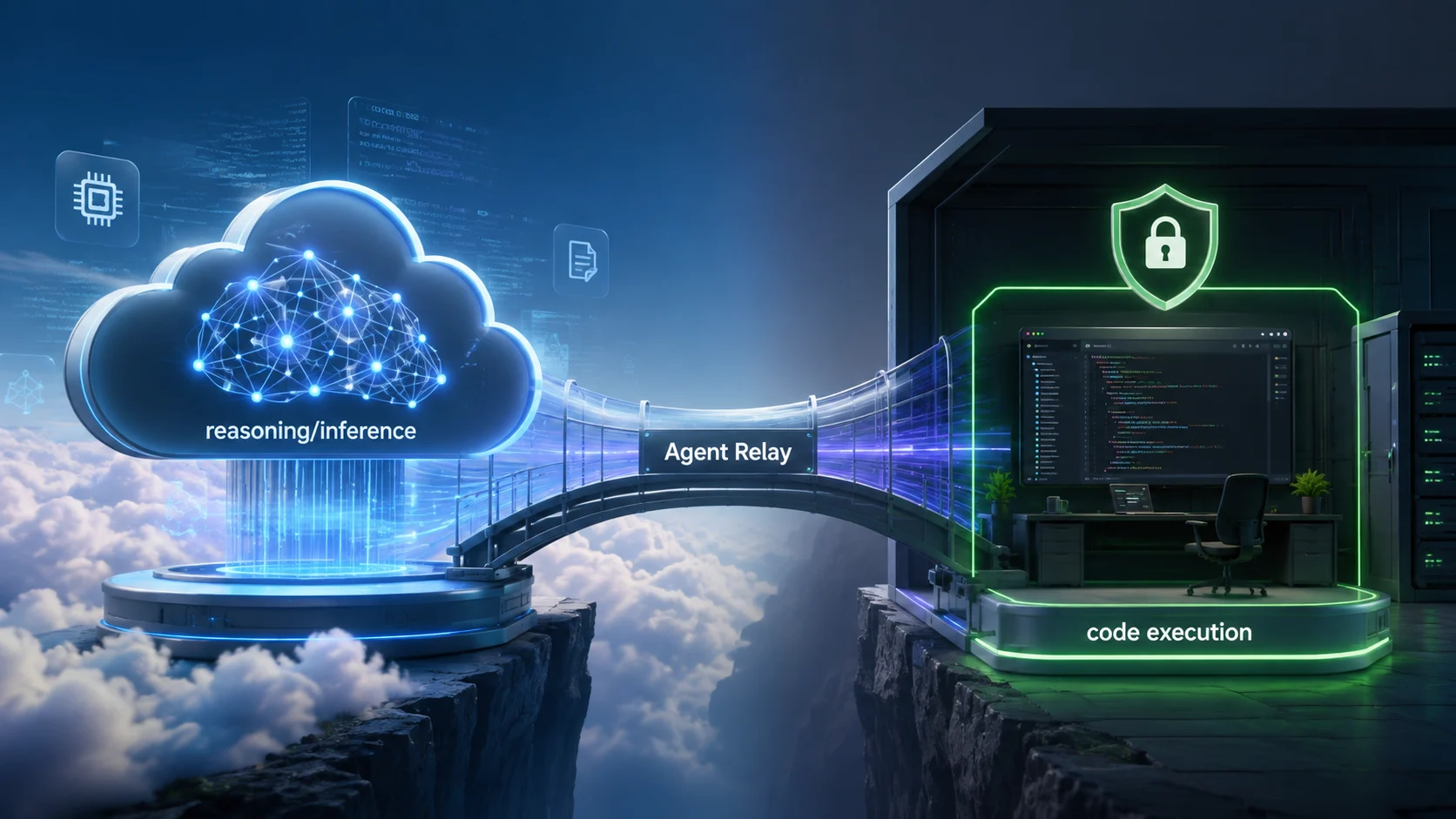
Think of it like a bridge. The AI agent can remain hosted by an external provider, while the actual code execution happens inside a Coder workspace.
That creates a separation between where the AI thinks and where the code runs.
What Is Coder Agent Relay?
Coder Agent Relay connects supported external cloud-hosted coding agents with Coder workspaces.
Instead of requiring the entire coding-agent experience to run inside the vendor’s cloud, Agent Relay allows the agent to interact with a Coder workspace where the actual code execution takes place.
In simple terms, the agent can stay in the cloud while the code runs inside the workspace.
Why Did Coder Launch Agent Relay?
The main idea behind Agent Relay is to address a problem with vendor-hosted coding-agent execution.
Cloud coding agents can be convenient, but enterprises may not want code execution to happen inside an external provider’s environment. Coder’s approach allows organizations to keep the cloud-agent experience while moving execution into their own workspace environment.
Think of it this way:
The agent can be in the cloud, while the code stays in the workspace.
Cloud-Hosted Agent vs. Self-Hosted Execution
These two terms can sound confusing, but they describe different parts of the same workflow.
| Part | Cloud-Hosted Agent | Self-Hosted Execution |
|---|---|---|
| AI reasoning/inference | External agent provider | — |
| Agent orchestration | External provider | — |
| Code execution | Workspace through Agent Relay | Coder workspace |
| Developer workspace | Coder | Coder |
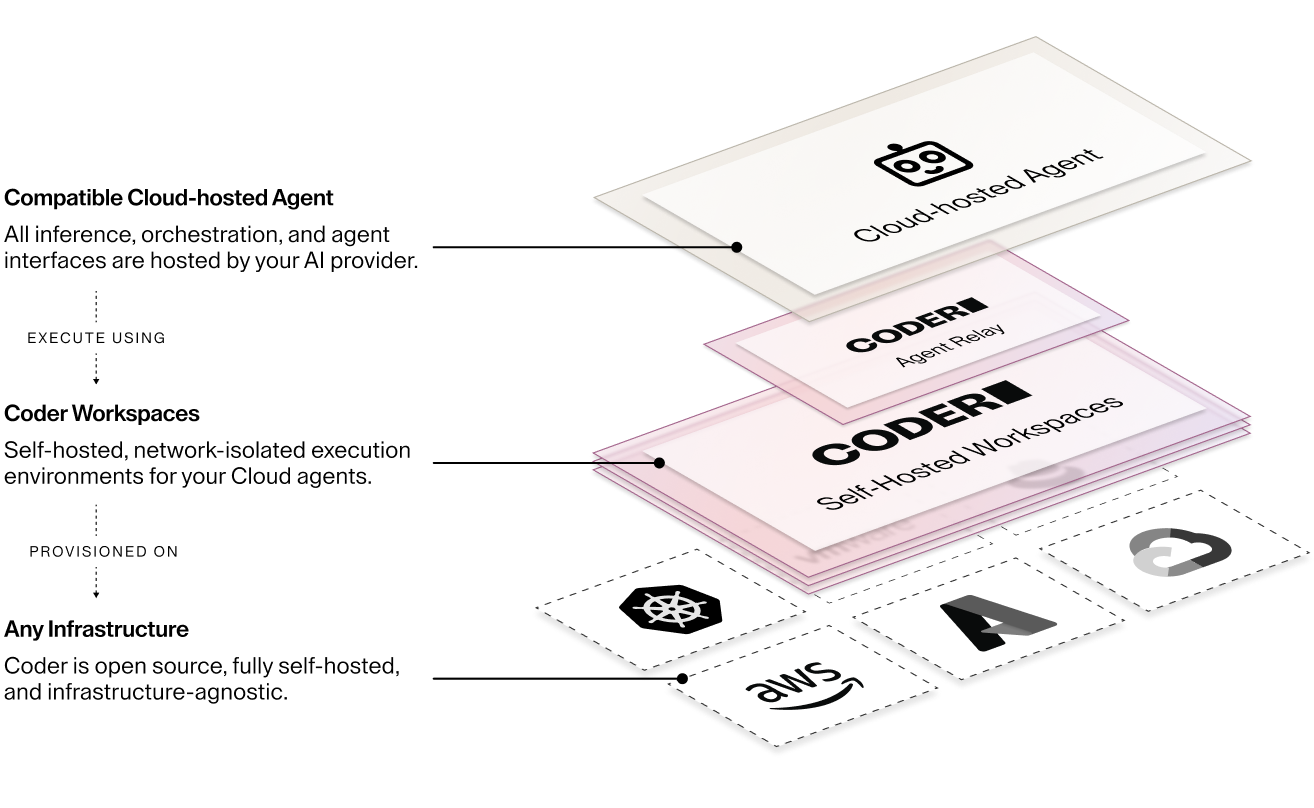
According to Coder’s documentation, the important distinction is that AI inference remains with the hosted agent provider, while execution takes place in the Coder workspace.
Where Does the AI Agent’s Reasoning Happen?
The agent’s reasoning and inference remain on the side of the external cloud-hosted agent provider.
So, Agent Relay isn’t moving the AI model itself into your workspace.
Where Does the Code Execution Happen?
The code execution happens inside the Coder workspace’s worker process.
That’s the key change: the agent can request actions, but those actions are carried out within the workspace.
How Agent Relay Connects Coder Workspaces With External Agents
Agent Relay acts as the connection between the external coding-agent provider and the Coder workspace.
A simplified view looks like this:
External Agent Provider → Agent Relay → Coder Workspace → Code Execution
This means the external provider can continue providing the cloud-agent experience while the workspace handles execution.
Cursor Cloud Agents Is the First Supported Provider
Cursor Cloud Agents is the first supported provider for Agent Relay.
That makes Cursor particularly important to the initial Agent Relay rollout, although the concept itself is about connecting Coder workspaces with supported external coding-agent providers.
What Changes for Developers—and What Stays the Same?
For developers, the biggest difference happens behind the scenes.
The familiar cloud-agent workflow can remain largely the same, but the location of code execution changes.
Think of it like ordering food from a restaurant but choosing where the final preparation happens. The request still goes through the same service, but the actual work takes place somewhere different.
With Agent Relay:
- The developer works with the cloud-hosted coding agent.
- The agent performs its reasoning and orchestration.
- Agent Relay connects the agent to the Coder workspace.
- The workspace performs the required code execution.
Agent Relay vs. Coder Agents
These names can easily be confused.
Coder Agents documentation describes Coder Agents as a way to delegate development work and research to coding agents within a Coder deployment.
Agent Relay is different. It focuses on connecting supported external cloud-hosted agents to Coder workspaces so their execution can happen inside those workspaces.
In short:
- Coder Agents: focuses on delegating work to coding agents.
- Agent Relay: focuses on connecting external cloud agents to Coder workspace execution.
Agent Relay vs. Running Coding Agents Directly Inside a Workspace
Running an entire coding agent directly inside a workspace means the agent stack itself operates there.
Agent Relay takes a different approach. The external provider continues handling the agent’s reasoning and orchestration, while the Coder workspace handles code execution.
That’s why Agent Relay can be viewed as a middle ground between fully vendor-hosted execution and running the entire agent locally.
Current Availability and Preview Status
Agent Relay is currently positioned as an early-access/closed-preview capability with select customers, rather than a broadly available feature.
Its availability may therefore change as Coder continues developing the technology.
Also Read: AI Agents Are Fighting AI Agents — How Autonomous Cyber Battles Really Work
Who Is Coder Agent Relay Designed For?
Agent Relay is primarily aimed at enterprise development teams that want the convenience of cloud-hosted coding agents while keeping code execution inside their Coder workspaces.
The core idea is simple:
Cloud-based AI reasoning + self-hosted workspace execution.
That separation is what makes Coder Agent Relay notable for teams evaluating how coding agents should fit into their development environments.