

What Is GPT-6 Astra?
GPT-6 Astra is OpenAI’s most capable model, built for what the company calls the “hardest end-to-end work.”
It can combine reasoning with tools such as web search, file search, functions and computer use. OpenAI lists a 1.05-million-token context window and up to 128,000 output tokens for the model.
In simple terms, think of a traditional chatbot as someone who gives you instructions. Astra is being designed more like an assistant who can follow those instructions and carry out the work.
Why Did OpenAI Develop Astra?
OpenAI says Astra brings together advances in pre-training, reinforcement learning and alignment.
The goal is to make AI more useful for complicated real-world work where a task may involve several decisions, tools and changing requirements rather than a single question and answer.
Where Astra Fits in OpenAI’s Model Lineup
| Model | Main positioning |
|---|---|
| GPT-6 Astra | Hardest end-to-end work |
| GPT-5.6 Sol | Complex professional work |
| GPT-5.6 Terra | Intelligence and cost balance |
| GPT-5.6 Luna | Cost-sensitive, high-volume workloads |
OpenAI currently positions GPT-6 Astra at the top of its general-purpose model lineup for complex reasoning and coding. Its API model ID is gpt-6-astra.
What Does “Agentic AI” Mean With Astra?
This is where Astra gets interesting.
Agentic AI refers to AI systems that can work toward a goal through multiple steps rather than simply producing a response to one prompt.
For example:
- You give the AI a goal.
- It reasons about what needs to happen.
- It uses available tools.
- It performs multiple steps.
- It adapts when requirements change.
- It produces the final result.
OpenAI says Astra can carry out multistep workflows across code, browsers and professional software.
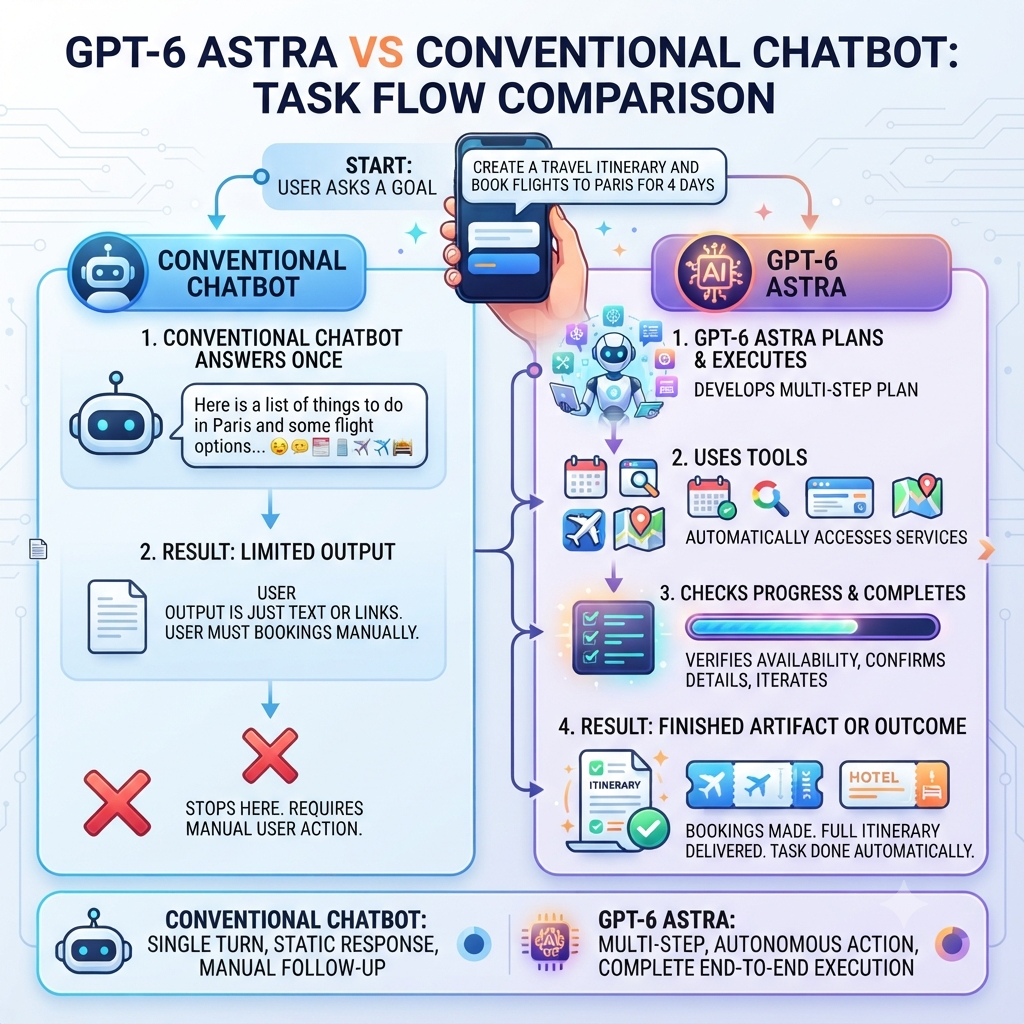
Astra vs a Conventional Chatbot
| Conventional chatbot | GPT-6 Astra |
|---|---|
| Primarily answers prompts | Works toward broader goals |
| Usually response-focused | Task and workflow-focused |
| Limited external interaction | Can use supported tools |
| Often stops after an answer | Can continue through multiple steps |
| Produces information | Can produce finished work |
The important change is therefore behavior, not simply another jump in chatbot intelligence.
Key Capabilities of GPT-6 Astra
Autonomous Task Execution
Astra can handle tasks such as filling online forms, updating CRM records, organizing calendars and conducting online research.
Reasoning and Multistep Work
The model is designed for complex tasks that require several stages of reasoning and execution instead of a single prompt-response cycle.
Tool Use and External Systems
Its supported tools include functions, web search, file search and computer use, allowing applications to connect Astra with external workflows.
Context and Long-Running Tasks
Astra has a 1.05-million-token context window, while OpenAI has also introduced features such as asynchronous tool calling for longer-running work.
Planning, Execution and Verification
Astra is designed to maintain the broader objective while responding to new requirements, changing direction when instructed and asking focused questions when missing information could affect the result.
What Is Actually New?
The biggest change isn’t that Astra suddenly invented reasoning or tool use.
Instead, OpenAI is combining these capabilities into a model designed for end-to-end task completion.
OpenAI also reports improvements in computer use, professional workflows, document creation and software engineering.
GPT-6 Astra Naming and Terminology
The official model name is GPT-6 Astra, while developers use the API identifier gpt-6-astra. OpenAI describes Astra as its flagship model for complex reasoning and coding.
Availability and Access
OpenAI says Astra is initially rolling out to a limited group of organizations, followed by availability for ChatGPT Plus, Pro, Business and Enterprise users.
Developers can access it through the OpenAI API, with availability also through Microsoft Azure and Amazon Bedrock.
Known Limitations and Open Questions
Astra’s increased ability to act also creates additional safety challenges.
OpenAI says Astra has additional monitoring and safeguards, including protections around potentially harmful autonomous actions. The company has classified Astra as its first model to reach the Critical cybersecurity capability level under its Preparedness Framework.
That means the important question is no longer simply “How smart is the model?” It is also “How safely can an increasingly capable model act?”
This is GPT-6 Astra.
Anything you can do on a computer, Astra can do for you. Fast. pic.twitter.com/gDd0IsewJw
— OpenAI (@OpenAI) September 3, 2026
The Bottom Line
GPT-6 Astra represents a shift from AI that primarily responds to AI that can increasingly work through a task.
Its combination of reasoning, computer use, tool calling, context and multistep workflows is what makes the model significant. Whether Astra becomes a genuine everyday digital worker will ultimately depend on how reliably, safely and widely these capabilities work in real-world applications.