

Tracked as CVE-2026-86218, the flaw can allow pre-authentication remote code execution (RCE) on an N-central server. In simple terms, an attacker may be able to execute code remotely without first logging into the platform. N-able has released N-central 2026.3 Hotfix 4 (build 2026.3.1.14) to address the vulnerability.
N-able N-central Vulnerability: What Happened and Why It Matters
N-central is a remote monitoring and management (RMM) platform used by IT teams and managed service providers (MSPs) to manage systems and devices.
The newly disclosed vulnerability is particularly serious because it affects the N-central server itself and can be exploited before authentication.
| Key detail | Information |
|---|---|
| Vulnerability | Pre-authentication RCE |
| CVE | CVE-2026-86218 |
| Severity | Critical |
| CVSS v4 | 10.0 |
| Fixed build | 2026.3.1.14 |
| Product | N-able N-central |
N-able says the vulnerability was responsibly disclosed through its security disclosure program. At the time of its advisory, the company said it had no confirmation of exploitation in production environments, while warning that unpatched systems remain at risk.
How the N-able N-central Vulnerability Could Enable Unauthenticated RCE
Remote code execution means an attacker can make a vulnerable system execute code of their choice remotely.
The word unauthenticated makes this much more concerning.
Think of authentication as the lock on a building. Normally, an attacker needs a key or credentials before getting inside. A pre-authentication vulnerability can potentially let them bypass that first checkpoint.
According to the CVSS details, CVE-2026-86218 requires:
- No existing privileges
- No user interaction
- Network access
- Low attack complexity
The CVSS 4.0 vector assigns the vulnerability a maximum 10.0 Critical score.
Which N-able N-central Versions Are Affected?
The published CVE record states that N-central versions before 2026.3.1.14 are affected.
Vulnerable versions
| Version status | Security status |
|---|---|
| Before 2026.3.1.14 | Affected |
| 2026.3.1.14 | Fixed |
N-able recommends upgrading self-hosted deployments to 2026.3.1.14 immediately.
Direct upgrade paths are available from versions including 2025.4, 2026.1, 2026.2, 2026.3 and earlier 2026.3 hotfix builds. Older installations may need an intermediate upgrade first.
For hosted N-central (NCOD), N-able says the patches have already been applied and customers do not need to take action for this vulnerability.
N-able N-central CVE Explained: Severity, CWE and Technical Classification
CVE identification
CVE-2026-86218 is the official identifier assigned to this N-central security flaw.
CVSS score and vector
Its CVSS v4 score is 10.0, the highest possible severity rating. The published vector indicates network-based exploitation, low complexity, no privileges required and no user interaction, with high impact across confidentiality, integrity and availability.
Relevant CWE classification
The vulnerability is classified as CWE-96, involving improper neutralization of directives in statically saved code, commonly described as static code injection.
What does the score mean for administrators?
For administrators, the practical takeaway is simple: this is not a vulnerability that should be treated as a routine patch.
The combination of remote network access, no authentication requirement and maximum CVSS severity makes vulnerable N-central installations a high-priority security concern.
What an Attacker Could Potentially Do After Exploiting N-central
If successfully exploited, the vulnerability could allow code execution on the N-central server.
That creates a serious security concern because N-central is a management platform rather than an isolated application. A compromised management server could potentially become a stepping stone toward systems and resources connected to it.
Potential consequences can include:
- Executing malicious code on the N-central server.
- Gaining access to the underlying system.
- Attempting further privilege escalation or persistence.
- Using the compromised management environment as a route toward other managed resources.
The exact post-exploitation impact depends on the environment and the privileges available to the compromised service.
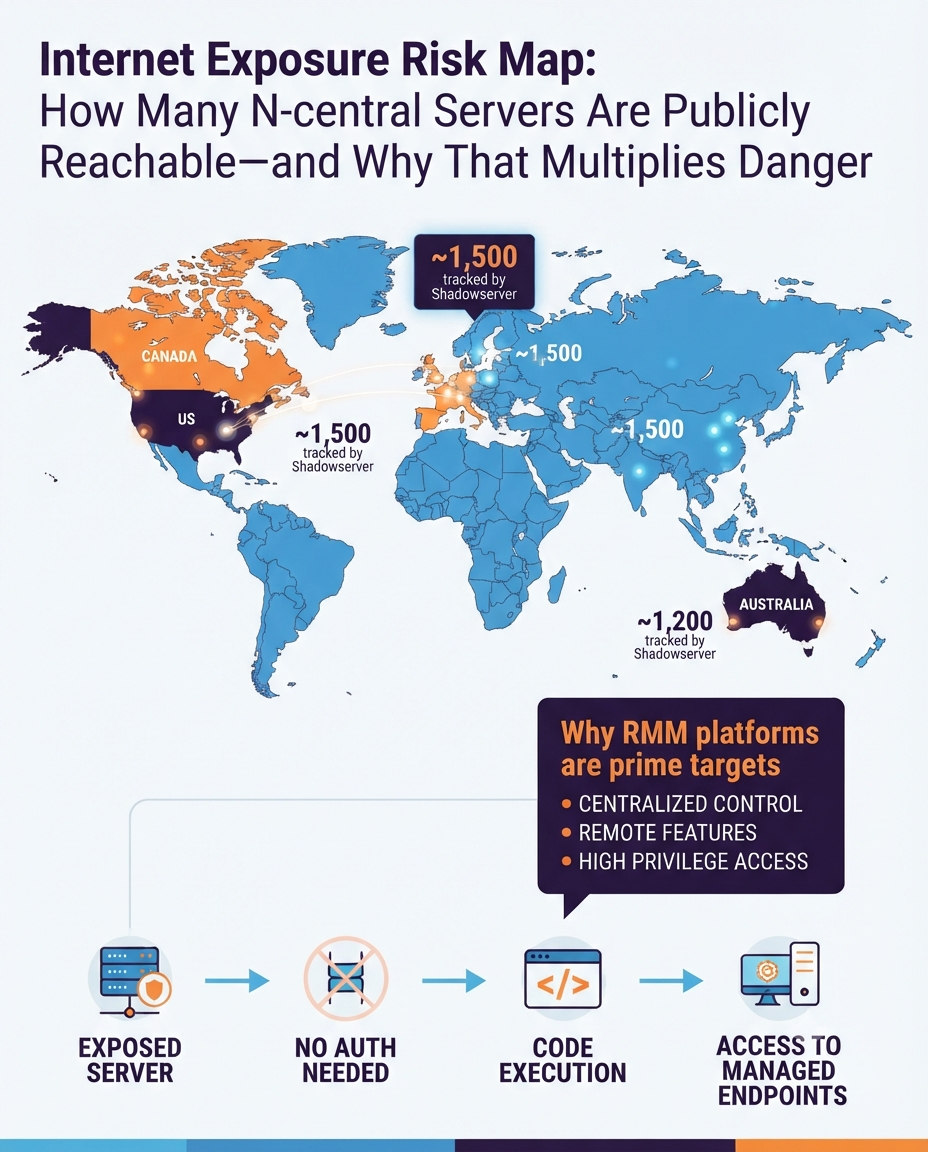
Internet-Facing N-central Servers: Why Exposure Changes the Risk
An internet-facing N-central server has a larger attack surface because attackers can reach it remotely.
This matters particularly for RMM platforms. They are designed to provide centralized management and remote access, making them valuable targets when compromised.
The basic risk can be thought of like this:
Internet exposure → Vulnerable N-central server → Remote exploitation → Potential server compromise
That does not mean every exposed server has been compromised. N-able stated that it had no confirmation of production exploitation when its advisory was published. However, the combination of remote exploitability, no authentication and maximum CVSS severity makes prompt patching especially important.
N-able N-central Vulnerability FAQ
Is authentication required?
No. CVE-2026-86218 is a pre-authentication vulnerability, meaning credentials are not required for the vulnerability’s attack conditions.
Is user interaction required?
No. The CVSS assessment lists user interaction as not required.
Is exploitation possible remotely?
Yes. The CVSS attack vector is network-based, meaning the vulnerability can potentially be exploited over a network.
Which deployments need immediate attention?
Self-hosted or on-premises N-central deployments running a version before 2026.3.1.14 should be treated as a priority. N-able recommends upgrading to 2026.3 Hotfix 4 (build 2026.3.1.14) immediately.
Hosted N-central customers were already patched according to N-able.