

If you use OpenVPN on Windows, the new OpenVPN 2.7.7 Windows security fixes are worth paying attention to. Released on September 3, 2026, OpenVPN 2.7.7 addresses several Windows-specific security problems involving command-line handling, network configuration, service permissions and input processing.
The easiest way to understand the update is to think of OpenVPN as a security checkpoint: version 2.7.7 tightens several places where unexpected input could previously get through.
Why OpenVPN 2.7.7 Is an Important Windows Security Update
The OpenVPN project describes 2.7.7 as a bug-fix release addressing multiple security issues. For Windows users, several fixes affect components that sit between OpenVPN, Windows services and network configuration tools.
| Security issue | What was fixed |
|---|---|
| CVE-2026-84256 | Safer CreateProcess() command-line quoting |
| CVE-2026-84226 | tapctl now uses the full path to netsh.exe |
| CVE-2026-82312 | Removed unsafe NULL DACLs from specific system objects |
| CVE-2026-78221 | Corrected UTF-8 IDN domain size handling |
For Windows installations running affected versions, upgrading to OpenVPN 2.7.7 closes these specific weaknesses.
CVE-2026-84256: How CreateProcess() Command-Line Quoting Was Fixed
This issue involves the Windows CreateProcess() function and characters that have special meaning to cmd.exe.
The problem was that OpenVPN did not correctly quote certain command-line arguments. Under a specific combination involving a validation script and a rogue certificate authority, this could make OpenVPN behave unexpectedly.
Think of command-line quoting like putting a fragile item inside a properly sealed box. If the packaging is incomplete, characters inside the input can be interpreted differently than intended.
OpenVPN 2.7.7 fixes the command-line quoting problem.
Affected versions: OpenVPN 2.1_rc10 through 2.6.22 and 2.7_alpha1 through 2.7.6 on Windows.
CVE-2026-84226: Why OpenVPN’s tapctl and netsh.exe Fix Matters
The second Windows issue concerns tapctl, OpenVPN’s utility for managing TAP network adapters.
Before the fix, tapctl could call netsh.exe without specifying its full path. On Windows, relying on an executable search path can create an opportunity for a different executable to be found first, a situation commonly associated with binary planting.
The OpenVPN 2.7.7 fix is straightforward: tapctl now calls netsh.exe using its full path.
In simple terms, instead of saying, “Find netsh.exe,” the software effectively tells Windows where the expected executable is located.
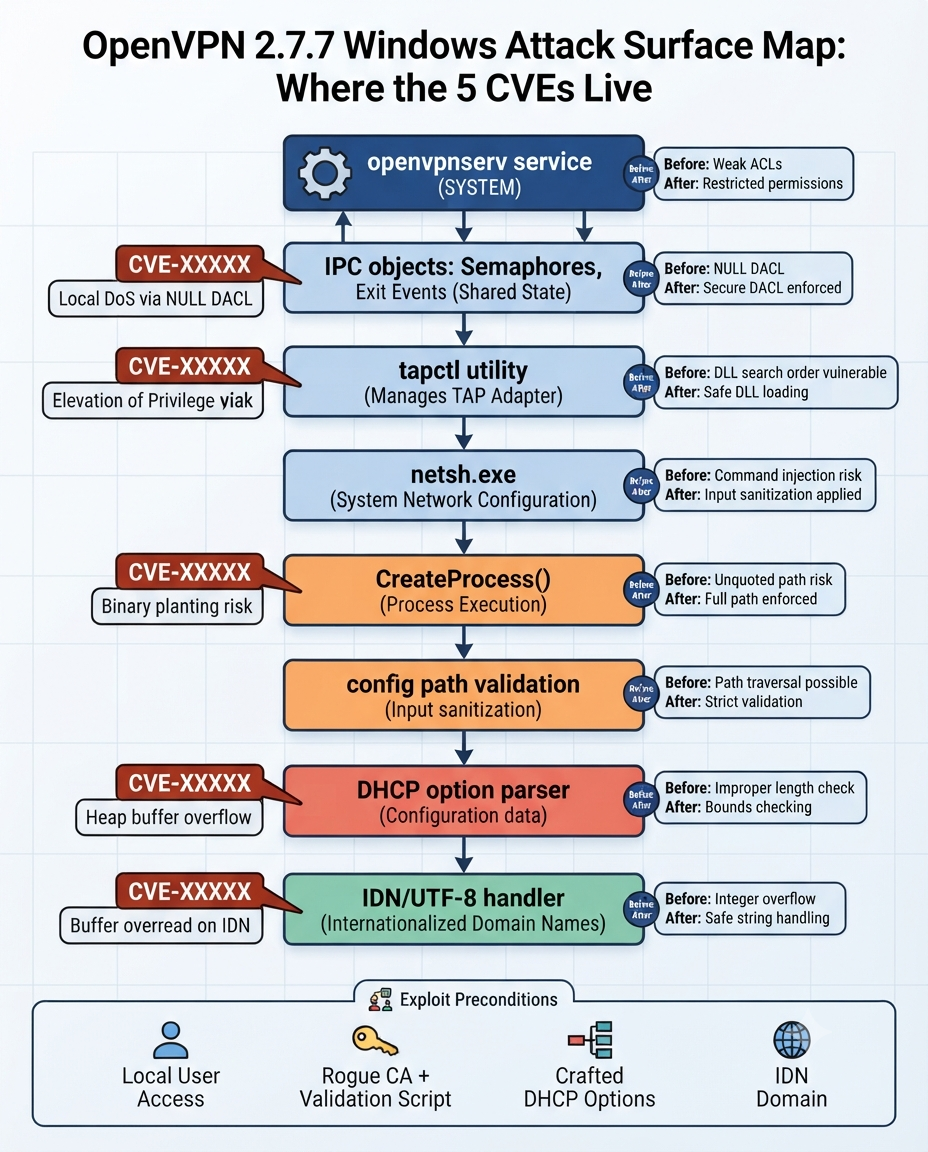
CVE-2026-82312: OpenVPN Windows Local Denial-of-Service Explained
This vulnerability involves NULL discretionary access control lists (DACLs) assigned to two Windows system objects: the OpenVPN --service exit event and the netsh.exe guard semaphore.
Because of the way these objects were created, a local user could interfere with another user’s OpenVPN process, for example, by blocking the semaphore or signalling the exit event.
That could result in a local denial-of-service (DoS).
The issue specifically affects certain service configurations, including setups using the automatic service to start and stop OpenVPN.
OpenVPN 2.7.7 addresses the problem by no longer using NULL DACLs for these system objects.
CVE-2026-78221: The UTF-8 IDN openvpnserv Buffer Overread
Another Windows-specific issue affects openvpnserv, the OpenVPN Windows service component.
The problem occurs when internationalized domain names (IDNs) containing UTF-8 encoding are involved. An incorrect size for NRPT domains could be passed to the service, potentially resulting in a buffer overread.
A useful analogy is asking someone to read a document while giving them the wrong number of pages. They may continue reading beyond the portion they were actually supposed to process.
OpenVPN 2.7.7 corrects the NRPT domain-size handling.
Affected versions: OpenVPN 2.7_alpha1 through 2.7.6 on Windows.
How OpenVPN 2.7.7 Hardens Windows Input Validation
The security work in OpenVPN 2.7.7 also strengthens how Windows input is handled.
One important area is configuration path validation. OpenVPN’s security announcements list a Windows configuration-path validation bypass involving the / separator, while another Windows issue concerns handling of DHCP search-option data.
The broader takeaway is simple: OpenVPN 2.7.7 is tightening the boundaries around Windows input, making it harder for unusual paths, network-related data or specially formatted input to bypass expected checks.
Which Windows OpenVPN Installations Should Upgrade Immediately?
If you’re running an affected OpenVPN version on Windows, upgrading to 2.7.7 is the sensible move.
Prioritize the update if your installation:
- Uses OpenVPN’s Windows service.
- Relies on
tapctlfor network adapter configuration. - Uses validation scripts with certificate-based authentication.
- Handles IDN/UTF-8 domain information.
- Uses automatic service start/stop configurations.
The official OpenVPN community download page provides OpenVPN 2.7.7 installers for Windows, including x86-64, ARM64 and 32-bit versions.
OpenVPN 2.7.7 Windows security fixes are mainly about closing gaps in how OpenVPN interacts with Windows.
From safer CreateProcess() quoting and full-path netsh.exe execution to stronger service-object permissions and corrected UTF-8 IDN handling, the update makes several important Windows components more defensive.
If you’re still running an affected version, upgrading to OpenVPN 2.7.7 is the simplest way to get these fixes.