
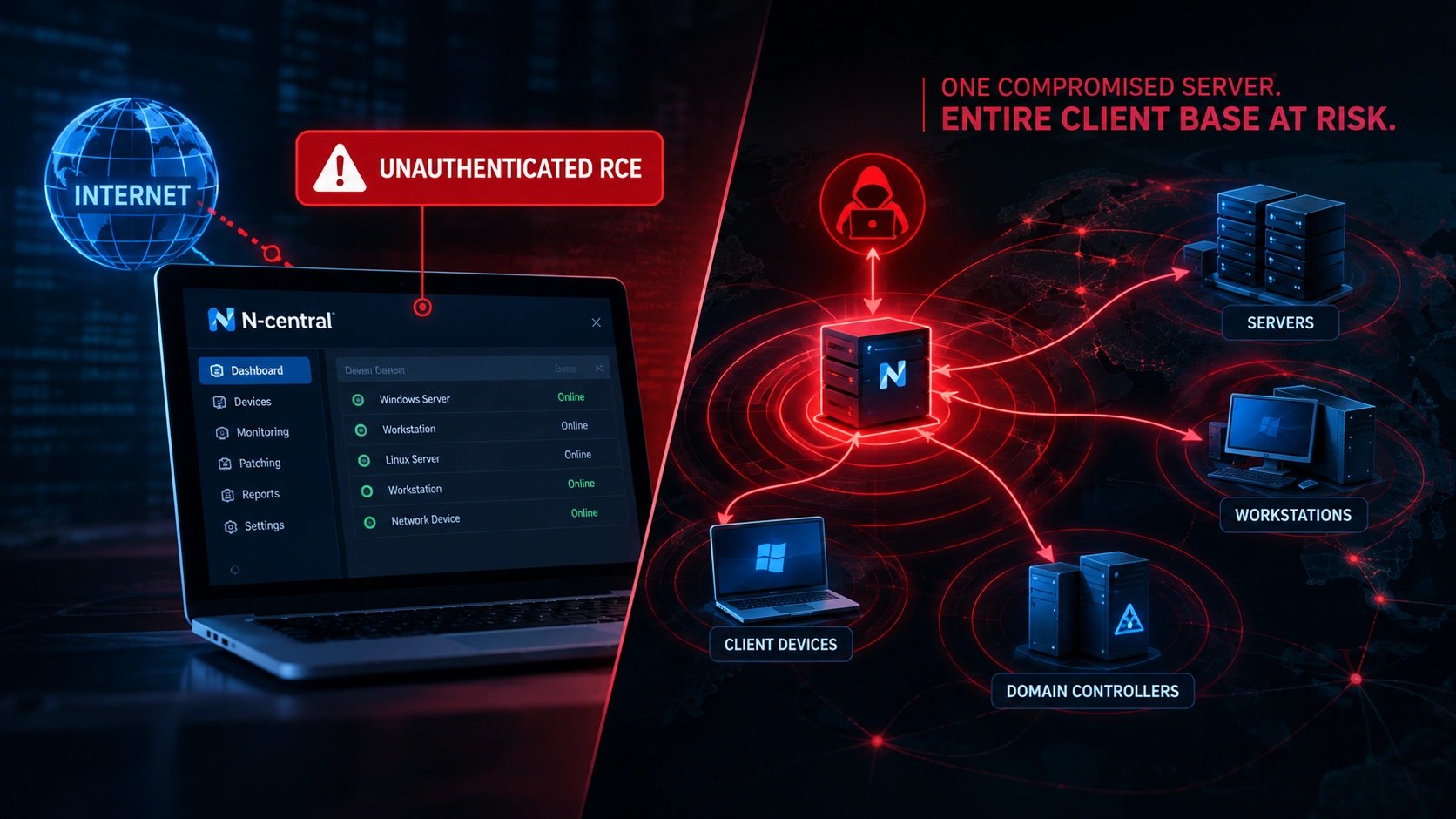
The latest N-able N-central RCE exploitation risk involves CVE-2026-86218, a critical vulnerability that can allow pre-authenticated remote code execution on an N-central server. N-able released N-central 2026.3 Hotfix 4 (build 2026.3.1.14) to address the flaw.
N-able says it has no confirmation that this specific CVE has been exploited in production, while Huntress has reported exploitation activity around N-central but says it cannot definitively attribute the observed compromise to CVE-2026-86218.
1. How an Attacker Could Target an Exposed N-able N-central Instance
Think of an internet-facing N-central server like an office building with its front door visible from the street. An attacker first needs to find the building, identify what it is and then determine whether the door is vulnerable.
Internet discovery
Attackers can search the internet for exposed N-central instances and identify systems that appear to belong to the RMM platform.
Target identification
Once an instance is discovered, attackers may investigate its version, exposed functionality and other characteristics to determine whether it could be vulnerable.
Huntress has also documented reconnaissance involving the /remoteControlAction.do?method=getPierDetails endpoint during recent N-central activity.
Initial exploitation conditions
The most important condition is an unpatched N-central server that an attacker can reach.
CVE-2026-86218 is a pre-authentication RCE vulnerability, meaning exploitation does not depend on having a legitimate N-central login first. N-able recommends that on-premises customers upgrade to 2026.3 HF4 (2026.3.1.14) immediately.
Hosted N-central customers do not need to take action because N-able says those instances have already been patched.
2. From Unauthenticated RCE to System Compromise: Possible Attack Chain
A useful way to understand the risk is to imagine the N-central server as the control room for an organization.
Initial access
If an attacker successfully exploits the RCE, they could potentially execute commands on the N-central server without first authenticating.
Command execution
The next concern is the attacker’s ability to abuse the RMM’s legitimate management capabilities. A compromised management server can potentially become a launch point for scripts, remote-control activity and other administrative operations.
Establishing control
Attackers may then attempt to maintain access through accounts, services or remote-access mechanisms.
Previous N-central investigations have identified suspicious account activity and Cloudflare tunnel infrastructure associated with post-exploitation activity.
Post-exploitation activity
The possible progression looks like this:
N-central compromise → command execution → environment discovery → endpoint access → credential access → lateral movement → potential data theft or ransomware
This is an attack-chain model, not proof that every compromised N-central server will follow every step.
3. Could a Compromised N-central Server Become a Gateway to Managed Endpoints?
Relationship between N-central and managed devices
N-central exists to centrally manage connected systems. That can include monitoring, scripting, patching and remote-control capabilities.
Why remote-management infrastructure can create a high-impact blast radius
The risk is scale.
Instead of compromising one workstation at a time, an attacker who gains control of a trusted RMM platform may have a much more powerful position from which to interact with numerous managed systems.
Huntress has observed attackers using compromised N-central infrastructure to run scripts, push tools and initiate remote sessions across downstream endpoints.
Separation between server compromise and endpoint compromise
However, compromising N-central does not automatically mean every managed endpoint is compromised.
The actual impact depends on factors such as permissions, segmentation, available remote-management functions, detection capabilities and how quickly defenders interrupt the intrusion.
4. What Makes RMM Platforms Attractive Targets for Attackers?
| Factor | Why attackers care |
|---|---|
| Centralized administration | One platform can manage many systems |
| Privileged operations | RMM tools can perform powerful administrative tasks |
| Large numbers of managed systems | One compromise can potentially affect many endpoints |
| Supply-chain implications | MSP infrastructure may connect multiple customer environments |
That combination makes RMM platforms particularly valuable targets:
Centralized control + high privileges + scale
5. N-central RCE: What Security Teams Should Look for in Logs
Security teams should look beyond the N-central server itself and investigate activity on connected endpoints.
Look for:
- Unexpected administrative activity: New accounts, privilege changes or unusual administrator sessions.
- Suspicious processes: Unexpected scripts, remote-control tools or unfamiliar executables.
- Unusual network connections: New outbound tunnels or unexpected connections involving N-central-managed systems.
- Authentication anomalies: Logins from unusual locations, unfamiliar IP addresses or activity outside normal working patterns.
- Unexpected configuration changes: Changes to users, permissions, policies or management settings.
N-able has also recommended auditing N-central user accounts for unexpected users.
6. Indicators of Possible N-central Exploitation
Treat indicators as investigation leads, rather than automatically assuming they prove exploitation.
Relevant IOCs when officially published
Use current IOCs from N-able and trusted incident-response sources, and verify that they relate to the specific campaign or vulnerability you are investigating.
Suspicious commands/processes
Investigate unfamiliar administrative commands, discovery activity, remote-access utilities and unexpected scripts executed through the RMM environment.
Unexpected accounts or persistence mechanisms
Pay particular attention to newly created accounts, suspicious account-name changes and unexpected services.
Huntress reported account-name anomalies involving .invalid strings and identified a malicious Cloudflare tunnel account tag associated with the broader N-central investigation.
Network-level indicators
Look for unusual inbound connections to the N-central server and unexpected outbound connections or tunneling from managed endpoints.
7. Could This Vulnerability Lead to Ransomware Deployment?
Attack-chain analysis
Potentially, yes — but the distinction between possibility and confirmed exploitation matters.
A compromised RMM platform could provide attackers with a powerful route toward managed endpoints. From there, attackers could potentially perform discovery, obtain credentials, move laterally and eventually deploy ransomware.
Conditions required for ransomware escalation
The risk becomes more serious when several conditions exist together:
- An exposed and vulnerable N-central server.
- Successful exploitation and continued attacker access.
- Sufficient privileges to interact with managed endpoints.
- Weak segmentation or excessive trust between management infrastructure and critical systems.
- Insufficient detection or delayed incident response.
Also Read: OpenVPN 2.7.7 Security Vulnerabilities: What Was Fixed in the September 2026 Update?
Difference between theoretical impact and confirmed exploitation
For CVE-2026-86218 specifically, N-able currently says it has no confirmation of production exploitation, although unpatched systems remain at risk.
At the same time, Huntress has documented active N-central exploitation activity but notes that it cannot definitively determine whether the observed compromise involved CVE-2026-86218.
That distinction is important: the ransomware pathway is technically plausible, but it should not be presented as confirmed ransomware exploitation of this particular CVE unless reliable evidence establishes that connection.