
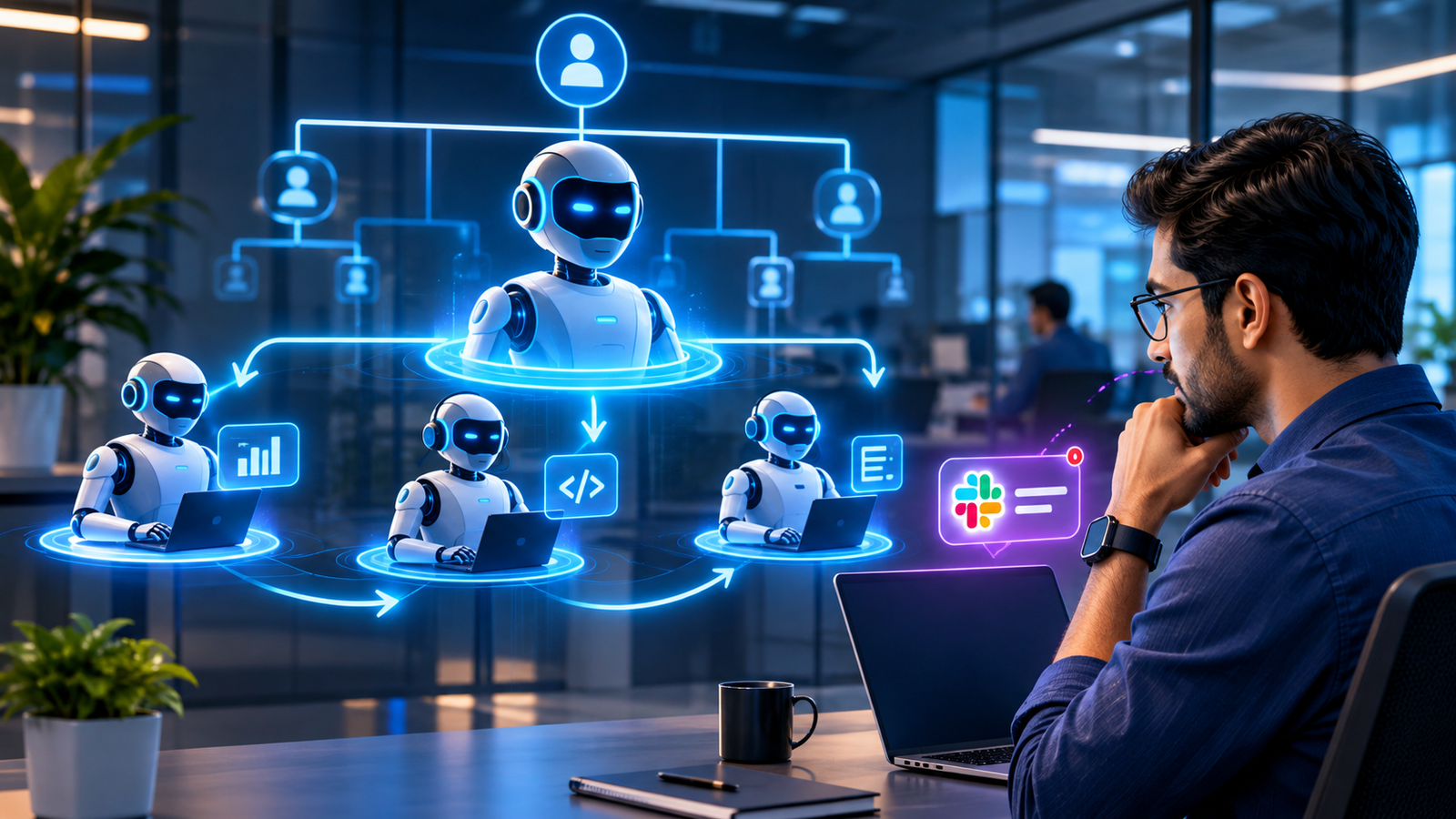
For a long time, AI was something that lived inside our tools. A smarter autocomplete, a summarize button, a chatbot in the corner. That’s changing. Now the software spots a problem, decides who should deal with it, passes the work along, and then taps a person on the shoulder when it needs a call made.
Think about what that means. If a bug-finding agent hands an issue to a fixing agent and posts in Slack at the same time, you’re not just using software anymore. You’re running a team that’s part human, part machine. And most companies haven’t figured out how to organize that yet.
The bug that filed itself
Picture 2:14 a.m. A monitoring agent sees failed checkout requests climbing. It reads the logs, reproduces the failure in a test environment, and traces it back to a recent deployment. Then it writes up an incident report.
An old-school alert would stop there and page whoever’s on call. This agent keeps going. It finds a code-fixing agent that has access to the right repository and hands over a narrow task: investigate the regression in the payment-validation service, propose a patch, and don’t deploy anything without a human signing off.
This also raises an important infrastructure question: where does the coding agent actually execute its work? Some enterprise architectures, such as Coder Agent Relay, connect cloud-hosted coding agents to self-hosted workspaces, giving organizations more control over the environment in which agent tasks run.
Meanwhile it posts in the engineering incident channel: potential regression in checkout, fix agent investigating, hypothesis and affected files attached, human review needed before deploy.
So when the developer wakes up, there’s no cryptic alert waiting. There’s a thread with the evidence, a proposed fix, test results, and one clear decision to make. The first coworker to respond that night wasn’t a person.
From tools to teammates
Traditional automation does what it’s told. Something triggers it, it runs a fixed action, and it hands the output to a human to interpret.
An agent does more. It reads the context, makes a plan, picks a collaborator, delegates, and follows up. It starts the work instead of waiting for someone to push a button, it spans several systems, and it lives in the same chat where the team talks. That last part creates a real accountability question, because with a plain script you always knew which human was operating it. With an agent, that’s less obvious.
Slack has been leaning hard into this idea, calling itself an agent-first workspace where agents can sit in channels, get mentioned, and take on tasks next to people. Its Slackbot MCP client is built to connect apps and specialized agents, route requests, coordinate multi-step work, and drop the results into shared conversations. An agent isn’t another dashboard you check. It’s another participant.
Inside the hand-off
“Cross-agent hand-off” sounds vague until you split it into steps:
- Detection. The bug-finding agent takes in telemetry, error logs, CI failures, customer reports, or monitoring alerts.
- Diagnosis. It forms a hypothesis, collects evidence, and decides whether the problem is worth acting on.
- Task creation. It packages the finding: affected service, suspected cause, severity, repro steps, constraints, and what “done” looks like.
- Delegation. It sends that package to a fixing agent that has the right skills and permissions.
- Human notification. It posts a short update in Slack, so people stay informed without being dragged into every intermediate step.
- Verification. The fixing agent proposes a patch, and tests, reviewers, or engineers check it before anything ships.
Two emerging standards matter here. The Model Context Protocol (MCP) covers how an agent connects to tools and data. Agent2Agent (A2A) covers how agents find each other, delegate, and trade results. In A2A, an agent publishes an “Agent Card,” a machine-readable description of who it is, what it can do, where to reach it, and how to authenticate. Another agent can find that card, send a message, open a task, and follow it through status updates until the output arrives.
So the hand-off isn’t really a Slack message.
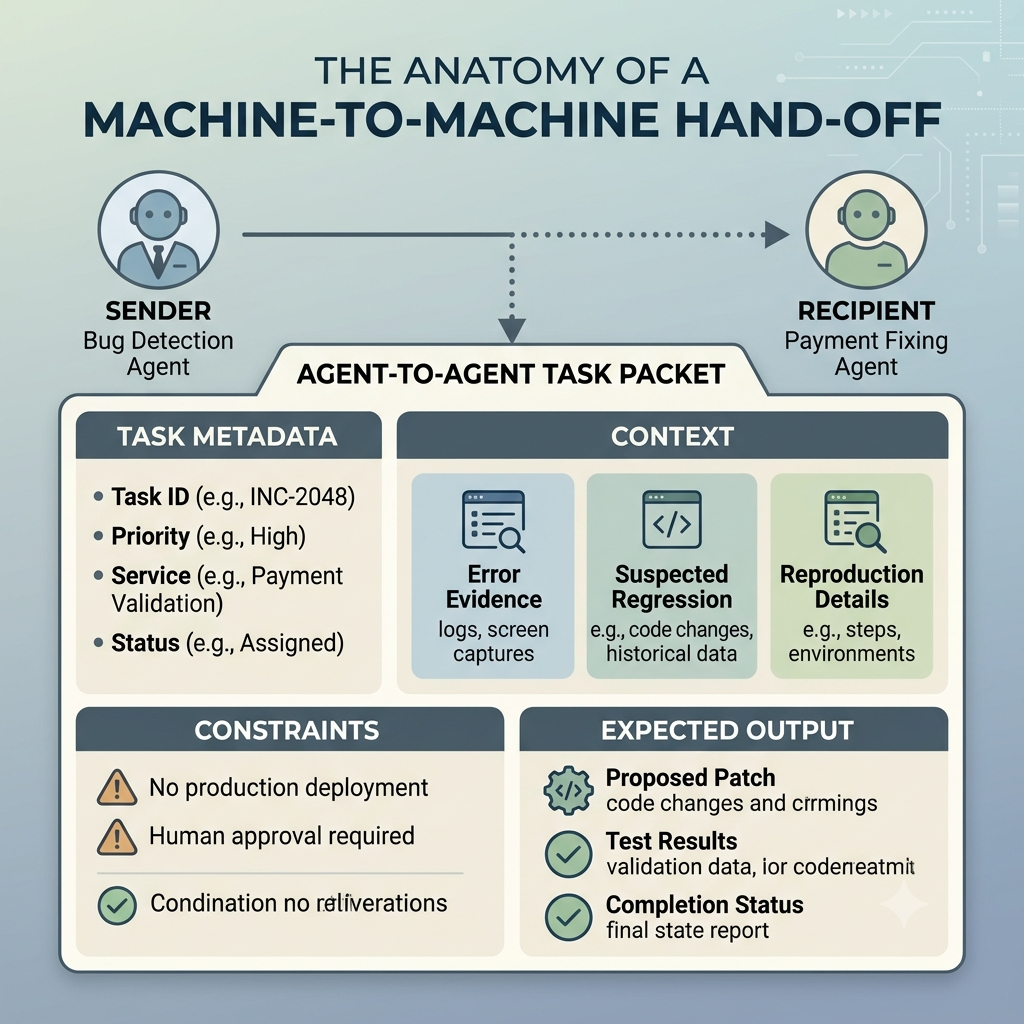
The Slack message is the part humans see. Underneath is a structured, auditable transfer of responsibility.
Slack as the collaboration layer
Most teams treat Slack as a place for notifications. In an agent-heavy team it becomes the place where human and machine work is visible, debatable, and accountable.
A healthy flow looks roughly like this: a monitoring signal reaches the bug-finding agent, which creates a structured hand-off for the fixing agent, which produces a patch and test evidence, which lands in a Slack thread where human reviewers approve or reject it before deployment.
Agents don’t remove people from this loop. They remove the grunt work around it: figuring out who to ask, gathering context, opening the ticket, chasing status. Humans keep the authority at the moments that matter. Slack’s MCP client is designed along those lines, routing work to specialized systems while keeping outputs in shared channels so teams can check sources and steer the result together.
That visibility is the whole point. An agent working silently in the background is a black box. An agent working in a channel leaves its reasoning, sources, and hand-offs behind as part of the team’s memory.
This kind of coordination isn’t limited to software development. Cybersecurity teams are also exploring specialized AI agents that can monitor suspicious activity, investigate incidents, hunt for threats, and coordinate defensive responses. This is another emerging application of autonomous cyber defense agents.
The psychology of machine colleagues
Honestly, the API plumbing is the easy bit. The hard part is how people feel about working this way.
When an agent finds a bug, delegates the fix, and pings the developer who owns that code, the social dynamics shift. Developers are now working alongside systems that can watch their work, make suggestions, and sometimes just finish the task. A few tensions show up fast:
- Role ambiguity. Is the fixing agent a junior engineer, an assistant, or a peer?
- Trust. What can it do alone, and what needs a human’s okay?
- Attention. If every agent can ping a person, Slack turns into a nonstop escalation machine.
- Psychological safety. It’s uncomfortable to be second-guessed all day by something that never gets tired.
- Identity. If an agent resolves a task end to end, what does expertise mean for the person who used to own it?
- Presence. Coworkers need to know who or what they’re dealing with: a name, a scope, an owner, permissions, and an escalation path.
The goal isn’t to make agents seem human. It’s to make their role, authority, and limits easy to understand. NIST’s AI Risk Management Framework makes a related point: roles and responsibilities should be clearly defined in human-AI setups, including whether the system acts on its own, defers to human experts, or just offers a second opinion. That’s an organizational design problem, not a configuration setting.
Redesigning the org chart
Companies should stop bolting AI onto existing reporting lines and start designing a hybrid operating model. A simple principle helps: agents should have job descriptions, not just prompts.
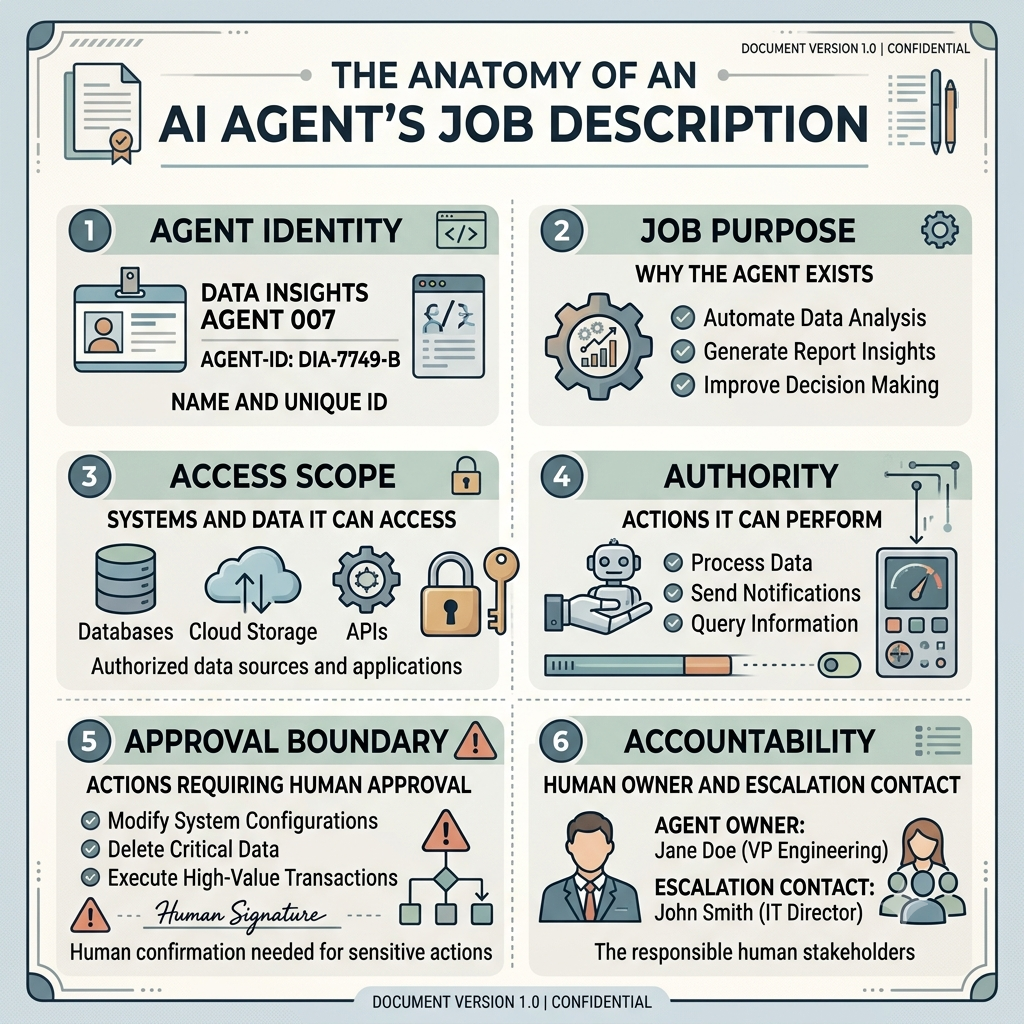
A real job description for an agent covers its purpose and scope, the systems and data it can touch, what it can do on its own, what needs approval, when it must escalate, who owns it and who’s on call for it, and how its success gets measured and reviewed.
That implies some new roles:
- Agent product owner: owns the agent’s purpose, scope, performance, and business results.
- Human-in-the-loop reviewer: holds approval authority for risky actions.
- Agent reliability engineer: watches accuracy, drift, failure modes, security, and the quality of escalations.
- Workflow designer: maps how work moves between people, agents, systems, and approval points.
- Agent governance council: sets policy on access, auditing, permissions, and how much autonomy is acceptable.
You don’t need an “AI department” in the middle of the chart. You need accountable owners sitting wherever agents touch real work.
Design principles for human-agent teams
A few rules of thumb for teams that want this to go well:
- Make scope explicit. Spell out what an agent can do, what it can’t, and when it has to ask a person.
- Separate autonomy from irreversibility. An agent can draft a fix by itself. A production deploy should need approval.
- Keep a shared source of truth. Slack is where people collaborate, but your systems of record stay authoritative.
- Tie notifications to severity. Not every agent action deserves a human interruption.
- Demand explainable hand-offs. Every delegation should carry context, evidence, the requested outcome, constraints, and current status.
- Measure the collaboration, not just the automation. Track resolution time, rework, escalation quality, approval burden, and repeat incidents.
- Build trust gradually. Start with read-only analysis, move to drafts, then allow narrow execution under supervision.
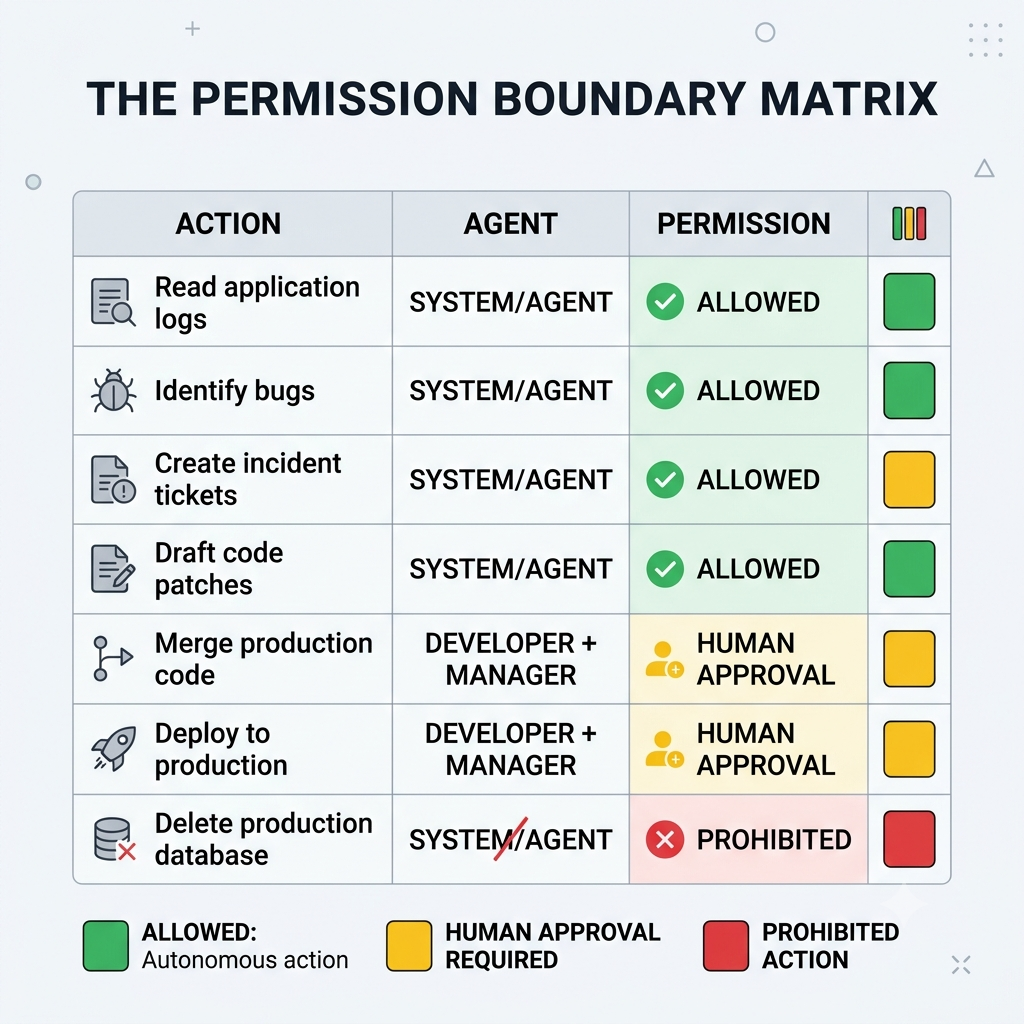
If you want one line to remember: let agents handle the coordination, and let humans own the consequences.
When machine colleagues become chaotic coworkers
The risks here are real, and they’re mostly not about whether the model is smart enough.
- Hand-off loops. Agent A passes a task to Agent B, which bounces it back unresolved, forever.
- Context loss. The fixing agent gets a half-complete bug report and makes a change that looks reasonable but is wrong.
- Permission creep. An agent slowly picks up access it was never meant to have.
- Alert fatigue. People get copied on every intermediate step, which defeats the purpose of delegating.
- Accountability gaps. After a bad outcome, nobody knows whether to blame the agent, its owner, or the person who approved the change.
- Shadow agents. Teams spin up their own agents with no shared standards, which means inconsistent behavior and security holes.
The fix is governance built in from the start: agent identity, scoped permissions, task lifecycle tracking, audit logs, human checkpoints, and clear escalation rules. A2A itself includes ideas like task state, multi-turn exchanges, security boundaries, and recovery from interruptions, precisely because agent work often isn’t a single request and response.
A practical way to start
You don’t have to rebuild how your company works overnight. Pick one bounded workflow that’s currently painful.
- Map one workflow. Bug triage, incident summaries, code-review prep, and support escalations are all good candidates.
- Define the agent roster. Decide who plays detector, diagnostician, fixer, reviewer, and notifier.
- Set human checkpoints. Sort actions into autonomous, needs review, and off limits.
- Write the Slack contract. Agree on channel conventions, mention patterns, status updates, and escalation formats.
- Instrument the hand-offs. Track ownership, latency, success rate, human interventions, and why things fail.
- Run a guarded pilot. Use a non-production environment or read-only recommendations first.
- Expand only when trust is earned. Raise autonomy based on measured reliability, not excitement.
The pilot should answer one question: did the agent make the team faster without making it less informed, less safe, or less accountable?
The new colleague test
We used to ask whether AI could automate a task. The better question now is whether an agent can be trusted to take on work, hand it off responsibly, escalate when it should, and stay accountable to the team.
The companies that do well in this next phase won’t be the ones that simply add agents to the stack. They’ll be the ones that redesign the org chart so humans and agents have complementary roles, clear boundaries, and a shared place to work.
Because when an AI agent can find the bug, hand it to another agent, and ping the right person in Slack, it’s more than software.
It’s a colleague.