

A customer asks your support agent, “Can I still get a refund?” The agent retrieves a refund policy from 2023, finds a decent match, and replies: “Yes, refunds are available within 30 days.” It sounds right. It’s polite, specific, and confident. It’s also wrong, because the policy changed last month.
The agent didn’t fail because it lacked knowledge. It failed because it answered anyway.
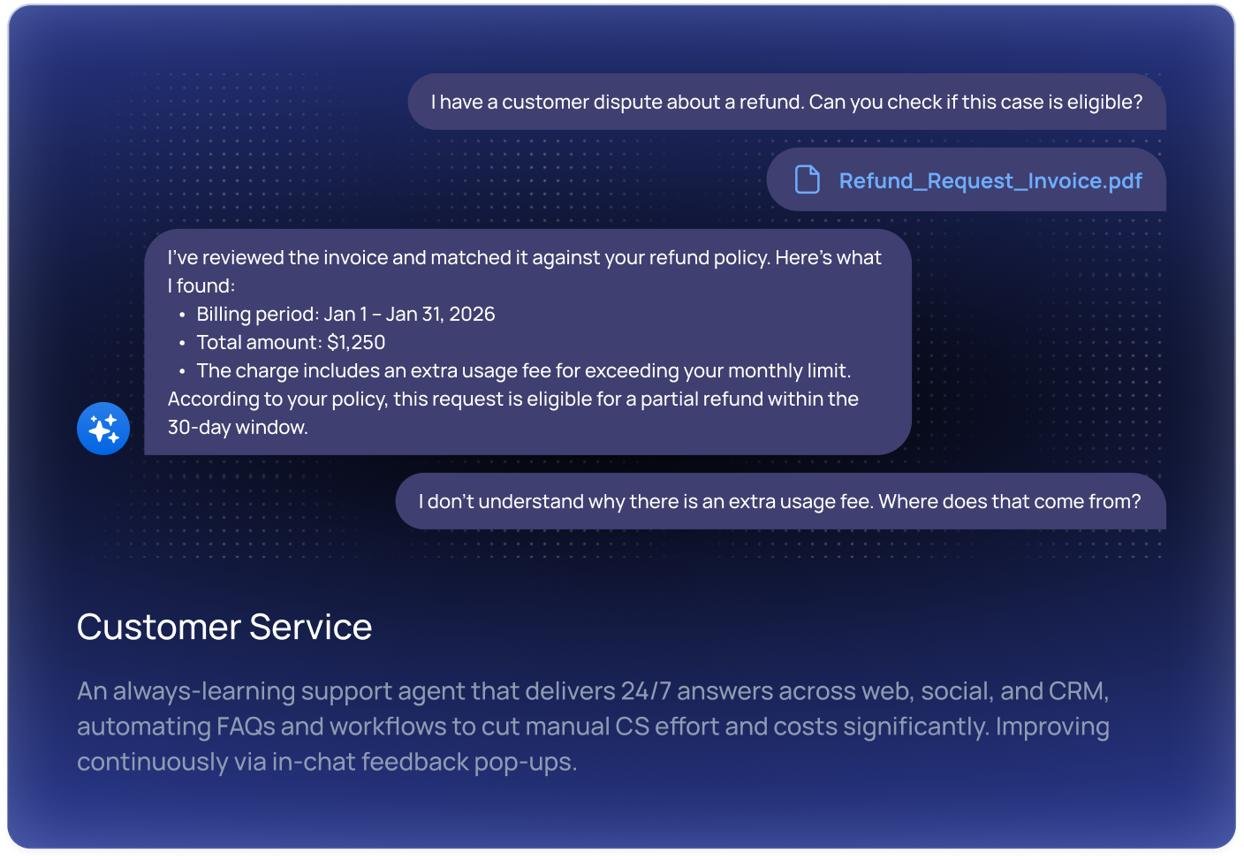
That’s the problem this article is about. Not how to stop bad context from reaching your agent (that’s a retrieval and drift problem, covered separately), but what the agent should do once weak, stale, or ambiguous context has already arrived.
My thesis is simple: a calibrated agent doesn’t try to eliminate uncertainty. It recognizes uncertainty, communicates it honestly, and picks a response proportionate to the risk.
Hallucination is also only one way this goes wrong. Agents make unsupported claims, repeat stale facts, misuse tools, summarize with too much confidence, and report tasks as complete when they aren’t. These are different failure classes, and they need different handling. Good fault-tolerant design accepts that not everything can be prevented, and plans for fallbacks, partial results, and clearly labeled uncertainty instead.
Also Read: The Complete Guide to Maintaining Reliable AI Agents: Drift Detection & Calibration
What calibration means for an agent
Calibration is the match between four things: what the agent claims to know, what evidence it actually has, how certain it sounds, and what it does next.
A model can be perfectly fluent and still badly calibrated. It can state an answer with total assurance when retrieval was thin, sources disagreed, or the user’s question could mean two different things. Fluency tells you nothing about evidence.
So here’s the working definition I’ll use:
Calibration is the discipline of making an agent’s response behavior match the quality and completeness of its available evidence.
In practice, the response is a function of four inputs: how good the evidence is, how risky the task is, what the user actually wants, and whether a fallback exists. Change any of those and the right behavior changes too.
Four states your agent can be in
Most of the confusion about hallucination goes away once you stop treating it as one thing. At any moment, an agent is in one of four states:
| State | What’s happening | Calibrated behavior |
|---|---|---|
| Grounded and confident | Strong evidence, clear request, reliable tool results | Answer directly, cite sources, state assumptions |
| Grounded but ambiguous | Evidence exists, but the user’s intent or edge case is unclear | Ask one targeted question, or offer bounded options |
| Weak or stale evidence | Low retrieval confidence, conflicting or outdated sources | Qualify the answer, retry, fall back, or escalate |
| No safe answer | Evidence is absent or contradictory, or the action is high-risk | Decline, request human review, or give a safe partial result |
Uncalibrated agents behave the same way in all four rows: they produce a polished answer. That’s the whole bug.
It also means “I don’t know” can be a successful outcome. If saying it prevents a wrong refund promise or a deleted record, the agent did its job.
Why fluent output hides the problem
Language models are built to produce coherent, plausible text. They aren’t built to flag when the evidence behind that text is thin. A smooth paragraph creates trust whether or not it deserves any.
Agents add a few wrinkles on top:
- Tool success looks like task success. An API can return a 200 and still hand back the wrong record, or an incomplete one. The agent sees “success” and moves on.
- Stale context produces answers that used to be true. These are the hardest to catch, because nothing in the answer looks wrong.
- Polish suppresses doubt. Users rarely second-guess an answer that reads confidently, so errors travel further.
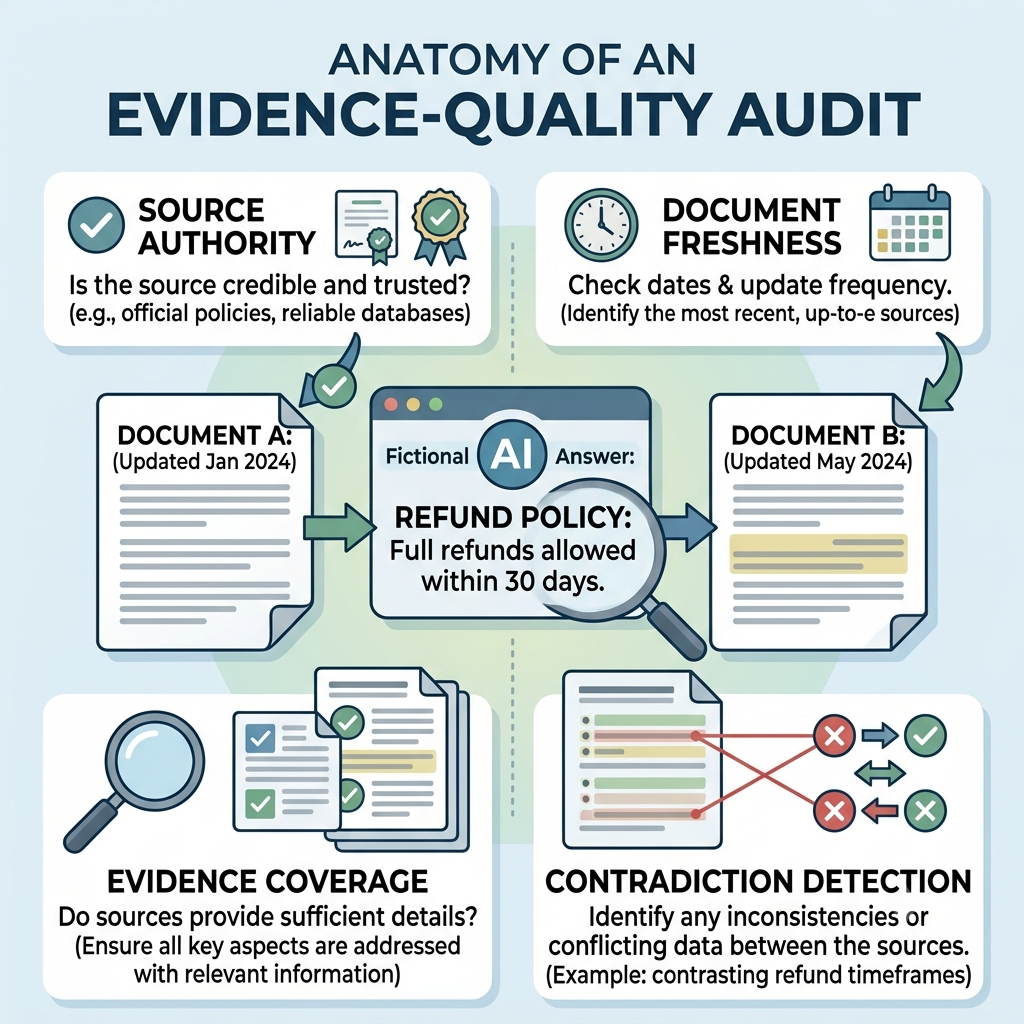
The fix isn’t only better retrieval. It’s a runtime policy that checks evidence age, conflict, coverage, and the risk of the action before the agent commits to an answer.
The calibration control loop
Here’s the framework I’d build around. It’s a loop, not a pipeline, because what happens after the response feeds back into the rules.
↓
Intent and risk classification
↓
Retrieval / tool execution
↓
Evidence quality assessment
↓
Confidence and uncertainty scoring
↓
Response policy decision
↓
Answer, clarify, caveat, fallback, or escalate
↓
User feedback and outcome capture
↓
Calibration rule and prompt updates
(back to the top)
In plain terms:
- Classify intent and risk. Is this informational, transactional, advisory, or consequential?
- Gather evidence. Retrieve documents, call tools, and keep the source metadata attached.
- Assess the evidence. Check relevance, coverage, recency, contradictions, and whether tool results are valid.
- Score uncertainty. Combine several signals (more on that next).
- Choose a path. Answer, clarify, caveat, retry, fall back, or escalate.
- Capture the outcome. Did the user accept, correct, escalate, or give up?
The important thing is that this lives in the agent’s runtime behavior, not in vector-space diagnostics. You can adopt it without touching your embeddings.
Confidence is not one number
Many teams add a single “confidence score” and call it done. It rarely holds up. Confidence is really several signals, and each one tells you something different:
| Signal | Examples | What it tells you |
|---|---|---|
| Model | Token probabilities, self-reported confidence, self-consistency | How unsure the model seems |
| Retrieval | Top similarity score, margin over runner-up, number of viable sources | Whether the context supports an answer |
| Evidence | Source age, authority, contradictions, citation coverage | Whether the sources are trustworthy and current |
| Tool | Status codes, schema validation, completeness, retry history | Whether the agent can act safely |
| Task | Financial, legal, medical, security, or irreversible stakes | How much certainty the action demands |
Don’t average these. A high model-confidence score shouldn’t rescue an answer built on a stale document or a tool result that failed validation. Treat them as inputs to a decision policy, where one bad signal can veto the rest.
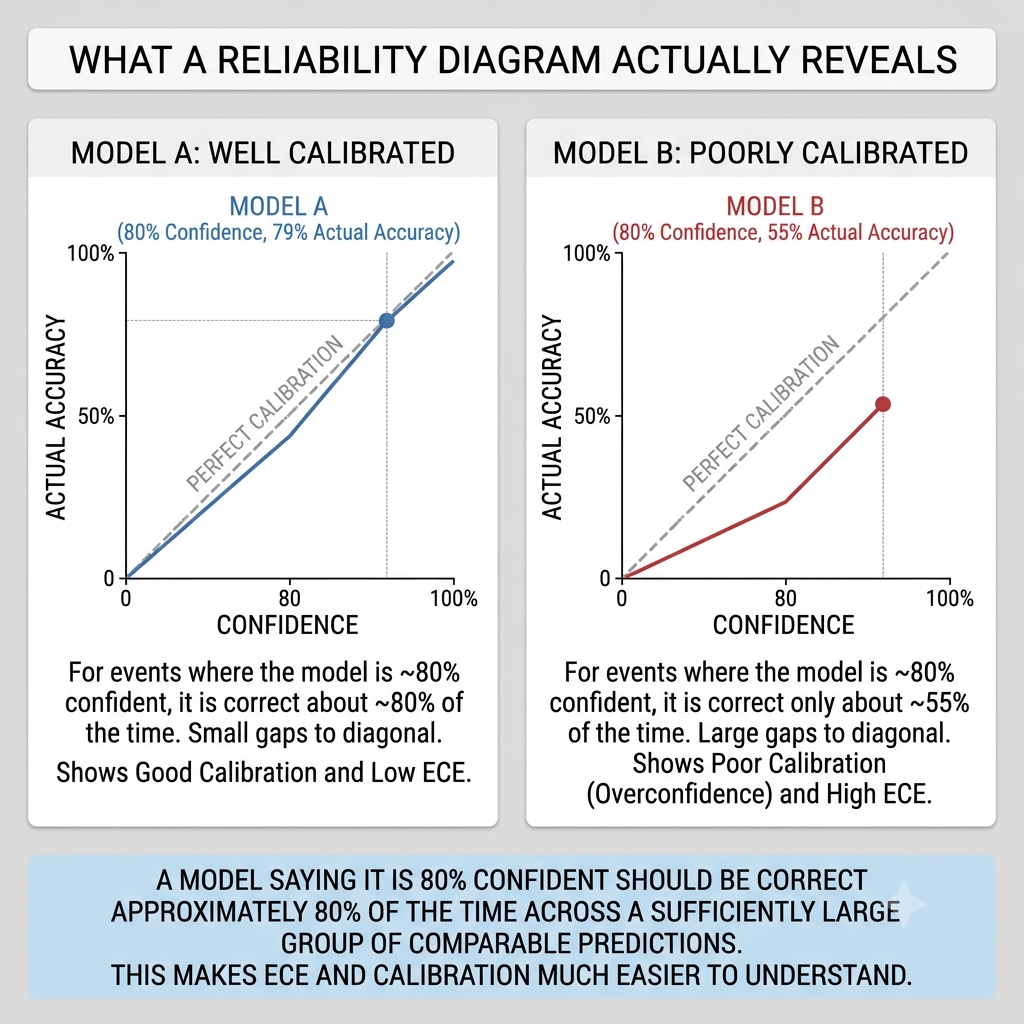
Expected Calibration Error (ECE) is worth tracking over time, since it shows whether stated confidence matches how often the agent is actually right. But it’s one measurement, not a calibration strategy.
Set thresholds by risk, not globally
A FAQ answer and a payment instruction should not meet the same evidence bar. One global threshold means you’re either too strict on trivial questions or too loose on dangerous ones.
| Risk tier | Example tasks | Minimum behavior |
|---|---|---|
| Low | General explanations, brainstorming, non-binding summaries | Answer with light sourcing, optional caveat |
| Medium | Product recommendations, workflow guidance, internal research | Adequate retrieval coverage, cite sources |
| High | Policy interpretation, financial guidance, customer commitments | Fresh, corroborated evidence; explicit limitations |
| Critical | Payments, deletions, access changes, regulated decisions | Verification, approval, or human review |
The rule underneath it: the higher the cost of being wrong, the lower the tolerance for uncertainty, and the stronger the fallback needs to be.
Frameworks like NIST’s AI Risk Management Framework push in the same direction. Risk tolerance, human oversight, and safe-failure behavior should be defined and written down, not left to whatever the agent happens to do.
Adapt the prompt to the evidence
Most agents run on one static system prompt, whatever the retrieval looked like. That’s a missed opportunity. The prompt can change depending on what the evidence looks like:
| Context condition | Instruction to add | Result |
|---|---|---|
| Strong, current evidence | Answer directly, cite sources, note assumptions only if material | Efficient, grounded answer |
| Partial evidence | Answer only what the sources support; name what’s missing; don’t infer beyond them | Bounded answer |
| Conflicting evidence | Name the conflict, prefer the most recent or authoritative source, flag what’s unresolved | Transparent qualification |
| Insufficient evidence | Don’t fabricate; ask a question, state what’s missing, or escalate | Safe refusal or handoff |
| Stale evidence | Use only sources within the freshness window; label anything based on older material | Time-aware answer |
A compact version of the underlying instruction might read:
Use only the supplied sources. If they are incomplete, conflicting, or older than the permitted freshness window, say so and recommend the next step. Don’t present an inference as a verified fact.
One caution. Treat these prompt changes like code. Version them, test them, and tie each to a failure you actually observed. Editing the prompt after every incident is how you end up with a system nobody can reason about.
When the agent must stop
Escalation should be a designed feature, not an error handler that fires when everything else breaks. Build explicit triggers:
- Confidence drops below the threshold for that risk tier
- Sources conflict or fail the freshness requirement
- The request falls outside the agent’s approved scope
- A tool returns an error, an incomplete result, or a suspicious value
- The user pushes back on an answer or asks for a person
- The action is irreversible, financial, legal, safety-related, or customer-facing
- Retries keep failing, or the result can’t be validated
And give each one an owner:
| Trigger | Immediate action | Owner |
|---|---|---|
| Low retrieval confidence | Ask for clarification or give a qualified partial answer | Agent |
| Conflicting authoritative sources | Withhold a definitive answer; route to expert review | Domain owner |
| Tool failure | Retry within limits, then fall back or pause | Agent platform |
| High-risk action | Require explicit approval before executing | Human approver |
| Repeated user corrections | Open a quality incident; review prompts and rules | Agent owner |
Escalation only works if someone is on the other end. Decide who reviews, who approves, who can override, and who owns the fix. Track overrides, errors, complaints, and response times, because those numbers tell you whether the human layer is actually working.
Graceful degradation: partial beats polished and wrong
A reliable agent doesn’t always have to deliver a complete answer. It has to deliver an honest, useful one. Think of it as a ladder:
- Full grounded answer. Strong evidence, low risk, respond directly.
- Qualified answer. Say what’s known, and name the assumptions and gaps.
- Clarifying question. Ask for the missing detail needed to proceed safely.
- Alternative path. Offer a documented fallback: a cached snapshot, a narrower search, a human handoff.
- Safe refusal. Decline when evidence or authorization is lacking.
- Incident escalation. Route to a person or an operational workflow when failure repeats or the impact is high.
Back to the refund example. A degraded response might look like this:
“I found guidance for the standard refund workflow, but I can’t verify whether it applies to annual subscriptions. I can outline the standard process, or route this to a billing specialist before you take action.”
That beats a confident “yes,” and it beats a generic “something went wrong.” The user knows where they stand and what to do next.
Learning from bad answers
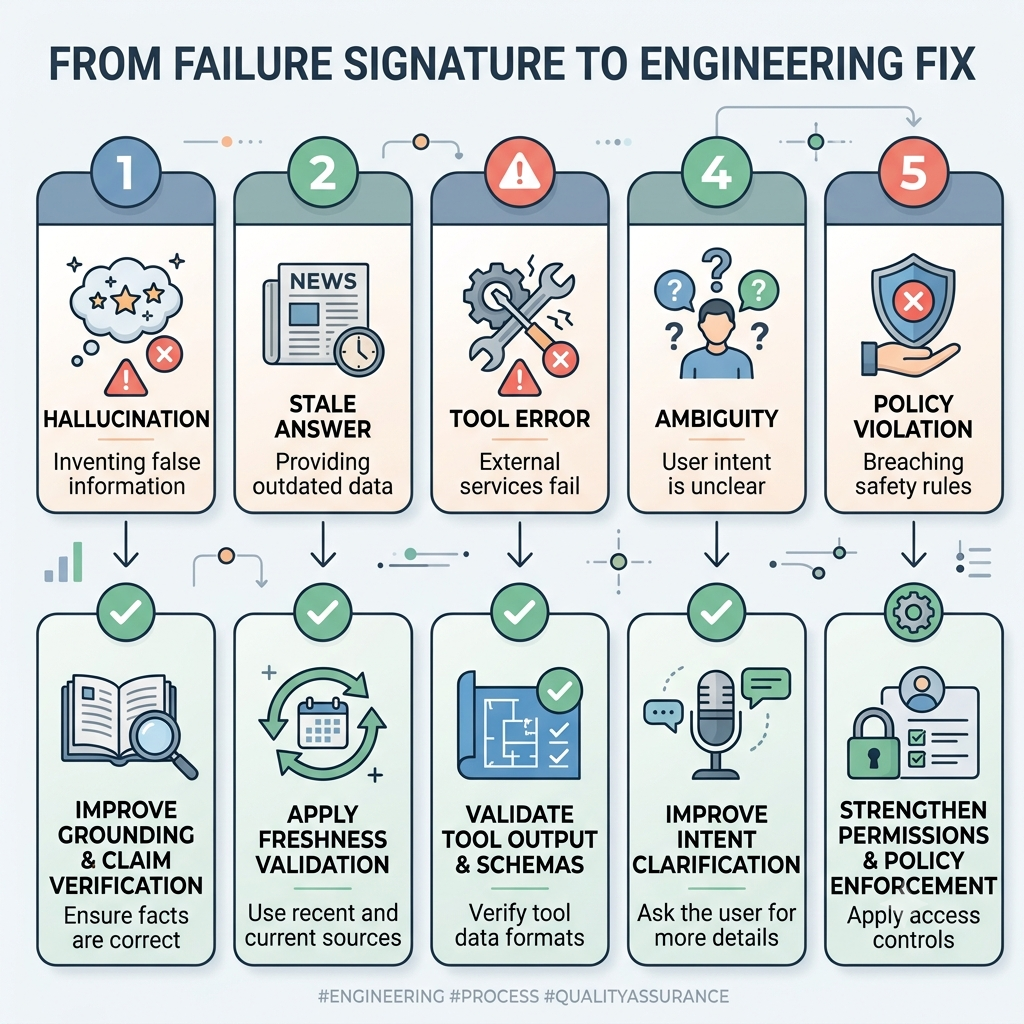
Calibration isn’t something you configure once. It improves when runtime failures feed back into the rules.
Collect feedback from two directions. Explicit signals include thumbs down, “this was wrong,” and submitted corrections. Implicit ones include retry rate, abandonment, edit rate, escalation rate, and complaints. Pair both with outcome labels: did the user finish the task, accept the answer, or need a human?
Then sort failures into a taxonomy so you fix the right thing: hallucination, stale answer, retrieval miss, tool error, ambiguity, policy violation. Each points to a different remedy, whether that’s a retrieval filter, a prompt change, a tool schema, a threshold, or an escalation rule.
Finally, keep a curated evaluation set and re-run it after every change. Without that, you’ll fix one failure and quietly introduce another.
This isn’t an RLHF tutorial, and it doesn’t need to be. The practical version is using good human corrections and real outcomes to improve your prompts, policies, retrieval rules, and test sets.
A production checklist
If you have an agent running today, check it against this list:
- Risk tiers defined for every task and action
- Evidence requirements set before generation, not only after
- Source citations required for factual and policy claims
- Retrieval confidence, evidence age, contradictions, and tool validity tracked separately
- Different response policies for low, medium, high, and critical tasks
- No irreversible actions without verification or approval
- Explicit instructions for incomplete, conflicting, and stale context
- A degradation path, so the agent isn’t forced into a full answer
- Uncertain and high-risk cases routed to a named human owner
- Evidence, signals, chosen path, and outcome logged for every interaction
- Overrides, corrections, escalations, and complaints reviewed on a schedule
- A regression suite covering ambiguous, stale, adversarial, and edge-case prompts
- “I can’t verify this” accepted as a valid outcome
Common mistakes
- Treating model confidence as proof of correctness
- Using one global threshold for every task
- Letting a successful API call stand in for a successful task
- Hiding uncertainty behind fluent language
- Escalating everything, which just creates alert fatigue
- Counting refusal as failure instead of safe behavior
- Changing prompts without regression tests or failure attribution
- Measuring answer quality while ignoring user outcomes and downstream actions
Where this is going
Calibration is moving from a post-launch monitoring concern to a core agent capability. Agents will need to reason about the quality of their own evidence. Calibration policies will sit in agent specifications next to tools and permissions. Human oversight will shift away from reading every output and toward reviewing high-risk exceptions and patterns of failure. And agents will increasingly be judged not just on accuracy, but on how safely and transparently they behave when their knowledge runs out.
The most trustworthy AI agent isn’t the one that always has an answer. It’s the one that knows when it has enough evidence to answer, when to ask, when to defer, and when to stop.