

AI agents can now research, plan, book, pay, and manage accounts for you. The trouble is how many of them still get access the old-fashioned way: you hand over your username, your password, and the one-time code that arrives on your phone.
For enterprises, that’s a credential crisis waiting to happen. A password was built to prove that a person is who they say they are. An agent needs something different: scoped, revocable permission to do one defined job, without getting the keys to your whole account.
United Airlines has made the problem hard to ignore. The company recently restricted unauthorized third-party AI agents, saying that sharing login details with a personal AI assistant can expose sensitive information and lead to purchases, account changes, or MileagePlus miles being spent without the customer meaning it. Banks are putting out similar warnings. So this isn’t an airline quirk. It’s a gap in how the web handles someone, or something, acting on your behalf.
The moment a password becomes a liability
Say you tell an AI assistant: “Find the cheapest United flight to Tokyo next month, use my miles, and book it.”
To do that, the agent may ask for your MileagePlus login, your password, and maybe a verification code. At that point you’ve done more than switch on a handy feature. You’ve given an autonomous third-party system the ability to be you.
United calls this “a lot of control.” An agent with access to a MileagePlus account can book trips and buy add-ons or upgrades, and it could expose personal data or act without anyone approving it. The airline now restricts unauthorized agents across its own digital platforms and through indirect channels like travel agencies and aggregators.
People wanting AI help isn’t the issue. The issue is that sharing credentials hands an agent far more power than the task needs.
Credential sharing is the new attack surface
Give an agent your password and it gets your whole login identity. In principle, it can reach everything that account can do, not only the flight search or bill payment you had in mind.
That opens up several risks:
- Over-privileged access: A password means broad control of the account. It doesn’t mean a narrow permission like “view upcoming trips” or “hold a seat.”
- Credential persistence: The agent, its servers, its browser session, or a connected plugin might store or transmit your login details.
- Third-party compromise: A flaw anywhere in the agent’s stack could leak credentials that unlock your airline, bank, email, or shopping accounts.
- Prompt injection and misuse: A malicious instruction hidden in a webpage, email, document, or plugin could trick an agent into doing something you never intended.
- Unclear accountability: If the agent books the wrong flight, burns your miles, or makes a payment, the company sees activity done with your credentials. Nothing marks it as an authorized agent action.
United’s advice to customers is to share only general information for planning and inspiration, and to keep confirmation numbers, MileagePlus details, and identity-validation information to themselves. If you’ve already given login details to a third-party agent, change your MileagePlus password right away.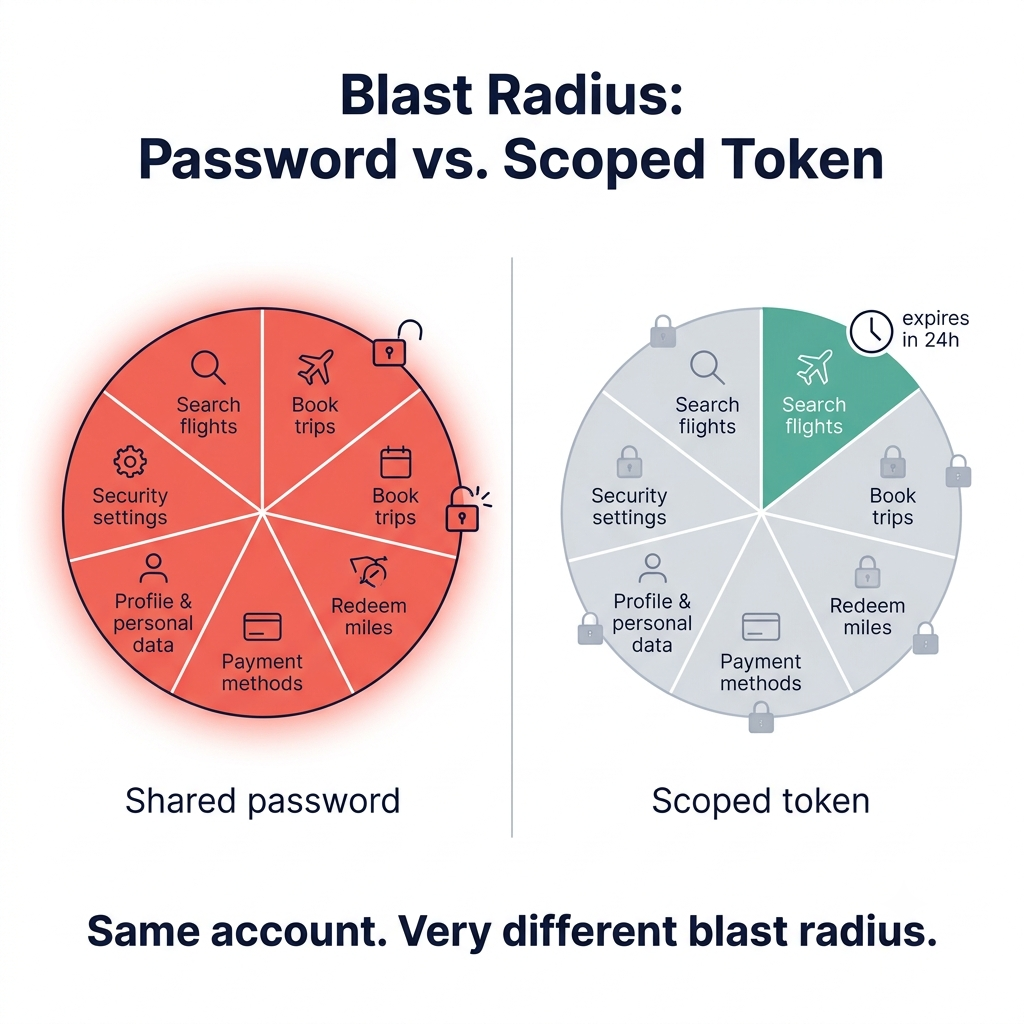
Why passwords and 2FA fail for agents
Password authentication assumes a human is logging in and doing the work. Multi-factor authentication reinforces that assumption by asking for a second proof of identity.
Agents break both assumptions.
| Legacy assumption | Agentic-web reality |
|---|---|
| A person logs in and acts | An agent may interpret intent, select options, and execute actions |
| A password proves the user | A shared password proves only that someone possesses the secret |
| MFA verifies a human | A verification code pasted into an agent can become another credential in the delegation chain |
| Access is granted broadly | Agents need task-specific, time-bound permissions |
| Actions are attributable to the account holder | Enterprises must distinguish the user, agent, task, approval, and outcome |
| Consent is a one-time login | High-risk actions need explicit, contextual approval |
MFA is still essential for protecting human accounts. But a one-time code given to an agent doesn’t make delegation safe. It may just move your most sensitive authentication factor into an environment you can’t trust.
Underneath all this, a password answers one question: can this party log in? Agent authorization has to answer a harder one: what exactly may this agent do, on whose behalf, within what limits, and for how long?
Airlines and banks are converging
United’s move fits a wider pattern. Major banks have told customers not to share online banking usernames and passwords with AI assistants, and some have started restricting unvetted agent access to customer accounts.
Bank of America, for instance, told customers not to give their credentials to outside services, AI tools acting on their behalf included. It also pointed out that customers may be held responsible for activity that results from credentials they chose to share.
The message from airlines, banks, and other companies is consistent. They aren’t necessarily turning agents away. What they’re pushing back on is delegation that is unauthenticated, unscoped, and unauditable.
United says it wants standardized, secure technical integrations, with protections for privacy, security, authorization, and accountability, before it lets agents interact directly with accounts or bookings. That’s the real signal here. The market doesn’t need more warnings. It needs an authorization standard.
The missing layer: Agent Authorization Standards
What the industry needs is a way for a user to say something like this:
“This agent may search flights and view my upcoming reservations for the next 24 hours. It may propose a booking, but it cannot purchase, change my profile, redeem miles, or access payment methods without my explicit approval.”
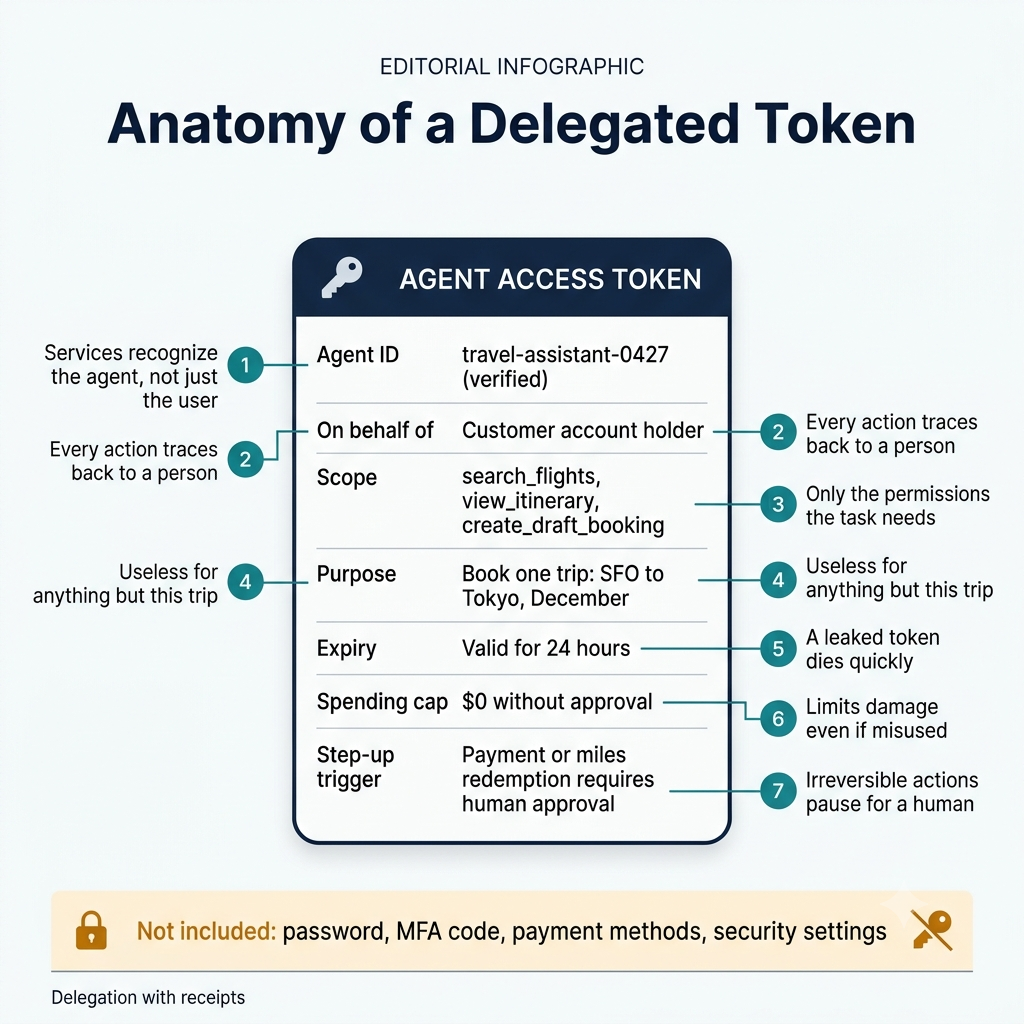
Making that possible takes an Agent Authorization Standard built on least privilege, explicit consent, and verifiable accountability.
A solid model would include:
- Scoped permissions: Grant “search flights” or “view itinerary,” never full account control.
- Explicit consent: Ask users to approve a specific capability instead of a blanket login.
- Least privilege: Give only the data and actions the task requires.
- Short-lived credentials: Let access expire quickly so a leaked token is worth little.
- Agent identity: Let services recognize the specific agent or integration instead of treating it as the user.
- Purpose binding: Tie authorization to a stated purpose, like booking one particular trip or paying one particular bill.
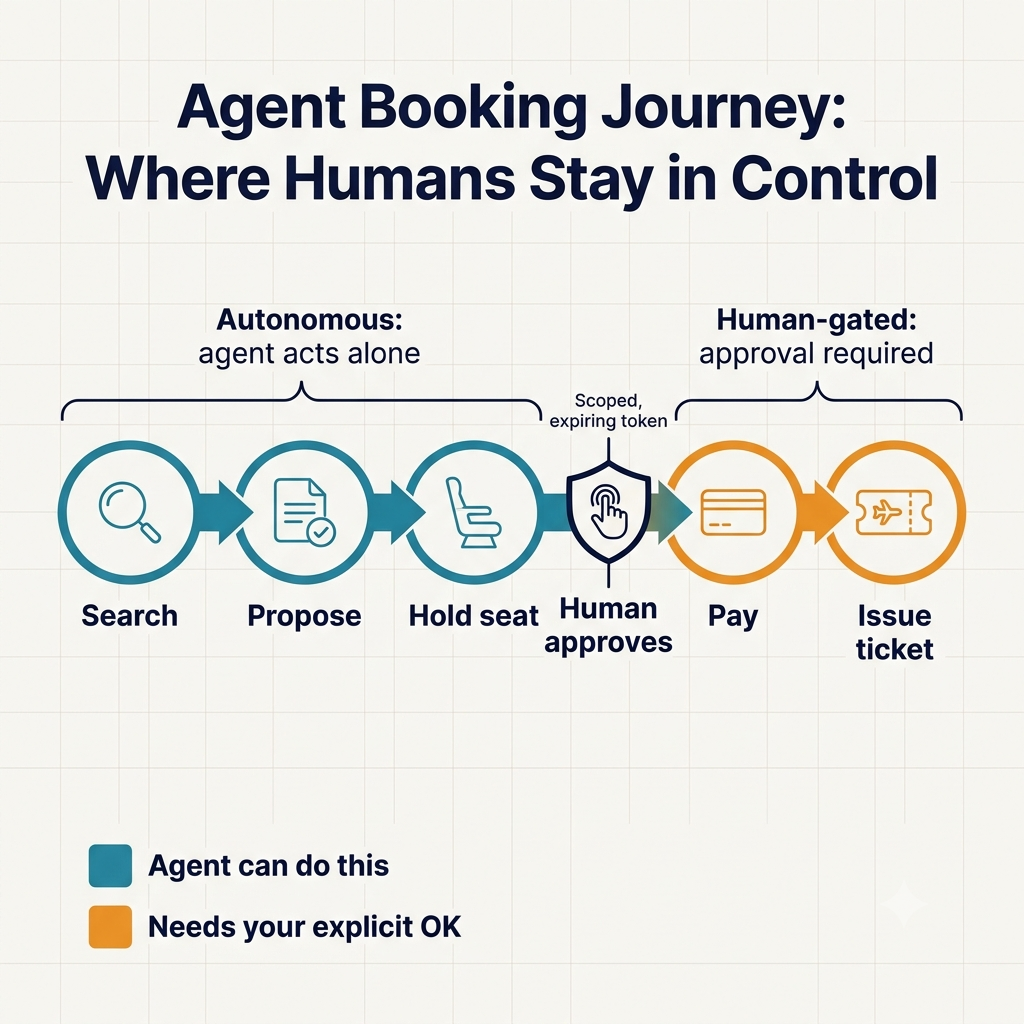
- Human approval for irreversible actions: Require a clear confirmation for purchases, ticket issuance, cancellations, account changes, and regulated acknowledgments.
- Revocation and auditability: Let users see, review, and instantly revoke agent access, and log every delegated action.
- Transaction-bound approval: For high-risk actions, tie authorization to the specific transaction and context instead of issuing a reusable, account-wide key.
Early IETF work on AI-agent authentication points the same way. It stresses cryptographic binding of agent credentials, minimum necessary scopes, short-lived credentials, and explicit expiration. Those principles are a good starting point for a broader industry standard.
OAuth is the foundation, not the whole answer
OAuth-style delegation is the right base because it separates authentication from authorization. Instead of giving an agent your password, a service issues a scoped access token that represents the permissions you’ve delegated. Current guidance treats those tokens as authorization handed to an agent, with user approval and agent authentication as two separate steps.
Generic OAuth still falls short, though. An agent-ready authorization layer needs governance controls that ordinary app permissions don’t fully cover:
- Fine-grained scopes: “Read itinerary” and “create draft booking” are very different from “book and pay.”
- Purpose-bound tokens: A token should be limited to a defined task, not just a broad API scope.
- Step-up authentication: Payments, identity changes, and high-value transactions should need fresh human approval.
- Policy enforcement: Enterprises should be able to apply spending limits, merchant restrictions, geographic controls, time windows, and velocity limits.
- Agent attestation: Services need a way to verify that an agent is what it claims to be and runs within approved security controls.
- Human-readable consent: Users should understand what they’re approving without decoding technical scope names.
- Complete audit trails: Every delegated action should trace back to a user, an agent, a permission, an approval, and an outcome.
Put simply: OAuth provides the plumbing, and Agent Authorization Standards provide the safety architecture.
What enterprises should build now
Companies that expect agent traffic should stop at blocking and start building safe paths for delegation.
- Classify agent actions by risk. Separate read-only research, itinerary changes, purchases, account changes, and regulated confirmations.
- Block raw credential entry. Don’t let third-party agents accept or retain primary passwords, recovery codes, or MFA codes.
- Offer official delegated access. Provide consent-based connections, scoped APIs, and agent-specific tokens in place of credential sharing.
- Create an agent trust registry. Publish the agents and integrations you approve, along with the permissions each may request.
- Require human confirmation for irreversible actions. Payments, ticketing, cancellations, and compliance acknowledgments should be explicit user decisions.
- Log the delegation chain. Record the user, agent, permission scope, approval event, action, timestamp, and result.
- Give users immediate control. Offer permission dashboards, revocation, session termination, and security alerts.
- Adapt fraud controls. Catch anomalous automation without penalizing legitimate, authorized agent activity.
United’s current stance, restricting unauthorized agents while still allowing general AI-powered research, is a sensible defensive first step. As agent adoption grows, though, companies will need positive, standardized ways for trusted agents to operate safely.
What users should do today
Until agent authorization standards mature, treat any request for full account access as a red flag.
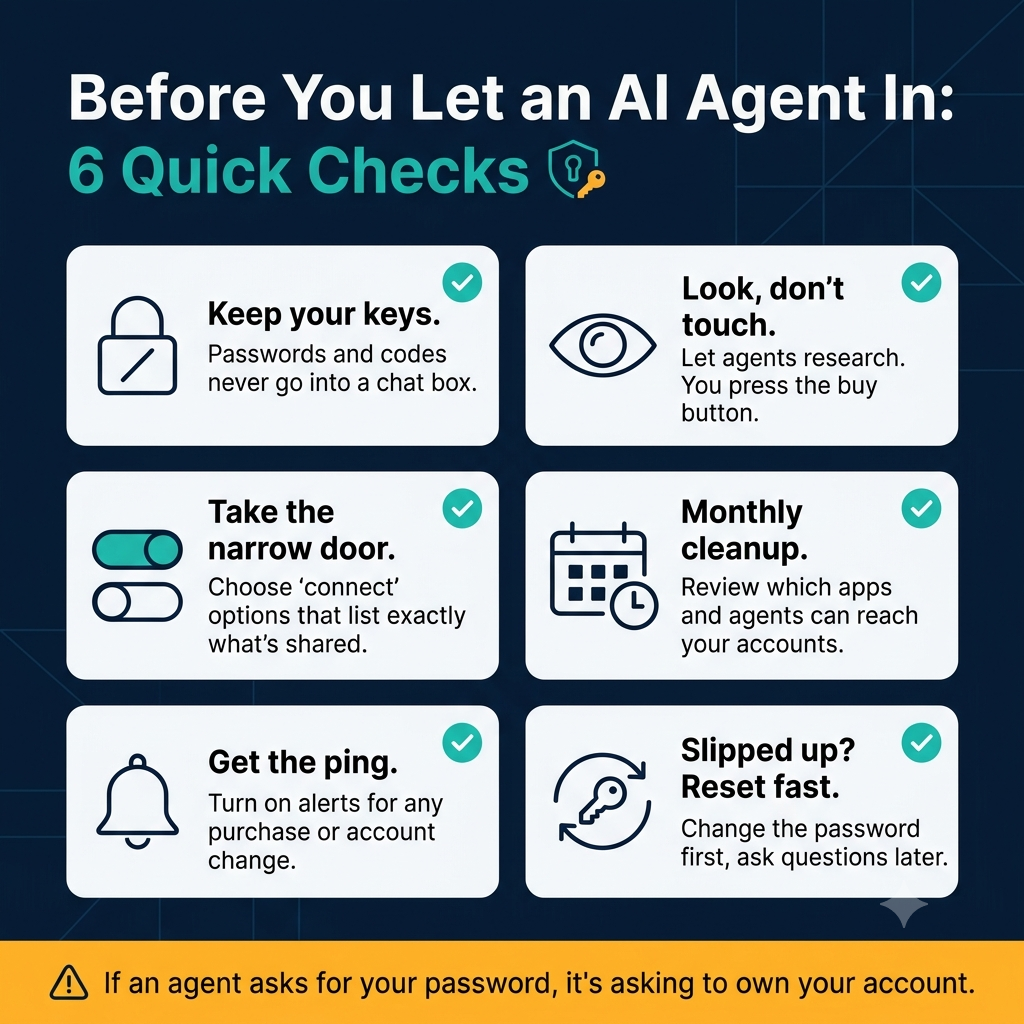
- Don’t paste banking, airline, email, or password-manager credentials into a general-purpose AI agent.
- Never share one-time passcodes, recovery codes, or MFA prompts.
- Use official integrations or consent-based connections where they exist.
- Stick to read-only access for planning, research, and analysis.
- Check your connected apps and agent permissions regularly.
- Change your passwords immediately if you’ve shared login details with an agent.
- Turn on MFA and alerts for transactions and account changes.
- Remember that when an agent asks for your password, it’s asking to own your account. It isn’t a routine login step.
United explicitly tells customers who shared MileagePlus login information with a third-party agent to change their password immediately and secure their account if they suspect anyone got in without permission.
Delegation with receipts
The next generation of identity won’t stop at asking, “Who are you?”
It will ask: Who is acting, on whose behalf, with what authority, for what purpose, within what limits, and with what audit trail?
In that world, you don’t hand an AI agent your password. You issue a narrow, revocable authorization, much like letting a travel agent hold a seat for you without letting them drain your miles or touch your account-security settings.
The organizations that come out ahead in the agentic web won’t be the ones that block every agent. They’ll be the ones that make safe delegation possible: authenticated agents, explicit consent, minimal scopes, transaction-level approvals, and full accountability.