

Picture a fraud analyst reopening an alert that a colleague closed last month. Or a wealth advisor walking into a review with a client whose cash needs changed completely since the last meeting. In both cases, the first thing anyone asks is the same: what happened before, and what’s different now?
A human team answers that from experience, notes and a lot of digging. An AI agent can only answer it if the institution has given it a memory, and a careful one. In banking, a customer’s risk picture doesn’t live in one chat or one transaction. It builds up over years of behavior, past alerts, advisor conversations, life events and market shifts. A context window can’t hold that, and shouldn’t.
That’s why memory in financial services is more than a convenience feature. It affects how accurate fraud detection is, how smoothly advisors hand off clients, and whether you can defend a decision to a regulator.
Why Financial Agents Need Memory
The goal isn’t for an agent to remember everything. It’s for the agent to keep useful context that has a known source, a clear owner and a sense of how fresh it is.
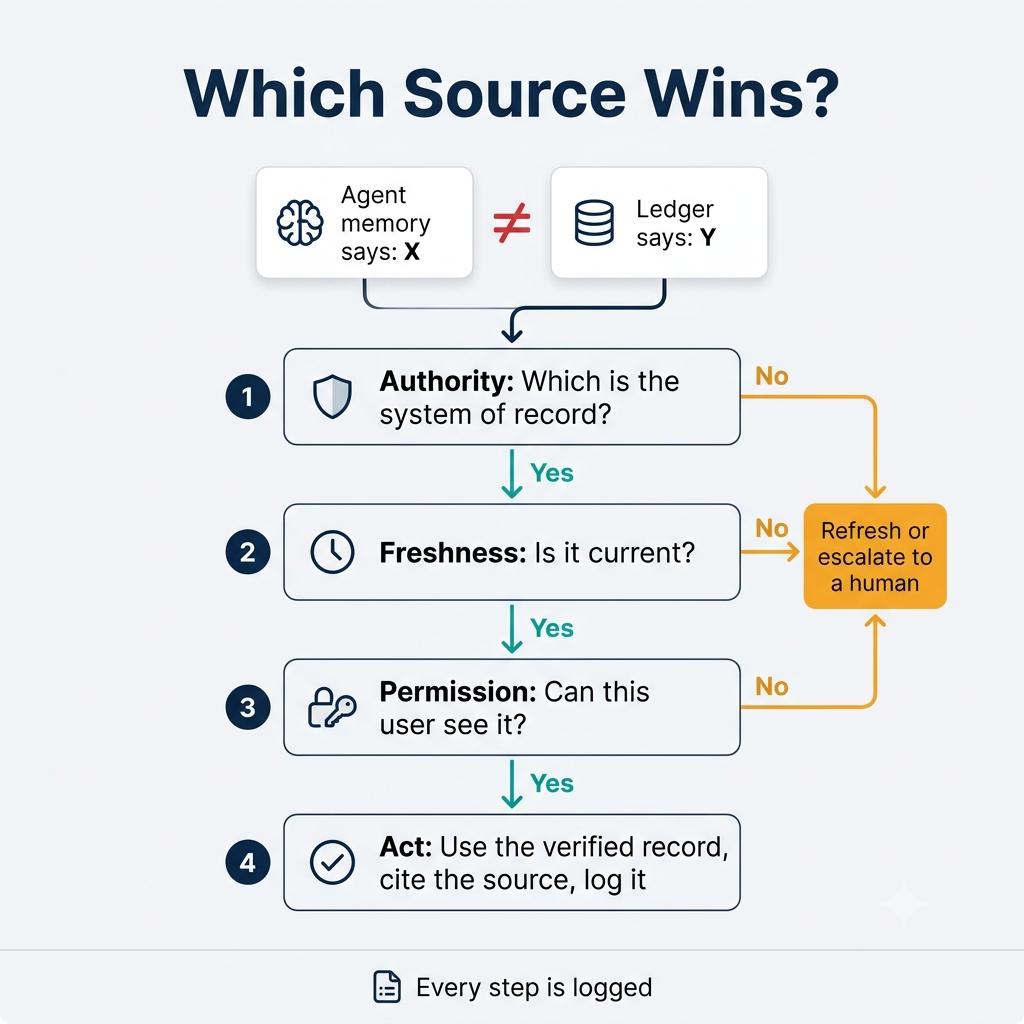
Before an agent acts, it should be able to answer three questions: What happened previously? What has changed? Which information is still authoritative? A record that looks similar to the current case isn’t necessarily current, correct, or something the requesting user is allowed to see. Good memory design accounts for all of that.
What “Stateful Memory” Means in Banking
Stateful agent memory keeps selected information across interactions and workflow steps, instead of relying only on the current conversation. It can point to authoritative business records while keeping its own history of events, decisions and derived context.
Here’s a practical way to divide it up for a financial deployment:
| Memory layer | Financial-services equivalent | Example |
|---|---|---|
| Working memory | Current case or advisory session | An analyst investigating an alert holds the transaction, counterparty, and recent evidence in context |
| Episodic memory | Historical interaction and event record | Prior fraud alerts, customer-service cases, advisor meetings, and prior risk decisions |
| Semantic memory | Client, product, and risk knowledge | Client preferences, risk tolerance, AML typologies, product eligibility, and known fraud patterns |
| Relational / graph memory | Entity and network context | Customer–account–device–merchant–beneficiary–counterparty relationships |
| System-of-record state | Authoritative business data | Core banking, CRM, transaction ledger, KYC, case management, and portfolio systems |
The line between memory and source records matters a lot. Use the ledger for exact transaction values and the approved client-profile system for current investment constraints. Use agent memory to preserve context and point back to those records. The agent should assemble only the relevant, permissioned context for each decision, not copy the bank’s databases into a second place.
(If you want the deeper comparison of vector databases and graph stores, that belongs in our pillar guide. Here we’re sticking to what’s specific to finance.)
Why Stateless Agents Fail in Finance
Plenty of agent failures are generic. These ones are particularly costly in a bank:
- A fraud agent looks at one transaction and misses a months-long pattern of account takeover, mule activity or structuring.
- A wealth agent gives generic suggestions because it can’t recall the client’s evolving goals, constraints and earlier advice.
- A compliance reviewer can’t reconstruct why an agent escalated, closed or referred a case.
- In a multi-agent workflow, findings get lost when a case moves from detection to investigation to reporting.
- Customers repeat themselves across channels because nothing durable and permissioned holds their prior context.
The common thread is that facts alone aren’t enough. Memory also needs to preserve decision provenance: what the agent knew, which sources it used, what it did, and who approved it. Audit logs should be immutable and exportable, and should capture the user, the agent, the memory layer, the source system and the retrieval request.
Use Case 1: Fraud Detection With Longitudinal Transaction Context
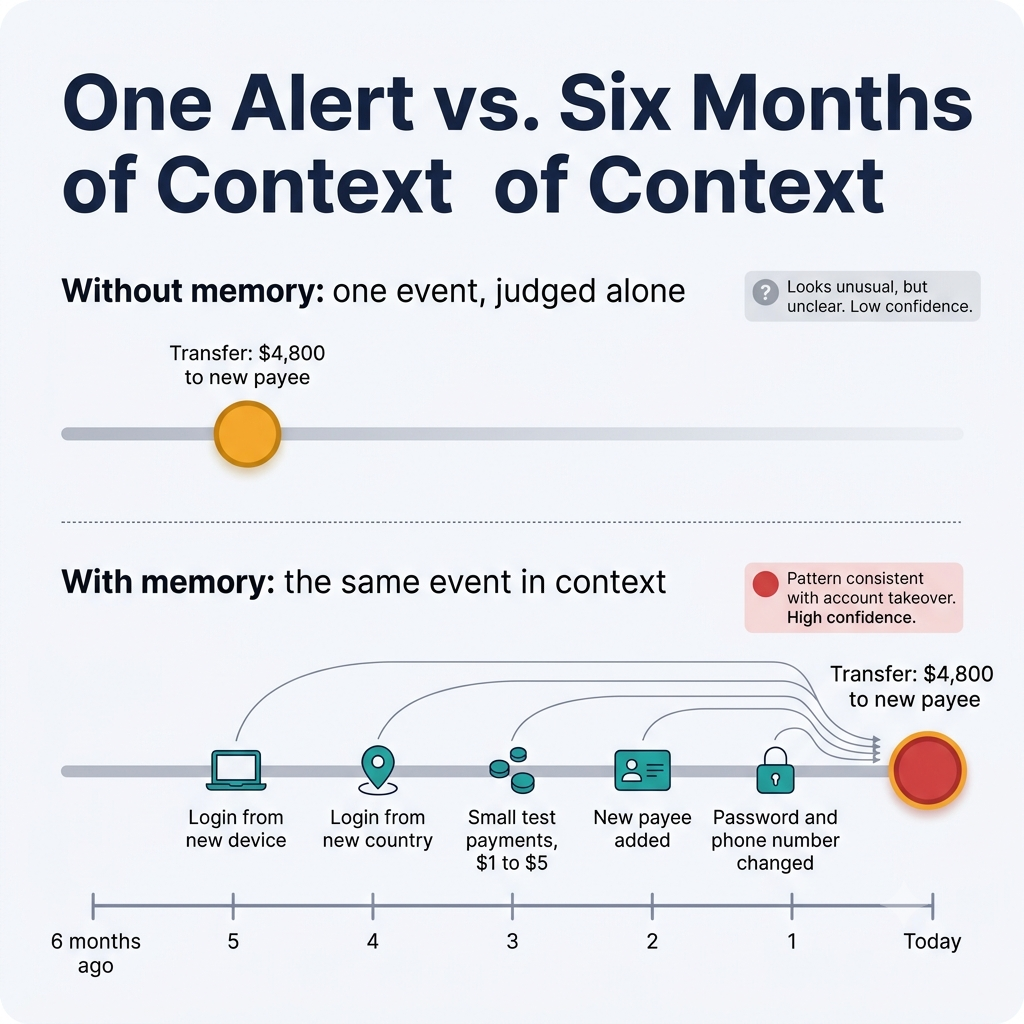
Fraud is where memory pays off most visibly, because the signal is so often spread across time and across entities.
How the workflow runs
- A transaction or payment event enters the monitoring system.
- The agent pulls relevant history: prior alerts, device and IP records, beneficiary relationships, merchant behavior, account tenure and similar past cases.
- It checks the event against rules, models and relationship signals from the graph.
- It produces a risk assessment backed by evidence, along with a recommended disposition.
- It records the rationale, the evidence references, the analyst’s review, any escalation and the final outcome.
What memory adds
- Multi-year behavioral baselines. The agent can spot deviations from a customer’s usual spending, login and transfer patterns instead of judging each event in isolation.
- Cross-entity context. Linking accounts, devices, merchants, beneficiaries and related parties can expose mule networks and coordinated fraud that no single alert would reveal.
- Case continuity. An analyst can pick up an investigation days later without rebuilding the story by hand.
- Feedback memory. Confirmed fraud, false positives, analyst dispositions and new typologies can inform future triage, as long as this happens under your model-risk governance.
- Evidence retention. The exact inputs, retrieved records, model outputs, tool calls and human decisions stay available for audit.
On the logging side, fraud workflows should capture alert creation, review, escalation, closure, SAR referral, analyst identity, timestamps, disposition rationale, evidence references and supervisor sign-off.
Guardrails
Memory should inform a risk assessment. It shouldn’t autonomously restrict accounts, block payments or trigger regulatory filings outside an approved control framework. High-impact actions need policy limits, human review thresholds and immutable audit trails.
Use Case 2: Automated Wealth Management and Advisor Continuity
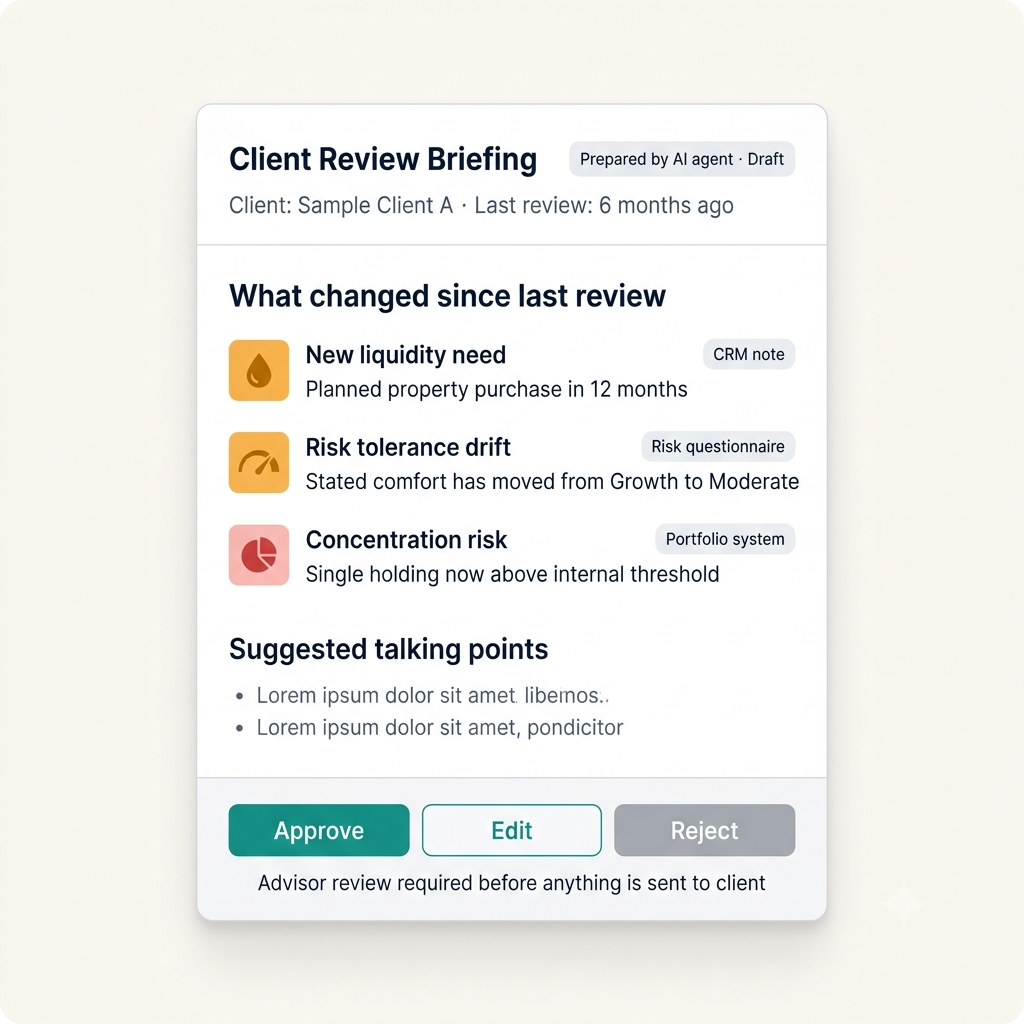
Here the value is client intelligence, which is a different thing from generic personalization. The question isn’t “what might this person like?” but “what do we know about this client’s situation, and what has changed?”
How the workflow runs
- A client interacts through an advisor, a portal or a scheduled review.
- The agent retrieves goals, constraints, risk profile, holdings, prior recommendations, life events and communication history.
- It flags changes such as new liquidity needs, risk-tolerance drift, concentration risk, tax events or new goals.
- It prepares an advisor-ready briefing, a portfolio hypothesis or a next-best-action suggestion.
- The advisor reviews, edits and approves before anything reaches the client.
What memory adds
- A longitudinal client profile. A durable, versioned view of goals, family circumstances, risk appetite, liquidity needs and preferences.
- Advice continuity. The agent remembers what was recommended, why, and whether the client accepted or declined it.
- Suitability context. Relevant constraints surface before anyone proposes an investment, credit, insurance or planning action.
- Smoother handoffs. When a relationship manager, planner or specialist joins, the context travels with the client.
- Proactive review triggers. A material change in a stored fact, like a liquidity event or a shift in retirement horizon, can prompt a review.
Long-term semantic memory can hold preferences and interaction patterns, while episodic memory keeps the history of conversations and decisions. Both need access controls at the tenant and user level.
Guardrails
The agent supports the advisor. It doesn’t replace fiduciary judgment. Recommendations should be explainable, grounded in approved data sources, and subject to suitability checks, disclosures and human approval.
Reference Architecture: A Governed Financial Memory Stack
A bank-specific view of the stack looks like this:
Financial systems of record
- Core banking and transaction ledger
- CRM and wealth platform
- KYC, AML and fraud case management
- Market, portfolio and risk data
Governed memory layer
- Session and case working memory
- Episodic event and decision log
- Semantic client and risk memory
- Entity-relationship graph
- Retrieval and policy engine
Agent orchestration
- Fraud triage agent
- Investigation agent
- Compliance reviewer agent
- Advisor copilot agent
- Human-in-the-loop approval
Governance and observability
- Identity and least-privilege access
- PII minimization and redaction
- Immutable audit logs
- Retention and deletion policies
- Monitoring, evaluation and drift controls
The memory layer combines short-lived session state, durable episodic records, semantic retrieval and relationship-aware graph context. Shared memory between agents helps with coordination, but each agent should only read or write the records its role requires.
Security, Privacy, and Regulatory Governance
This section carries more weight here than in the other industry guides, because financial memory holds some of the most sensitive data an organization has: customer identities, transactions and investment positions.
- Tenant and customer isolation. One customer, business unit or agent must never reach another’s memory.
- Least-privilege retrieval. Pass the requesting user’s identity down to the underlying systems instead of leaning on a shared service account.
- PII minimization. Store only the attributes you need, and redact or tokenize sensitive identifiers where you can.
- Data residency and retention. Apply jurisdiction-specific retention, deletion and legal-hold rules.
- Immutable auditability. Log retrievals, memory writes, agent actions, tool calls, approvals and overrides.
- Human oversight. Decide in advance which decisions need analyst, advisor or compliance sign-off.
- Model and memory drift. Watch retrieval quality, false-positive rates, bias and stale memories.
- Prompt-injection defense. Treat documents, inputs and third-party data as untrusted, and enforce policy at the data and execution layers rather than trusting the model to behave.
One framing helps here: memory governance is data governance. If a record would be unacceptable in a regulated system of record, it shouldn’t be quietly persisted in an agent’s memory store.
Implementation Roadmap
Start small and be deliberate.
- Pick one bounded workflow. Fraud alert triage or advisor-meeting prep works well. An enterprise-wide autonomous agent doesn’t.
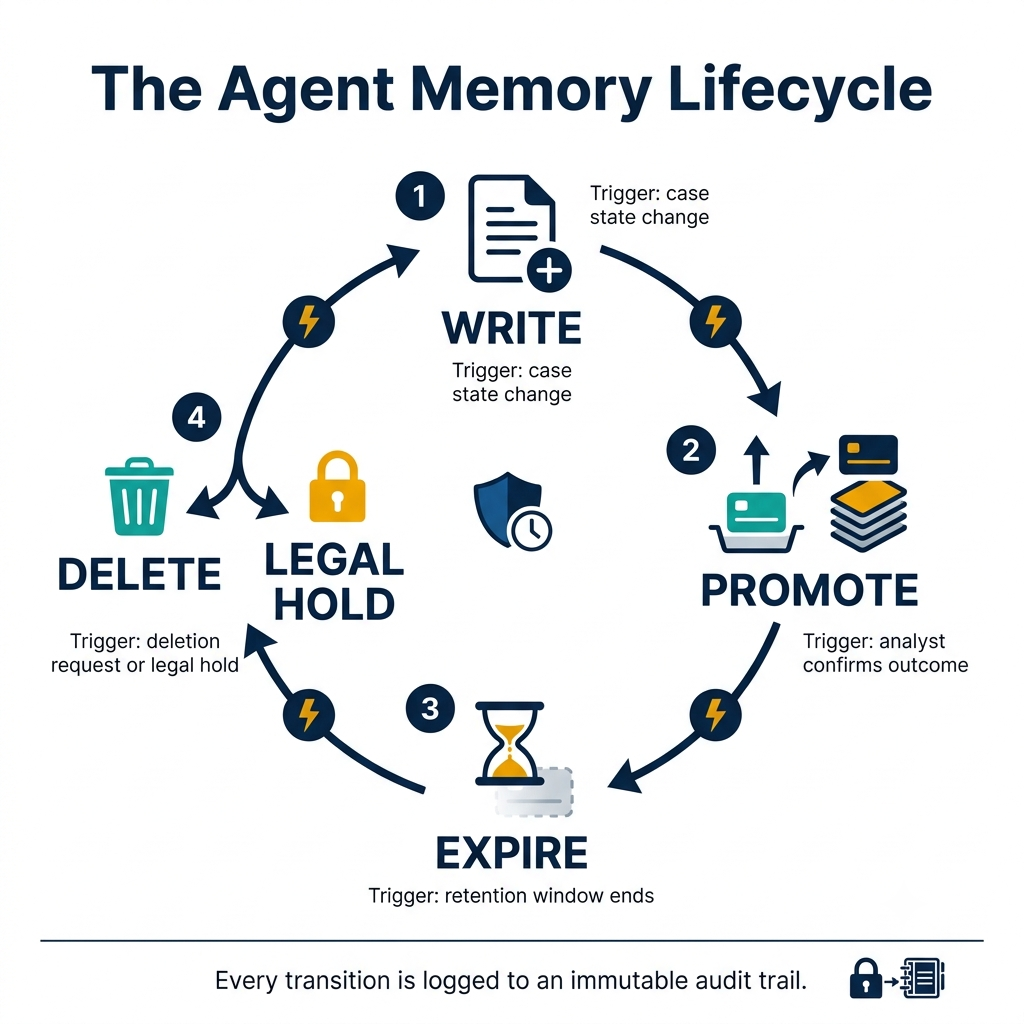
- Write the memory contract. Spell out what gets retained, for how long, who can access it, and what triggers deletion or promotion.
- Connect your systems of record. Integrate transaction, case-management, CRM, KYC and portfolio data with permission-aware retrieval.
- Make outputs evidence-first. Every recommendation or alert disposition should cite the records behind it.
- Pilot with humans in the loop. Measure precision, recall, analyst time saved, false-positive impact and escalation quality.
- Scale with governance. Add tenant isolation, audit export, retention automation, evaluation and multi-agent access controls as you grow.
One more point: memory persistence should be driven by explicit, deterministic triggers tied to agent state changes. Don’t leave it to the model’s discretion what gets remembered.
KPIs and Success Metrics
| Outcome | Example metric |
|---|---|
| Fraud effectiveness | False-positive rate, detection recall, time-to-triage, confirmed-fraud rate |
| Investigation efficiency | Analyst handling time, cases per analyst, evidence-collection time |
| Wealth advisory quality | Advisor preparation time, recommendation acceptance rate, suitability-review exceptions |
| Client experience | Repeat-information rate, issue-resolution time, advisor response time |
| Compliance readiness | Audit-log completeness, retrieval-access review coverage, retention-policy exceptions |
| Agent reliability | Retrieval precision, stale-memory rate, escalation accuracy, human override rate |
FAQs
Does agent memory store raw transaction data?
Not necessarily. Use references, tokens, redacted fields and permission-aware retrieval from the systems of record.
Can memory improve fraud detection?
Yes. It preserves longitudinal behavior, entity relationships, past case outcomes and analyst feedback. But treat it like any other risk-data asset and govern it accordingly.
Can an AI agent make final fraud decisions?
For high-impact actions, usually not. Use policy thresholds, human review and auditable approval workflows.
How is this different from a CRM?
A CRM is a system of record. Agent memory adds a governed retrieval and reasoning layer that pulls together the right context for a specific task.
What should be audited?
Every memory write, retrieval, model decision, tool call, recommendation, human approval and override.
Conclusion
Financial institutions don’t need agents that simply answer questions. They need agents that remember responsibly over time, reason across related entities, and leave a trail that stands up to scrutiny. Get the memory design right, with clear sources, tight access control and real audit evidence, and agents become a dependable part of fraud and wealth operations instead of a risk to manage.