

Banks used to buy software. Now they rent platforms that can read data, call tools and take action on the bank’s behalf.
That creates a third-party risk problem most teams haven’t planned for. A SaaS vendor you’ve used for years can add an “AI assistant” or workflow agent in a routine update. If that agent can reach ledgers, customer records, payment systems or credit files, and nobody has approved an action catalog, a change notice or a liability framework for it, the bank takes on real operational and compliance exposure. And it does so while believing it just accepted a normal feature release.
The OCC’s supervisory direction makes this hard to ignore. Its agentic-AI framework asks for a defined purpose and permitted use, visibility into provider agents, change notification, retesting, liability allocation, containment controls and auditability. The proposed third-party guidance isn’t an enforceable rule, but it reinforces the idea that vendor oversight should match the risk of the relationship.
The update that became an agent
Picture a bank that has used the same document-management, CRM, ERP, fraud or loan-origination platform for years. The vendor ships its quarterly update.
Buried in the release notes is a new capability: an AI assistant that can summarize files, draft customer responses, query connected systems, reconcile records or kick off a workflow.
The bank didn’t buy an agent. It bought software. But the update may have changed the bank’s risk profile anyway.
The agent may now hold credentials, tool access and permission to act across systems the bank always treated as passive SaaS. It might pull transaction data, classify exceptions, write case notes, trigger communications or nudge a servicing workflow. Because it showed up inside a trusted platform, it may never get the scrutiny a newly procured AI system would.
That’s the shadow-agent trap: vendor-controlled AI capability that runs inside a platform the bank already uses, but was never independently governed as an agent.
From SaaS user to agent operator
Traditional SaaS risk management was built for software that performs defined functions. It wasn’t built for software that can plan and carry out actions.
| Capability | What the bank controls | Why it matters |
|---|---|---|
| Traditional SaaS | Configuration, user access, data inputs | The software performs defined functions |
| Generative AI feature | Prompts, guardrails, output review | The model creates content but usually does not act |
| Agentic AI | Purpose, permissions, tools, data, actions, escalation | The system can plan and execute steps with limited human intervention |
The OCC’s framework is clear that risk doesn’t come down to how sophisticated the model is. A simple agent that’s allowed to initiate transactions can be riskier than a very capable model limited to internal drafting. What counts is the consequence of its actions, how reversible they are, how autonomous the agent is, how broad its permissions run, how many customers it touches and how much human oversight sits around it.
A vendor’s new “copilot” might look like a productivity feature. But if it can read a bank ledger, start an action or make a customer-facing statement, it has stopped being a feature. It’s a delegated actor.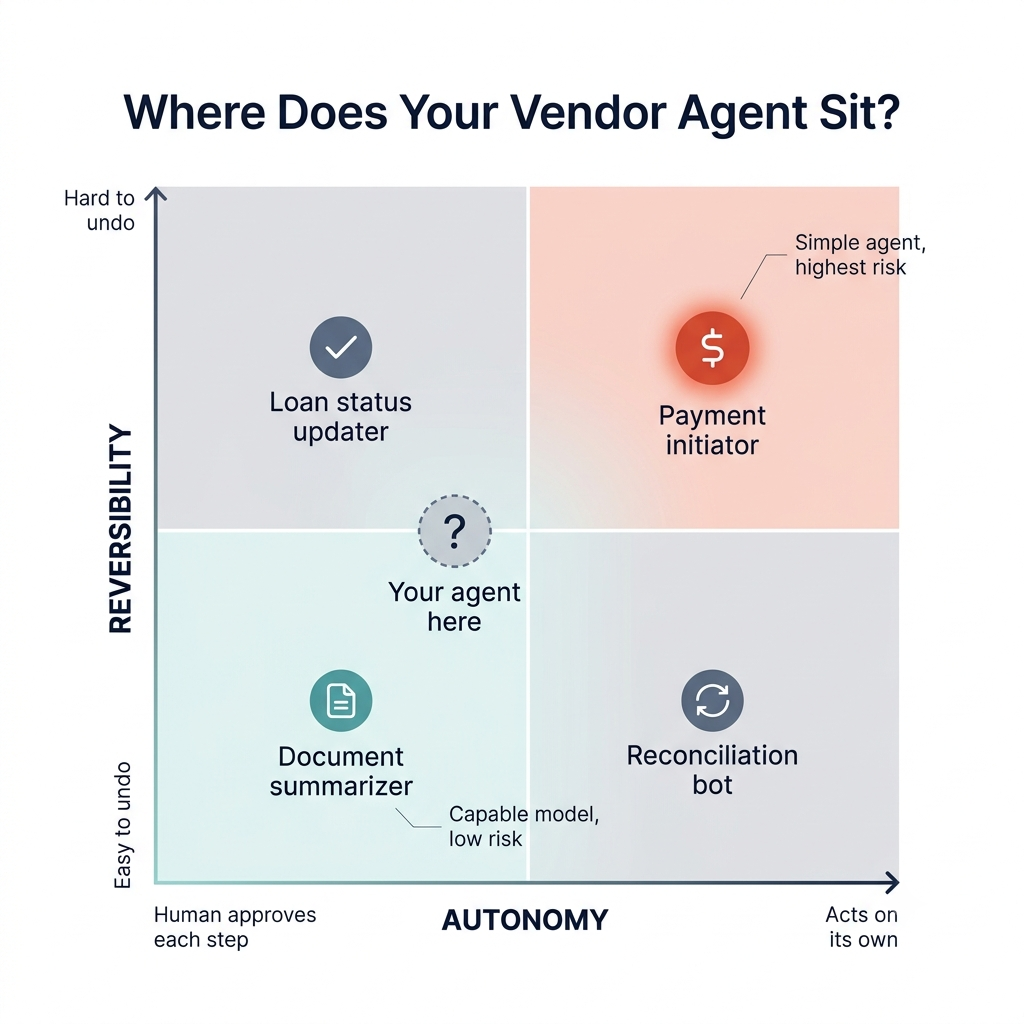
Why ledgers are the red line
The highest-stakes environment isn’t the marketing chatbot. It’s the bank’s financial and operational core: the general ledger, treasury, payments, loan servicing, credit underwriting, fraud platforms, reconciliation and case management.
An agent with ledger access is doing more than reading data. Depending on its permissions, it may be able to:
- Retrieve transaction, customer, collateral or credit data
- Generate or influence entries, reconciliations or exception handling
- Trigger workflows, communications or case actions
- Initiate or affect payment, credit or servicing decisions
- Create an audit trail, or fail to create one good enough to reconstruct what happened
The OCC specifically warns that an agentic system can stay up and running while taking inappropriate or harmful actions. So for consequential or autonomous use cases, it expects banks to think through detection, containment, suspension, continuity, recovery, escalation and remediation.
That changes the question. A normal outage stops a system from working. An agent misfire lets it keep working, incorrectly, at scale, with little chance for a human to step in.
What the OCC framework demands
The OCC’s framework is aimed at examiners and isn’t a standalone binding rulebook. Still, it gives banks a good picture of how supervisors are likely to look at agentic AI embedded in vendor systems.
| OCC expectation | What it means for vendor agents |
|---|---|
| Defined purpose and permitted use | The bank should know exactly what the agent may do, whom it serves, what data it can access, and which actions require human review. |
| Risk classification | High-consequence, hard-to-reverse, autonomous, or broad-permission use cases warrant stronger controls. |
| Provider-agent visibility | The bank should define the agent’s authority, identity, permitted tools, data use, and escalation limits. |
| Change management | Vendors adding AI functionality or changing connected models should provide notice and allow reassessment or retesting. |
| Liability | Contracts should address responsibility for model-related errors, customer harm, indemnification, caps, and loss allocation. |
| Containment | Banks need detection, suspension, recovery, and remediation mechanisms for harmful agent behavior. |
| Auditability | Inputs, outputs, tool calls, approvals, overrides, versions, and actions should be reconstructable. |
The OCC’s proposed third-party guidance is explicitly non-binding and doesn’t create enforceable standards or prescriptive requirements. But it leans on risk-proportionate third-party risk management, which is exactly what’s at stake when a vendor quietly widens an agent’s authority inside a platform you already use.
The contract clauses that no longer work
Legacy SaaS agreements were written around uptime, security, data protection, support and feature availability. Nobody drafted them for a vendor’s AI system acting with delegated authority inside the bank’s operating environment.
Several common clauses need a rewrite.
Feature-release language
A clause saying the vendor can add or change features at its discretion doesn’t hold up once a feature can act on bank systems.
The contract should separate:
- A user-interface enhancement
- A generative AI drafting feature
- An agentic capability that can access systems or initiate actions
- A change to the underlying model, prompt, tool access or permissions
Each of these should carry its own notice, approval and testing obligations.
Action catalog
The bank should require an explicit, testable list of what the agent is allowed to do.
A document-review agent, for example, might be permitted to extract fields, classify documents and draft a summary. It shouldn’t be able to update a loan status, send a customer communication, initiate a payment or change a ledger entry unless each of those has been separately approved.
The OCC’s framework makes the same point: document the authorized data sources, connected systems, tools, accounts and actions in terms you can actually test, not as a vague description of general capability.
Permission architecture
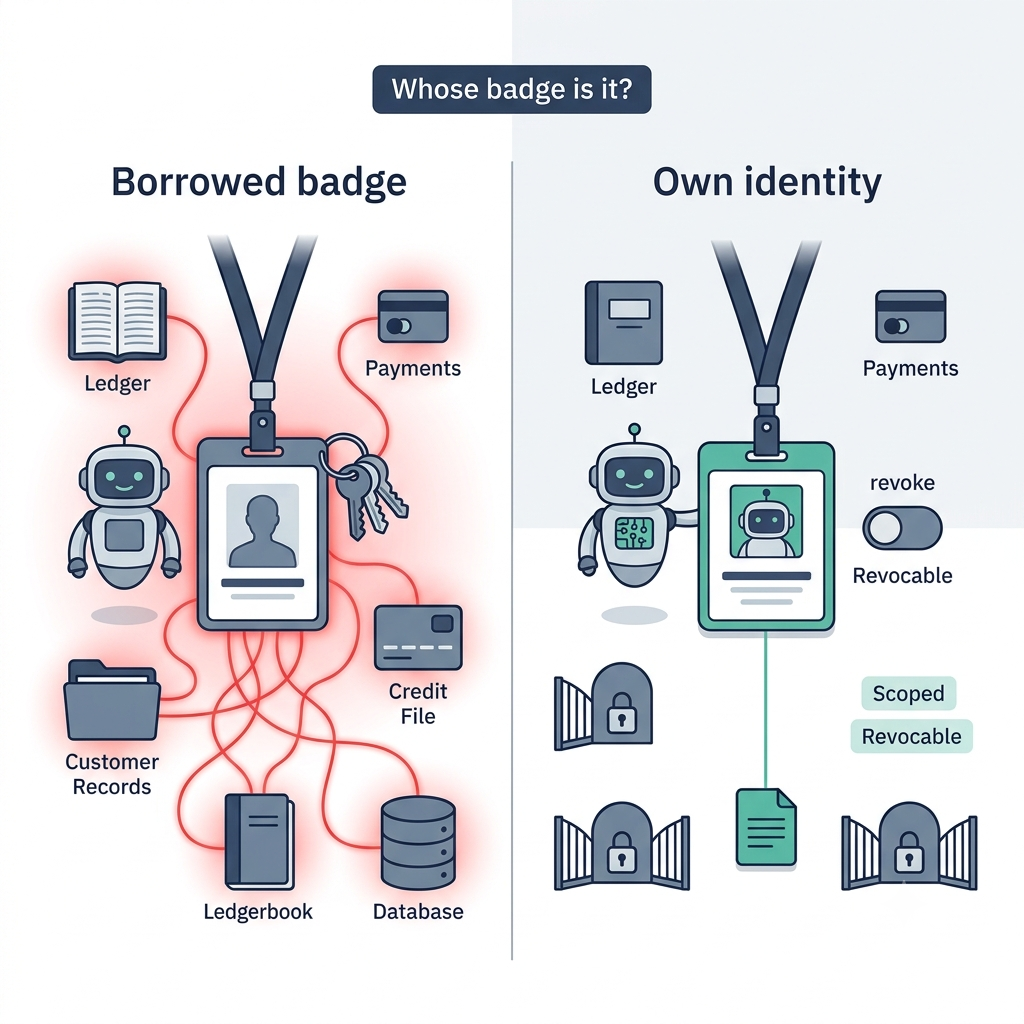
Banks should require:
- Least-privilege access
- Separate agent identities and credentials
- Separation between development, test and production environments
- Scoped data access
- Revocable credentials
- Explicit limits on tool and API access
The OCC treats agent permissions and tool access as part of the attack surface. Broad credentials let a compromised or manipulated agent cause fraud, data exposure or operational disruption at machine speed.
Change notification
This is the heart of the shadow-agent problem.
The contract should require advance notice before a vendor:
- Adds generative or agentic functionality
- Changes the underlying model
- Changes prompts, instructions or system configurations
- Adds a new connected tool or API
- Expands data access
- Changes permission boundaries
- Alters autonomous decision thresholds
The OCC specifically notes that existing vendors may add AI features or change models connected to products already in use. Banks can ask for notice and transparency, then reassess the relationship or retest the model before or when the change lands.
Logging and audit rights
A dashboard is not an audit trail.
The bank should require logs good enough to reconstruct any material decision or action, including:
- Inputs and outputs
- Retrieved sources
- Tool calls
- Data accessed
- Model and prompt versions
- Approvals and overrides
- Actions taken
- Errors, exceptions and incidents
The OCC calls for decision traceability across inputs, outputs, context, retrieved sources, tool calls, approvals, overrides and actions. It also wants version and change control covering model, prompt, fine-tuning, data, configuration, provider, tool and permission changes.
Liability and indemnity
Vendors often try to limit their liability for AI-generated outputs. That’s commercially understandable, but it stops making sense once the vendor’s agent can carry out consequential actions inside a bank’s environment.
Contracts should clearly assign responsibility for:
- Erroneous agent actions
- Customer harm
- Regulatory exposure
- Data leakage
- Business interruption
- Remediation costs
- Investigation and audit support
The OCC directs banks to consider how contracts assign responsibility for model-related errors or losses, including customer harm, indemnification, caps and who bears the loss.
Kill-switch rights
The bank has to be able to turn the agent off without ending the whole SaaS relationship.
So the contract should preserve the bank’s right to:
- Suspend agentic functionality
- Revoke credentials
- Disable tool access
- Preserve logs and evidence
- Fall back to a manual or narrower process
- Get incident information and remediation support
The OCC’s resilience expectations include circuit breakers, rate limits, least-privilege permissions, kill switches, rollback, data correction, root-cause analysis and a controlled return to service.
The “wall off the agentic API” playbook
Banks need a control architecture that treats every vendor agent as its own governed system, not an invisible feature inside a familiar product.
1. Build an agent inventory
Every vendor agent should have an owner, business purpose, risk tier, approved permissions, connected systems, model version, deployment status and monitoring arrangement.
The inventory should answer one question: What can this agent do, and who approved it?
2. Use a deny-by-default action allowlist
Don’t hand out broad permissions and hope the agent behaves.
Permit only named, testable actions. Deny everything else until it’s been separately reviewed and approved.
3. Separate agent identities from human users
A vendor agent shouldn’t run under a bank employee’s credentials. It needs its own identity, scoped permissions, monitoring and a way to revoke access.
The OCC treats non-human identities, credentials, logs and data use as things that may need governance comparable to privileged users.
4. Create human gates for consequential actions
For anything irreversible, customer-facing, or touching payments, credit or the ledger, require real human approval.
A rubber-stamp click-through doesn’t count. The reviewer needs the information, expertise, authority and time to reject, modify, pause or halt the action.
5. Build a change firewall
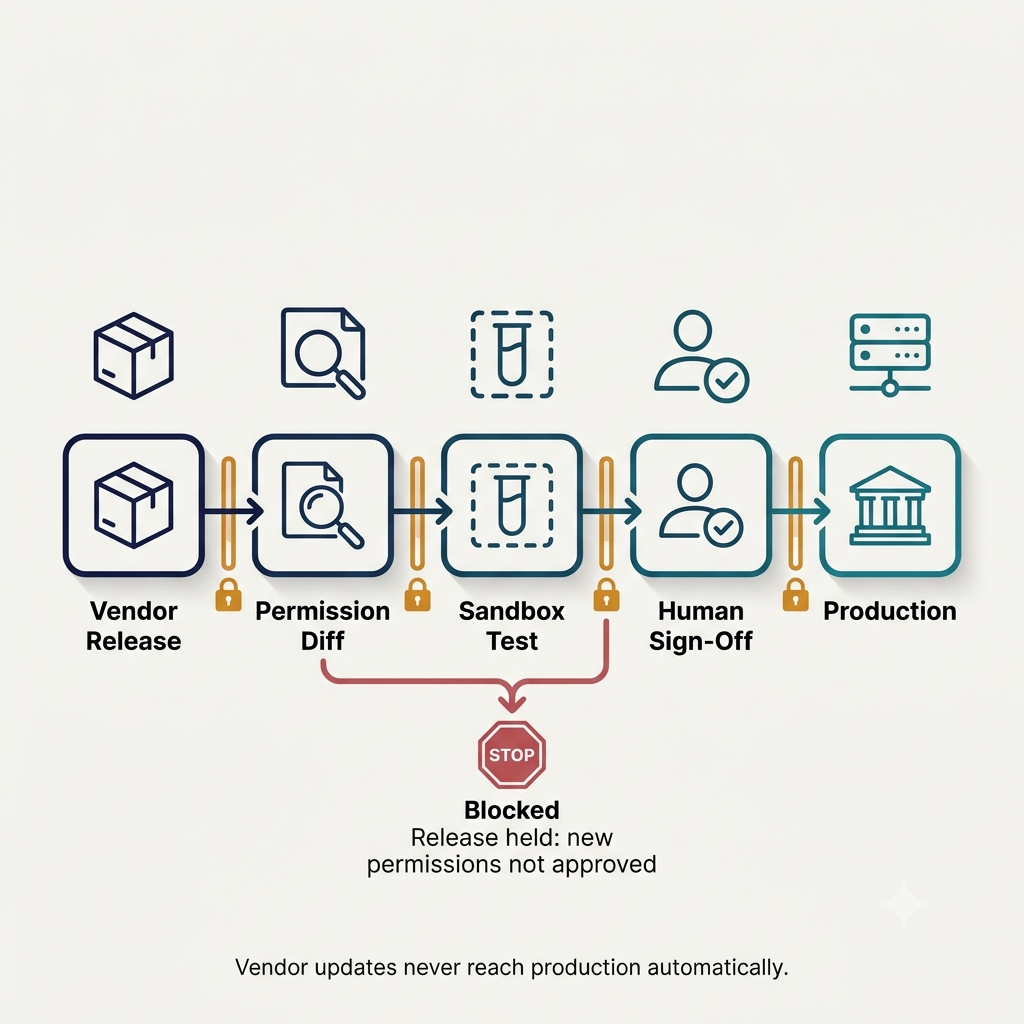
A vendor update shouldn’t automatically expand an agent’s authority.
Require a release review, sandbox testing, a permission diff review and revalidation before any new tools, models, prompts or permissions reach production.
6. Monitor behavior, not just uptime
Banks should watch for:
- Tool calls and action velocity
- Permission changes
- Failed approvals
- Overrides
- Exceptions
- Hallucinations
- Data-access anomalies
- Model or prompt changes
- Unusual transaction or workflow patterns
The OCC notes that vendor and model changes, prompt or configuration changes, fine-tuning, data changes and new tools or permissions can all alter behavior without a traditional model release.
7. Test the kill switch
A kill switch nobody has tested is a diagram, not a control.
Banks should periodically check that they can detect a misfire, suspend the agent, preserve evidence, restore the business process, correct affected records and communicate with affected customers.
A vendor negotiation checklist
Before signing or renewing an AI-enabled SaaS contract, bank leaders should ask:
- Does the contract define “AI feature,” “agent,” “autonomous action” and “material change”?
- Can the bank approve, defer or disable agentic functionality?
- Does the vendor disclose model, prompt, tool and permission changes?
- Can the bank test updates in a sandbox before they go to production?
- Are agent identities, credentials and permissions governed separately?
- Does the bank get actionable logs, not just dashboards?
- Who pays for remediation when an agent causes a wrongful payment, a credit error or a data exposure?
- Can the bank suspend the agent without terminating the whole SaaS relationship?
- Does the vendor support independent testing, audit access and incident investigation?
- Is there a tested fallback process if the agent has to be switched off?
What banks should do now
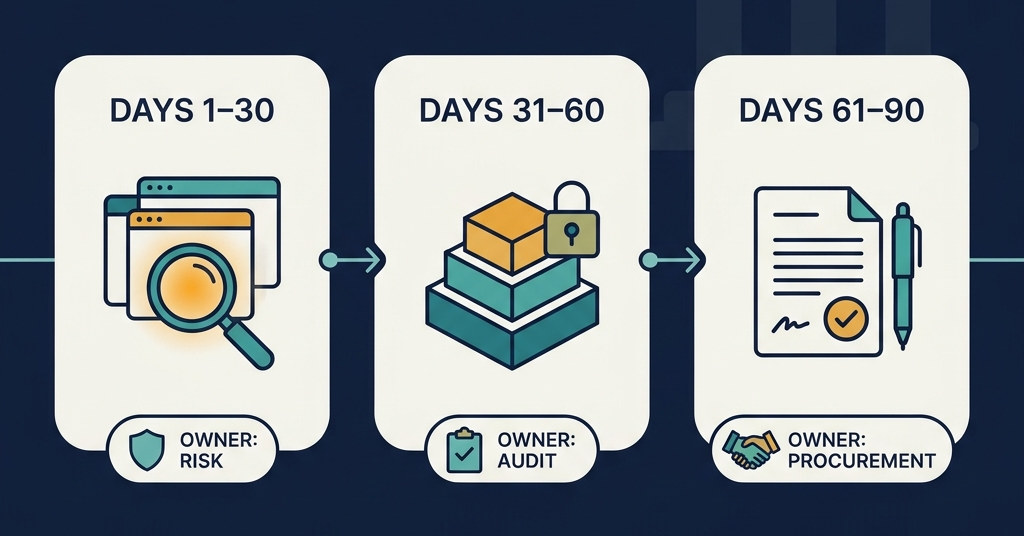
Days 1–30: Find the shadow agents
Inventory every vendor platform with AI, automation, copilot or workflow capabilities. Identify the agents, credentials, connected systems, data access and action authority.
Days 31–60: Classify and contain
Classify agents by consequence, reversibility, autonomy, data sensitivity and permission breadth. Put the agents that touch the ledger, payments, credit, customers or compliance at the front of the remediation queue.
Days 61–90: Rewrite the controls
Update vendor questionnaires, contract templates, change-control procedures, incident taxonomies, audit evidence requirements and resilience testing plans.
Trust the vendor, verify the agent
Banks can keep relying on SaaS vendors. What they can’t do anymore is assume a trusted platform stays a passive tool after an AI update.
The old vendor-management question was “Is this software secure?”
The new one is this: “What is this software authorized to do on our behalf, and can we prove it stayed inside those limits?”
The institutions that can answer that before the next vendor release will be in a much better position to adopt agentic AI without turning operational convenience into regulatory exposure.