

Most supply chains don’t have a data problem. They have a memory problem. The forecast revision from last Tuesday, the supplier who promised 21 days and delivered in 34, the planner who bumped safety stock for a reason nobody wrote down: all of it exists somewhere, scattered across systems and inboxes, and it rarely makes it into the next decision.
AI agents inherit the same problem unless you give them a way to remember. An agent with memory can store, retrieve, and update information beyond a single interaction, including facts, past events, and procedures. Without it, every replenishment call, every PO exception, every shipment delay gets treated like the first time it ever happened.
This article looks at the operational side of agent memory: what supply-chain and ERP agents need to remember, how that supports predictive inventory and vendor operations, and how to keep it governed once agents start acting on it.
The supply chain is a state machine
A supply chain never sits still. Demand climbs, stock moves between sites, suppliers slip, carriers reroute, production plans change, and budgets get squeezed. An agent that only sees the prompt in front of it can’t keep up with that.
Ask a stateless agent for the current inventory of SKU 4821 and it’ll do fine. Ask it whether to expedite the purchase order and it falls apart, because that decision depends on things it doesn’t know:
- The demand forecast and how it’s been revised lately
- Inventory across warehouses and plants
- Inbound POs and their promised dates
- How reliable the supplier has actually been on lead times
- Earlier exceptions, approvals, and fixes
- Which production runs or customer orders a delay would hit
This is why autonomy in the supply chain isn’t really about building one brilliant agent. It’s about building a shared, durable operational memory that several agents can read from, write to, and act on. When agents coordinate through a common state, with facts, task records, and intermediate results in one place, they stop stepping on each other.
Why supply-chain agents fail without memory
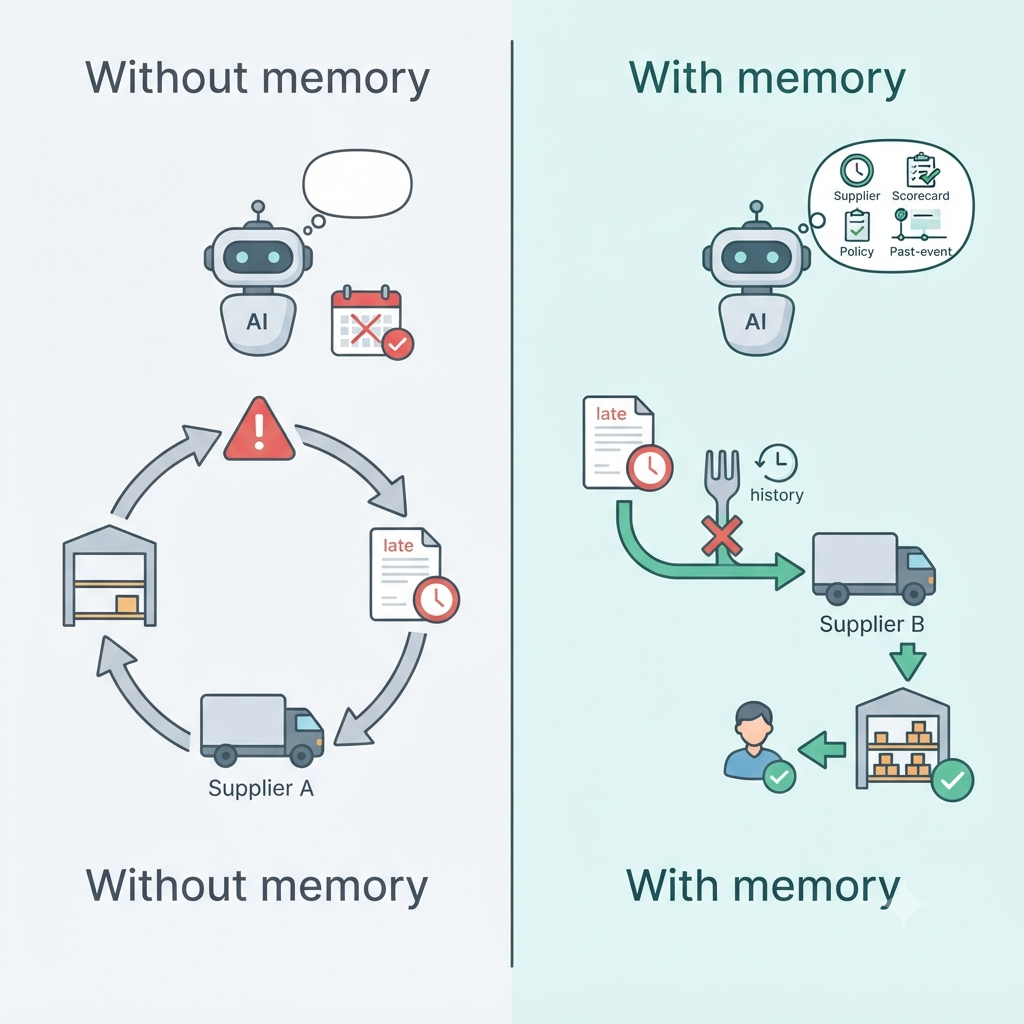
Without persistent memory, AI automation stays stuck at the task level. It can write a report or answer a question, but it can’t carry a decision through to the end.
You’ll usually see it go wrong in a few familiar ways:
- Asking for the same data over and over. A demand planning agent pulls the same inventory, forecast, and supplier data every cycle because it has no record of what it already looked at or assumed.
- Repeating failed moves. A replenishment agent recommends the same supplier that already failed, or re-raises a PO that was blocked, because the earlier constraint is gone.
- Missing the knock-on effects. A logistics agent sees a late shipment but can’t connect it to the production plan or customer order it threatens.
- Losing supplier context. A procurement agent forgets the negotiation history, the approved alternatives, the compliance status, the lead-time record.
- Stalled handoffs. One agent finishes its piece, and the next has no idea what happened, what’s still open, or who owns what.
Memory turns a string of one-off actions into a continuous operating loop. It carries state across sessions, and durable workflow state means an interrupted process can pick up where it stopped instead of starting over.
The memory model for supply-chain agents
Enterprise agent memory is usually split into working, episodic, semantic, and procedural layers. In a supply chain, those layers have to reflect operational reality, not just chat history.
| Memory layer | What it stores | Supply-chain example |
|---|---|---|
| Working memory | The active task, constraints, tool outputs, and in-flight exceptions | “PO 4821 is short 2,400 units, and the alternate supplier quote is pending.” |
| Episodic memory | Time-stamped events, decisions, outcomes, exceptions, and corrective actions | “Supplier A missed the promised date in Q3; expedited freight recovered four days.” |
| Semantic memory | Verified entities, relationships, policies, and domain knowledge | “Supplier A supplies Component X; its contractual lead time is 21 days; Plant 3 consumes it.” |
| Procedural memory | Approved workflows, escalation rules, and decision playbooks | “When projected stockout risk exceeds 15%, request approval before switching suppliers.” |
| Shared workflow state | Cross-agent task status, handoffs, approvals, and intermediate results | “Demand agent updated the forecast; procurement is awaiting risk review; logistics reserved capacity.” |
Working memory
This is what the agent is holding in its head right now: the current task, the data it just pulled, the constraints in play. It’s quick and disposable, and it’s nowhere near enough for decisions that stretch across days, weeks, or several systems.
Episodic memory
Episodic memory records what happened, when, and how it turned out. In a supply chain that means late shipments, recommendations that didn’t work, supplier exceptions, planner overrides, and whatever it took to fix them.
Say a supplier missed a delivery date last quarter, the team paid for expedited freight, and production was protected at an extra cost. The agent should remember all of that, and it should shape the next sourcing recommendation.
Semantic memory
Semantic memory is the stable stuff: what a supplier can make, which parts are approved, which plant uses what, contractual lead times, inventory policies, substitution rules. It answers the question “what’s true about this network?”
Knowledge graphs suit this layer well because they model connected things like suppliers, components, plants, customers, and orders. That makes multi-hop questions easy, such as “which plants are affected if this supplier slips?”
Procedural memory
Procedural memory holds how your organization wants work done: replenishment policies, approval thresholds, escalation paths, sourcing rules, exception playbooks. It answers “what’s the right process for this kind of decision?”
You can’t skip this layer. An autonomous agent shouldn’t decide on historical patterns alone. It has to work inside your business rules, financial controls, and approval limits.
Shared workflow state
This is the coordination layer for multi-agent setups. It tracks who owns which task, what’s done, which approvals are pending, and what’s been handed off.
It’s easy to confuse with semantic memory, but they do different jobs. Semantic memory says, “Supplier A has a 21-day lead time.” Workflow state says, “Procurement has asked for a risk review and is waiting on logistics to assess alternate routes.”
Memory architecture for an autonomous supply chain
The aim is simple: keep your enterprise systems authoritative, and give agents a governed layer of context to reason and coordinate on top of them.
ERP / WMS / TMS / MRP / Procurement / Finance
                    ↓
        Event and context ingestion
                    ↓
     Governed supply-chain memory layer
                    ↓
       Retrieval and context assembly
                    ↓
          Multi-agent orchestration
                    ↓
      Human approval and execution
                    ↓
          Outcome feedback to memory
1. Systems of record
Your ERP, WMS, TMS, MRP, procurement, quality, and finance systems stay the source of truth. Agent memory shouldn’t quietly replace transactional data. It sits on top and makes the right context retrievable at the right moment.
2. Event and context ingestion
The memory layer should take in signals like:
- Demand forecasts and their revisions
- Sales orders, promotions, and market signals
- Inventory movements and stock positions
- Purchase orders, receipts, and supplier confirmations
- Shipment updates, carrier events, and delivery exceptions
- Supplier communications, quotes, and contract changes
- External risks such as weather, geopolitical events, or supplier disruptions
3. Governed memory layer
Keep working, episodic, semantic, procedural, and workflow memory separate. Each should have a clear owner, retention rules, access controls, and update policies.
4. Retrieval and context assembly
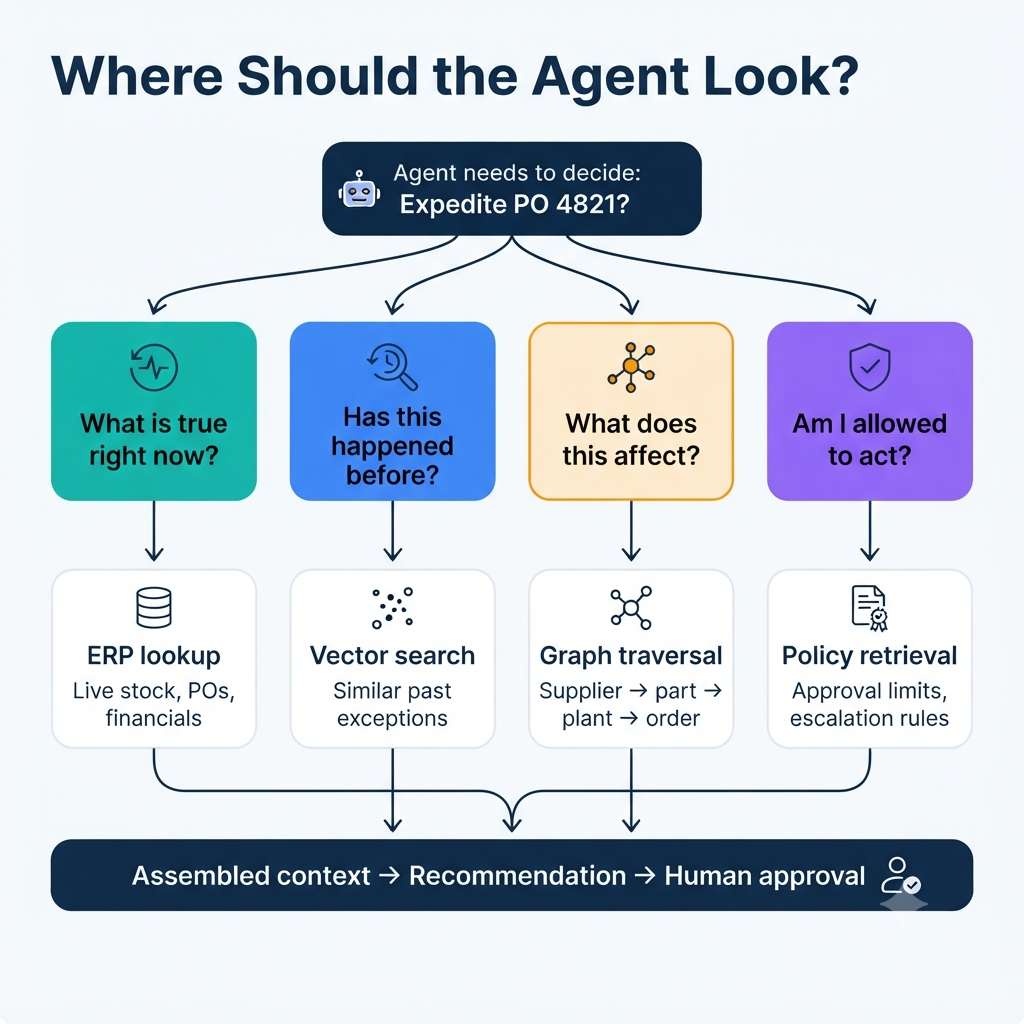
When it’s time to decide, the agent should pull from several places at once:
- Deterministic ERP lookups for current inventory, orders, POs, and financials
- Vector retrieval for similar past exceptions and decisions
- Graph traversal across suppliers, SKUs, plants, customers, and orders
- Policy retrieval for approval rules, sourcing constraints, and escalation steps
Pairing vector search (good at similarity) with graph structures (good at relationships) is a common pattern in production systems for exactly this reason.
5. Multi-agent orchestration
The orchestration layer routes work between specialist agents, enforces policy, tracks handoffs, and keeps the shared task state current.
6. Action and feedback loop
Once an action is taken, or a human approves a recommendation, record what happened. Did the replenishment prevent the stockout? Did the alternate supplier deliver on time? Did expediting actually fix the delay?
That feedback updates episodic memory, sharpens supplier assessments, and makes the next recommendation better.
Use case: Predictive inventory and replenishment
Predictive inventory is one of the clearest wins for agent memory, because good replenishment depends on both what’s happening now and what’s happened before.
A memory-enabled inventory agent can:
- Build a demand profile for each SKU and location from historical sales, seasonality, promotions, and live signals
- Remember forecast adjustments, planner overrides, and past forecast misses
- Spot emerging stockout or overstock risk before it turns into a service problem
- Recommend replenishment quantities, transfer orders, or production changes
- Learn from actual demand and delivery results to improve the next planning cycle
Example: A seasonal demand shift
Suppose a demand agent notices orders accelerating for a seasonal SKU. It pulls up:
- Last year’s comparable demand pattern
- Current inventory across the relevant locations
- Inbound POs and promised delivery dates
- The supplier’s lead-time history
- A planner’s earlier override that raised safety stock for this SKU
From there it can propose a replenishment plan, flag the plants affected, estimate service risk, and keep the reasoning on file for audit and future learning.
That’s a real step up from a static forecast, because the agent connects the demand signal to inventory, suppliers, logistics, and past planning decisions. Agentic systems can keep forecasts current using live demand, inventory, and market data, then trigger replenishment instead of just producing a report.
Use case: Vendor operations and procurement memory
Vendor operations need a different kind of memory than fraud detection or customer support. The goal isn’t to score transaction risk or personalize a conversation. It’s to hold a reliable, usable picture of your supplier relationships and keep procurement moving.
A procurement agent should remember:
- Supplier performance: on-time delivery, fill rate, quality incidents, price changes, capacity limits, responsiveness
- Contracts and policies: approved suppliers, negotiated terms, lead times, minimum order quantities, substitution rules
- Negotiation history: past RFQs, quotes, commitments, escalations, approved alternatives
- Exception history: recurring delays, quality holds, geopolitical exposure, corrective actions
- Workflow state: open RFQs, pending approvals, PO amendments, expediting requests
Example: A delayed component
A key component is running late. The procurement agent looks up the supplier’s track record, the qualified alternates, the contract terms, how exposed inventory is, and what was done last time something like this happened.
It can then lay out the options: expedite with the current supplier, shift volume to an alternate, split the order, or escalate to a human. Whatever gets decided, and why, goes back into memory.
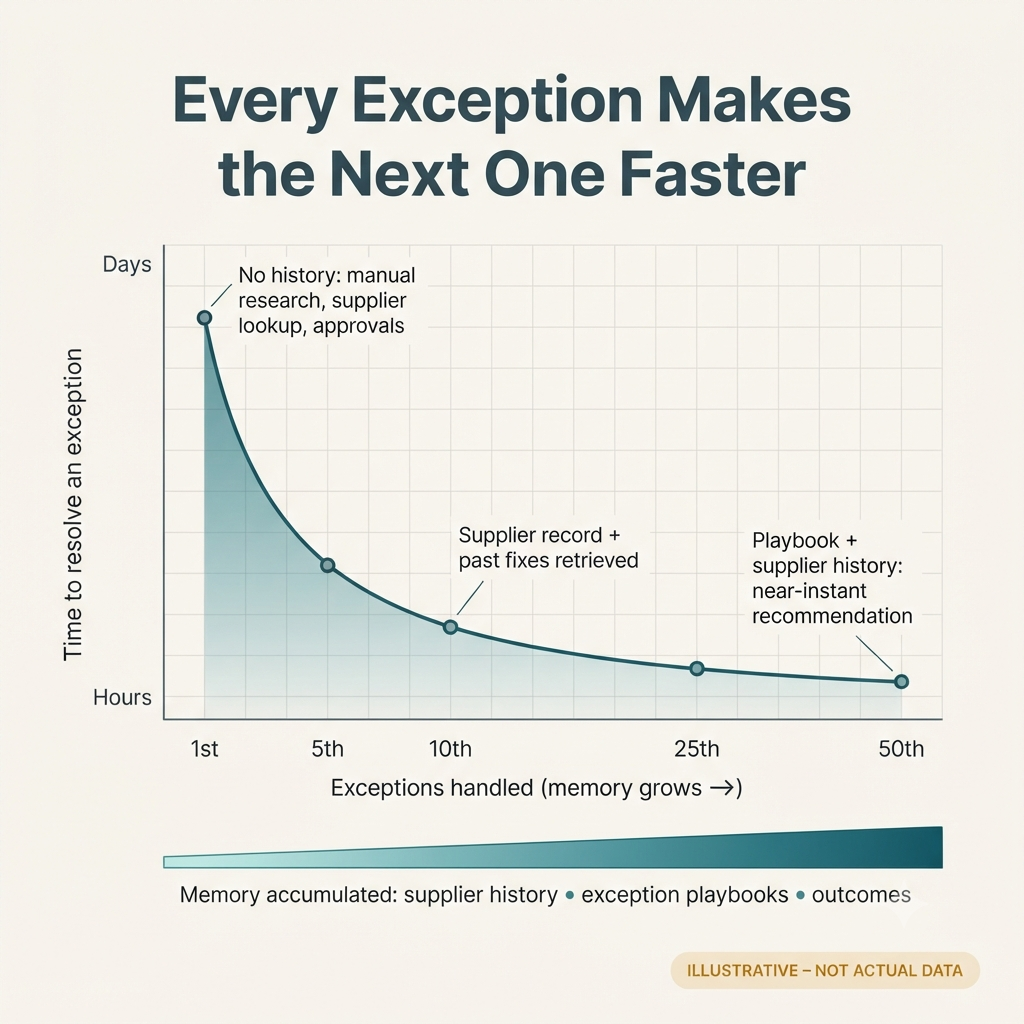
The advantage compounds. Every exception makes the next one easier, because the agent keeps both the playbook and the supplier history.
Use case: Multi-agent ERP workflows
Memory matters most when several agents have to work together. A single chatbot with a long conversation history isn’t the same thing as a multi-agent system sharing operational state.
Typical roles include:
- Demand agent: watches forecasts, orders, promotions, and market signals
- Inventory agent: tracks stock positions, safety stock, aging, and replenishment needs
- Procurement agent: handles supplier communication, sourcing options, and PO changes
- Logistics agent: follows shipments, capacity, delays, and delivery risk
- Finance agent: checks budget, cost impact, payment terms, and approval requirements
- Orchestrator: coordinates handoffs, enforces policy, and maintains shared task state
End-to-end workflow
Demand shift detected
→ Inventory agent identifies projected shortage
→ Procurement agent retrieves supplier and contract context
→ Logistics agent assesses inbound and alternate routes
→ Finance agent validates budget and approval rules
→ Orchestrator routes recommendation for human approval
→ Outcome and rationale written back to shared memory
In this flow, memory isn’t a transcript of what each agent said. It’s the shared state that tells the system what’s been decided, what’s still open, and what should happen next.
Multi-agent systems can use shared memory to keep inventory levels in sync, anticipate demand, and optimize logistics, while workflow agents use it to track each step and preserve progress across a business process.
Governance: Memory without operational risk
Giving agents memory also creates real risk. An agent acting on stale lead times, bad supplier ratings, duplicate records, or contract terms it shouldn’t see can make an expensive mistake quickly.
Governance here needs to be specific to supply chain:
- Data ownership: decide which system is authoritative for inventory, supplier master data, contracts, and financials.
- Access control: limit supplier pricing, contracts, plant-level inventory, and procurement actions by role and business unit.
- Auditability: keep the input signals, retrieved context, recommendation, human approval, and final action for every consequential decision.
- Memory quality: stop stale lead times, outdated supplier ratings, duplicate entities, and wrong substitutions from creeping into decisions.
- Human oversight: require sign-off for high-risk moves like supplier switches, large POs, expedited freight, or production-plan changes.
- Tenant and entity isolation: make sure one business unit, region, or supplier can’t see another’s sensitive operational context.
Enterprise memory systems increasingly need access control, auditing, versioning, and content attribution. Production designs typically combine role-based access, policy-scoped memory, and audit logging.
Implementation roadmap
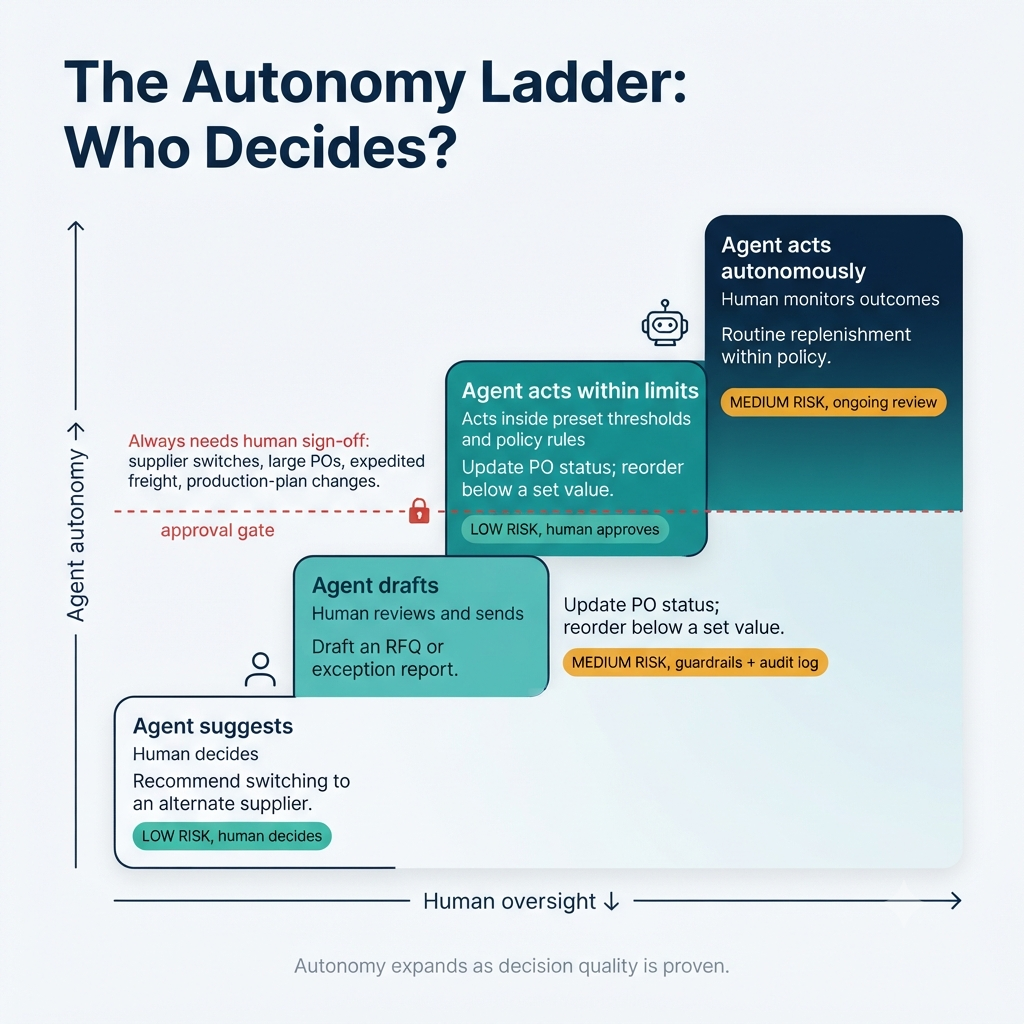
Don’t start by handing agents broad authority to execute transactions. A phased rollout builds trust in the memory layer while keeping risk contained.
Phase 1: Read-only operational memory
Connect your ERP, WMS, and TMS data. Build up knowledge about suppliers, SKUs, plants, and orders. Let agents recommend actions while people keep the decision rights.
Phase 2: Exception automation
Put memory-backed agents on delayed POs, stockout risks, and replenishment recommendations. Keep human approval on anything high-impact.
Phase 3: Multi-agent coordination
Add shared workflow state and agent handoffs, and automate low-risk tasks such as drafting RFQs, updating internal task status, or preparing exception reports.
Phase 4: Continuous learning
Feed real outcomes back into memory to improve forecasts, supplier assessments, and exception playbooks. The system should learn what worked, what didn’t, and why.
FAQ
How is agent memory different from an ERP database?
An ERP is the system of record for transactions, master data, and business processes. Agent memory is a governed context layer that helps agents pull the right facts, events, relationships, and procedures at the moment they need to decide.
Can AI agents automatically place purchase orders?
They can, but most companies should start with recommendations and human approval. Automatic PO creation makes sense only for low-risk, policy-compliant cases, and only after you’ve validated decision quality and controls.
What data should a supply-chain agent remember?
Demand signals, inventory positions, supplier performance, lead-time history, shipment exceptions, past decisions, approvals, and the results of earlier corrective actions.
How do you prevent agents from acting on stale data?
Use source-system timestamps, validity windows, expiration rules for memories, scheduled refreshes, and retrieval policies that favor current authoritative data over older context.
What is the difference between workflow state and long-term semantic memory?
Workflow state tracks a process in motion: what’s done, what’s pending, who’s next. Semantic memory stores lasting facts and relationships, like supplier lead times, approved parts, and plant assignments.
How do you audit an autonomous supply-chain decision?
Log the input signals, retrieved memories, recommendation, policy checks, human approval, final action, and eventual outcome. Together they form an end-to-end decision trail.
When should a company use a knowledge graph versus a vector database?
Use a vector database when the agent needs to find similar past events or unstructured content. Use a knowledge graph when the decision hinges on connected entities, like supplier-to-part-to-plant-to-customer links. Plenty of production systems use both.
The takeaway
Memory is what separates a supply-chain assistant that answers questions from a system that can actually operate.
Agents that retain demand context, inventory positions, supplier history, exception playbooks, and workflow state make better replenishment calls, handle vendors with real institutional knowledge, and coordinate complex ERP workflows without losing the thread.
The strongest implementations don’t try to replace the ERP. They add a governed memory layer on top of it, one that preserves context, enforces policy, keeps humans in the loop, and gets better with every decision.