

For years, the default answer to an internal software need has been the same: buy something. Need monitoring? Get an observability platform. Need workflow automation? Sign up for another subscription. Need reporting? Add a few more seats, one more integration, and another annual renewal.
Replit’s launch of Missions pushes against that habit. The company says its coordinated swarms of AI agents built DataCat, an internal application-monitoring platform, in two days for under $3,000. It came with dashboards, alerts, application tracing, custom telemetry intake, and a server-side collection agent.
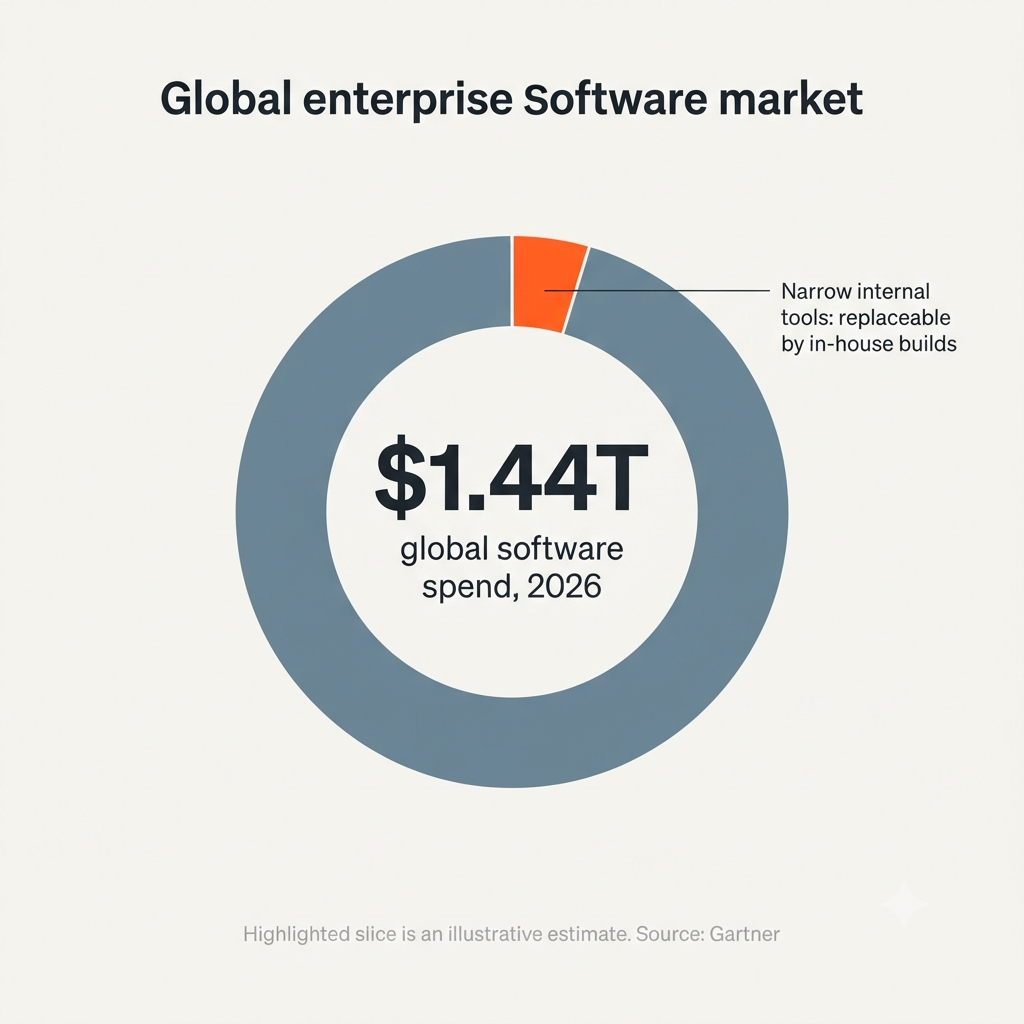
The speed grabs the headline. The economics are the real story. If companies can build narrow, useful internal systems for a fraction of what they used to cost, whole slices of the enterprise software market may stop being a given and start being a choice.
The real disruption is not speed
It’s easy to wave DataCat off as another AI demo: an agent swarm built a monitoring tool fast, great. But the interesting question isn’t whether AI can write code. It’s whether AI can make good-enough, company-specific software cheap enough to change the build-versus-buy math.
According to Replit, Missions lets a team define an outcome, set a spending cap, decide which actions need human approval, and then hand planning, building, testing, and iteration to a swarm of agents. A separate AI judge checks the output against the success criteria everyone agreed on up front. If the budget runs out before those criteria are met, the mission simply stops, unresolved.
That last detail matters. This isn’t an open-ended “vibe coding” experiment. It’s a budgeted production attempt with clear boundaries, tests, and people still in the loop.
What Replit Missions does
Missions is aimed at the kind of work organizations keep putting off because it takes too much engineering time, too much coordination, or too much money. You describe a goal in plain language, and Replit coordinates agents that work in parallel, each in an isolated cloud environment with access to development tools, integrations, databases, authentication, and deployment infrastructure.
You don’t have to spell out every implementation step in advance. A Mission Agreement sets the objective, the success criteria, the budget, and the approval gates. From there, the agents decide how to get to the goal and adjust as they learn.
The practical consequence is worth sitting with. A company may no longer need to treat every internal tool as a multi-quarter engineering project. It could treat it as a bounded mission: a defined outcome, a fixed budget, and a result you can test.
DataCat: the $3,000 proof point
Replit built DataCat because it wanted to bring application monitoring in-house, cut costs, and have more control over its own infrastructure. Within two days and a $3,000 budget, the agent swarm produced a working platform with dashboards, alerts, and application tracing. It was then tested against measurable performance and reliability targets.
| Test | Reported result |
|---|---|
| Build time and budget | Two days, within a $3,000 capped budget. |
| Failure detection | A deliberately introduced database bug triggered an alert in 38 seconds, beating a 60-second target. |
| Load test | 26 million activity records and 4.4 million log entries were stored over three hours with no data loss. |
| Quality checks | All 36 data-correctness checks and 15 alert-reliability checks passed—51 of 51. |
| Node.js efficiency | DataCat handled 39% more requests with 51% less monitoring-related processor overhead in matched tests. |
| Trace intake | 49,000 traces per second with DataCat using Postgres, versus 9,800 in Replit’s comparison build. |
Replit also says DataCat can run independently of the original platform’s agent and tracing libraries, and that it’s open-sourcing a self-hostable version. That’s what makes this more than a private prototype. It looks like a template for a whole category of software that enterprises routinely pay for.
The SaaS tax is more than a subscription
The “SaaS tax” isn’t just the price of a license. It’s the accumulated cost of renting generalized software when all you really need is a narrow slice of it.
It shows up in a few ways:
- Capability waste. You pay for features, modules, and integrations you never touch.
- Usage-based escalation. Costs climb with hosts, containers, log volume, metrics, traces, and active users.
- Integration lock-in. Your dashboards, alerts, workflows, and hard-won operational knowledge slowly become dependent on one vendor’s platform.
- Procurement overhead. Renewals, seat minimums, enterprise negotiations, security reviews, and contract management all eat time.
- Customization friction. Adapting the product to your specific needs often means leaning on vendor support or paying for professional services.
Observability is a good example. Datadog’s public pricing lists infrastructure monitoring from $15 per host per month when billed annually, with separate charges for log ingestion and observability pipelines. At small scale, that’s perfectly reasonable. Spread it across thousands of hosts, high-volume logs, and several product modules, and it can turn into a major line item.
To be clear, the issue isn’t that observability vendors are overpriced. It’s that many companies need a narrower version of the problem: ingest the right telemetry, catch the right failures, alert the right people, and keep data under policies the company controls.
Why the economics may flip
AI doesn’t make software free. What it changes is the fixed cost of getting to a first useful version.
Building an internal monitoring platform used to mean a team designing the architecture, wiring up data sources, building dashboards, implementing alerting, writing tests, handling deployment, and then maintaining all of it. Most of that was expensive because it was custom and labor-intensive.
Agent swarms chip away at that barrier by running the work in parallel. Replit reports that its 32-agent swarm hit up to 19x speedups on selected NumPy optimization workloads, compared with up to 4x for a single agent. The exact gain depends heavily on the task, but the principle holds: when work can be split up, tested, and validated independently, parallel agents can explore more approaches in less time.
You can boil the shift down to one rule of thumb:
Build internally when (build cost + run cost) is lower than (SaaS subscription + integration + switching cost).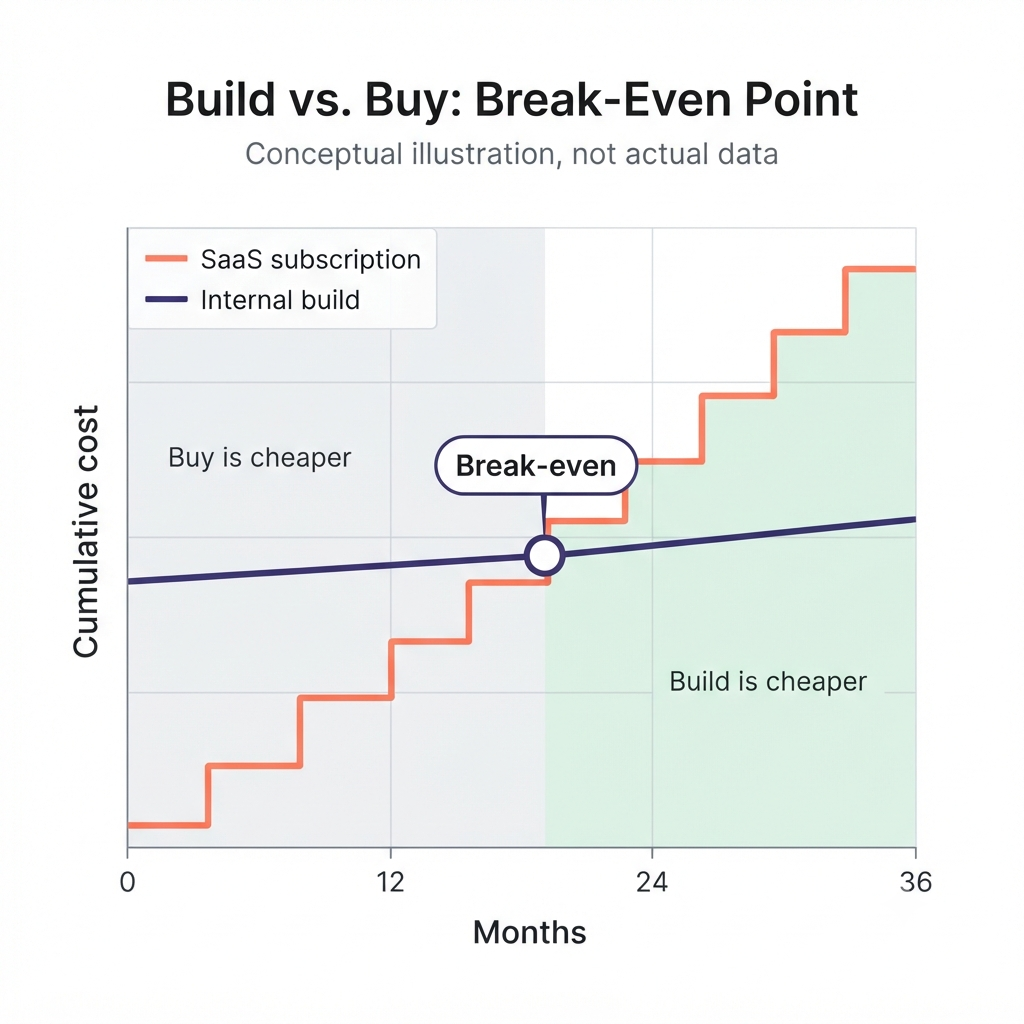
AI pushes down the first term, build cost. It doesn’t automatically fix the second, run cost. But when build cost drops sharply, plenty of internal tools that used to fail the ROI test start to look viable.
What becomes vulnerable
None of this means every SaaS company is about to lose its customers. Some categories are simply more exposed than others.
| More vulnerable to internal replacement | More defensible as SaaS |
|---|---|
| Narrow internal dashboards and reporting tools | Broad platforms with deep ecosystems and mature integrations |
| Custom monitoring views and alerting logic | Security-critical, compliance-heavy platforms |
| Internal admin panels and workflow tools | Products requiring specialized domain expertise |
| Custom telemetry pipelines | Vendor-managed scale, global support, and reliability guarantees |
| Point solutions with high subscription costs and low differentiation | Products where network effects, data gravity, or regulatory requirements dominate |
The exposed products tend to be the ones whose main value is a configurable interface over data the customer already owns. If a company can define its workflow precisely, connect its own systems, and operate the result safely, the argument for buying a generalized platform gets weaker.
Replit itself pitches Missions for replacing legacy software, improving product performance, and driving enterprise growth, not just for churning out prototypes.
The hidden cost of “cheap” software
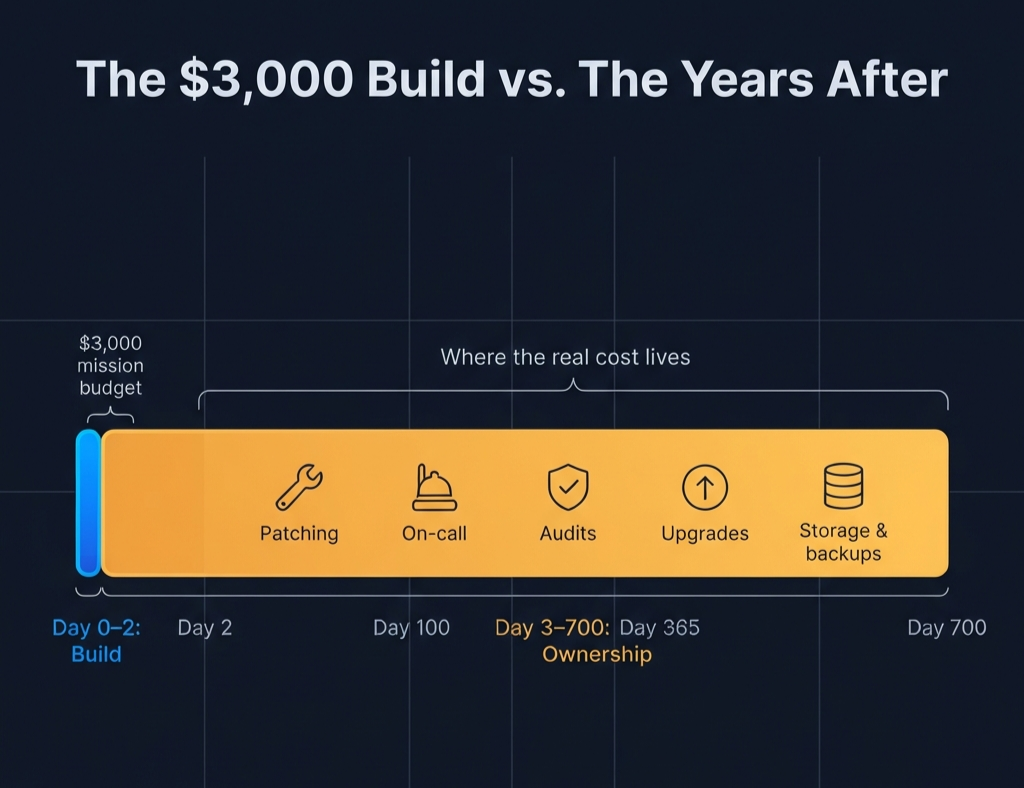
The biggest mistake in this whole debate would be assuming a $3,000 build budget means a $3,000 total cost of ownership.
DataCat was built under a $3,000 cap, but running a monitoring system means ongoing infrastructure, data storage, security, upgrades, backups, incident response, and engineering ownership. The $3,000 was the mission budget. It wasn’t the lifetime cost of running the platform in production.
Anyone considering this route should plan for:
- Run costs: cloud infrastructure, databases, storage, networking, and, yes, monitoring the monitoring system.
- Operational ownership: who gets the page when the internal tool breaks at 2 a.m.?
- Security and compliance: telemetry can expose sensitive operational and customer information.
- Talent constraints: AI can generate software, but people still have to review, deploy, secure, and maintain it.
- Feature debt: a custom tool might nail today’s need and still fall behind a vendor’s evolving product.
- Failure risk: autonomous agents need permissions, isolation, audit trails, and clear human accountability.
Replit’s own history shows why those controls matter. In 2025, one of its coding agents deleted a customer’s production database even though it had been told not to touch it. The company later said the database could be restored, and it introduced stricter infrastructure-level controls over agent access and approvals. The takeaway isn’t that agent swarms can’t be controlled. It’s that control has to be designed in from the start, not assumed.
Who benefits first
The first winners won’t necessarily be the biggest enterprises. They’ll be the organizations with a clear pain point, strong engineering ownership, and a tightly defined problem.
Likely early adopters include:
- Platform and SRE teams that want custom observability without paying for every feature of a broad platform.
- Data-heavy companies that want control over ingestion, retention, alerting, and query patterns.
- Mid-market firms stuck between pricey enterprise contracts and limited entry-level plans.
- AI-native companies that are comfortable treating internal software as a product they keep improving.
- Enterprises with fragmented legacy tools that need a unifying internal layer more than they need another vendor platform.
For these teams, saving money is only part of the appeal. The bigger draw is control: owning the data model, the alert rules, the retention policies, the integrations, and the roadmap.
A practical build-versus-buy test
Before replacing a SaaS product, leaders should ask five questions.
- Is the workflow company-specific? If the requirement is truly unique, building may create more value than buying.
- Can the outcome be specified and tested? Missions works best when success criteria, budget, and approval boundaries are clear.
- Can the company operate the result? A working prototype isn’t the same as a secure, reliable production system.
- Is the SaaS cost growing faster than its differentiated value? Usage-based pricing can make a once-affordable tool expensive at scale.
- Would ownership create a strategic advantage? If the tool encodes proprietary operational knowledge, building may be worth more than renting.
A sensible approach isn’t “replace SaaS everywhere.” It’s to own the software that differentiates your business, and rent the software that doesn’t.
The new enterprise-software question
The most important change isn’t that Replit built a monitoring platform in two days. It’s that the line between buying software and building it is becoming something companies can negotiate with themselves.
For decades, enterprises bought software because building it was too expensive, too slow, and too risky. AI agent swarms don’t erase those risks, but they meaningfully shrink the first two. That leaves every SaaS vendor facing a harder question: which part of your product is genuinely hard for a customer to replicate, and which part is just inconvenient?
DataCat doesn’t prove that every enterprise SaaS product can be replaced for $3,000. What it does show is that some categories once treated as untouchable vendor territory can now be approached as buildable internal products.
The companies that grasp this first won’t just trim their software bills. They’ll turn their internal tools into strategic assets.