

Running AI agents inside your own walls gives you control, privacy, and independence. It also hands you a problem nobody warns you about: you now own the compute, the queues, the failures, and the cost of every unnecessary agent turn. The teams that get this right don’t just add more agents or buy faster GPUs. They design the whole system with care, from how agents are arranged to how they share context, which models they use, how their outputs get checked, and how anyone can see what’s going on.
Here’s the thing to keep in mind through the rest of this blog: in a sovereign setup, every new agent also adds a handoff, a model call, a queue, and one more chance for a mistake to become someone else’s input.
What is sovereign multi-agent AI?
It’s a setup where several specialized AI agents work inside an environment your organization controls. Usually that means self-hosted or privately managed models, internal data, private tool integrations, and clear boundaries around what agents can do.
The alternative is the cloud-native approach, where your agents call managed model endpoints and lean on the provider’s elastic capacity. The differences matter, so here they are side by side:
| Dimension | Sovereign multi-agent setup | Cloud-native API setup |
|---|---|---|
| Compute | Fixed, private, capacity-bounded | Elastic, provider-managed |
| Data boundary | Data remains under organizational control | Data may leave the trust boundary |
| Scaling model | Capacity planning, queues, and concurrency limits | Provider-managed elasticity |
| Cost profile | Infrastructure utilization and GPU/NPU efficiency | Token and API consumption |
| Primary constraint | Local throughput, concurrency, and coordination | API latency, rate limits, and token cost |
| Operational responsibility | Organization owns runtime, capacity, and reliability | Provider owns much of the inference layer |
The trade-off is simple to state. Sovereign deployments give you more say over your data, models, and execution, but you lose the option of shrugging off a demand spike and letting someone else’s capacity absorb it. Multi-agent designs bring real benefits, like parallelism, specialization, and fault isolation. They also bring coordination overhead and a growing chance that something goes wrong along the way.
Why multi-agent systems slow down
Contrary to what many people assume, multi-agent systems don’t slow down because local models are slow. They slow down because the workflow burns limited compute on coordination instead of useful work.
Three costs tend to pile up:
- Coordination bloat. Planners, routers, supervisors, critics, and synthesizers all use inference capacity before anything useful comes out.
- Redundant reasoning. Agents re-read context they already have, re-plan, debate, retry, or ask a colleague to reformat something that was fine the first time.
- Cascading failures. A weak output becomes the next agent’s input. That agent tries to fix it, which triggers retries, escalations, or a bad final answer.
A typical flow looks like this:
User request
  → Planner
  → Router
  → Specialist agent
  → Validator
  → Retry / escalation
  → Synthesizer
  → Final output
Each arrow in that diagram can add latency, token use, state transfer, and risk of failure.
A helpful way to think about it: the end-to-end time of a workflow should be close to its critical path, meaning the longest chain of work that truly depends on earlier work. It should not be the sum of every agent’s runtime. If tasks that could run in parallel run one after another instead, you end up paying for all of them in sequence.
There’s also a ceiling on how far adding agents helps. Research on scaling multi-agent systems keeps finding the same pattern: past a certain point, the overhead of communication, conflicting reasoning, and synchronization outweighs whatever the extra specialists bring.
The error-compounding problem
Reliability is where things get dangerous. When steps depend on each other, reliability multiplies down. If each stage has an independent accuracy of p, the whole chain succeeds roughly p to the power of n of the time, where n is the number of stages.
Take a three-stage chain where each stage is right 92% of the time. End to end, that’s about 78%, and that’s before you count correlated failures or retries. Run a four-agent pipeline at 90% per agent and you get a correct result about 66% of the time. Even at 99% per agent, a four-stage run only succeeds around 96% of the time.
| Per-stage accuracy | Three-stage reliability | Four-stage reliability |
|---|---|---|
| 90% | 73% | 66% |
| 95% | 86% | 81% |
| 99% | 97% | 96% |
This is why I think of validation as a throughput tool, not just a quality tool. A hallucinated fact, a bad extraction, a faulty tool result, or a malformed handoff can trigger a pile of expensive repair work downstream if nobody catches it. What you want is failure isolation: stop the bad result at the boundary where it appeared, instead of letting it spread through the whole workflow.
The effect of unchecked propagation can be large. One study found that independent agent systems amplified errors 17.2 times, while centralized coordination cut that to 4.4 times by forcing validation checkpoints before results got combined.
The sovereign performance gap
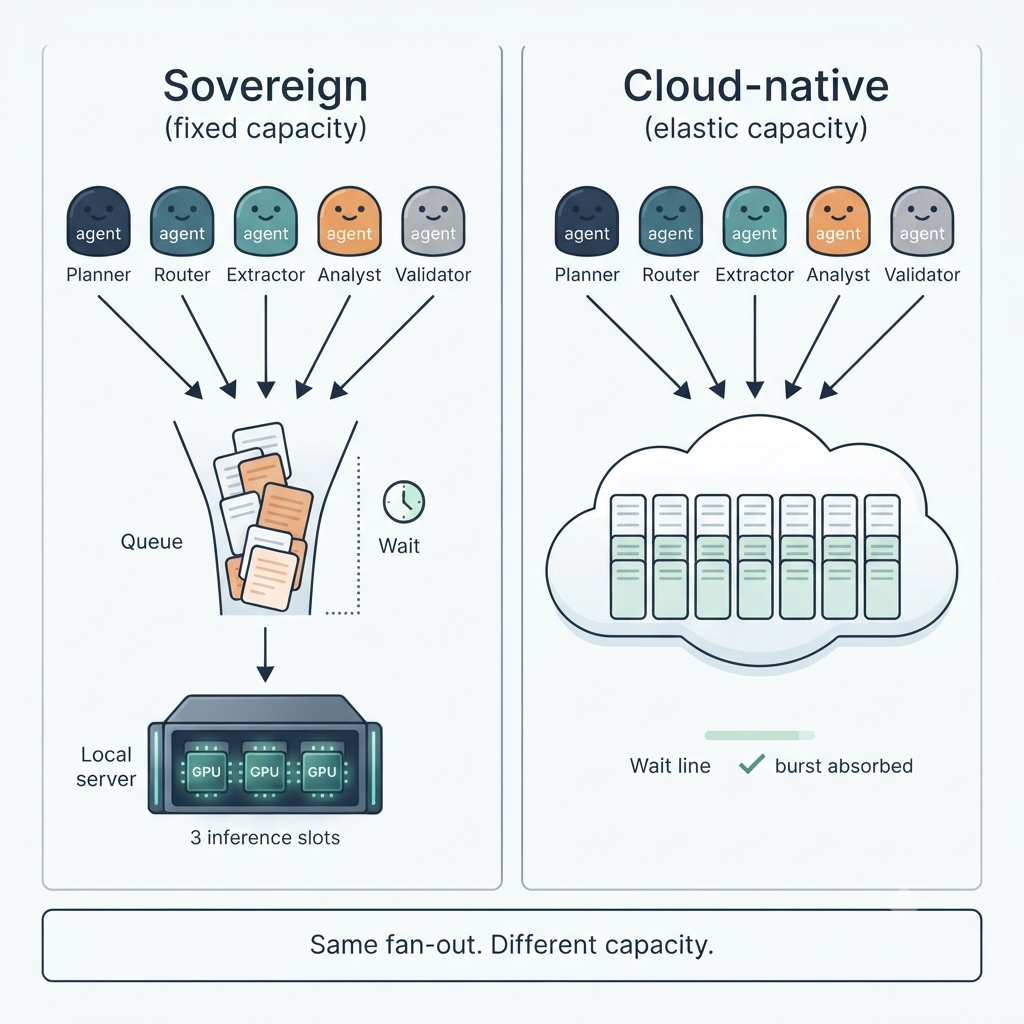
The same agent design can behave very differently on sovereign infrastructure than in the cloud.
A cloud-native system can soak up bursts of demand because the provider’s capacity stretches. A sovereign system has to spread concurrent agent requests across a fixed amount of local inference capacity. Fan-out makes that harder. When a router sends work to several specialists at once, they all want inference at the same moment. Queues, model loading, batching efficiency, and concurrency limits stop being background details and become the main performance variables.
Again, the problem isn’t that local models are slow. It’s that scarce local capacity gets spent on things like:
- Low-value coordination calls
- Repeated reasoning over the same context
- Oversized prompts and tool definitions
- Tasks sent to the wrong place
- Sequential work that could have run in parallel
- Retries caused by weak validation
AWS’s guidance on this points the same way. They recommend tracking collaboration overhead directly, including coordination latency, redundant work rate, and throughput per model, and revisiting your collaboration approach as traffic changes.
The core optimization loop
The strongest sovereign multi-agent systems treat optimization as a loop, not a one-off tuning session:
Right-Sized Topology
        ↓
Model Tiering
        ↓
State Compression
        ↓
Verification Gates
        ↓
Observability
        ↓
Continuous optimization
It’s less a checklist than an operating model for finding where latency, cost, and failures come from, and fixing them before they compound. Here’s each piece in turn.
Right-sized topology
Use the fewest agents that still give you meaningful specialization. That cuts coordination calls, handoffs, repeated reasoning, and the number of ways things can break.
If a task has predictable steps, give it a deterministic workflow. Save dynamic agent-to-agent negotiation for work that really needs exploration, adaptive planning, or independent viewpoints. And don’t add agents just because your org chart has that many boxes. Research suggests orchestration overhead is often the biggest barrier to scaling, and that coordination should stay shallow unless there’s a clear reason otherwise.
The principle: fewer, better-bounded agents usually beat a large swarm.
What to measure: agents per task, handoffs per task, coordination latency, redundant work rate, and task completion rate.
Deep dive: Multi-Agent Topology & Error Control
Model tiering
Match the model to the job. Otherwise your most capable (and most expensive) inference capacity gets eaten by simple routing, extraction, formatting, and classification.
Small, fast models can handle classification, extraction, routing, formatting, and basic tool orchestration. Bring in the larger reasoning models when there’s real ambiguity, synthesis, complex planning, or a high-stakes decision. Think of model choice as a routing decision rather than a default. The right model is the smallest one that clears your quality bar, not automatically the biggest one you have.
The principle: not every agent needs the largest model, and not every task needs an agent.
What to measure: model mix, tokens per task, latency by tier, success rate by tier, and cost per successful task.
Deep dive: Sovereign Compute, Model Tiering & Local Inference Optimization
State compression
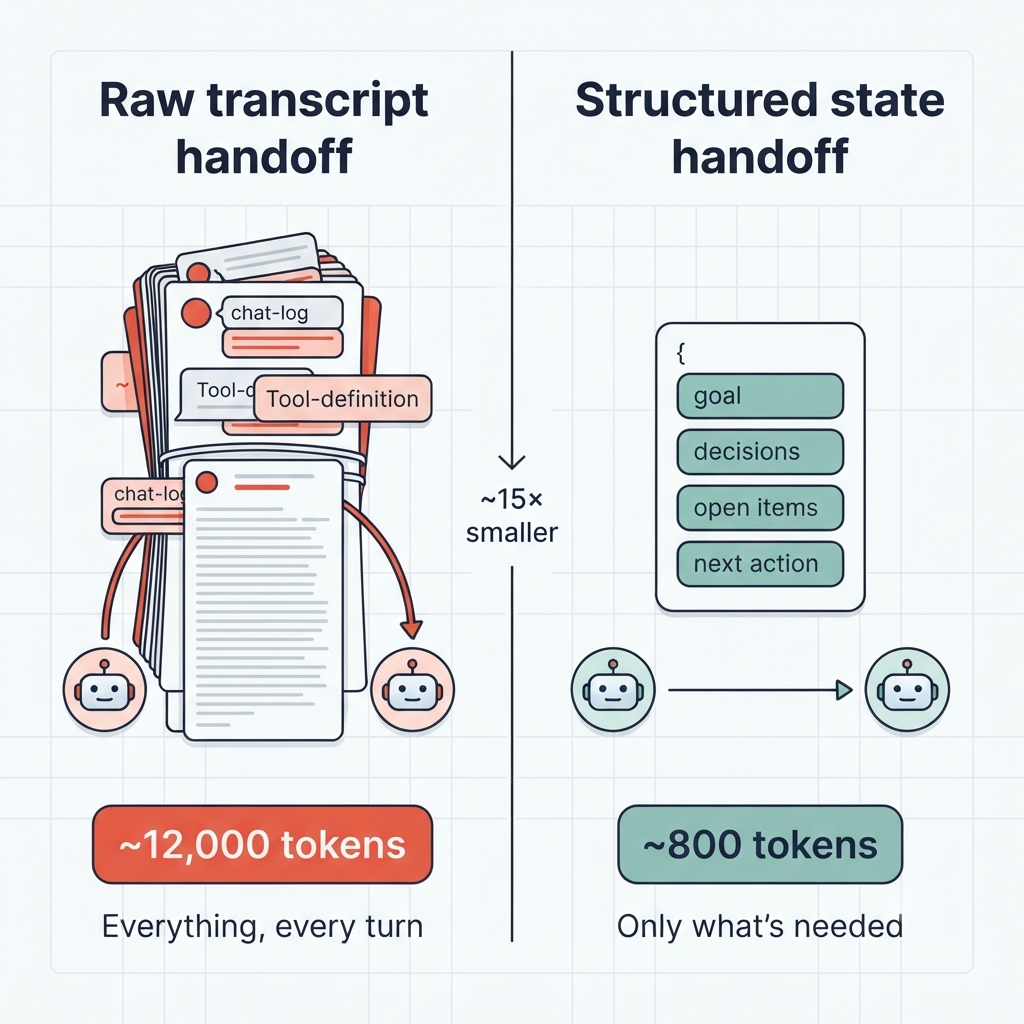
Give each agent only the context it needs. When everyone receives the full conversation history, every tool definition, and every intermediate output, you pay a coordination tax on every single turn. Compression changes agent communication from “send everything” to “send the minimum that’s sufficient.”
In practice, that means swapping raw transcript forwarding for structured, task-relevant state, and keeping system prompts, tool definitions, and intermediate results lean. The payoff is smaller prompts, faster context processing, lower token use, and fewer tool-selection mistakes.
The principle: context is a shared resource, and unmanaged context turns into coordination debt.
What to measure: context size per handoff, tokens per agent call, prompt-cache hit rate, retrieval relevance, and tool-selection accuracy.
Deep dive: Context Engineering, Shared Memory & Tool Scoping
Verification gates
Check outputs at agent boundaries before they feed downstream work. This keeps bad results from becoming expensive inputs and cuts down on retry loops.
Use deterministic checks wherever you can, and add critic or auditor agents where judgment is needed. When something fails, return a structured, actionable error instead of an opaque exception. Set retry budgets, escalation paths, and a terminal fallback. Without those limits, one weak agent can turn a small slip into a total workflow failure.
The principle: a validation gate is cheaper than a downstream repair loop.
What to measure: validation pass rate, retry rate, escalation rate, downstream failure rate, and time to recovery.
Deep dive: Multi-Agent Topology & Error Control, with governance overlap in Observability, Metrics & Enterprise Governance
Observability
Measure the workflow, not just the individual model calls. When you can trace the whole path from request to result, you can tell whether time is going to reasoning, coordination, tool execution, queueing, or validation. Then you feed what you learn back into your topology, model tiering, and state design.
End-to-end evaluation matters here because many compounding failures only show up when agents interact. Testing each agent alone won’t reveal them.
The principle: you can’t optimize what you can’t attribute.
What to measure: end-to-end latency, handoff latency, retry rate, tool-call success, task completion, and final-output quality.
Deep dive: Observability, Metrics & Enterprise Governance
The performance ROI model
Results will vary with workload, model mix, tool latency, concurrency, and task complexity. No universal benchmark applies to every deployment, so don’t trust anyone who offers one. The direction of improvement, though, is usually consistent:
| Metric | Unoptimized sovereign multi-agent workflow | Optimized workflow | Primary lever |
|---|---|---|---|
| End-to-end latency | High, often dominated by sequential handoffs | Lower through parallelism, routing, and fewer turns | Topology, model tiering |
| Task completion rate | Lower due to retries and cascading failures | Higher through early validation and bounded recovery | Verification gates |
| Inference utilization | Wasted on redundant reasoning and oversized context | Higher useful work per compute unit | Model tiering, state compression |
| Cost per successful task | High due to retries and over-provisioned models | Lower through routing and reduced turns | Model tiering, topology |
| Debugging time | High because failures are hard to attribute | Lower through span-level attribution | Observability |
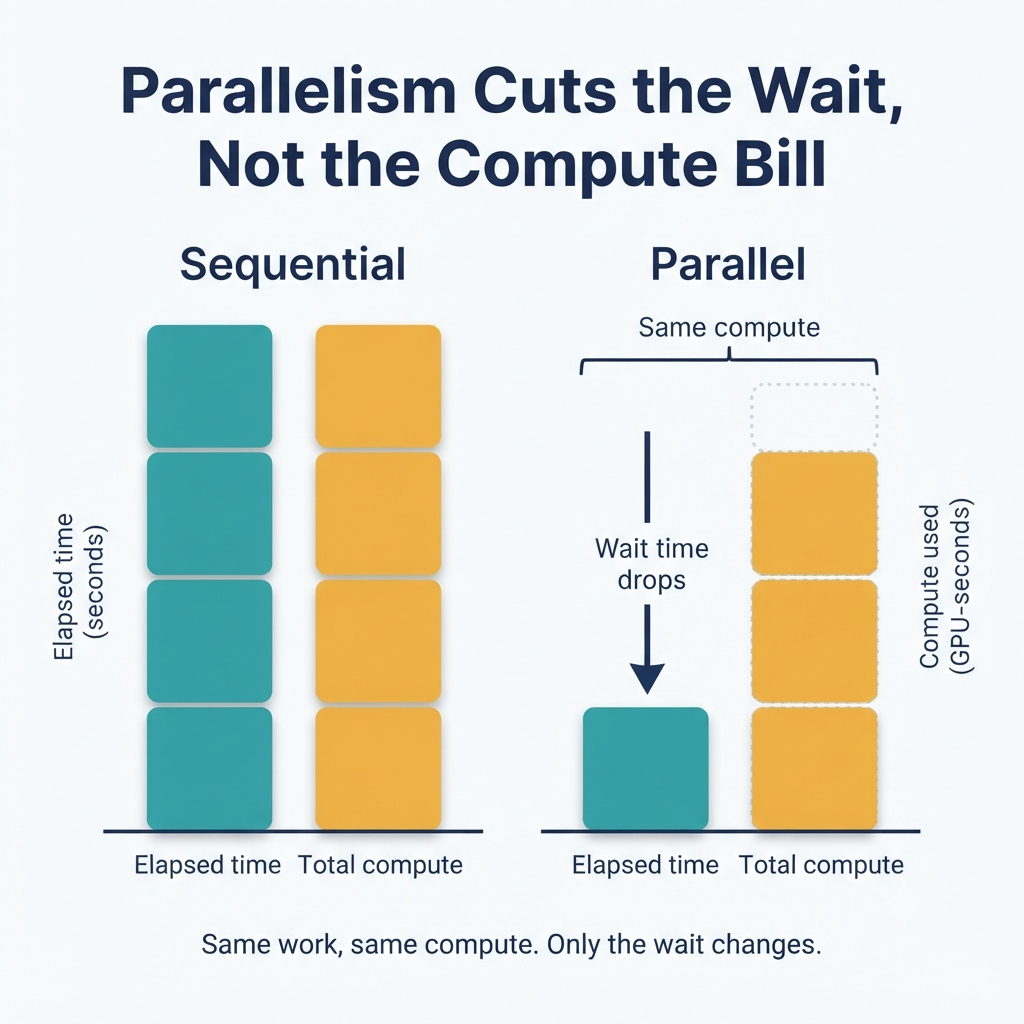
One distinction worth making is between elapsed time and compute cost. Running independent subtasks in parallel can shorten the wait, but it doesn’t automatically lower the total compute you spend.
And before you add multi-agent complexity at all, benchmark a strong single-agent baseline. If one capable model already hits your threshold, extra agents may just add coordination tax with no gain in accuracy.
A practical optimization sequence
If you want something to do on Monday morning, try this:
- Baseline the current workflow. Measure completion rate, end-to-end latency, retries, model calls, and where failures happen.
- Find the bottleneck. Is it topology, context, model choice, compute saturation, or missing verification?
- Cut unnecessary agents and turns. Simplify before you touch infrastructure.
- Apply the five-part loop. Right-size the topology, tier your models, compress state, add verification gates, and instrument everything.
- Re-baseline and iterate. Compare against the original workflow, not just against one agent’s isolated performance.
The first optimization is often subtraction. Drop an unnecessary planner, merge a redundant validator, shorten a handoff, or kill a retry loop before you think about adding hardware.
When not to use multi-agent AI
A multi-agent system isn’t automatically better than one well-designed agent.
It makes sense when the task needs:
- Distinct capabilities or domains
- Different tool boundaries
- Parallel execution of independent work
- Fault isolation
- Complexity beyond what a single agent’s context can reasonably hold
It doesn’t make sense when your agents share the same context, tools, and model and just pass work back and forth. And if latency, auditability, or predictability matters most, a single agent or a deterministic workflow is usually the better pick.
Multi-agent architectures do solve real problems that single agents can’t, especially around parallelism, specialization, and isolation. But they also add model calls, tool requests, intermediate outputs, coordination steps, and new ways to fail.
Performance is an architecture decision
How well a sovereign multi-agent system performs comes down to how topology, context, models, compute, validation, and observability work together. It’s not a single tuning job. It’s an ongoing loop.
The teams that get the most out of their systems don’t just tune the model. They tune the system. They remove agents that don’t earn their coordination cost, send work to appropriately sized models, trim state before it becomes context debt, validate outputs before errors spread, and measure the workflow from start to finish.
That’s the playbook in one line: right-size the topology, tier the models, compress the state, gate the outputs, and observe the system.
Explore the deep dives
- Multi-Agent Topology & Error Control: How to prevent deadlocks, infinite turns, and hallucination propagation through orchestration patterns and validation boundaries.
- Context Engineering, Shared Memory & Tool Scoping: How to cut token bloat and tool-selection failures with structured handoffs, memory design, and tool scoping.
- Sovereign Compute, Model Tiering & Local Inference Optimization: How to get the most from fixed or self-hosted GPU/NPU compute through model routing and inference tuning.
- Observability, Metrics & Enterprise Governance: How to measure span-level performance, enforce security boundaries, and govern automated decisions in private multi-agent systems.