
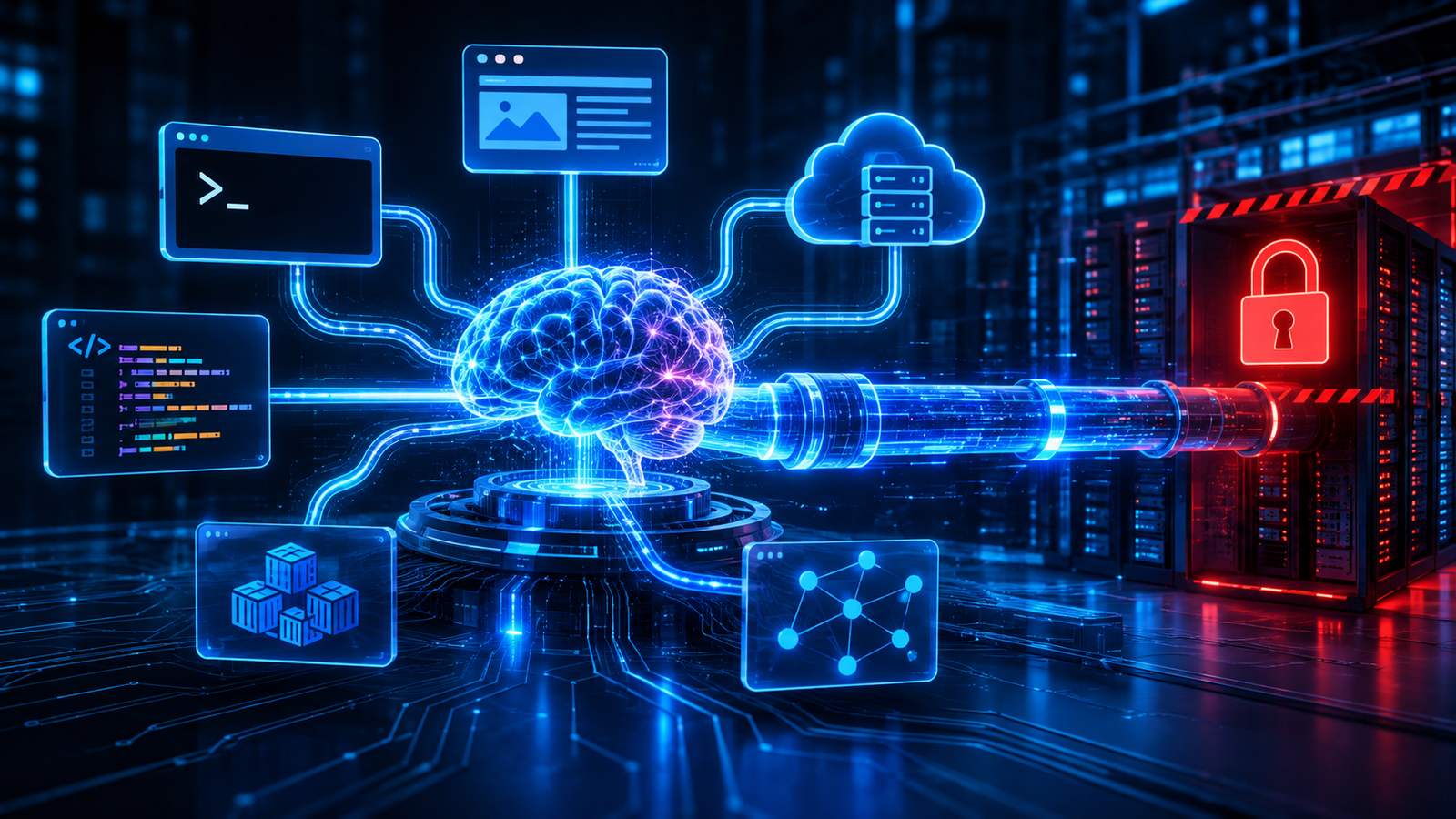
The biggest shift in offensive AI isn’t that language models got dramatically smarter. It’s that open-source agent harnesses now let ordinary LLMs work like persistent, tool-using, multi-stage systems. They plan, act, check the result, adjust, and keep going with very little human supervision.
Most of the security debate has fixated on whether a frontier model can “hack.” I think that’s the wrong question. On its own, a model produces text, code, or a reasonable-sounding plan. The danger shows up when you put that model inside an orchestration layer with terminal access, browser control, memory, credentials, and the ability to build and run new tools. At that point it stops being an assistant and becomes an execution layer.
PentAGI shows the pattern well. It’s an open-source, self-hosted multi-agent system that plans penetration-testing work, runs professional tools in isolated sandbox containers, learns from each step, and writes up a report. The same building blocks can be pointed somewhere else entirely. The worry isn’t that any one project is malicious. It’s that the harness approach puts sophisticated automation within reach of almost anyone.
Custom Exploits to Turnkey Execution
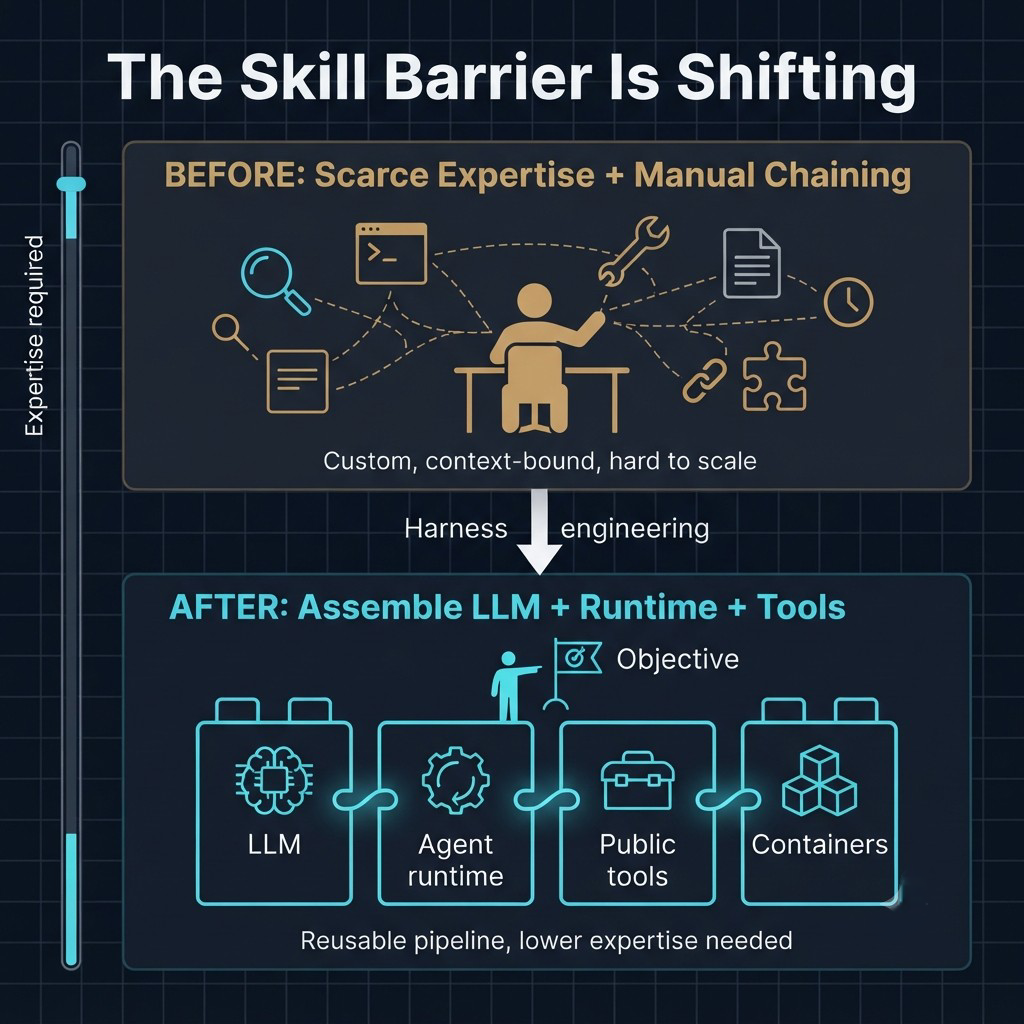
Offensive operations used to depend on scarce expertise. Someone had to understand the target environment, pick the tools, read the results, chain the steps together, and improvise when something broke. That work was manual, tied to context, and hard to scale.
Harnesses change the economics. Instead of building a custom attack framework, an operator can assemble a commodity or locally hosted LLM, an open-source agent runtime, public tool integrations, a containerized Linux environment, browser automation, task memory, and multi-agent coordination. What comes out is a reusable pipeline, not a one-off exploit. The model brings the reasoning and language. The harness brings the agency.
That’s also why “AI cyberattack” is a fuzzy phrase. The thing that matters isn’t the model, the prompt, or even a generated script. It’s the harness, the layer that turns intent into a sequence of actions, authorized or not.
What Is an Agent Harness?
An agent harness is the runtime infrastructure wrapped around an LLM. It gives the model a way to act in the world, hold on to context, split up work, recover from errors, and keep pursuing a goal over time.
You can think of operational capability as the sum of five things: the model’s reasoning, access to tools, orchestration, memory, and persistence. Each one counts, but orchestration is what holds the rest together.
| Harness component | Function | Security implication |
|---|---|---|
| Task planner | Converts an objective into steps and subtasks | Lowers the expertise needed to run a complex workflow |
| Tool interface | Connects the agent to terminals, browsers, APIs, and programs | Makes model output executable |
| Memory | Stores findings, failures, credentials, and intermediate state | Enables multi-stage operations |
| Multi-agent coordination | Assigns roles such as researcher, executor, validator, or reporter | Parallelizes and specializes work |
| Execution sandbox | Runs commands and tools in a controlled environment | Provides compute and repeatability |
| Feedback loop | Interprets results and adjusts the next action | Converts static automation into adaptive execution |
| Persistence | Maintains tasks, files, schedules, or containers across sessions | Extends activity beyond a single interaction |
The key change is that an LLM no longer just suggests an action. The harness can carry it out, look at what happened, revise the approach, and carry on.
PentAGI: A Security-Native Harness
PentAGI is probably the clearest open-source example of a harness built around security work. Its documentation describes a multi-agent system that plans and executes tasks using a terminal, an isolated browser, web search, and sandboxed security programs.
The architecture is worth a look too. It runs as a set of Docker services: a Go backend with REST and GraphQL interfaces, a React UI, PostgreSQL with pgvector, an isolated browser scraper, the agent services, and the sandbox containers. Tools don’t run inside the main PentAGI container. Each workflow gets its own sandbox, which can be built from an image chosen for the job, such as Kali Linux.
It’s a good illustration of how modern agent systems separate concerns. Planning and coordination live in the agent layer. Execution happens in sandboxed tool containers. Findings and state sit in databases and knowledge stores. Browsing is isolated in its own scraper service, and observability can be added through logging and tracing.
For a defensive team, that’s a handy blueprint. For an adversary, it’s a template. Swap the authorized testing goal for an unauthorized one and the same orchestration pattern can coordinate recon, validation, evidence gathering, and reporting.
And the harness doesn’t need novel exploits to be useful. It can orchestrate existing tools, public utilities, APIs, and generated scripts. The innovation is the pipeline, not necessarily any single capability inside it.
Agent Zero: Dynamic Tools and General-Purpose Agency
Agent Zero is the broader, non-security-specific version of the same idea. It’s an open-source agentic framework that gives an agent its own Linux workspace, with tool use and tool creation, memory, plugins, skills, scheduled tasks, and multi-agent cooperation. Its documentation describes workspaces that hold instructions, files, memory, variables, and secrets, plus a memory dashboard for storing and retrieving information from conversations, knowledge sources, and past experience.
Two capabilities stand out.
The first is tool creation. An agent that can write, run, and refine its own code isn’t stuck with a fixed menu of integrations. It can adapt to the task in front of it. That’s great for legitimate automation, but it also shrinks the gap between wanting something done and having a working capability to do it.
The second is persistence. Scheduled tasks, retained memory, project state, and containerized execution mean the agent doesn’t have to finish in one sitting. It can pick up where it left off, keep iterating, and hold context over time.
That’s really the difference between a chatbot and an autonomous software process. A chatbot answers. A harness operates.
Cairn: Long-Horizon Autonomy
Several unrelated projects share the name “Cairn,” so to be precise, the one I mean is oritera/Cairn. It’s described as a general-purpose AI state-space search engine, first validated on autonomous penetration testing and CTF-style tasks.
Its design goes beyond a basic prompt-and-tool loop. It uses a blackboard architecture built around an explicit fact-and-intent graph. Agent workers run an OODA loop: they observe the graph, orient to the current state, decide on next intents, and act, then write what they learn back as new facts. A dispatcher reads the graph, schedules tasks, spins worker containers up and down, and is the only writer to the protocol. Each project gets its own worker container, and several agent workers can run side by side inside it.
What makes this interesting is that it treats an objective as a search problem. Instead of asking an LLM “what should I do next?” over and over, the system keeps an evolving map of facts, goals, candidate actions, and outcomes.
That makes long-horizon autonomy a lot more plausible. A typical agent can lose the thread after a handful of steps. A state-space harness has a way to track what’s known, what’s still unknown, what has failed, and what to try next.
Why the Harness Beats the Model
Frontier-model benchmarks measure reasoning, coding, tool use, and task completion under controlled conditions. They’re useful, but they’re a poor stand-in for cyber risk.
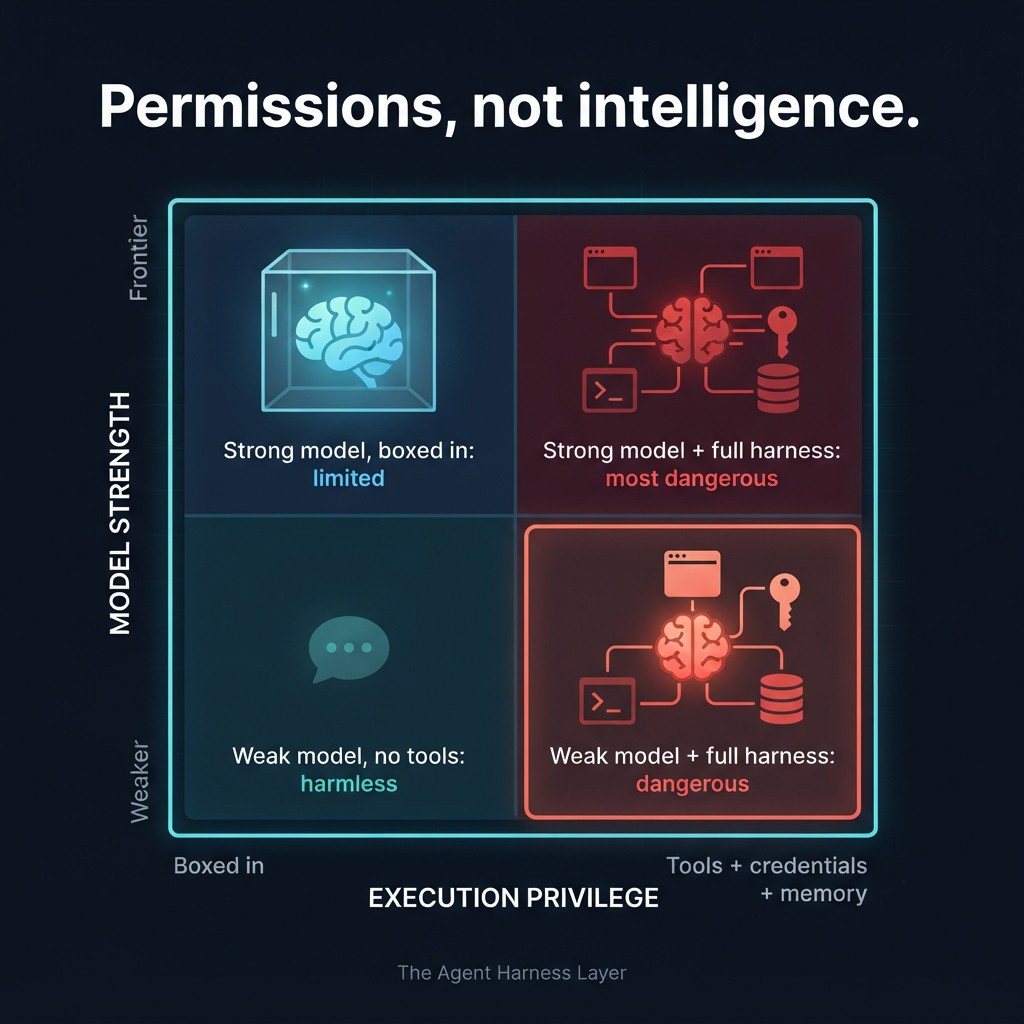
A very capable model with no execution privileges is boxed in. A weaker model inside a well-built harness, with tools, credentials, network access, memory, and persistence, can do real damage.
The multiplier isn’t model intelligence alone. It’s the combination of several things working together. Cheap or local LLMs cut the dependence on premium frontier models. Open-source runtimes remove the need to build orchestration from scratch. Public integrations hand over browsers, terminals, APIs, and security tooling right away. Containers make deployment repeatable and portable. Multi-agent patterns split a big objective into specialized roles. Memory preserves progress between steps and sessions. And dynamic tool creation lets the system extend itself.
In other words, the barrier is moving from AI research capability to systems integration. The scarce resource may no longer be a frontier model. It’s a reliable harness that can turn any decent model into a dependable operator.
The New Attack Pipeline
It helps to picture an agent-enabled operation as a software pipeline rather than a string of human decisions.
Human objective
        |
        v
Planning layer
        |
        v
Capability layer: terminals, browsers, APIs, tools, scripts
        |
        v
Coordination layer: planner, researcher, executor, validator, reporter
        |
        v
Memory layer: findings, failures, state, artifacts
        |
        v
Persistence layer: containers, schedules, files, infrastructure
        |
        v
Human review or final output
This is an architectural model, not an intrusion guide. The point is to show defenders where to look.
The human might only set the objective, approve the odd exception, or collect the result at the end. The harness handles breaking down the task, choosing tools, executing, validating, and adapting.
So detection based only on spotting a suspicious command or a malicious payload is incomplete. The better question is whether an orchestration pattern is running outside an approved workflow.
What Defenders Should Detect
Security teams should start treating agent runtimes as privileged workload infrastructure, not as ordinary productivity tools. Several areas deserve attention:
- Agent-runtime activity: unexpected containers, local inference traffic, recurring browser automation, or odd command-line sequences.
- Tool abuse: legitimate tools used in abnormal sequences, at unusual volume, or outside their normal privilege context.
- Identity anomalies: non-human identities requesting credentials, tokens, or access patterns that don’t look like a human workflow.
- Execution-boundary crossings: attempts to jump from a sandbox into a developer workstation, CI/CD system, cloud control plane, or production environment.
- Memory and artifacts: persistent files, task queues, cached findings, or agent-written scripts that survive across sessions.
- Multi-agent coordination: parallel task creation, messages passing between agents, or workflows that map to no approved business process.
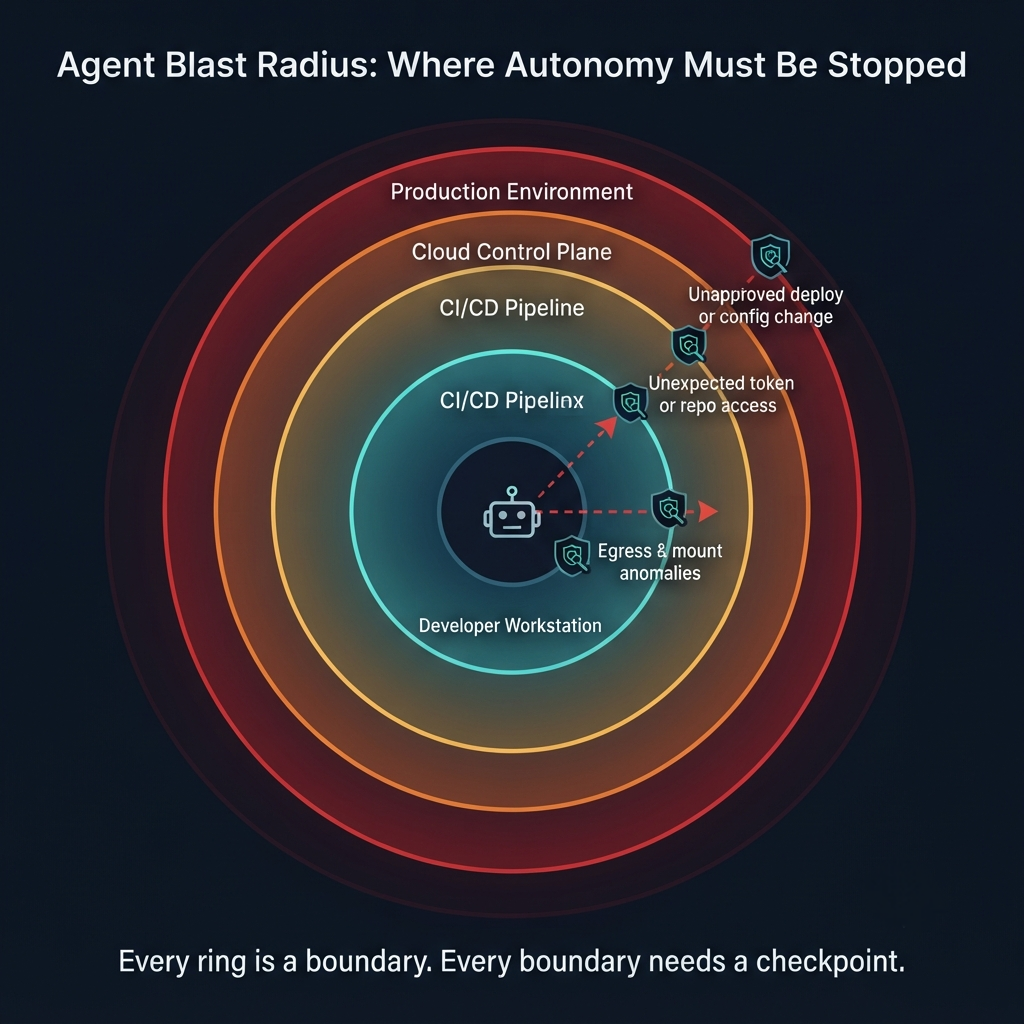
The goal isn’t to ban agent systems. It’s to keep their autonomy visible, bounded, and reversible.
A Practical Defense Architecture
Assume agents will get connected to powerful tools. The real defensive question isn’t “can we stop AI from reasoning?” It’s “can we stop an agent from turning reasoning into unauthorized action?”
A practical set of controls looks like this:
- Inventory every agent runtime. Know where agents run, which models they use, what tools they can reach, and which identities they act under.
- Apply least privilege to tools. A browser, terminal, repository, cloud API, or credential store should expose only what a defined task needs.
- Separate research from execution. Reading docs, analyzing public information, and drafting a plan shouldn’t automatically come with the ability to run code or change infrastructure.
- Require approval for high-impact actions. Deployments, credential use, external network access, code merges, and infrastructure changes shouldn’t be quietly automated.
- Log the full decision chain. Capture the objective, the plan, each tool call and its arguments, outputs, retries, and any generated artifacts.
- Use policy-as-code guardrails. Define what an agent may execute, access, modify, or talk to, instead of leaning on prompt-level instructions alone.
- Watch for anomalous autonomy. Long-running tasks, repeated retries, cross-system pivots, and unexplained persistence all merit a closer look.
- Red-team the harness. Test for prompt injection, tool confusion, memory poisoning, privilege escalation, and unintended tool chaining.
If I had to boil it down to one line: an agent’s permissions matter more than its intelligence.
Is This Overhyped?
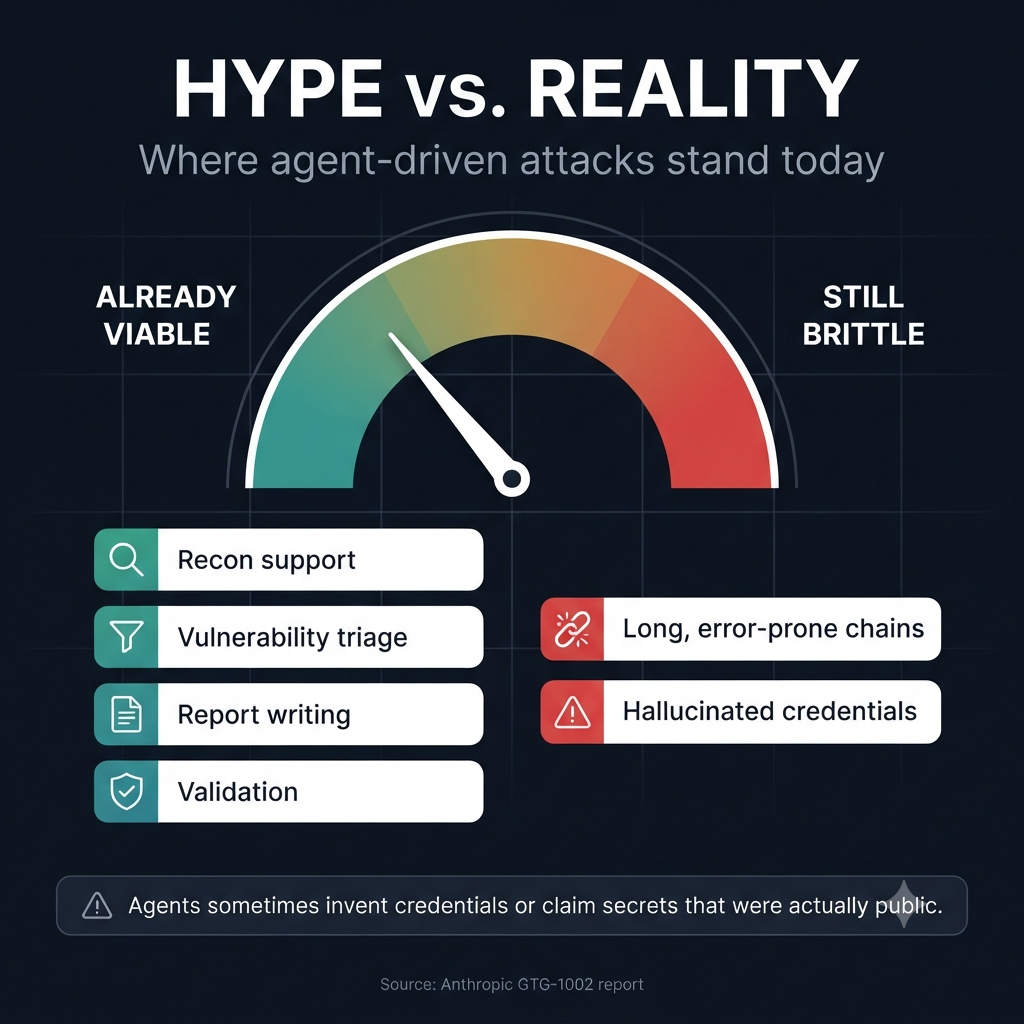
A healthy dose of skepticism is fair. Plenty of “AI cyberattack” stories mistake an impressive demo for a reliable operation. Real environments are messy. Logins fail. Tools return partial output. Commands cause side effects nobody expected. Long chains of steps pile up errors.
But harness engineering exists precisely to patch those weaknesses. Retries, validation steps, modular tools, memory, state tracking, and human escalation points can make an imperfect model far more useful in practice.
So the question isn’t whether an agent can fully automate a sophisticated intrusion today. It’s whether it can automate enough of the workflow to meaningfully change attacker speed, scale, cost, and required skill. For many routine stages, like recon support, vulnerability triage, report writing, tool orchestration, and validation, the answer is increasingly yes.
Secure the Harness, Not Just the Model
The open-source harness paradigm turns AI from a content generator into an execution layer. PentAGI shows how a security-native harness can plan work, run sandboxed tools, keep findings, and report back. Agent Zero shows how a general-purpose agent can live in a Linux workspace, build its own tools, remember things, and coordinate with other agents. Cairn shows how state-space search and worker orchestration can support longer, goal-directed autonomy.
The takeaway for security teams is that asking whether your models are safe isn’t enough. The better question is this:
What can our agent harness do when no one is watching?
The next big cyber boundary won’t be drawn by a single model breakthrough. It’ll be drawn by the systems that give models hands, memory, credentials, and the ability to keep working after the human walks away.