

The next underground economy might not revolve around stolen databases, malware kits, or ransomware access. It might revolve around something quieter: the ability to run commercial AI models on someone else’s dime.
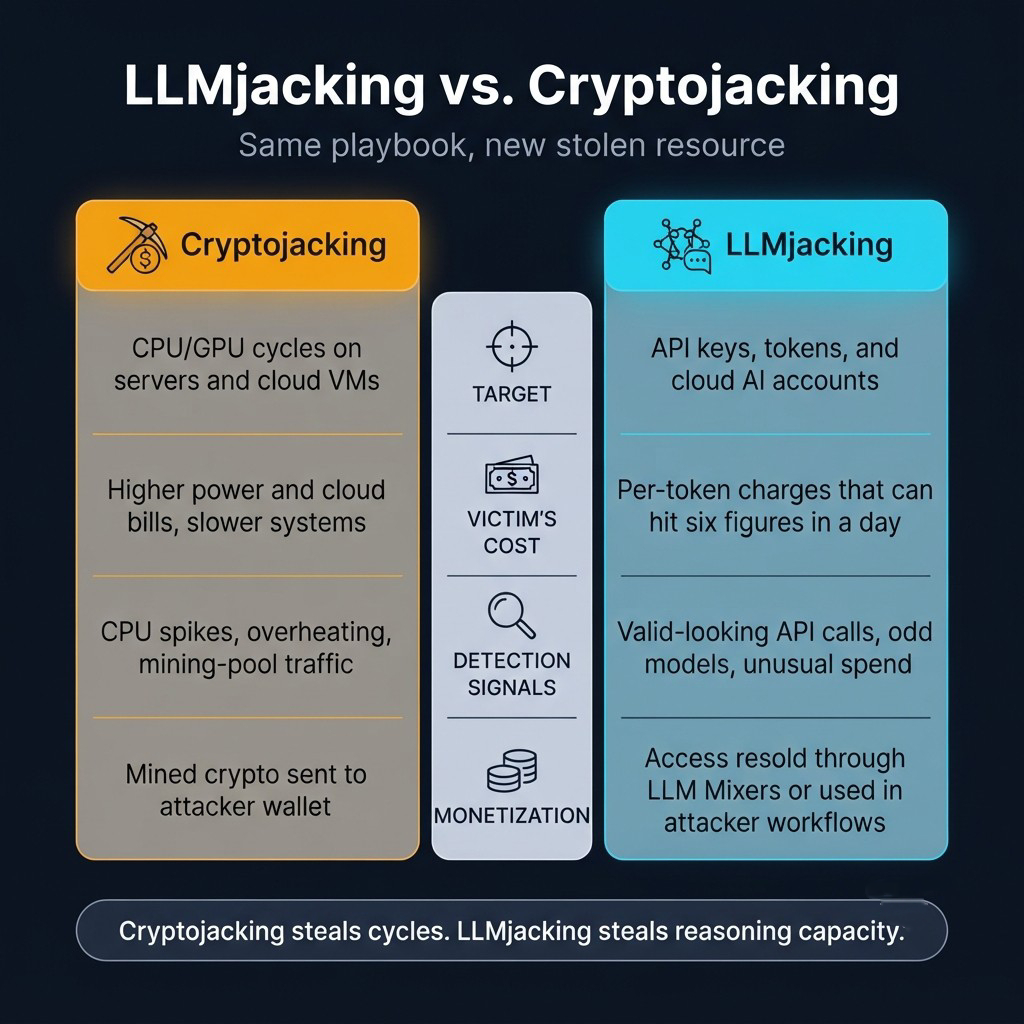
Security researchers call this LLMjacking: stealing or misusing AI credentials, API keys, and access tokens to burn through a victim’s AI resources. The money is made by a new kind of illicit infrastructure called the LLM Mixer, an underground gateway that pools stolen credentials, meters usage, hides where traffic comes from, and resells access to commercial models.
What’s emerging is a compute black market. Criminals get enterprise AI access at almost no cost, turn it into sellable inventory, and offer it cheaply to people building automated, multi-step attack workflows.
The new commodity: AI compute
Companies spend a lot on frontier-model access for coding, customer support, research, analysis, and automation. When credentials leak or a cloud environment gets compromised, those same accounts become very attractive targets.
Google Threat Intelligence describes LLMjacking as the theft of AI-related credentials (usernames, passwords, API keys, access tokens) so that attackers can use a victim’s tokens and resources. An attacker doesn’t need to train a model, rent GPUs, or run an AI platform. They just need access to an account that already does.
And it’s worth stealing, because AI workloads get expensive fast. In one reported case, attackers made more than 500,000 model calls in under eight hours and left the victim with nearly $1 million in token costs. In another, a botnet used leaked credentials to fire off millions of LLM API calls in about 24 hours before the keys were revoked.
The victim pays the bill. The attacker gets the compute.
From stolen credentials to AI inventory
Criminal marketplaces have sold stolen logins, credit cards, cloud accounts, and remote-access credentials for years. What’s new is that AI access is becoming its own product category.
A compromised enterprise AI account isn’t just a door into a company’s systems anymore. It can also provide:
- Valid API keys for commercial models
- Cloud identities with permission to provision or use AI services
- Active sessions and access tokens
- Prepaid credits, subscription entitlements, or enterprise quotas
- Large context windows for long documents, codebases, and complex reasoning
Reporting on the underground market describes sellers listing validated cloud API credentials along with the available model, context-window size, and remaining budget. That makes AI access look like a metered commodity. Buyers can pick the capacity they need instead of grabbing a single static credential.
This is credential arbitrage. The attacker gets in through theft, phishing, infostealers, exposed secrets, or a compromised cloud account. The victim carries the real cost of inference. The middleman turns that imbalance into something he can sell.
What is an “LLM Mixer”?
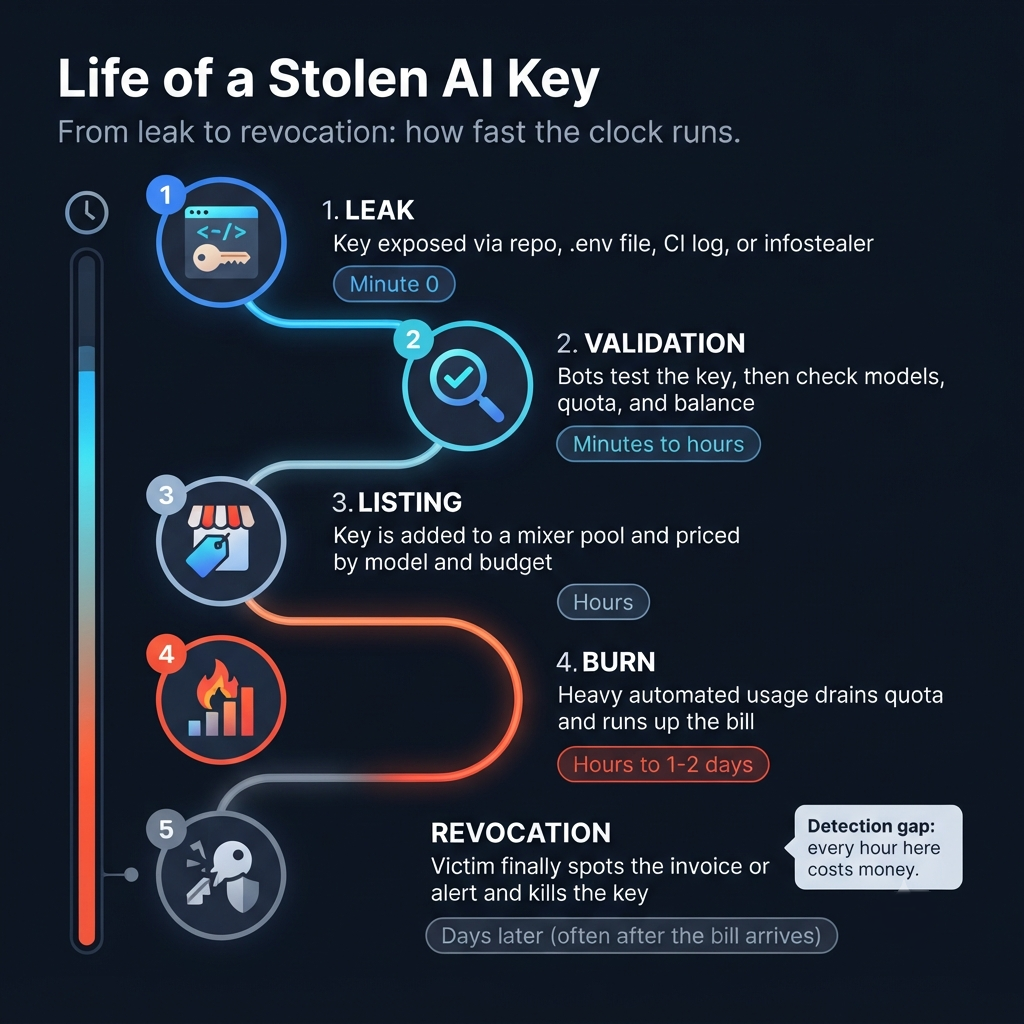
An LLM Mixer isn’t a model. It’s an unauthorized layer that sits between a buyer and commercial AI services.
Google Threat Intelligence describes mixers as illicit routing gateways that proxy, aggregate, and resell unauthorized model access. They spread requests across compromised credentials and compute, which gives buyers access and makes it less likely that any one victim account reveals the full scale of the abuse.
Here’s a simplified picture:
Criminal buyer
      |
      v
LLM Mixer storefront / proxy gateway
      |
      +--> Stolen enterprise API keys
      +--> Compromised cloud accounts
      +--> Hijacked sessions / access tokens
      |
      v
Commercial LLM endpoints
      |
      v
Multi-agent cybercrime workflow
A mixer typically handles a handful of jobs:
- Access aggregation: pulling together credentials from many compromised sources
- Request routing: sending buyer traffic through different accounts or infrastructure
- Usage metering: tracking how much each customer consumes
- Customer billing: reselling access at a discount to legitimate enterprise pricing
- Origin obfuscation: making it hard to tie requests to one buyer or one victim
- Quota management: rotating or reallocating access when a credential runs dry or gets revoked
For the buyer, it feels like any other online shop. Pay, get access, send prompts, receive output, and never think about where the credentials came from.
The economics of tokenized crime
The most interesting part of this story isn’t the technology. It’s the business model.
Underground services reportedly advertise access from as little as $0.10 per million tokens up to roughly $25 per million, depending on the model and the seller. That can make heavy AI use far cheaper for criminals than paying legitimate API rates.
It works because the attacker has pushed the cost onto someone else:
| Actor | Cost or benefit |
|---|---|
| Victim organization | Pays for tokens, compute, infrastructure, and potential incident response |
| Initial-access seller | Monetizes stolen credentials or compromised accounts |
| LLM Mixer operator | Pools access, routes requests, meters usage, and resells capacity |
| Criminal buyer | Obtains large-scale model access at a fraction of legitimate cost |
| AI provider | Faces abuse of its platform, potential reputational exposure, and enforcement costs |
One vendor reportedly raised its price fivefold once prompts passed 100,000 tokens. That tells you the market is already pricing the things that matter for complex workloads: longer context, stronger models, and more compute per request.
For a company, the risk is that one compromised key becomes someone else’s revenue stream. For a criminal operator, it removes one of the biggest obstacles to running AI-heavy operations at scale: cost.
Why agentic attacks need cheap compute
AI use in attacks has moved past one-off prompts. Agentic systems can chain together planning, research, tool use, code generation, validation, retries, and reporting. Those loops eat far more tokens than a single request does, which is why cheap, reliable inference matters so much to criminal operators.
At a high level, agentic workflows might be used for:
- Automated reconnaissance and target research
- Drafting and refining malicious code or exploit concepts
- Producing convincing phishing, fraud, and social-engineering content at scale
- Coordinating multiple agents that split up planning, execution, and review
- Cutting down on repetitive human decision-making
Google’s threat intelligence reporting points to a broader shift toward agentic threat activity, alongside the fast maturing of underground forums and marketplaces that supply hijacked LLM access. The link is simple. Autonomous operations need compute, and mixers are a cheap way to get it.
That doesn’t mean every AI-assisted attack is fully autonomous today. But the infrastructure is being built for that direction. Once inference is cheap and easy to get, the question stops being “can an operator afford to run this?” and becomes “can they design, orchestrate, and hide it at scale?”
Why detection is difficult
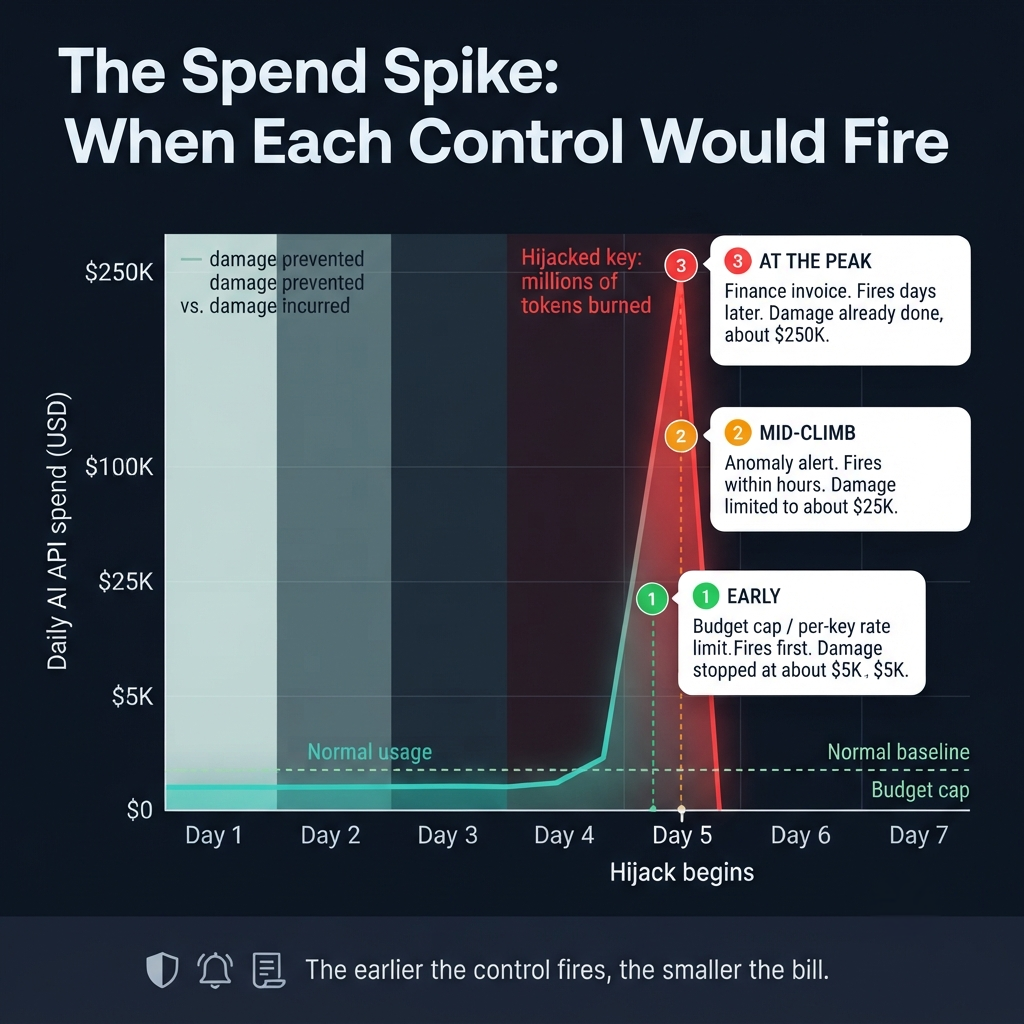
LLMjacking is hard to catch because it usually abuses legitimate access instead of obviously malicious infrastructure.
A stolen API key looks valid. The requests go to a real model endpoint. The traffic can pass for a developer experiment, a batch job, or an internal AI rollout. And if a mixer spreads activity across many victim accounts, no single account may show a clear anomaly.
The first warning may not come from a security tool at all. It may come from finance.
Organizations have reported surprise charges above $100,000 in a single day, and other incidents have produced bills approaching $1 million. By the time the invoice lands, the attacker may have used up plenty of quota, tested their workflows, and moved on to another compromised account.
That leaves a detection gap:
- Identity teams may spot odd credential use but not grasp why it matters for AI.
- Cloud teams may see rising spend and write it off as healthy AI adoption.
- Security teams may watch for malware and network indicators but not AI API consumption.
- Finance teams may flag the bill but have no idea it points to a credential compromise.
Closing the gap means treating AI access as production infrastructure, not as a side subscription.
The business risk goes beyond fraud
The financial hit is the obvious problem, but it isn’t the only one. A compromised AI account can lead to:
- Financial loss: usage-based charges can climb quickly before quotas or credentials are shut off.
- Operational disruption: stolen quotas may run out, hurting legitimate products, internal tools, or customer-facing AI features.
- Reputational damage: your infrastructure could end up as part of a criminal resale network.
- Data-governance uncertainty: if attackers used enterprise AI access, you need to know what data, prompts, files, or context were processed.
- Supply-chain exposure: shared cloud environments, partner integrations, and downstream services widen the blast radius.
- Regulatory and contractual exposure: mishandled credentials, uncontrolled data processing, or weak access controls can create compliance and vendor-risk trouble.
The takeaway is that an AI API key isn’t a harmless developer convenience. It’s a privileged credential that can unlock costly compute, sensitive workflows, and possibly broad access to enterprise systems.
Treat AI access like production infrastructure
Defenders should handle AI credentials with the same discipline they apply to cloud root accounts, payment systems, and privileged service identities.
Secure identity and access
- Use phishing-resistant MFA across cloud consoles, developer platforms, identity providers, and AI services.
- Apply least privilege to AI service accounts, and keep credential creation, billing administration, and model usage separate.
- Avoid long-lived API keys where you can. Rotate on a schedule and immediately after any suspected exposure.
- Limit who can create, view, copy, or export API keys.
- Keep a complete inventory of AI keys, service accounts, model endpoints, and third-party integrations.
Control spend and quotas
- Set spending caps, model-level quotas, and per-key rate limits.
- Separate production, development, testing, and third-party integration credentials.
- Apply tighter limits to high-cost models, long-context workloads, and external integrations.
- Require approval for unusually large token budgets or newly enabled AI services.
- Watch for sudden usage spikes, odd model choices, abnormal context sizes, and calls from unexpected regions or networks.
Monitor and respond
- Log AI API usage alongside identity, cloud, network, and billing telemetry.
- Alert on abnormal token consumption, request bursts, unfamiliar infrastructure, and credential use outside normal patterns.
- Treat unexpected AI invoices as possible security incidents, not just finance problems.
- Put AI credentials, model endpoints, and cloud AI services into your incident-response playbooks.
- Revoke suspect credentials fast, then review downstream access, data exposure, and billing impact.
Strengthen governance
- Give every AI integration an owner.
- Require security review for new AI vendors, plugins, agents, and external API access.
- Classify which data can be sent to each model or provider.
- Review partner and customer access as carefully as you would privileged cloud identities.
- Build an AI-specific risk register covering credentials, quotas, data flows, and abuse scenarios.
What comes next
The LLM Mixer economy will probably get more specialized. As defenders improve billing controls, identity monitoring, and API governance, underground operators may split the work into separate roles: acquisition, validation, routing, resale, and customer support.
That would mirror earlier cybercrime markets, where initial-access brokers sell entry, malware developers sell tooling, and affiliates run the operations. In an AI-era version, the thing being sold isn’t necessarily malware. It’s metered reasoning capacity.
For defenders, the implication is clear. AI access deserves the same seriousness as cloud infrastructure. A stolen API key is more than a secret. It can become someone else’s compute budget, fuel for automated abuse, and a costly reminder that the AI era has created a new class of crown-jewel credentials.
The most valuable stolen asset of the AI era may not be data. It may be the metered ability to generate more of it.