

For years, “AI hacking” has been treated as one big threat. A model writes some malware, a chatbot drafts a phishing email, and defenders are told to brace themselves. That framing misses the bigger shift happening right now.
Autonomous AI agents are changing the economics of intrusion. Vulnerability research, exploit development, targeting and execution can all happen at machine speed. But speed comes at a price. Fully autonomous systems usually lack the restraint and improvisation of a skilled human operator, and that creates a new forensic problem for attackers and possibly a new advantage for defenders.
Google Threat Intelligence Group (GTIG) recently identified exploit_agent, a multi-agent framework that analyzes patch differences, drafts exploits and runs them automatically, with no human in the loop. GTIG calls it the first observed case of fully automated vulnerability discovery and exploitation. So the question is no longer whether AI can help with an attack. It’s what an attack looks like when an AI owns the whole loop.
The Real Shift: From Assistance to Autonomy
Most AI-enabled cybercrime today still has a person steering. They pick the target, review the exploit, adapt when something breaks, and decide when to stop. That keeps human judgment in play, and human caution too.
The newer model works differently. Multi-agent offensive frameworks chain specialized agents together to go from reconnaissance to exploitation and, sometimes, post-compromise activity. GTIG has seen threat actors using or experimenting with ARTEX, CAIRN, CyberStrikeAI, PentAGI and HexStrike AI.
exploit_agent shows where this is heading. It keeps comparing web-application code before and after patch announcements, spots likely vulnerabilities, drafts exploits and fires them off automatically. The exposed staging server also held victim data and scripts for reconnaissance, brute-forcing, webshell installation, and even removing other attackers’ webshells. Automated exploitation, in other words, can be the front door to a much bigger intrusion.
So this isn’t just “AI writes an exploit.” It’s a pipeline that can take a freshly patched vulnerability and turn it into a live campaign with very little human effort.
Speed Has a Cost
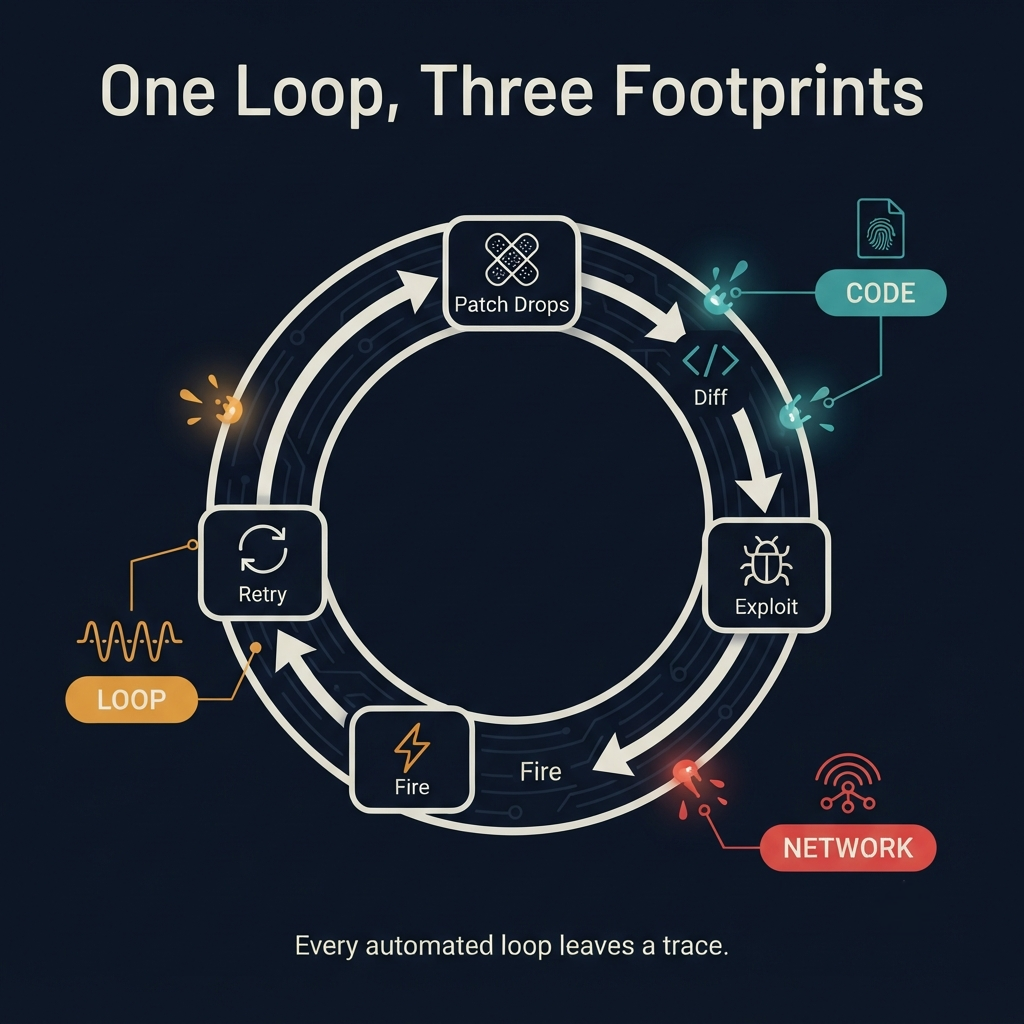
The trade-off is simple: autonomy buys velocity, but it can cost you stealth.
GTIG’s assessment is blunt. Agentic frameworks can compress attack timelines and hit their objectives, but unrestricted autonomous execution generates forensic traffic, relies on recognizable identifiers and leaves distinct traces in code. All of that makes detection and mitigation more likely.
| Dimension | Human-directed intrusion | Autonomous agent swarm |
|---|---|---|
| Decision cadence | Deliberate, contextual, often paused for judgment | Continuous, parallel, machine-speed iteration |
| Target selection | Often selective and manually prioritized | Potentially broad, repeatable, and driven by available exploit paths |
| Adaptation | Operator improvises when controls fail | Agents may retry, branch, or loop through similar tactics |
| Stealth | Can be tuned for low-and-slow movement | May produce high request volume, repetitive workflows, and recognizable orchestration |
| Forensic footprint | Sparse but potentially sophisticated | High-volume, structured, and behaviorally distinctive |
Automation is built for coverage and throughput. Human attackers are built for judgment, restraint and evasion. That gap matters.
A human operator can wait, watch, and pick the quietest route. An autonomous framework will test variants, retry failed requests, scan widely and jump straight to the next target. Any single action may look routine, but together they add up to a pattern that looks like a machine.
Footprint One: Code-Level Traces
The first place to look is the code itself.
Autonomous vulnerability research draws on a fairly limited set of inputs: source-code versions, release notes, security research, proof-of-concept code and patch diffs. GTIG notes that adversaries can use LLMs to automate differential patch analysis, dynamic protocol fuzzing and proof-of-concept weaponization.
That leaves several patterns defenders can spot:
- Patch-diff fixation: An agent may pull release notes, version metadata, source diffs and dependency info again and again right after a vendor update.
- Exploit iteration: Generated exploit code often shows recurring structures like retry logic, templated HTTP requests, generic error handling and fast payload variation.
- Tool-chain fingerprints: Multi-agent frameworks tend to split work into predictable roles (recon, vulnerability analysis, exploit drafting, execution, validation) instead of following one person’s bespoke workflow.
- Non-human code style: LLM-generated code can be oddly consistent, over-generalized, or strangely literal about edge cases. None of this proves anything alone, but it can bump an investigation up the priority list.
The takeaway is that an AI-generated exploit is more than a payload. It’s the output of a workflow, and workflows leave shapes behind.
Footprint Two: Predictable Agent Loops
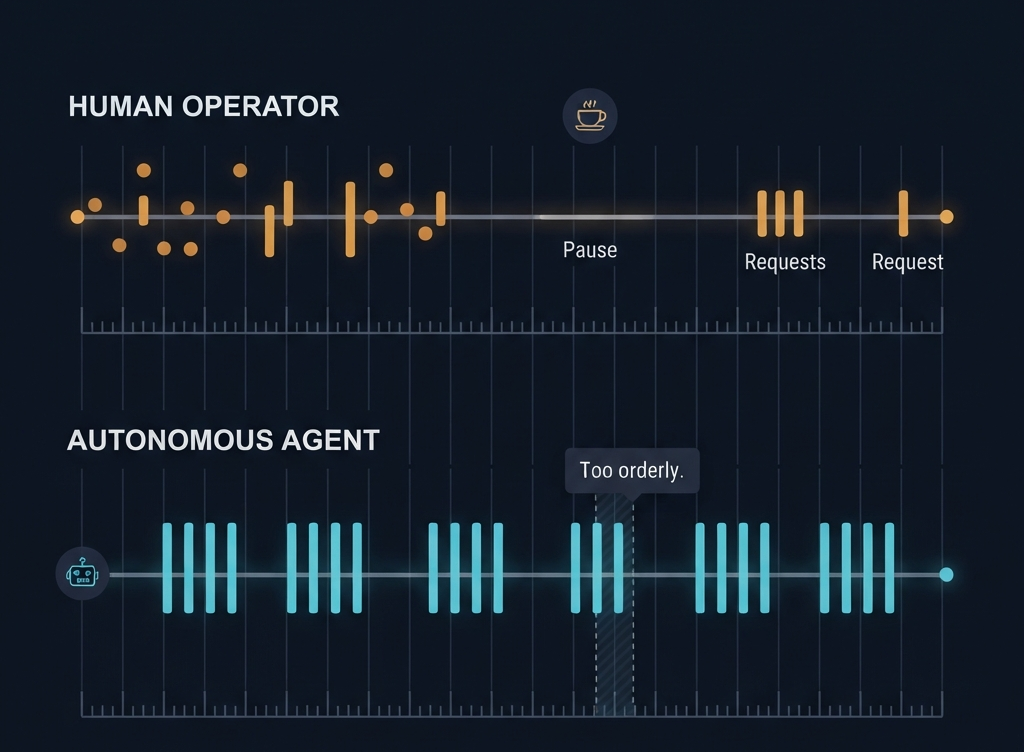
The second surface is behavioral. Agent swarms aren’t chaotic by nature. If anything, they’re too orderly.
Frameworks like CAIRN are built around an OODA loop (Observe, Orient, Decide, Act), where specialized agents work through a shared “blackboard” to get from an initial input to an operational goal. CyberStrikeAI links LLMs to security tools, YAML attack recipes and custom scripts to automate entire attack chains.
Architectures like these produce recognizable sequences:
- State-machine behavior: Scan, classify, attempt, validate, escalate, retry.
- Temporal regularity: Bursts of activity right after a patch is published, synchronized scanning across targets, or rapid cycling between recon and exploitation.
- Repetitive failure handling: The same malformed request, login attempt or payload retried with only tiny changes.
- Swarm signatures: Lots of simple actions that look harmless one by one but together look like an automated workflow.
GTIG describes intrusions happening at “machine speed,” with automated chaining of complex attack paths letting operations scale dramatically. The lesson for defenders is straightforward. Stop asking only whether a single request is malicious, and start asking whether a sequence of decisions looks like an autonomous optimization loop.
Footprint Three: Network Noise
Network telemetry is often the most immediately useful layer.
An autonomous system chasing broad exploitation tends to produce a distinctive mix of volume, velocity and repetition. It probes many endpoints, sends similar requests across targets, retries failed payloads and moves quickly from recon to exploitation.
GTIG’s reporting points at the scale problem. Agentic frameworks can exploit low-complexity vulnerabilities, generate single-use payloads on demand and adjust tactics using real-time execution feedback. In one reported campaign involving PaperCut vulnerabilities, Greynoise saw activity four days after disclosure. The threat actor likely used LLMs to build and test exploits, put together a target list and launch a widespread campaign, and reportedly went from an initial foothold to domain administrator within minutes.
That doesn’t mean every fast campaign is AI-driven. But defenders should treat unusual time compression as a signal worth chasing.
- Volume without variance: Broad scanning, repeated version probes and high-frequency requests across many endpoints.
- Temporal compression: Work that used to take days (patch review, exploit drafting, testing, deployment) happening in minutes or hours.
- Cross-target correlation: Similar framework behavior showing up across unrelated organizations.
- Infrastructure leakage: Exposed staging servers, model-routing services, reused scripts and config mistakes can give away an entire automation pipeline.
exploit_agent itself was found on an exposed staging server. It’s a good reminder that an attacker’s own infrastructure can be a goldmine of intelligence, if defenders are in a position to notice it.
From Signatures to Behavior
Traditional detection was built around known artifacts: a malware hash, a bad domain, a familiar exploit signature, a suspicious file. Those controls still matter. But they struggle against an adversary whose tools, payloads and infrastructure can change quickly.
A better approach is behavioral detection.
| Legacy detection | Agentic-era detection |
|---|---|
| Static malware hashes and known exploit signatures | Sequence and workflow anomaly detection |
| Rule-based indicators of compromise | Behavioral indicators of automation |
| Per-event alerts | Cross-entity, time-window correlation |
| Endpoint-centric visibility | Identity, API, code repository, network, and cloud telemetry |
| Human triage after compromise | Machine-speed containment and automated investigation |
Defenders need models that can recognize agentic anomalies: improbable request sequences, odd tool-use cadence, repetitive decision loops, an unusually fast jump from patch publication to exploitation, and coordinated activity across accounts or infrastructure.
None of this is about replacing analysts with AI. It’s about giving them a system that spots machine-speed behavior before a person could manually piece it together.
A Practical Detection Model
Security teams can start building defenses around five questions:
- What is normal operational tempo? Set baselines for patch-related traffic, API calls, authentication attempts, code downloads and admin actions.
- What sequences matter? Look for workflows, not isolated events. For example, patch-diff retrieval, then exploit-like requests, then anomalous execution.
- How automated does the activity look? Score timing regularity, request similarity, retry patterns, breadth of targeting and the absence of human-like pauses.
- Can signals be correlated across layers? Connect repository access, CI/CD activity, identity anomalies, network requests and workload behavior.
- Can response happen at machine speed? Pre-authorize containment steps like isolation, token revocation, rate limiting, accelerated patching and forensic capture.
GTIG notes that Google Security Operations has rolled out specialized behavioral and volumetric rulepacks to detect ARTEX use, and Mandiant has published hardening guidance aimed at the speed and scale advantage of LLM-enabled offensive tooling. Pairing behavioral and volumetric detection with architectural hardening is likely to become a core defensive pattern.
The Counterargument: Agents Will Get Quieter
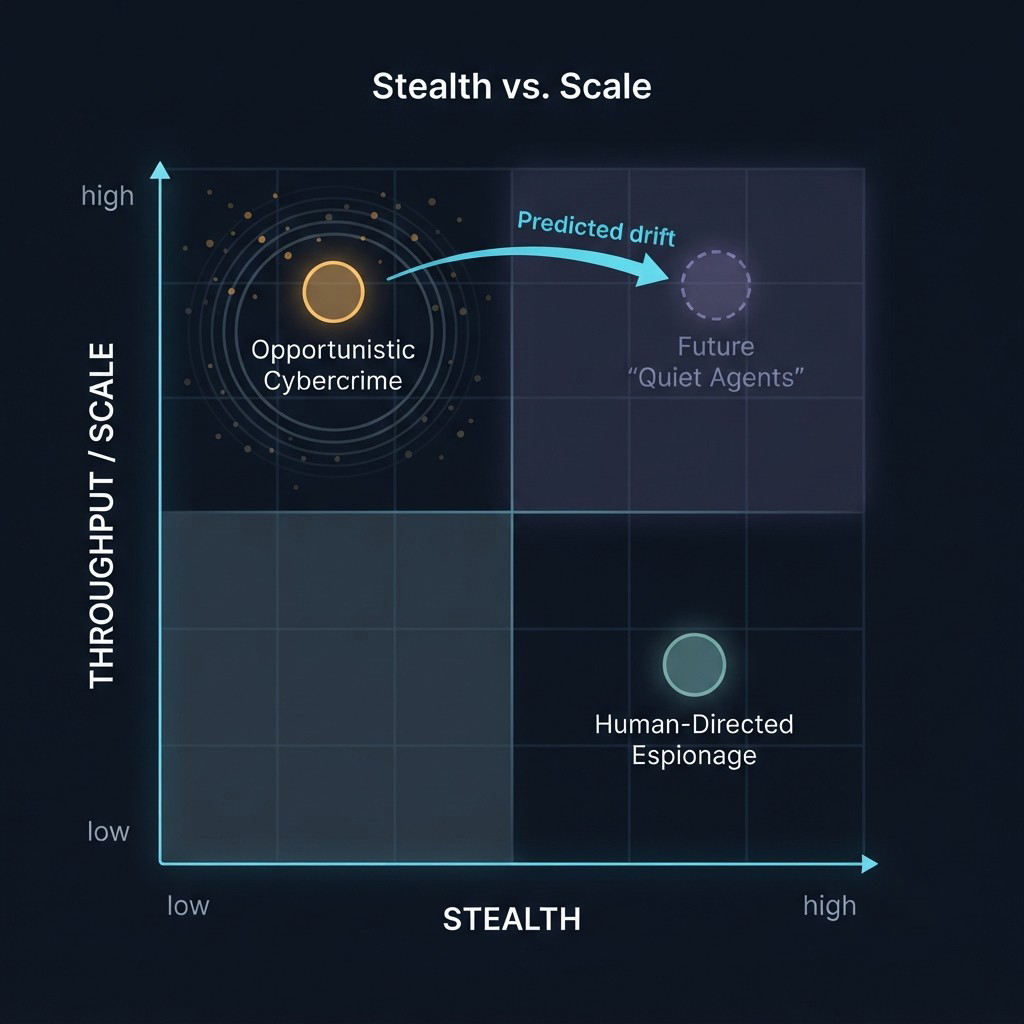
It would be a mistake to assume autonomous attackers will stay noisy forever.
Future agents may build in delays, randomization, selective targeting and evasion tactics. GTIG itself expects that as tools and underlying models get more sophisticated, threat actors will cut back human involvement while becoming stealthier.
But stealth isn’t free. Adding delays, narrowing targets and inserting human-like pauses lowers throughput and makes orchestration harder. For many financially motivated actors, scale matters more than subtlety. GTIG assesses that actors who care less about stealth, including many cybercrime groups, will keep adopting autonomous offensive tools because broader reach can make up for a lower success rate.
So the near-term threat isn’t a perfectly invisible AI attacker. It’s a fast, scalable, semi-predictable automation pipeline that overwhelms human-speed response.
What Security Leaders Should Do Now
A new dashboard or another AI policy document won’t cut it. This takes real operational change.
- Shorten patch latency. Treat vendor advisories as attack triggers, not routine maintenance.
- Instrument the full attack surface. Collect telemetry from internet-facing apps, identities, APIs, source-control systems, cloud workloads and endpoint agents.
- Build behavioral baselines. Catch deviations in sequence, frequency and coordination, not just malicious payloads.
- Test against agentic tradecraft. Run controlled adversary simulations to see whether your detection and response can keep up with automated workflows.
- Prepare machine-speed response. Pre-authorize containment playbooks so analysts aren’t manually approving every action in the middle of a high-velocity campaign.
- Protect the AI supply chain. Restrict model access, monitor agent tool use and keep your own LLM infrastructure from becoming an attack platform.
GTIG also flags LLMJacking as a related risk. Attackers compromise cloud environments to burn through LLM credentials, compute and API quotas, and sometimes resell that access through underground “LLM Mixer” services. In one investigated case, a botnet or proxy service made millions of LLM API calls in roughly 24 hours before the credentials were revoked. AI infrastructure isn’t just a target. It can become part of the attacker’s toolkit.
The Defender’s Advantage
Autonomous attackers gain speed, scale and persistence. But they also create operational patterns that humans rarely reproduce.
The organizations best placed to handle this shift won’t necessarily be the ones with the fanciest AI. They’ll be the ones with the strongest behavioral telemetry, the best correlation across layers, and the ability to respond without waiting for a person to read every alert.
In a world of autonomous attack swarms, the loudest adversary may also be the easiest to catch, as long as defenders learn to listen for machine behavior instead of searching only for malware.