

The next big shift in commerce probably won’t start with someone opening an app. It might start with a single instruction: “Reorder my household essentials under $100, favor sustainable options, and get it here before Friday.” An AI agent takes it from there. It reads the request, searches retailers, compares products, applies the constraints, builds a cart, and pays.
That’s agentic commerce: AI agents acting for consumers to find products, weigh alternatives, make decisions, and complete purchases within rules the consumer has already approved. For brands, the old goal of winning human attention is no longer enough. They now have to be visible, understandable, eligible, and preferred in the eyes of the AI systems that increasingly sit between them and the buyer.
Retail analytics were built around human journeys: impressions, clicks, sessions, product views, add-to-carts, checkouts. Those numbers still matter, but they no longer tell the whole story. When the shopper is a machine, brands need a different way of measuring, one designed to observe, simulate, and decode what happens when autonomous buyers meet commercial systems.
The Buyer Is Becoming an Agent
In ordinary ecommerce, a person browses, compares, reads reviews, and checks out. In agentic commerce, the consumer hands some or all of that work to an agent that operates within their preferences and limits.
The person still owns the outcome, but the machine does most of the legwork. It may:
- Turn a loose need into a structured shopping task.
- Search across catalogs, retailers, and product sources.
- Filter by price, availability, delivery timing, dietary needs, compatibility, or sustainability criteria.
- Compare alternatives and build a shortlist.
- Recommend or pick a product.
- Apply promotions, create a cart, and start a secure payment.
- Handle replenishment and recurring purchases over time.
That changes what the consumer does. Rather than walking through every step, they become the principal: they set the goals, the budget, the preferences, and the approval boundaries. The agent is the one actually doing the buying.
Why Traditional Metrics Break Down
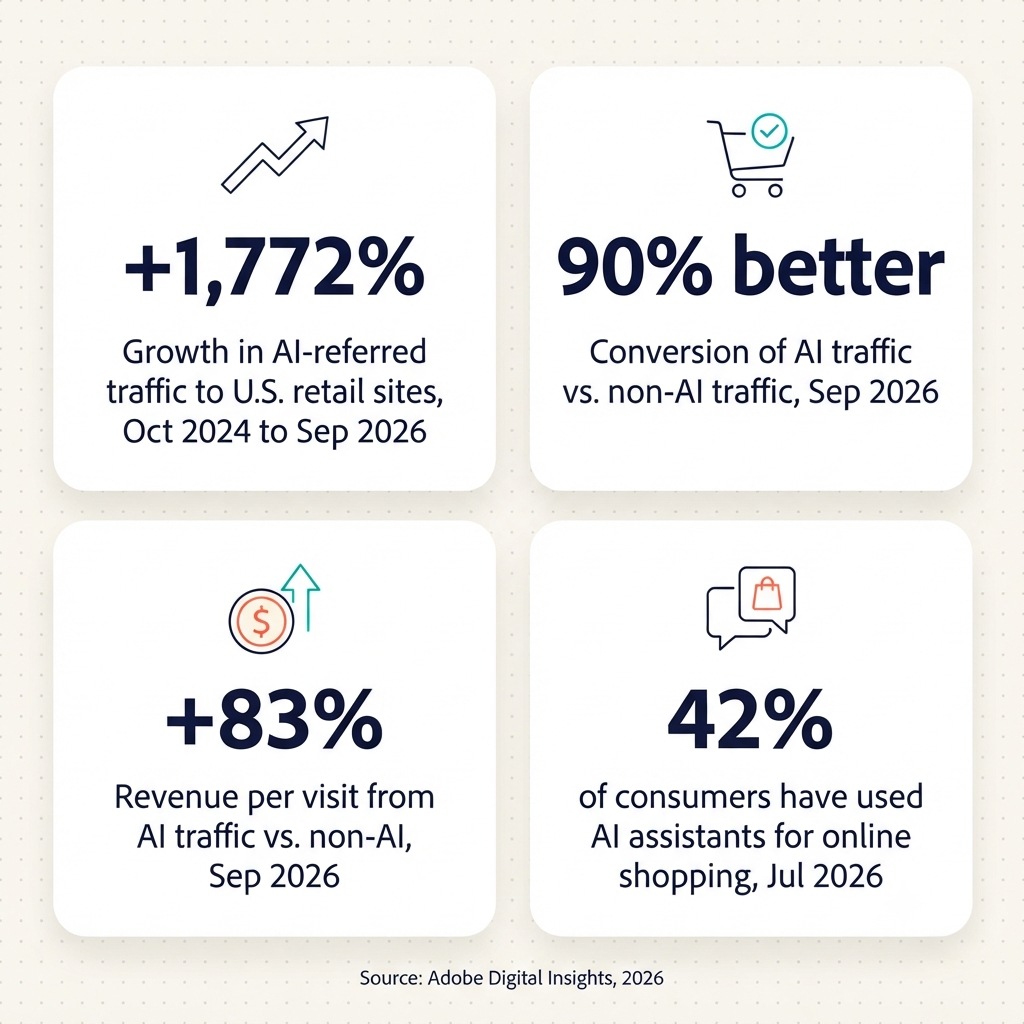
Most digital analytics quietly assume a human is present at every meaningful stage. Agentic commerce removes that assumption.
A shopper might never see a product page. They might never compare options themselves or add anything to a cart. A purchase can still happen.
That leaves some real blind spots.
| Legacy ecommerce signal | What it misses in agentic commerce |
|---|---|
| Page views and sessions | The agent may retrieve and evaluate products without generating a human session |
| Click-through rate | The agent may move directly from intent to consideration and purchase |
| Add-to-cart rate | The agent may create, modify, or abandon carts autonomously |
| Search ranking | A product may be visible in search but excluded from the agent’s consideration set |
| Conversion rate | Attribution may be split across the agent, marketplace, retailer, payment provider, and merchant |
| Promotion performance | An offer may be visible to humans but ineligible or unusable in an agent workflow |
| Customer journey data | The “journey” may be a sequence of machine queries, comparisons, and transaction instructions |
Sales don’t vanish, and that’s worth saying plainly. What changes is the evidence trail. A brand may still see the transaction itself, but it won’t see the reasoning, the alternatives, the constraints, or the machine decisions that produced it.
Enter Multi-Agent Prototypes
A multi-agent prototype is a controlled environment where specialized AI agents simulate, observe, and evaluate commercial interactions. Instead of treating AI as one opaque black box, it splits the work into roles.
A useful prototype includes:
- A shopper agent, which represents the consumer’s intent, preferences, budget, and constraints.
- A merchant or catalog agent, which represents products, specifications, inventory, pricing, offers, and fulfillment rules.
- A discovery agent, which pulls relevant products from the available sources.
- A comparison agent, which weighs alternatives against the shopper’s criteria.
- A recommendation agent, which selects or ranks the best-fit options.
- A transaction agent, which handles cart creation, eligibility, checkout, and fulfillment.
- A measurement agent, which records what was visible, considered, recommended, purchased, or rejected.
- A governance agent, which watches for problems with accuracy, privacy, bias, policy compliance, and brand safety.
This mirrors where AI-native measurement is already heading. NIQ’s Cadence, for instance, is described as a compound AI operating system that ties together data, models, knowledge, and specialized agents in a single environment. Its network has 19 agents working in coordination to turn raw signals into recommendations people can act on.
Consumer intent
        ↓
Personal shopper agent
        ↓
Discovery → comparison → recommendation → transaction
        ↓
Merchant / catalog / pricing / inventory agents
        ↓
Multi-agent measurement layer
        ↓
Brand performance, diagnosis, and optimization
The real payoff isn’t automation. It’s observability. A multi-agent setup can leave behind a structured record of how an autonomous shopper ran into a brand, which alternatives it looked at, whether the product fit the shopper’s constraints, and whether the interaction ended in a sale.
What Brands Need to Measure
An agentic-commerce dashboard won’t look like the ecommerce dashboards we’re used to. Brands will need metrics that show machine behavior, not just human behavior.
| Measurement area | What it reveals | Core question |
|---|---|---|
| Agent visibility | Whether a product enters the agent’s consideration set | “Did our product appear when the agent searched?” |
| Recommendation share | How often a visible product is selected, shortlisted, or recommended | “When we are considered, how often do we win?” |
| Content readiness | Whether product information is complete, structured, and machine-readable | “Can the agent accurately understand our product?” |
| Offer eligibility | Whether promotions, bundles, and loyalty benefits work in agent workflows | “Can the agent apply the intended offer?” |
| Cart completion and conversion | Whether agent-initiated intent becomes a verified purchase | “How many agent carts become orders?” |
| Data freshness | Whether price, stock, and product details are current across agent-facing channels | “Did the agent see accurate availability and pricing?” |
| Incrementality | Whether agent-driven demand creates new sales or shifts demand from another channel | “Did the agent generate incremental revenue?” |
These matter because agent-compatible commerce depends on pricing, offers, availability, and fulfillment being reachable programmatically, and in near real time. If a product is out of stock, wrongly specified, priced inconsistently, or can’t support an agent-mediated offer, it can lose the sale before a person ever lays eyes on it.
From Share of Search to Share of Agent Consideration
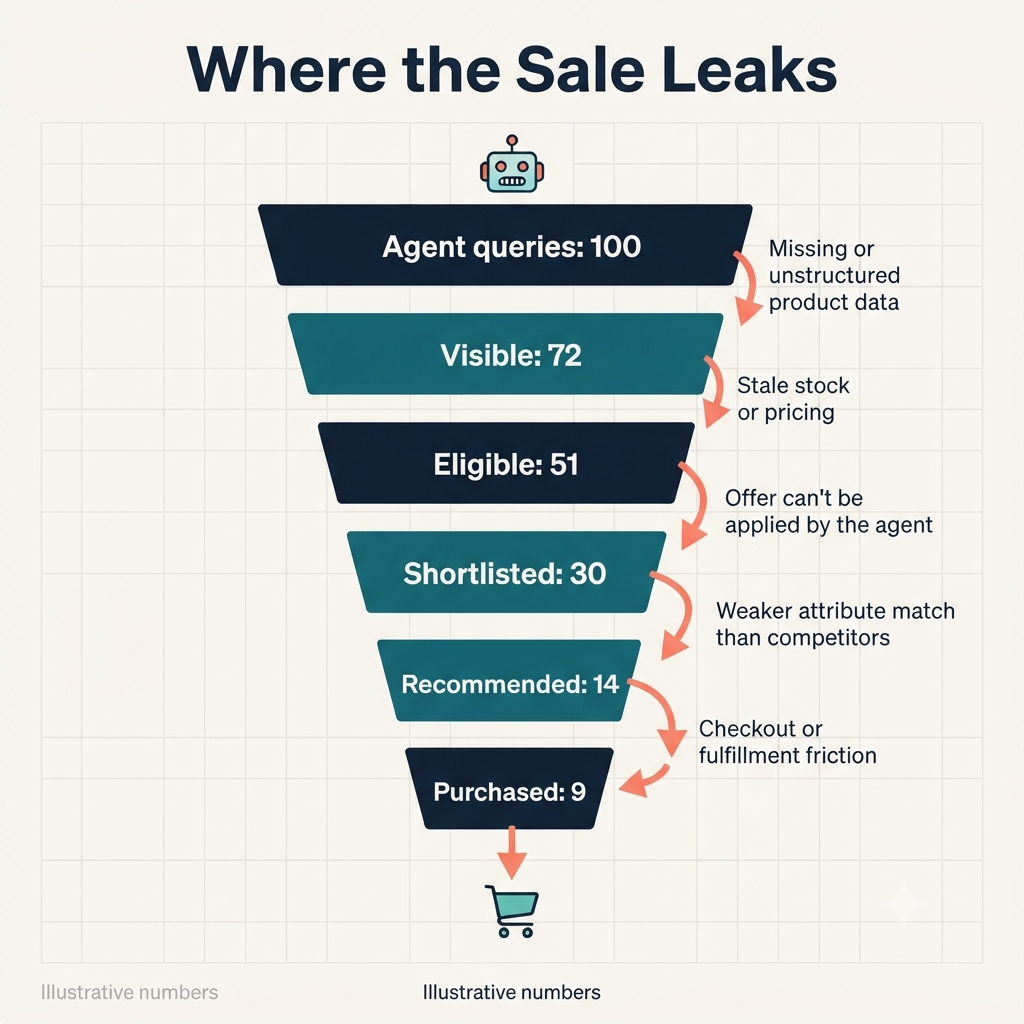
Brands have spent years competing for share of search, share of shelf, and share of voice. Agentic commerce opens a new front: share of agent consideration.
It’s the proportion of relevant agent journeys in which a brand gets retrieved, evaluated, shortlisted, or recommended. Sitting in a catalog isn’t enough. The product has to be discoverable, interpretable, trustworthy, and eligible inside the agent’s decision process.
Four new lenses will matter:
- Agent consideration share: How often the brand shows up in the set of products an agent evaluates.
- Agent recommendation win rate: How often the brand wins once it’s been considered.
- Machine-readable shelf presence: How completely and consistently product data appears across agent-accessible sources.
- Agent-mediated revenue: Revenue that can be credibly tied to agent discovery, recommendation, cart creation, or checkout.
Think of it as the machine version of shelf placement. A brand can have great packaging, strong advertising, and a big retail footprint, and still lose if an AI agent can’t find the product, read its attributes, compare it fairly, or finish the purchase without friction.
The New Competitive Advantage: Machine Trust
In agentic commerce, trust stops being a soft idea and becomes something operational.
A human shopper will often forgive a vague product description or a messy size chart. An AI agent won’t. It needs structured, reliable information to justify a recommendation.
Brands should start treating the following as commercial infrastructure:
- Accurate product titles, descriptions, specifications, and images.
- Standardized attributes for size, ingredients, compatibility, materials, certifications, and usage.
- Real-time inventory, pricing, delivery, and returns information.
- Clear promotion rules that agents can read and apply.
- Verified reviews, ratings, and trust signals.
- Accessible policies on returns, warranties, safety, and fulfillment.
- Consent, privacy, and governance controls for agent-mediated transactions.
The winners won’t necessarily be the brands with the most content. They’ll be the ones with the most decision-ready content, meaning information an AI agent can retrieve, interpret, compare, and act on with confidence.
How Brands Can Prepare Now
There’s no reason to wait for agentic commerce to go mainstream before getting ready. A good first step is making your commercial systems observable to both people and machines.
Build an agent-ready product foundation
Audit product data across every channel. Look for missing attributes, inconsistent naming, stale availability, vague specifications, and promotion rules a machine can’t interpret.
Instrument the agentic journey
Track AI-originated traffic, agent referrals, agent-created carts, verified orders, cancellations, substitutions, and returns. Tie those signals back to revenue, market share, repeat purchase, and customer acquisition.
Create a measurement sandbox
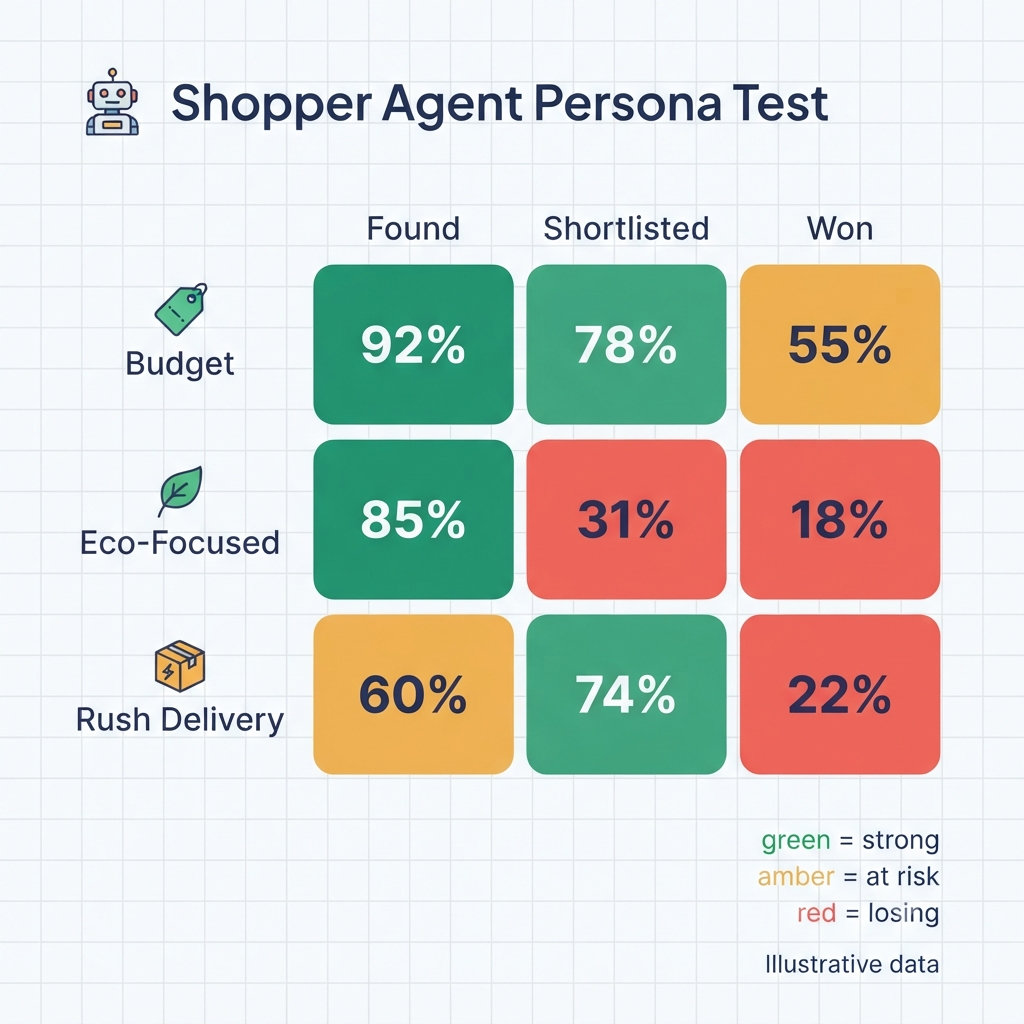
Run controlled shopper-agent simulations with different personas, prompts, budgets, constraints, and competitor sets. Then check whether your brand gets discovered, understood, shortlisted, recommended, and converted.
Connect exposure to outcomes
Don’t stop at visibility. Link agent exposure to commercial results. One product might be highly visible but rarely chosen, while another is less visible yet converts exceptionally well whenever it’s considered.
Test offers and fulfillment logic
Make sure discounts, bundles, loyalty benefits, delivery windows, and return policies actually work in agent-mediated flows. An offer an agent can’t apply might as well not exist in an agentic purchase.
Establish governance
Set rules for consent, data use, pricing integrity, brand safety, model transparency, and human approval on high-risk or high-value purchases. Merchants need to keep control over pricing, payments, and compliance even as agents take on more of the transaction.
The Strategic Shift for Brands
Agentic commerce makes data quality, product content, interoperability, and measurement into core growth capabilities. The brands that can answer these questions will have the edge:
- Are we in the agent’s consideration set?
- Can the agent understand what we sell?
- Does our offer work in an agent-led transaction?
- Are we winning recommendations against relevant alternatives?
- Are agent-driven sales incremental, or are they cannibalizing something else?
- Where are we losing before the human shopper ever gets involved?
NIQ’s approach to agentic commerce explicitly connects behavior across platforms, channels, and retailers to verified purchase outcomes, which reflects how much machine-mediated exposure needs to be tied to real commercial results. And nearly half of retail and CPG companies are already using or evaluating agentic AI, so this is turning into a practical operating issue rather than a distant concept.
The Dashboard for the Machine Buyer
The brands that win in agentic commerce won’t just optimize for clicks. They’ll build measurement systems that show how machines discover, evaluate, recommend, and buy on behalf of people.
Tomorrow’s dashboard won’t only ask:
“How many people visited our product page?”
It will ask:
“When an autonomous shopper agent searched for a product like ours, were we visible? Was our data understandable? Were we eligible for the shopper’s constraints? Did we make the shortlist? Did we win the recommendation? And did that recommendation create incremental value?”
That’s the new measurement challenge. Multi-agent prototypes give brands a way to take it on: instead of guessing what AI agents see, they can simulate, track, and decode the machine buyer’s journey from intent to transaction.