
These days, getting an answer out of an AI is the easy part. The hard part is trusting it enough to act on. Would you change your pricing, move media spend, rework an assortment, or launch a product on the strength of one chatbot’s reply?
That gap gets wider when the AI has to make sense of a messy commercial ecosystem: point-of-sale transactions, e-commerce activity, consumer panels, product attributes, promotions, economic signals. A single large language model can sound fluent and respond fast, but sounding right isn’t the same as being right. A better approach is multi-agent consensus. Instead of leaning on one model’s confident output, you build a pipeline where specialized agents extract, challenge, reconcile and synthesize evidence before anything reaches a decision-maker. NIQ’s Cadence is one example, running a coordinated network of 19 specialized agents across data ingestion, harmonization, measurement, insight generation and optimization.
The cost of a confident wrong answer
Picture a category manager asking an AI why a product category is shrinking. The system answers without hesitation: “Sales fell 8% because price increases reduced purchase frequency.”
It sounds reasonable, and it might even be partly true. But suppose the model missed a distribution change, misread the promotion calendar, mixed up product variants, or used a different category definition than the one your team uses. The recommendation that follows could cost real money.
In an enterprise, a hallucination is more than an embarrassing chatbot moment. It can turn into:
- A false product-code mapping that skews sales performance
- A market-share claim the data doesn’t support
- A promotion-ROI estimate that ignores timing, cannibalization or channel effects
- A forecast that mistakes a seasonal blip for a lasting trend
- A strategy no analyst can trace back to any evidence
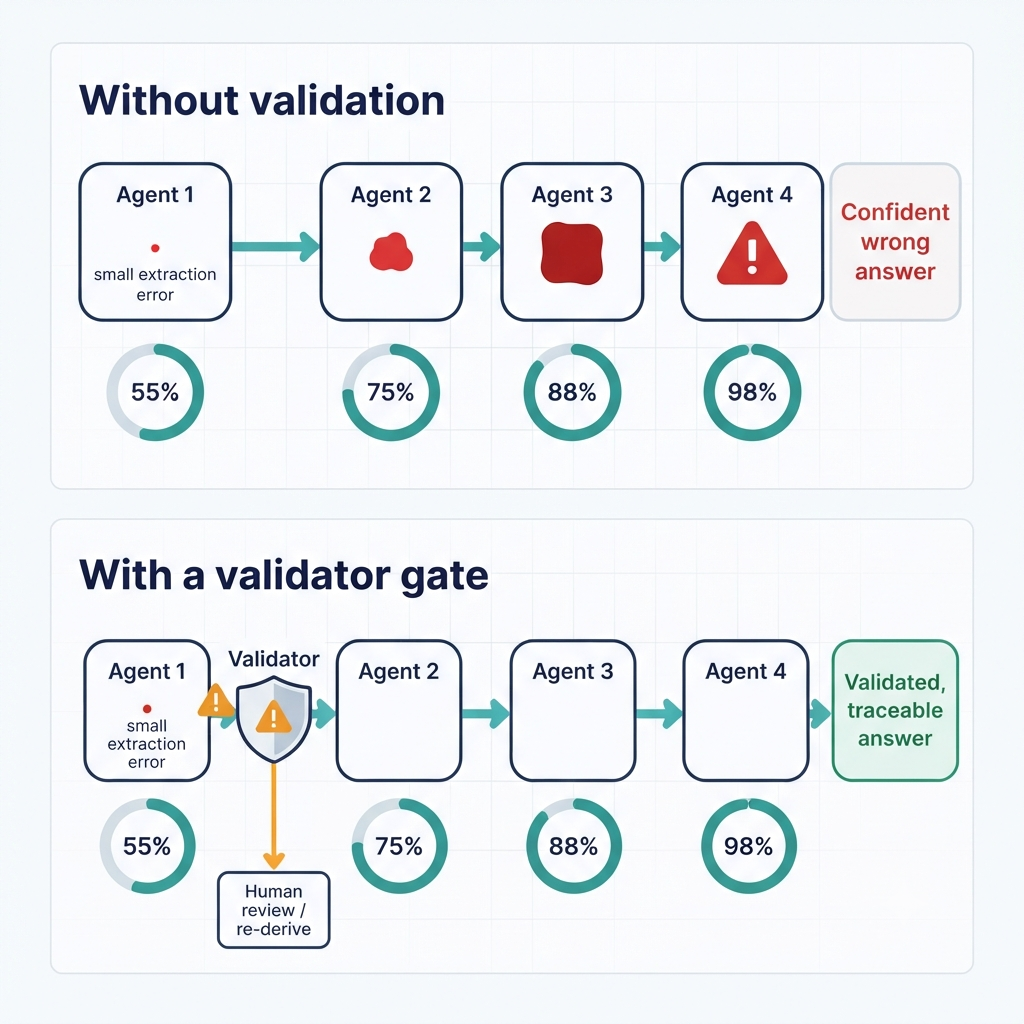
It gets worse when one AI’s output feeds another. A small extraction error gets repeated, reinterpreted and amplified until it looks like agreement. Researchers studying multi-agent systems call this a hallucination cascade: a bad claim from one agent spreads and grows as later agents build on it.
Why single-LLM analytics breaks at scale
Enterprise data isn’t just big. It’s fragmented, always changing, and inconsistent in what it means.
A modern consumer-insights platform may pull together POS transactions, e-commerce activity, consumer panels, product attributes and economic signals. Every source has its own identifiers, update schedule, definitions and quality problems. So the real work isn’t retrieving information. It’s translating all of it into one shared business language.
The data problem
Take a simple-sounding question: “Which brands are growing in the premium snack category?”
To answer it properly, the system has to decide:
- Which products belong in the category
- Whether “premium” means price, ingredients, brand positioning or how retailers merchandise it
- Which channels and markets count
- Whether to measure units, value or both
- How promotions, distribution changes and seasonality affect the numbers
- Whether the same product is identified consistently across retailers and time periods
A single LLM can spin a believable story, but it can’t guarantee that every assumption, calculation and entity mapping underneath it is correct.
Why reprompting is not enough
Asking a model to double-check itself can help a little. But it doesn’t produce an independent trail of evidence. Often the model just repeats its first line of reasoning with more confidence.
Reliable analytics needs explicit controls:
- Source lineage
- Schema and business-rule validation
- Independent calculation or re-derivation
- Uncertainty scoring
- Human review for high-impact decisions
- Audit logs showing how a conclusion was reached
This is where multi-agent setups earn their keep. They don’t replace good data. They make verification a built-in step of the analytical workflow.
From one oracle to a verification pipeline
In a multi-agent system, each AI component gets a bounded job. Every agent has a defined role, access to the tools or data it needs, and a structured output the next stage can check.
That’s quite different from putting several chatbots in a room to debate. The aim isn’t open-ended discussion. It’s a governed workflow where every material claim has to survive validation before it becomes a business recommendation.
| Stage | Agent role | Reliability function |
|---|---|---|
| Ingestion | Data-ingestion agent | Detects missing fields, schema breaks, duplicates, and source anomalies |
| Harmonization | Entity-resolution agent | Maps SKUs, retailers, channels, and time periods to a common model |
| Extraction | Insight-extraction agent | Identifies patterns and generates candidate claims with source references |
| Validation | Audit or challenger agent | Independently checks calculations, definitions, and evidence |
| Reconciliation | Consensus agent | Resolves disagreement, flags low-confidence output, or requests human review |
| Synthesis | Strategy agent | Converts validated findings into recommendations and next actions |
NIQ describes Cadence as a compound-AI operating system that orchestrates specialized agents across ingestion, harmonization, measurement, insights and optimization. The agent network is built to deliver personalized, decision-ready recommendations rather than a pile of unstructured text.
How consensus creates reliability
Peer verification, not blind agreement
In a well-designed system, one agent might extract a claim while a second checks it independently against source data and business rules. A third agent only synthesizes the claims that clear defined confidence and evidence thresholds.
Say an agent reports that a brand’s sales grew 12%. A validator should ask:
- Is the 12% based on the right time window?
- Are product and category definitions consistent?
- Did distribution, pricing, promotion or assortment change?
- Can the lift be separated from seasonality or overall category growth?
- Does the evidence support the stated cause, or only a correlation?
If the validator can’t back up the causal claim, the consensus layer should downgrade it, ask for more analysis, or hand it to a human analyst.
Consensus must require evidence alignment
Consensus shouldn’t mean majority vote among models. If several agents share the same blind spot, they’ll happily agree on the same wrong answer.
Research on multi-agent reliability warns that agents can reinforce each other’s mistakes and produce a false consensus when nothing external checks them. One study found that independent instances of the same model family landed on the same wrong answer far more often than you’d expect if their errors were truly independent.
So repeated sampling isn’t enough. Effective consensus needs independent evidence, varied validation methods, and clear rules for what happens when agents disagree.
Practical consensus mechanisms
Enterprises can use a handful of mechanisms to make multi-agent systems more dependable:
- Independent re-derivation: Several agents calculate the same metric from source data using different methods or data paths.
- Claim-to-evidence mapping: Every material claim links back to a dataset, query, time window and transformation.
- Business-rule gates: The system rejects impossible or inconsistent outputs, like negative prices, market shares above 100%, or mismatched category definitions.
- Confidence and uncertainty scoring: Low-confidence findings go to human review instead of being presented as settled.
- Disagreement as a signal: When agents diverge, that triggers a closer look rather than automatic averaging.
- External verification: Agents check claims against authoritative reference data, business rules or curated knowledge sources.
Research on collective hallucination suggests combining confidence-weighted aggregation, adaptive impact regulation, external claim verification and selective isolation of unreliable agents to keep errors from spreading.
A practical example: diagnosing a category decline
Here’s how a multi-agent workflow might handle a real commercial question.
Step 1: Ingest the evidence
The ingestion agent pulls POS data, e-commerce activity, consumer-panel data, promotions, pricing and product attributes. It flags missing periods, duplicate records and unexpected shifts in retailer coverage.
Step 2: Harmonize the data
The harmonization agent sorts out product variants, retailer naming differences, channel definitions and time-period alignment. It builds one common analytical model, so downstream agents don’t each interpret the raw sources their own way.
Step 3: Extract a candidate insight
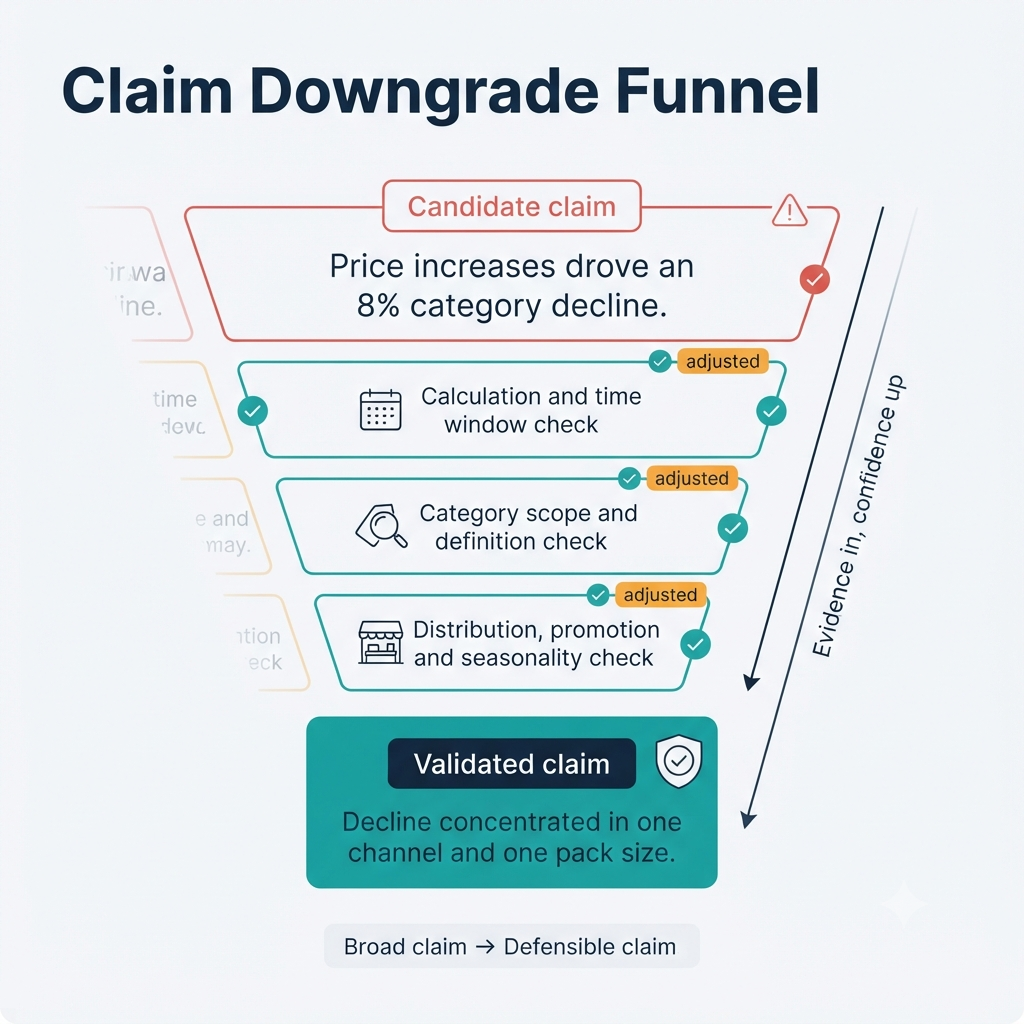
The extraction agent proposes: “Category volume declined 8% because price increases reduced purchase frequency.”
That’s a useful hypothesis. It isn’t a decision-ready conclusion yet.
Step 4: Validate the claim
The validation agent checks the calculation, category scope and time window, and looks at whether distribution or promotions changed. It finds that most of the decline sits in one channel and one pack size.
Step 5: Reconcile the finding
The consensus agent decides the original causal claim is too broad. It downgrades the conclusion and puts forward a narrower, better-supported explanation.
Step 6: Synthesize the recommendation
The synthesis agent turns that into something actionable: fix the price-pack architecture and channel-specific availability instead of launching a blanket price cut.
What you end up with isn’t just a faster answer. It’s a defensible one, with traceable assumptions, stated confidence and a clear path from evidence to action.
What enterprises need beyond agents
Multi-agent consensus can’t make up for weak data foundations. If the underlying data is incomplete, inconsistently coded or biased, the agents may simply disagree about the wrong facts.
NIQ stresses that AI needs clean, carefully coded, highly granular information to work properly, and says its AI is trained on verified household- and SKU-level purchase data rather than modeled or self-reported inputs. Its platform ties POS transactions, e-commerce activity, consumer panels, product attributes and economic signals into a single intelligence ecosystem.
Data governance remains essential
A reliable multi-agent system depends on:
- Data contracts that define fields, formats and quality thresholds
- Master data management for products, retailers, channels and categories
- Access controls and permissions
- Data lineage and versioning
- Audit logs for every material transformation and recommendation
- Clear escalation paths for uncertain or high-impact findings
Human-in-the-loop is a feature
Not every decision should be automated. Agents are at their best when they prepare evidence, spot anomalies and surface disagreement. People are still needed for context, judgment, accountability and any decision with serious commercial or ethical consequences.
A mature operating model separates three modes:
- Automate: Routine anomaly detection, data reconciliation and report prep
- Assist: Insight generation, scenario modeling and recommendation drafting
- Approve: Pricing, investment, market entry and other high-stakes calls
Measure reliability like a product
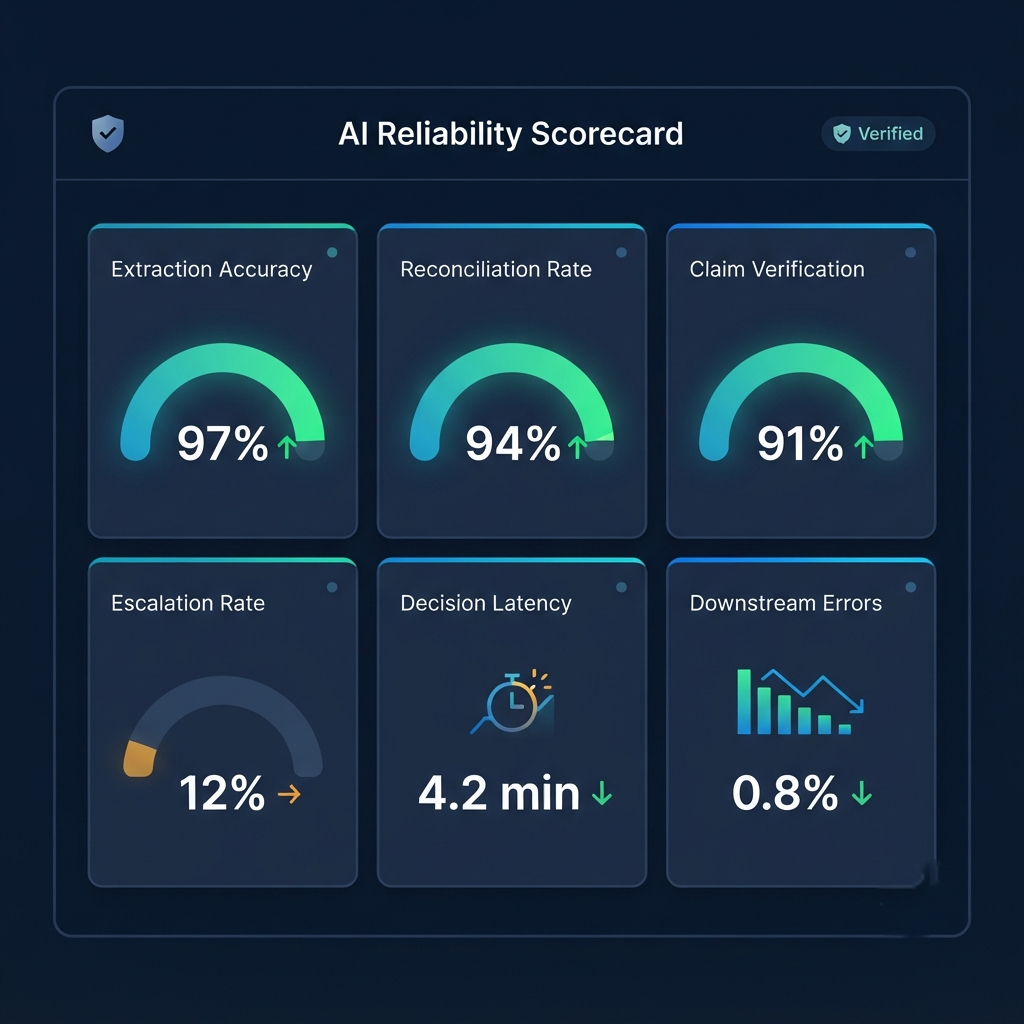
If reliability is the goal, measure it. Don’t just assume it.
| Metric | What it measures |
|---|---|
| Extraction accuracy | Share of extracted fields that match a validated source of truth |
| Reconciliation rate | Share of records successfully mapped across systems |
| Claim verification rate | Share of material claims supported by traceable evidence |
| Escalation rate | Share of outputs routed to human review |
| Decision latency | Time from question to validated, decision-ready insight |
| Downstream error rate | Errors discovered after an insight is used in planning or execution |
Tracking these turns “AI reliability” from a vague hope into an everyday discipline.
The strategic payoff
Multi-agent consensus shifts analytics from a system that produces answers to one that produces, verifies, reconciles and decides.
The payoff isn’t speed at any price. It’s faster decisions without giving up trust. NIQ positions Cadence as a way to get teams from analysis to action sooner, with agents that surface next-best moves, model budget scenarios, forecast outcomes and speed up workflows.
The bigger lesson is a simple one. Enterprise AI maturity won’t be judged by how many models a company has deployed. It’ll be judged by how reliably that company can turn complex ecosystem data into decisions people are willing to act on.
Reliable AI isn’t a bigger model. It’s a better system of checks.