

Everyone keeps asking whether attackers can use AI to write exploits. I think that’s the wrong question. The bigger shift is that open-source agent platforms now let an operator name a goal, hand over access to a target, and let a team of AI workers explore, take notes, adapt, and try again until something works.
Cairn is the clearest example right now. It’s an open-source problem-solving engine whose first proven use is autonomous penetration testing. Its agents coordinate through a shared “blackboard,” keep a graph of facts and intentions, and run tasks in parallel inside worker containers. What used to be the scarce ingredient, elite exploit-writing skill, matters less. What matters now is how long you can keep agents running, whether you have access to a target, and how patient you are.
From tools to orchestration
Older offensive tools automated single jobs: scanning, enumeration, password guessing, delivering a payload, exploiting a known flaw. Agentic frameworks automate something bigger, which is the decision loop that turns what you’ve seen into what you do next.
Cairn makes this explicit. Each worker runs an Observe-Orient-Decide-Act loop. It reads the shared graph, picks its next move, acts, and writes what it learned back. A dispatcher watches the graph, schedules work, and starts and stops worker containers. So the framework stops being a toolbox and becomes a control plane.
| Legacy offensive tooling | Agentic orchestration platform |
|---|---|
| Executes a defined technique | Pursues a stated objective |
| Requires an operator to interpret most results | Records findings and uses them to plan next steps |
| Often follows a linear workflow | Can branch, retry, and explore alternatives |
| Depends heavily on specialist tradecraft | Depends more on access, infrastructure, and task direction |
| Produces isolated events | Produces a persistent, evolving operational record |
That’s why the framework matters more than any single exploit. It strings individual actions together into a coherent, lasting campaign.
The blackboard is the battlefield
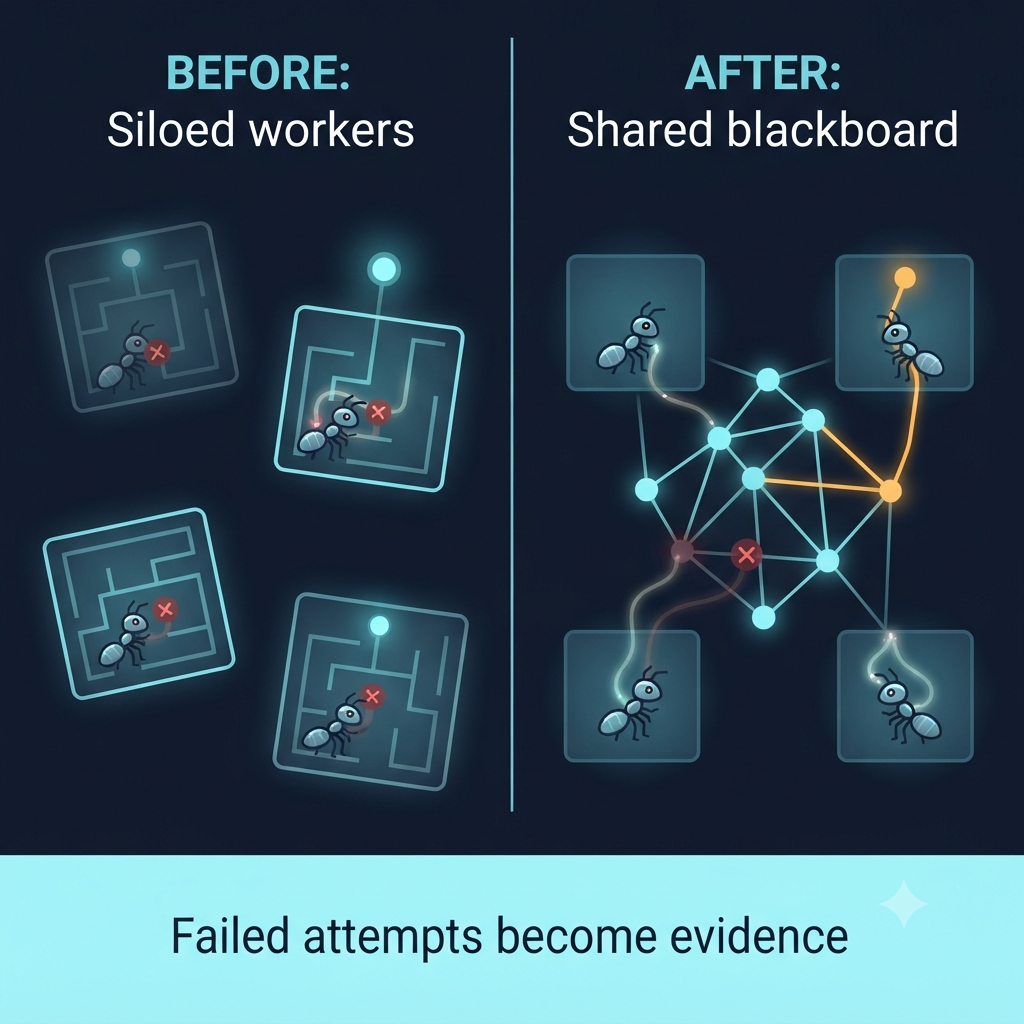
Cairn’s agents don’t talk to each other directly. They read from and write to a shared space, a pattern called stigmergy (think ants leaving trails). That design has two big consequences.
First, context survives. If one worker finds an exposed service, a credential, a misconfiguration, or a dead-end login path, every other worker can use that. Nobody starts from scratch.
Second, the attack gets more adaptive. A failed attempt isn’t wasted. It becomes evidence that narrows the search and shapes the next try.
Here’s the loop in order:
- Observe the current graph and target state.
- Orient around the objective and the facts on hand.
- Decide on the next plausible action.
- Act with an integrated tool, command, request, or exploit path.
- Record the result as a new fact.
- Repeat until the objective is met, the operator steps in, or resources run out.
This is the mechanism that turns a pentesting framework into a force multiplier.
Plain language becomes the interface
The biggest change is what the operator has to type. Instead of specifying every command, payload, and sequence, they can give a target and a broad goal.
Unit 42 reported that attackers using Cairn often supplied little more than a domain name and a one-line objective. The framework’s workers then planned and carried out the steps toward it.
None of this makes the system autonomous in the sci-fi sense. It still needs reachability, credentials, vulnerabilities, tooling, compute, and human guidance. But the operator no longer has to choreograph every move. The new profile looks less like an elite exploit developer and more like someone who can:
- Provision servers, containers, and network access.
- Get initial credentials or spot an exposed target.
- Configure model endpoints and tool integrations.
- Write short, clear objectives.
- Review results and step in when the agent hits a decision point.
- Keep access alive and avoid detection.
The expertise hasn’t gone away. It’s just moved up the stack.
Why “autonomous” is misleading
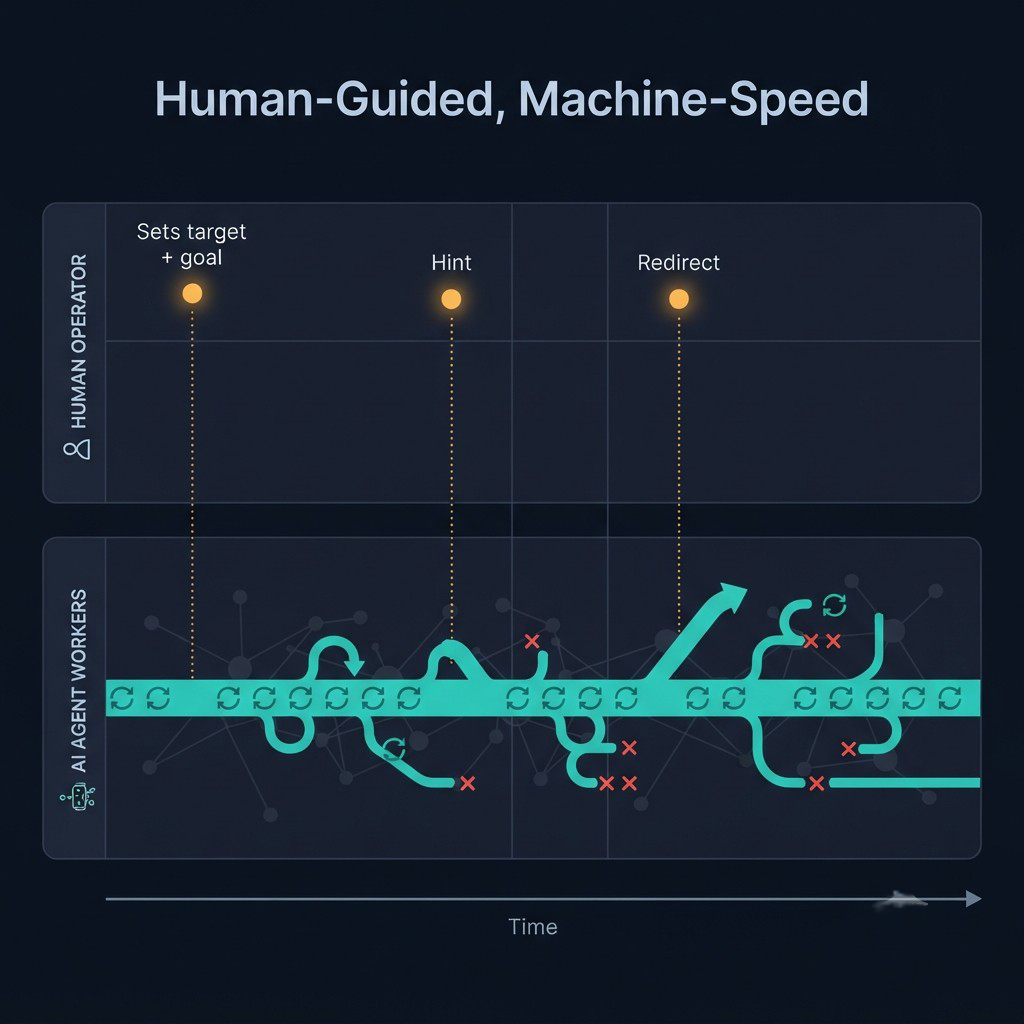
“Autonomous” conjures a self-directed AI breaking into systems with no human involved. A more accurate picture is human-guided, machine-speed iteration.
Unit 42 found that Cairn’s operators could drop in hints at any moment to steer things. In the campaign they observed, humans kept the important decisions while the agent workers handled exploration, execution, and keeping track of context.
That split is arguably worse than full autonomy, because it pairs human judgment with machine persistence:
- The human picks the target, supplies access, and sets the goal.
- The agent explores paths, retries failures, and maintains shared state.
- The human checks progress and redirects when needed.
- The system keeps running without fatigue or the attention limits of a person.
The danger isn’t one dramatic breakthrough. It’s constant, parallel, low-friction experimentation.
The force-multiplier effect
Agentic frameworks don’t necessarily invent new kinds of vulnerabilities. They make existing ones easier to find, combine, and exploit at scale. A misconfigured service, weak authentication flow, exposed endpoint, or overly generous identity role may have been exploitable all along. What changes is how cheaply and quickly someone can discover and chain them.
Cairn’s observed activity was reported as 25 autonomous campaigns against at least 19 organizations between August and September 2026. Unit 42 said the attackers gained unauthorized access or pulled data from 10 of them.
The takeaway isn’t that every organization will face this exact campaign. It’s that the economics of offensive work have shifted:
| Resource | Before agentic orchestration | After agentic orchestration |
|---|---|---|
| Reconnaissance | Manual, time-consuming | Continuous and parallel |
| Exploit attempts | Limited by operator attention | Can be retried and varied extensively |
| Context retention | Depends on operator notes | Stored in a shared graph |
| Coordination | Requires multiple skilled people | Can be distributed across agent workers |
| Campaign duration | Bounded by human work hours | Limited by infrastructure and cost |
| Required expertise | Broad offensive-security mastery | More accessible operational setup and direction |
This isn’t “AI hacking” in some magical sense. It’s trial and error, industrialized.
Why open source amplifies exposure
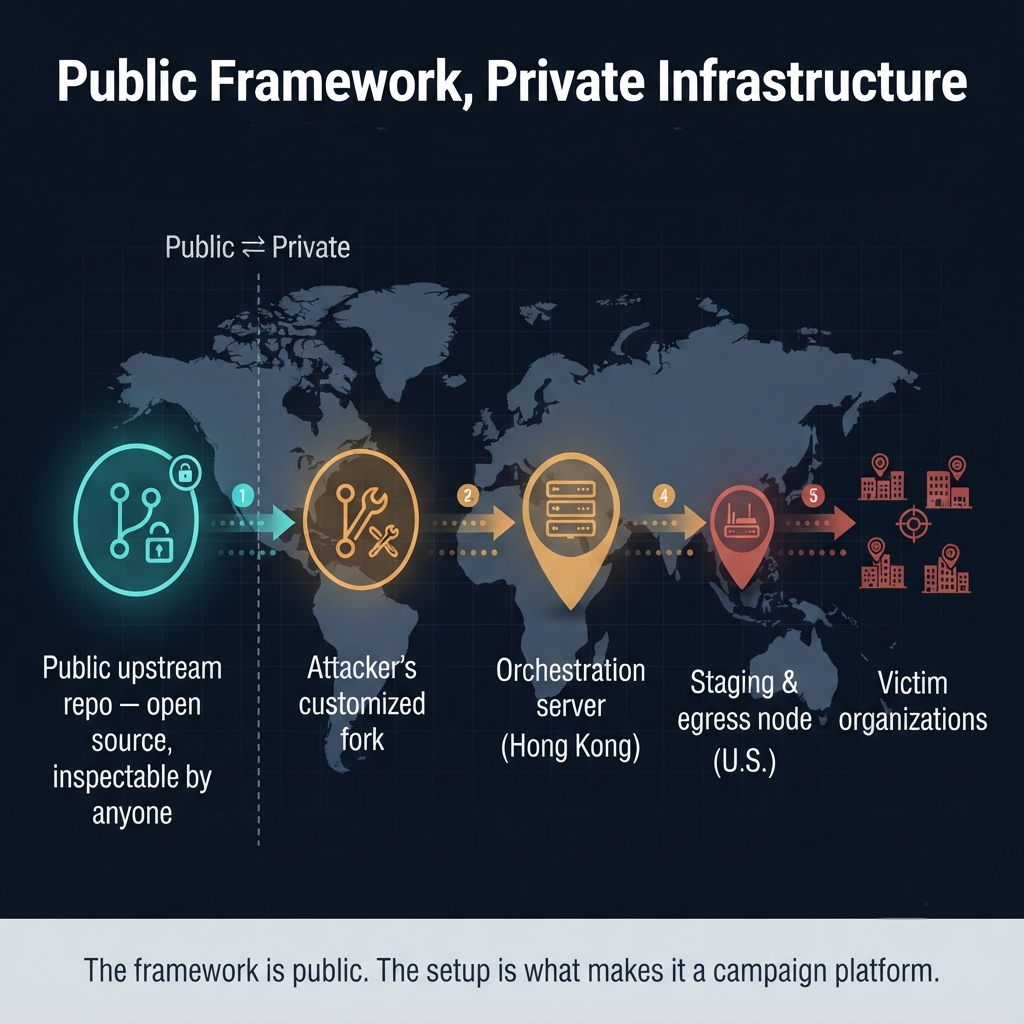
Open source is vital to security research. It brings transparency, peer review, reproducibility, and defensive innovation. The dual-use problem exists because those same traits make a system easy to inspect, fork, customize, self-host, and plug into an attacker’s own environment.
An adversary doesn’t have to compromise the upstream project. They can deploy their own copy, tweak the prompts and integrations, connect their preferred models and tools, and run it all from infrastructure they control.
Unit 42 reported that the actors here used a customized fork of Cairn running from a server in Hong Kong, with a U.S. node handling staging and egress. That detail says a lot. The framework is public infrastructure, and the attacker’s customization and setup are what turn it into a campaign platform.
What defenders should detect
Don’t hunt only for a single exploit or a tidy kill chain. Look for the fingerprints of iterative exploration. Useful signals include:
- Repeated reconnaissance from the same origin across several protocols.
- Sequences of actions that change after failed attempts.
- Enumeration bursts followed by targeted access attempts.
- Odd mixes of scanning, authentication, cloud, and command-execution activity.
- Signs that an actor is carrying state across sessions or containers.
- Pauses that look like a human stepping in, followed by a precise change of direction.
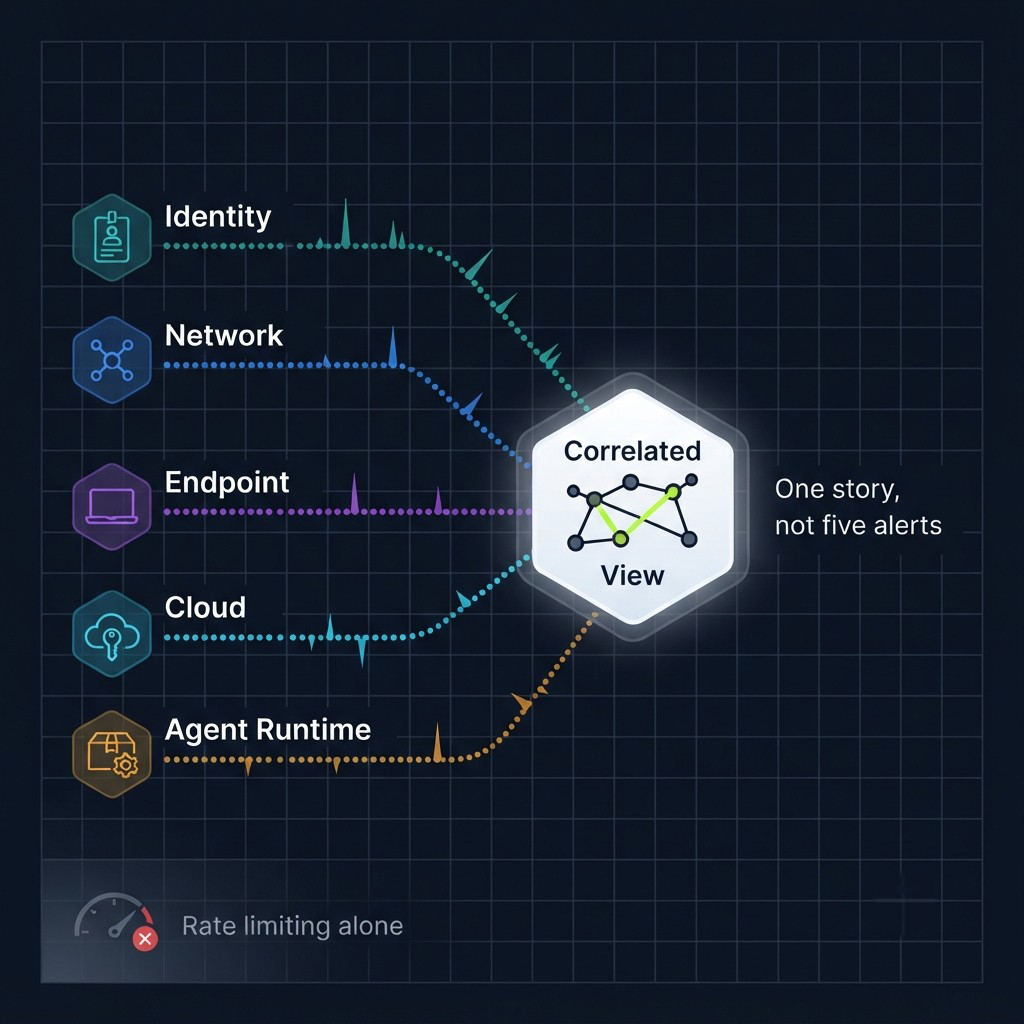
Unit 42 noted that Cairn produced hundreds of thousands of noisy, high-frequency requests across multiple edge protocols from a single origin IP. Rate limiting alone probably won’t cut it. Defenders need to correlate across time, identity, network, endpoint, and cloud telemetry.
What defenders should change
Treat agent runtimes as privileged infrastructure
If your organization is experimenting with agentic security tooling, assume the orchestration platform itself is high-risk.
- Run it only in isolated, monitored environments.
- Restrict outbound access and limit tool integrations to an approved list.
- Use scoped, short-lived credentials.
- Log prompts, tool calls, commands, file access, and network requests.
- Require explicit approval for destructive or high-impact actions.
- Keep agent environments separate from production systems and credentials.
- Treat plugins, model endpoints, and framework updates as supply-chain risks.
Assume an adaptive adversary
The goal isn’t just to block one request. It’s to make iterative attacks expensive, visible, and short-lived. That means shrinking exposed attack surface, enforcing phishing-resistant MFA, applying least privilege, segmenting networks, and correlating telemetry across layers.
It also means running controlled purple-team exercises with agentic frameworks in authorized environments. The point isn’t to replicate an attack. It’s to learn what machine-speed exploration looks like in your own logs before an adversary shows you.
The ethical boundary
This technology isn’t inherently malicious. Red teams need automation to test defenses at realistic scale, and defenders need to understand how modern attacks work. The dividing line is authorization and control:
- Authorized testing has documented scope, consent, rules of engagement, approval gates, and audit trails.
- Defensive research happens in controlled labs, against synthetic targets, with responsible disclosure.
- Malicious use means unauthorized access, persistence, data theft, or disruption.
The framework is dual use. What decides whether it’s a security instrument or a weapon is the operating model around it: scope, consent, oversight, and accountability.
The real takeaway
The security community should stop asking only whether AI can write an exploit. The more pressing question is what happens when an open-source system can hold an objective, preserve context, coordinate multiple workers, and keep trying new routes against a live environment.
Cairn makes that question concrete: a shared blackboard, a fact-intent graph, dispatcher-managed worker containers, and concurrent agents, all built to chase a goal. The dilemma isn’t about one framework. It’s about a new offensive operating model:
Intent goes in. Persistent, adaptive exploration comes out.