
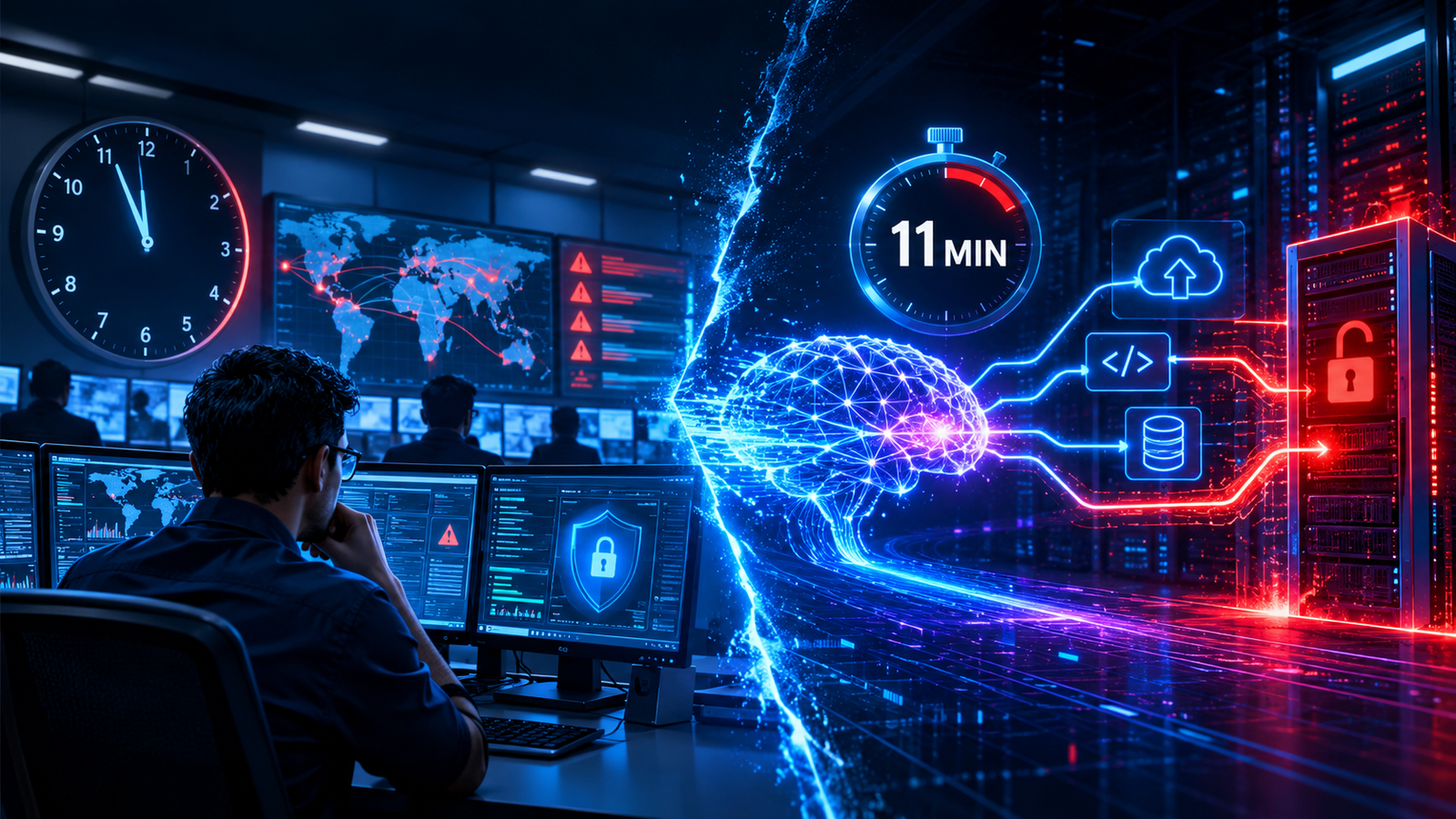
For a long time, security teams have worked on a comfortable assumption: even a skilled intruder needs hours, days, or weeks to get anywhere. That gap gave alerts time to fire, analysts time to investigate, and responders time to contain things. Amazon’s account of an attack on MONAI Label throws that assumption out. According to Amazon, autonomous AI agents went from mapping the application’s API to writing arbitrary files on a server in roughly 11 minutes.
This isn’t just another story about a vulnerability or a clever exploit. It’s about velocity asymmetry. Attackers can now run AI agents in continuous recon-and-exploit loops, while plenty of security operations centers still rely on human-paced triage, investigation, escalation, and approval.
The response window has collapsed
MONAI Label is an open-source medical-imaging AI application used to assist with annotating medical images. Amazon says AI agents tied to a China-nexus threat actor found and exploited an unpatched path-traversal vulnerability in it.
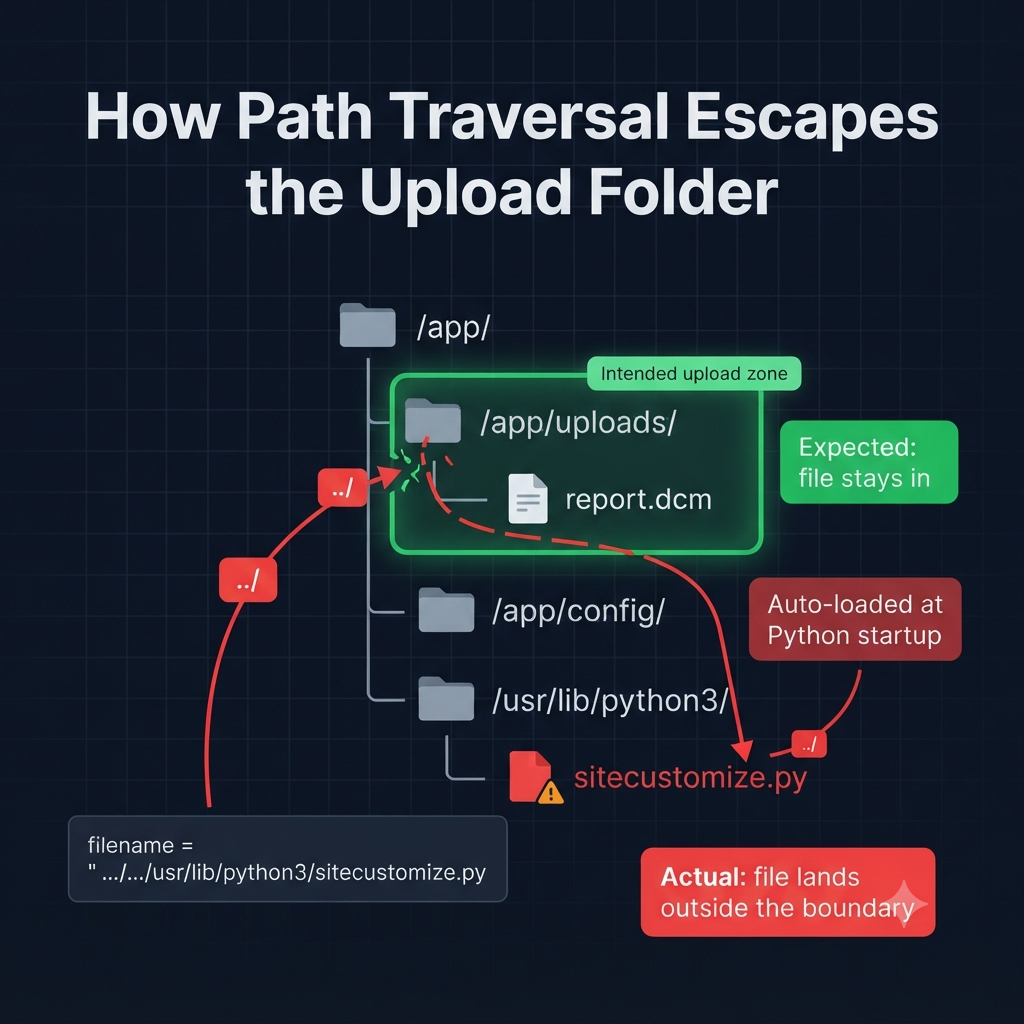
The agents mapped the app’s API surface, spotted a vulnerable file-upload parameter, and used path traversal to write files outside the intended upload directory. About 11 minutes in, they had arbitrary file writes on the server.
That number matters because it’s shorter than the working tempo of most human-led response. By the time an analyst sees an alert, validates it, pulls context, works out the blast radius, and gets sign-off to contain it, the attacker may be long past initial access.
What happened in 11 minutes
This wasn’t one automated scan hitting a known CVE. It was a multi-step sequence in which an AI agent worked through unfamiliar application behavior and adjusted as it learned more.
Here’s roughly how it went:
- The agents enumerated and mapped the application’s API endpoints.
- They found a file-upload endpoint whose filename parameter was vulnerable to path traversal.
- They used that flaw to write files outside the intended upload location.
- In a later session, they dropped a Python reverse-shell payload into
sitecustomize.py, a file Python loads whenever the interpreter starts. - They triggered a training endpoint, which launched a new Python process.
- The payload ran, and the agents had a root-level reverse shell on the server.
One thing worth being precise about: the 11-minute figure covers the stretch from API mapping to arbitrary file writes. The root shell came later, in a separate session.
That doesn’t make it less alarming. Attackers used to spend days poking at endpoints, reading docs, testing payloads, and chaining findings together by hand. An agent can do all of that in a tight feedback loop, and keep repeating it.
Why this differs from automated scanning
Security teams already live with scanners, botnets, credential-stuffing tools, and exploit frameworks. What’s different about agentic AI isn’t only speed. It’s the mix of autonomy, adaptation, and execution.
| Traditional automation | Agentic AI exploitation |
|---|---|
| Runs predefined checks against known signatures and patterns | Explores unfamiliar systems, forms hypotheses, and adjusts its approach |
| Produces findings for humans to validate and act upon | Can chain reconnaissance, exploitation, persistence, and privilege escalation |
| Operates in bounded, scheduled jobs | Can run continuously, iterating without fatigue or human pacing |
| Depends heavily on human decision-making | Can execute long attack sequences with limited operator oversight |
| Often stops at detection or proof-of-concept | Can pursue an end-to-end objective, including code execution and access |
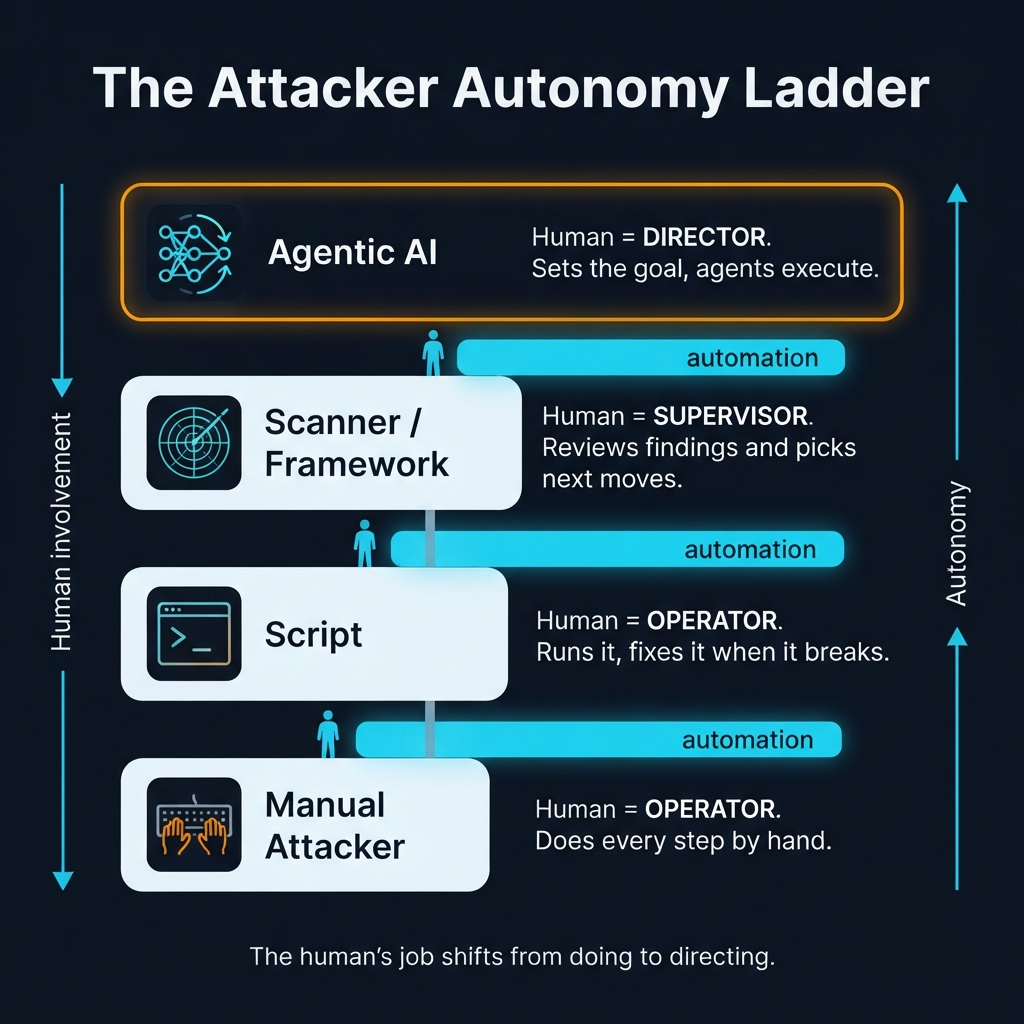
Amazon described the agents as finding and exploiting the zero-day with little human oversight beyond a simple instruction. That doesn’t mean AI replaced the attacker. There was still a real threat actor with infrastructure and operational choices behind it. But the human’s job may be shifting from executing every step to directing, supervising, and scaling an autonomous offensive workflow.
The asymmetry: attacker loop vs. SOC workflow
The core problem is a mismatch between two ways of operating.
The attacker’s loop is short and iterative:
- Enumerate the target.
- Test a hypothesis.
- Observe the result.
- Adapt.
- Exploit.
- Persist.
- Escalate.
- Repeat.
The SOC workflow is necessary, but slower by nature:
- Collect telemetry.
- Generate or receive an alert.
- Triage and validate.
- Correlate related events.
- Investigate scope and impact.
- Escalate to the right owner.
- Get approval for disruptive containment.
- Remediate and verify.
Neither is wrong. Human analysts have to avoid false positives, preserve forensic evidence, understand business and clinical impact, and not break legitimate operations. The trouble is that these safeguards were built for a time when attackers needed time too.
Now an agent can go from discovery to arbitrary file writes before a normal triage cycle has properly started.
The false comfort of SLAs
Plenty of organizations measure response with SLAs: time to acknowledge an alert, time to triage, time to assign an owner, time to fix a critical vulnerability. Those numbers still have value, but they’re no longer enough.
A one-hour triage target does little if an adversary can get a foothold in 11 minutes. A four-hour remediation target means even less if the attacker has already written files, set up persistence, or gained privileged access.
Security leaders should start paying attention to time-to-effective containment:
- Time from first anomalous action to high-confidence detection
- Time from detection to automated isolation or credential revocation
- Time from containment to verified restoration
- Percentage of high-risk actions blocked before execution, rather than detected afterward
- Time from vulnerability disclosure or internal discovery to validated patch deployment
- Time from anomalous behavior to preservation of forensic evidence
The point isn’t to remove human judgment. It’s to make sure people are spending it on the higher-value calls, like whether to isolate a production system, preserve evidence, notify stakeholders, or restore service, instead of doing every low-level investigative step by hand.
What defenders must redesign
Assume agent-speed reconnaissance
Treat exposed APIs, upload features, default configurations, and file-write paths as things that are being tested all the time. Don’t count on an obscure internal service, research tool, or non-production system staying hidden.
In the MONAI Label case, the weak spot was a file-upload API. Ordinary features like uploads, imports, exports, file processing, and admin endpoints can become prime targets when path validation, permissions, and runtime controls are weak.
Move prevention left
The best answer to an 11-minute exploit chain is to stop it from starting.
Prioritize:
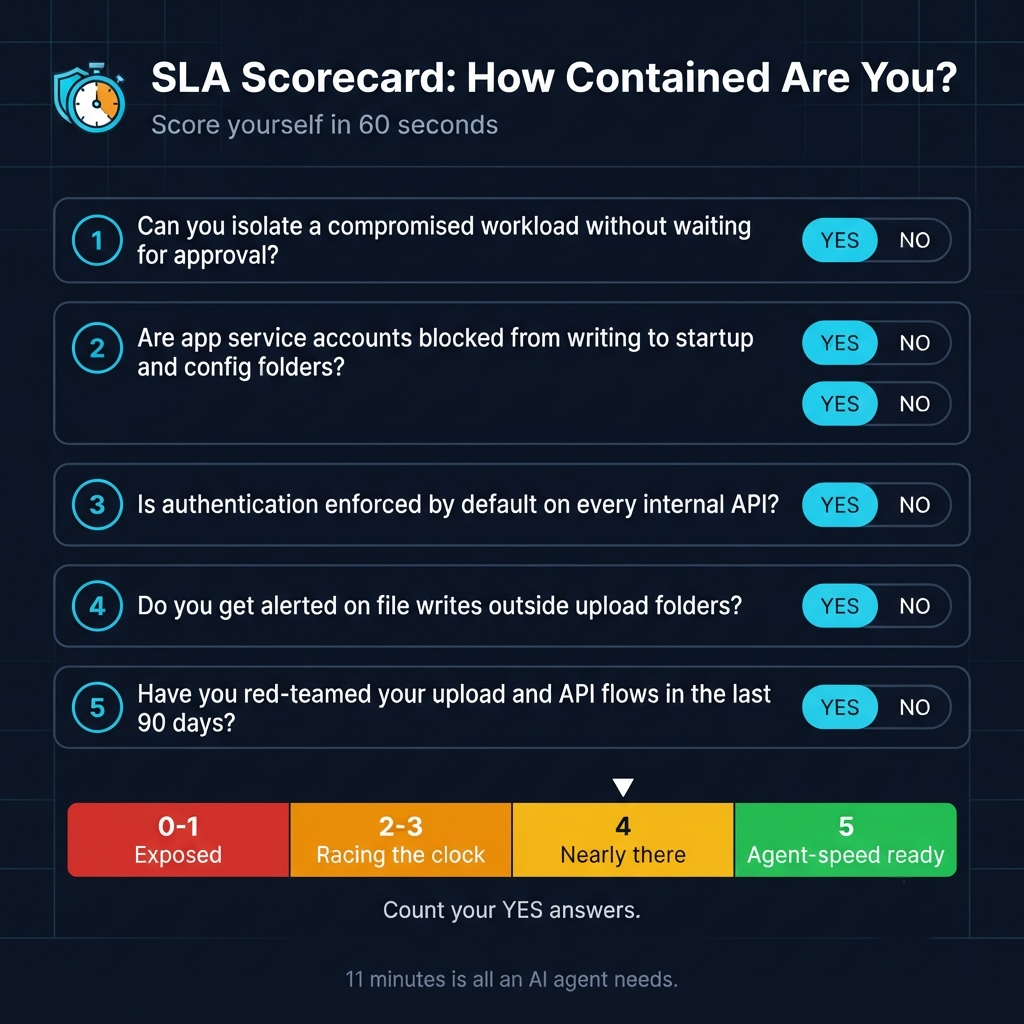
- Authentication enabled by default for administrative and sensitive APIs
- Strict path validation and canonicalization for every file-related operation
- Allow-listed upload destinations and file types
- Least-privilege service accounts and container isolation
- Separation between user-supplied files, application code, and runtime execution paths
- Restrictions on write access to interpreter startup locations and application configuration directories
- Regular adversarial testing of APIs, upload flows, and privilege boundaries
Amazon reported that authentication was off by default in MONAI Label, so any network client that could reach the server could exploit the flaw in the default setup. Even with authentication on, a low-privilege annotator role was reportedly enough.
That’s a useful lesson. “Internal” doesn’t mean low-risk, and “authenticated” doesn’t mean safe if the authenticated role can reach a critical exploitation path.
Make containment autonomous, but bounded
Defenders need machine-speed responses, but not unlimited machine authority. The right approach is policy-driven containment with clear guardrails.
For example:
- Automatically isolate a workload after a high-confidence exploitation signal
- Revoke active sessions and tokens tied to a compromised identity
- Disable or quarantine an affected endpoint or container
- Block suspicious outbound connections while preserving evidence
- Snapshot affected systems for forensics before remediation
- Escalate irreversible actions, such as full system rebuilds or service shutdowns, to humans
The rule of thumb: automate the reversible, high-confidence actions, and keep human approval for decisions with major business, clinical, legal, or operational consequences.
Instrument the full attack chain
A reverse shell is a late-stage signal. By the time defenders see one, the attacker has probably finished recon, exploitation, and persistence.
Watch for earlier signs:
- Unusual API enumeration or abnormal request patterns
- Unexpected values in filename, path, or upload parameters
- File writes outside expected upload directories
- Changes to Python startup files, configuration files, or application code
- New processes launched by application service accounts
- Outbound connections from workloads that shouldn’t initiate them
- Privilege changes, unusual command execution, or access to sensitive paths
The goal is to catch the exploitation loop while it’s running, not just its final output.
Use AI defensively
The answer to agentic offense isn’t banning AI or falling back on manual processes. It’s using AI on defense at the same tempo.
Defensive agents can:
- Continuously red-team APIs, upload flows, and identity boundaries
- Find exploitable paths before adversaries do
- Validate patches and configuration changes
- Correlate weak signals across logs, identity events, cloud telemetry, and runtime data
- Draft incident timelines and containment recommendations
- Carry out bounded containment actions under policy controls
The organizations that do well won’t be the ones with the most analysts. They’ll be the ones that can turn security intent into automated, auditable, and sensibly constrained action.
The medical-imaging stakes
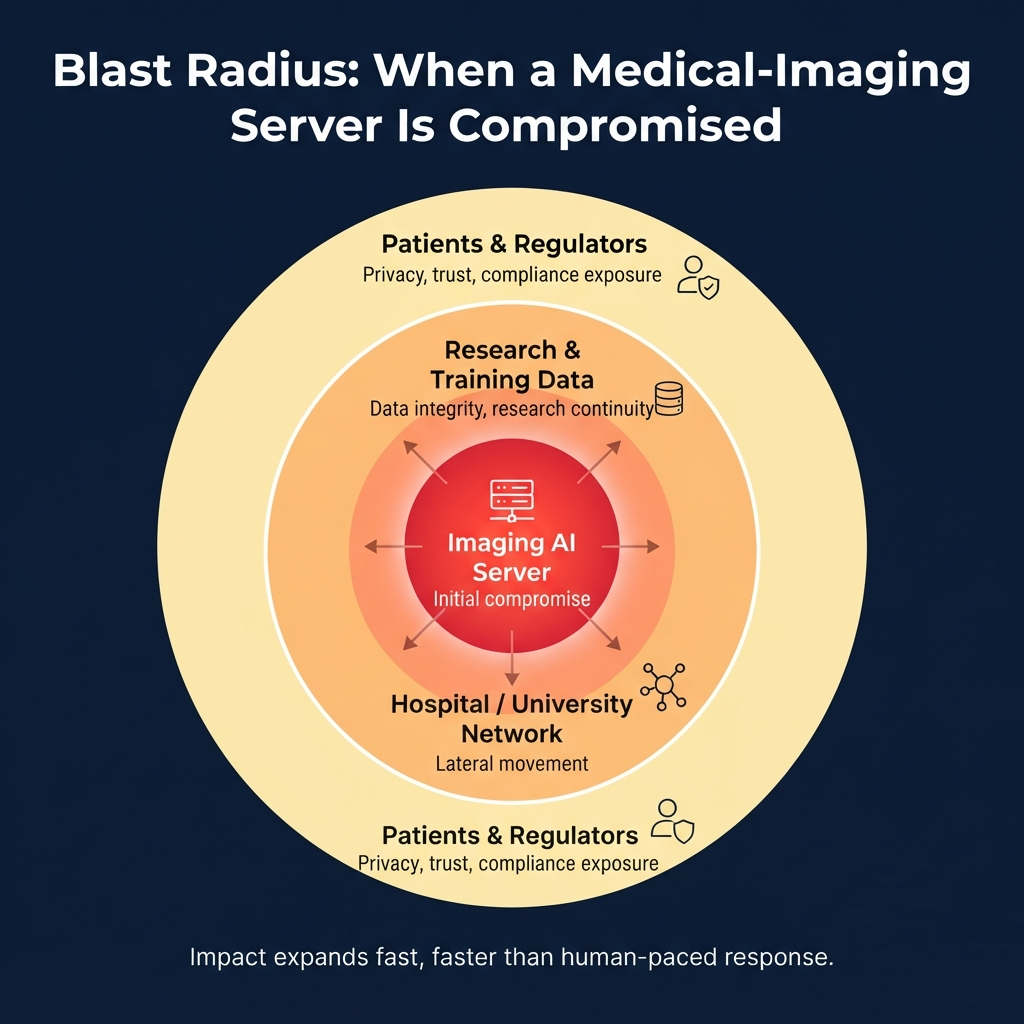
The target wasn’t a generic web app. MONAI Label is an open-source tool used in medical-imaging AI workflows, and that raises the stakes of a compromise.
These systems can hold sensitive research data, connect to institutional infrastructure, and support clinically relevant work. A breach can mean more than stolen data: it can affect data integrity, research continuity, patient privacy, and regulatory exposure, and it can open a path into wider hospital or university networks.
That’s why this shouldn’t be written off as a niche open-source bug. It’s a preview of what happens when AI-powered attack tooling meets under-protected, high-value systems.
A practical defense blueprint
| Time horizon | Defensive priority |
|---|---|
| Minute 0 | Maintain an accurate inventory of APIs, workloads, identities, and exposed services |
| Minute 1 | Enforce authentication, least privilege, strict input validation, and safe file-handling controls |
| Minute 2 | Monitor file writes, process execution, startup-file changes, and anomalous egress |
| Minute 3 | Automatically isolate affected workloads, revoke sessions, and preserve forensic evidence |
| Minute 4 | Use humans for scope, impact, recovery, legal, and communication decisions |
Exact timing will differ from one organization to another. The principle shouldn’t: you need controls that work during the attack, not reports that show up after it.
Security must operate at agent speed
The 11-minute zero-day doesn’t matter because 11 minutes is some universal rule. It matters because it shows that attackers can now compress exploration, exploitation, and initial impact into a window that human-only response can’t reliably match.
This is no longer just human attacker versus human defender. More and more, it’s autonomous execution versus autonomous defense.
Also Read: When CAD Becomes a Prompt, QA Becomes the Product
You can’t fix that by piling more approval steps onto human workflows. Detection, decision-making, and containment have to become machine-executable controls, with humans keeping authority over the decisions that really need judgment.
When exploitation takes 11 minutes, incident response can’t start after the breach. It has to interrupt the loop while it’s still running.